Archive for February 11th, 2010
Anticompetitive partiality?

We have all heard people complaining about how a case turned out in a particular way due to the special relationship that the contrary party had with the decision maker (be it a judge or an administrative agency), but I suspect that categorizing that as an anticompetitive practice hadn’t crossed the minds of many of us.
Apparently it did occur to someone that fostering a good relationship with judges could amount to an anticompetitive practice. The Spanish Audiencia Nacional has issued a Judgment upholding a decision issued by the CNC in 2006 which shelved a complaint alleging that a Bar Association infringed the competition rules by paying judges to intervene at conferences and seminars organized by the Bar. The complainant argued that those judges could eventually be called upon to decide on cases on which the Bar itself or the members of its Board might be interested parties.
The legal basis for the complaint was a provision in the former Spanish Competition Act which targeted acts of unfair competition that significantly distort competition and therefore affect the public interest (the current Act retains a similar but amended provision). The alleged act of unfair competition is envisaged in Article 15 of the Unfair Competition Act, which provides that it is deemed unfair to obtain benefits from a significant competitive advantage obtained by illegal means.
The complainants firstly alleged that the retribution perceived by judges in exchange for their attendance to a given conference could compromise their impartiality. With respect to this claim, the Court responds that judicial activity is not an economic activity carried out in the market, and therefore cannot be reviewed in the light of the Competition Act.
Secondly, it was argued that the practice could have an affect on the market for legal services in as much as the attendance of judges to such conferences could create an impression upon clients that a particular lawyer is more trustworthy because of his ability to have built a relationship with judges over the course of those events.
The Judgment also rejects this second contention stating that in order for such practice to affect competition it would be necessary that (i) potential clients had a very extensive knowledge of the particular relationships between specific lawyers and judges; and (ii) the cases affecting those clients would fall under the jurisdiction of the said judges. The Court underlined that the parties had not put forward any evidence showing that such information existed on the market, nor had they provided examples of particular cases.
I certainly would never support applying competition law to this sort of conduct, and therefore believe that the Judgment is a sensible exercise of common sense. In fact, I would encourage fostering as much interaction as possible between enforcers and lawyers. It is a healthy way of exchanging viewpoints which can be enrichening for all: lawyers can convey their concerns to enforcers, and the latter are able to receive feedback and have the opportunity to publicly explain and debate their views without the constraints posed by formal acts. In this sense, enhancing communication results in benefits to the functioning of the system. In addition, I very much doubt that in most instances an enforcer’s independency could be undermined because of their attendance to a conference or seminar.
Nonetheless, reading the Judgment I couldn’t help wondering whether some aspects of the reasoning put forward by the Audiencia Nacional are truly applicable to the little and idiosyncratic world of competition law to the same extent as they are to other areas. Don’t get me wrong; it’s not that I believe there’s anything wrong with how things are done in our field; my point is that the Judgment’s reasoning departs from an assumption regarding legal markets that highlights the difference of niche areas of practice, and particularly of ours:
Competition is surely one of the areas of law practice where there is a greater interaction between enforcers, lawyers, economists, academics, and even clients. It is a somehow narrow and certainly specialized area, and its enforcement has traditionally been entrusted to specific authorities located in a handful of cities (most relevant EU Competition law cases are still dealt with in Brussels).
All those factors mean that not only are we relatively few people working on these issues (which explains the astonishing cult of personality that exists here in comparison to other areas of law), but also that enforcers and lawyers or economists on the other side of the table are in constant interaction: many are friends or have very similar backgrounds: some have probably studied together, some others have worked together, and in many instances people’s lives take place in the same communities.
In this context, it is not rare for lawyers and officials to write books or articles jointly, and it is all the more common to attend conferences or seminars together. Accordingly, contrary to what the Audiencia Nacional assumes to be standard market circumstances, in our field many potential clients do have a “very extensive knowledge of the particular relationships between specific lawyers and judges”, and “the cases affecting those clients would fall under the jurisdiction of the said authorities”.
Does this affect the perception clients have of their lawyers? Sure it might, and in fact it’s one of the main marketing tools for some law firms. Does this mean that fostering interaction with judges or competition authorities is an anticompetitive practice? Surely not, but because of different reasons to those stated in the Judgment above. Is it unethical or morally/professionally reprehensible? Not at all provided that deontological boundaries are effectively respected and appear to be respected (Caesar’s wife must be above suspicion). Should lawyers ‘sell’ clients their good relationships with enforcers? I don’t see the problem provided that it is done prudently: a lawyer may sell the fact that he’s respected in the legal community since clients will surely appreciate having a lawyer perceived as trustworthy by people on the other side of the table, but it could be imprudent on the part of the lawyer to imply more than that, and naive on the part of the client to think that an enforcer might adopt a different stance towards matters defended by lawyers with whom they have a closer relationship. One can understand suspicions on the part of contrary parties, but at the end of the day, it all comes down to having a little more faith on the enforcers.
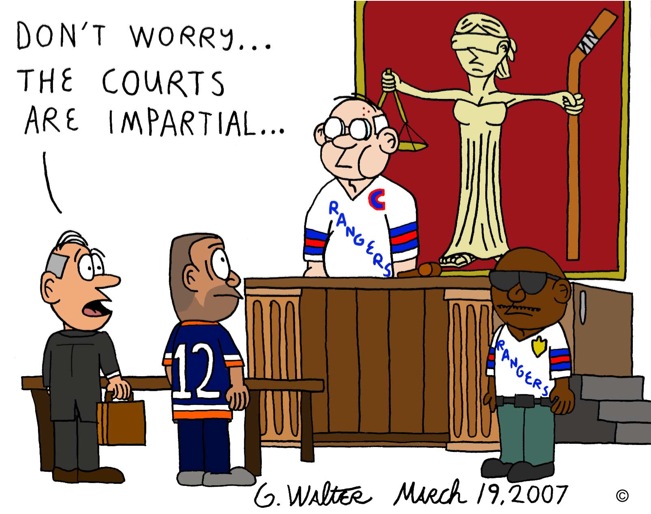
(Image possibly subject to copyrights: source here)


 Chillin'Competition