Archive for June 2023
AG Rantos in Case C‑331/21, AdC v EDP: why formalism does not work as a tool to identify restrictions by object

Discussions around formalism are making a comeback in competition law. And they are doing so with an interesting twist. Some of the constituencies that were opposed to formalism are now embracing it, and vice versa. This trend deserves a close look, and it keeps me busy these days.
People often mean very different things when they talk about formalism in competition law.
This piece concerns the least controversial and most straightforward understanding of the notion. Competition law is said to be formalistic when the formal features of a practice are used to determine whether or not it is lawful.
For instance, an authority would be formalistic when it infers a restriction of competition from the fact that the agreement under consideration provides for price-fixing or market-sharing.
The case law makes it unambiguously clear that the form of an agreement (or a clause) is as such insufficient to establish a ‘by object’ infringement . This point has been frequently addressed on the blog (see, in particular, here, where I discussed the legend of the ‘object box’).
We know from experience that it is incorrect to say, for example, that a price-fixing agreement between competitors is necessarily (even presumptively) restrictive by object.
The need to consider the relevant economic and legal context knows no exceptions. In fact, it is not difficult to find examples in the case law of practices that, formally speaking, look like restrictions by object but are not.
In spite of the above, formalism comes back every now and then. I can see why. It gives the illusion that establishing a restriction by object is a clean and fast exercise (as opposed to a context-specific and occasionally time-consuming one).
I thought of the eternal return of the formalistic approach when going over AG Rantos’ Opinion in Case C‑331/21, AdC v EDP (see here). As is invariably true, it is an incredibly rich Opinion. A single post would not do it justice (a key and elegant point AG Rantos makes, which can alone clarify our understanding of a thorny issue, will have to wait for a second entry).
The case (a preliminary reference) is about a non-compete introduced in an agreement concluded between an electricity supplier (EDP) and a food retailer (Continente). The clause was part of a cooperation arrangement that gave consumers participating in Continente’s loyalty scheme a 10% discount in their electricity bills.
Is such a non-compete clause restrictive by object? Maybe. Or maybe not. As AG Rantos’ analysis shows, context is crucial, and the task of applying the law to the facts of the case lies with the referring court, not the Court of Justice (Servizio Elettrico Nazionale, where AG Rantos also delivered the Opinion, recently emphasised this point).
One element of the context relates to whether EDP and Continente were potential competitors. In this regard, the Opinion is extensive and valuable. It cites, by the way, the work on the notion by my colleague Niamh Dunne. Another element of the context pertains to whether the non-compete clause is ancillary to the main transaction.
The single most notable section of the Opinion, in any event, is the one devoted to the notion of restriction by object. This section (perhaps because it is so brief) could be interpreted as suggesting that a non-compete clause in an agreement concluded between actual or potential competitors is a ‘by object’ infringement unless it is ancillary to the main transaction (paras 117-118).
This (seeming) conclusion appears to rest on two premises. First, that the non-compete clause would amount to market-sharing if not ancillary to the main transaction. Second, that market-sharing between competitors is restrictive by object without it being necessary to evaluate the relevant context (para 118).
The ambiguous drafting of this section, which hints at formalism, is just a drop in an ocean of consistent case law. As such, it cannot change the prevailing legal doctrines. The reason I write about it is because it is a really useful case study showing why a formalistic approach invariably fails when going about restrictions by object.
There are three main points to make in this regard.
First, the seminal (and recent) Generics ruling did not follow a formalistic approach. Like AdC v EDP, Generics concerned a (temporary) set of non-compete obligations (pay-for-delay) accepted by potential competitors (that is, generic manufacturers).
However, at no point did the Court hold that the relevant non-competes were presumptively a ‘by object’ infringement, and the ancillarity of the obligation played no role in the assessment.
In fact, the judgment goes as far as to hold that, in some instances, a pay-for-delay arrangement does not even infringe Article 101(1) TFEU (let alone by its very nature).
The ECJ made it clear that identifying the object of such clauses is a context-specific exercise (see in particular Generics, para 89) that takes into account a number of factors (including the pro-competitive effects of the non-competes).
Second, we have long understood that non-competes between actual or potential competitors are not always restrictive by object. This is so, crucially, even when the ancillary restraints doctrine does not apply.
Some examples can be drawn from the case law. One is provided by trade mark delimitation agreements, at stake in BAT (Toltecs-Dorcet). A settlement between right holders is not ancillary to a main transaction. However, it provides for non-compete obligations insofar as it defines the respective sphere of application of each trade mark. In spite of this fact, the Court ruled that a genuine trade mark delimination agreement is not restrictive by object.
Other examples can be drawn from the Commission’s own practice. Think of specialisation agreements concluded between competitors. Pursuant to such agreements, at least one of the parties ceases to produce one good, which it commits to purchasing from the other party. In other words: a straightforward non-compete between rivals (whicn, moreover, is not ancillary to any other transaction).
The Commission has never suggested that specialisation agreements are restrictive by object, as it has always understood them to be a plausible source of pro-competitive gains (namely economies of scale).
Third, not even every market-sharing agreement is necessarily restrictive by object. It may sound counterintuitive, but the experience acquired over six decades shows that an agreement between competitors that formally provides for market-sharing does not always amount to a ‘by object’ infringement.
I could provide many examples, but the Commission did a wonderful job in its Guidance on restrictions by object. You will see that the document provides an extensive list of scenarios showing, again, that form is an unreliable indicator when it comes to establishing restrictions by object (and this includes not just market-sharing arrangements, but also, among others, price-fixing).
Announcing the 4th edition of Chillin’Competition’s Rubén Perea Award (Deadline: 30 September)
We are delighted to announce the Fourth Edition of the writing award in the memory of our friend and colleague, Rubén Perea Molleda.
EVP Vestager hand-delivered the Award to its first two winners and she kindly offered to do the same in future editions, so the winner can expect to have a photo like this one. As in previous editions, the winning paper will also be published in a special issue of the Journal of European Competition Law & Practice, together with a selection of the best submissions received (the JECLAP special issue featuring the winner and finalists of the 3rd edition will be out within the next few days).
Who can participate?
You may participate if you have not reached the age of 30 by the submission date (i.e., if you were born after 30 September 1993). Undergraduate and postgraduate students, as well as scholars and practitioners are all invited to participate.
What papers can be submitted?
You may submit a single-author unpublished paper which is not under consideration elsewhere. The paper may be specifically prepared for the award or originally drafted as an undergraduate or postgraduate dissertation.
The paper must not exceed 15,000 words (footnotes included; no bibliography needed).
Prior to submission, please make sure your paper follows the JECLAP House Style rules, which can be found here.
How to submit?
Please submit the paper via this link: https://mc.manuscriptcentral.com/jeclap.
IMPORTANT: As you go through the submission process, make sure that in Step 5, you answer YES to the question “Is this for a special issue?” and indicate that it is for the Rubén Perea Award.
What is the DEADLINE?
Papers will have to be submitted by 23.59 (Brussels time) of 30 September 2023.
EVENT: Regulation 1/2003 and EU Antitrust Enforcement (Brussels, 29th June) – registration open
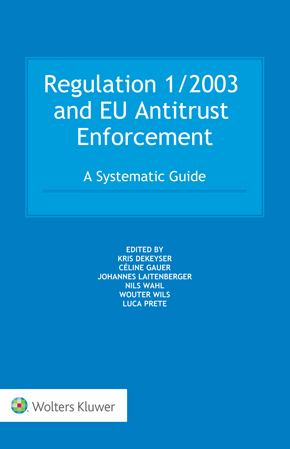
Earlier this year, a treatise on Regulation 1/2003 came out with Kluwer, with contributions from Alfonso (see here for his) and myself (mine on the enforcement aspects of the Digital Markets Act).
The volume is a genuine tour de force and it is only fitting to set up an event to celebrate the achievement and touch upon some of the key themes addressed in it (the timing, with the review of Regulation 1/2003 under way, could not be better).
We will be meeting on the afternoon of Thursday 29th June in Brussels, at the Fondation Universitaire (Rue d’Egmont, 11, next to Porte de Namur). You can register for the event here.
As you see in the programme below, we will be discussing the present and future of Regulation 1/2003 with several leading figures, followed by a drinks reception. We very much look forward to seeing many of you there!
16.30 | Welcome: Pablo Ibáñez Colomo (LSE and College of Europe)
16.45 | Introductory remarks: Johannes Laitenberger (General Court)
16.55 | Regulation 1/2003: looking back at its achievements
- Chair: Céline Gauer (European Commission)
- Lars Kjølbye (Lathan & Watkins)
- Margarida Matos Rosa (formerly Autoridade da Concorrência)
- Jacques Steenbergen (formerly Belgian Competition Authority)
- Wouter Wils (European Commission and King’s College London)
17.45 | Break
18.00 | Regulation 1/2003 and the future of enforcement
- Chair: Pablo Ibáñez Colomo (LSE and College of Europe)
- Pascal Berghe (European Commission)
- Or Brook (University of Leeds)
- Massimiliano Kadar (European Commission)
18.45 | Closing remarks: Nils Wahl (Court of Justice)
Antitrust Divergences and Convergences in post-Modern Times (Brussels, 26 June)

Eleanor Fox and Damien Gerard are two unique members of the competition law community. Eleanor is a force of nature, a brilliant scholar and probably the US academic who has paid more attention to convergence and divergence in US-EU antitrust enforcement. Damien is the total competition lawyer, with experience in private practice, top-universities, DG Comp and, currently, as Prosecutor General of the Belgian Competition Authority. Together, they have authored “EU Competition law: Cases, Texts and Context“.
To launch the second edition of this excellent book, Eleanor and Damien have organized a discussion about “Antitrust Divergences and Convergences in post-Modern Times” on 26 June in Brussels (Fondation Universitaire) featuring Inge Bernaerts (DG COMP), Nicholas Levy (Cleary Gottlieb) and myself (Garrigues).
If you want to join us for the discussion (and for the drinks…), just CLICK HERE. Look forward to seeing many of you there.


 Chillin'Competition
