The New Competition Law (I): the transformations of enforcement under Regulation 1/2003
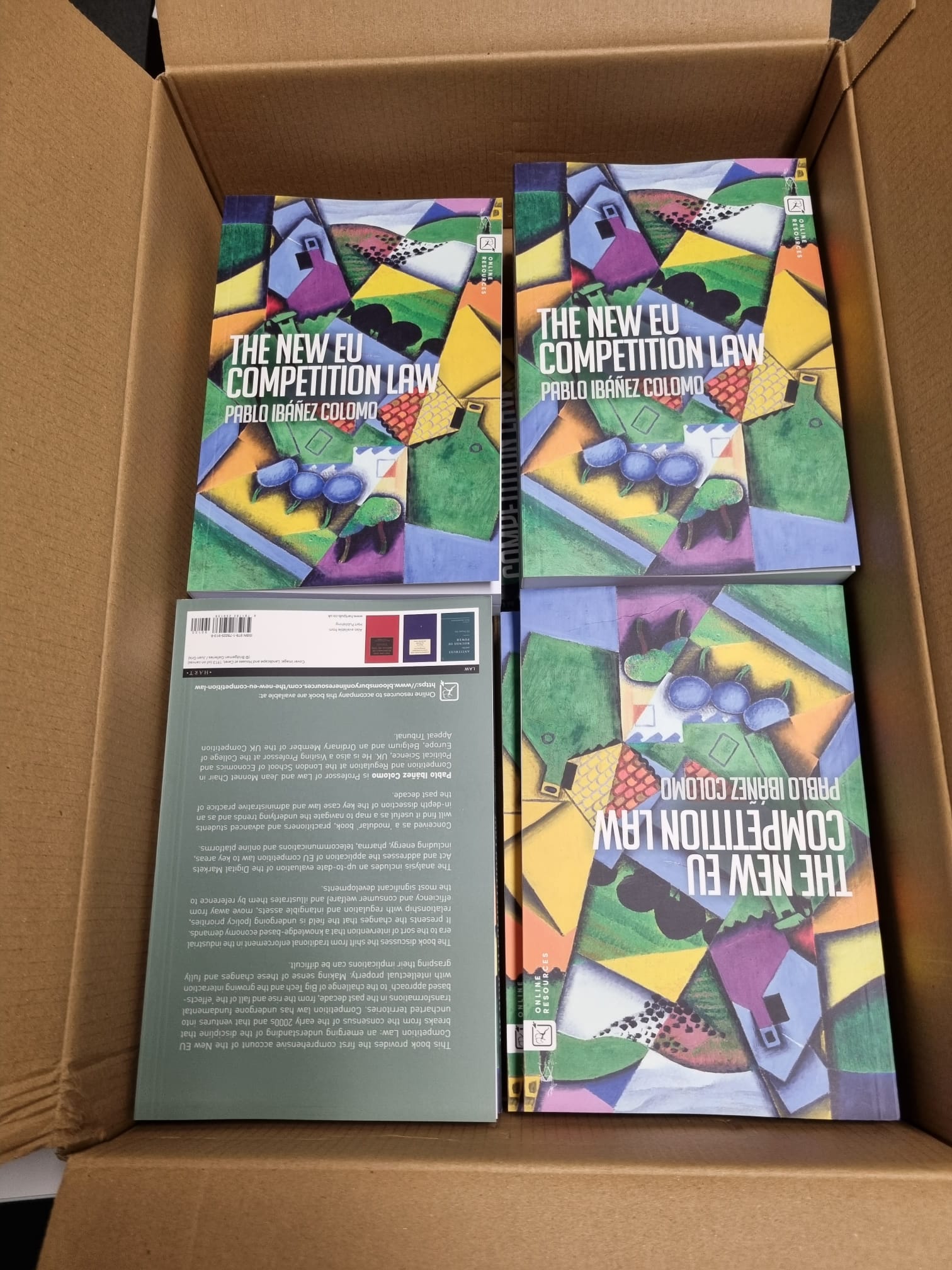
The New EU Competition Law comes out this Thursday (check here for a 20% discount). As you see in the picture, I got to see the hard copies (finally!) last week, with that beautiful painting by Juan Gris adding life and colour to the cover (it is the second time his work features in a book of mine, and something tells me it will not be the last). And I started to get the urge to share with the world what the monograph is all about. Which takes me to the topic of this post.
The starting point of the book is the realisation that EU competition law has changed in fundamental ways since the entry into force of Regulation 1/2003. I felt that these mutations had not been examined systematically in a single monograph, but in disparate articles that addressed one aspect or the other. As is often the case, I found myself trying to put together something I could not find elsewhere.
What are the mutations that Regulation 1/2003 favoured? In essence, this regime gave more freedom to the European Commission: more freedom to decide which cases to investigate and more freedom to make the most of its limited resources.
The new institutional landscape led to two shifts (which I discuss in Chapter 1). First, the Commission has explored, significantly more frequently than in the past, into the substantive and institutional limits of Articles 101 and 102 TFEU. ‘Market-shaping’ enforcement, in other words, has become a central feature of the contemporary landscape.
This transformation, alone, speaks to the success of Regulation 1/2003 and, more generally, of the EU model. It means that the Commission is not paralysed by fear (whether the fear relates to the exploration of new doctrines, the reinterpretation of existing ones or the implementation of the remedies) when applying Articles 101 and 102 TFEU.
Second, enforcement has become ‘policy-driven’, as opposed to ‘law-driven’. This phenomenon is not surprising. The Commission emphasised, in the lead up to Regulation 1/2003, that, after four decades, there was a ‘competition culture’ firmly in place in the EU and announced that, in the new landscape, it would make a more assertive use of its powers to advance its policy objectives.
The symbol of ‘policy-driven’ enforcement is the commitments decision, which has featured prominently in non-cartel investigations (in particular in ‘market-shaping’ cases, which demand, by their very nature, complex and resource-consuming remedies).
These two transformations have been compounded by a shift in the intellectual climate (addressed in Chapter 2) since the early to late 2010s. The modest, technocratic view of competition policy that dominated enforcement since the late 1990s progressively gave way to an approach that is less concerned with Type I errors and more with the effective application of Articles 101 and 102 TFEU.
There appears to be a progressive move away from the ‘more economics-based approach’: a new consensus may well be developing around a different set of values.
These transformation of the institutional and intellectual landscapes have had several consequences for EU competition law (and, as I argue, have led to the emergence of a ‘new’ iteration of the discipline). My book focuses on two of these consequences.
One of these consequences, which cuts across the whole of the book, is the permanent interaction with economic regulation (Chapter 3). ‘Market-shaping’ enforcement, by definition, is regulatory-like (it may lead, inter alia, to a duty to deal, to price regulation or to the redesign of products and business modelas).
Inevitably, it will enter into contact and interact with other regimes (such as telecommunications and energy regulation, which I cover extensively in Chapter 6). In some cases, Articles 101 and 102 TFEU have acted as a safety net or filled gaps in regulation; in others, they have gone as far as to rectify it or amend it de facto.
Occasionally, competition law has addressed a brewing ‘expectation of regulation’ that legislation may not be in a position to address fully and/or immediately (the legislative process is known to be often protracted and unpredictable).
Over time, it has become increasingly difficult (and increasingly pointless) to draw the line between competition law and regulation: it is no longer easy to figure out where one starts and where the other finishes. And it does not really matter. In a sense, the relationship between the DMA and Article 102 TFEU (and, indeed, the very existence of the DMA), encapsulates this idea well (as I argue in Chapter 5).
A second consequence is the change in the relationship with intangible property in general and intellectual property in particular (Chapters 4 and 7). During the formative years, EU competition law was largely deferential to intellectual property systems.
This attitude has changed over the past few years across a number of fronts that involve copyright and patents. I have discussed extensively many of these developments on the blog: taken together these developments signal a more assertive attitude vis-a-vis the malaise in intellectual property.
I very much look forward to discussing my ideas, on this platform and elsewhere. On this same note: remember that we will have a get-together on 11th January (Brussels) and 25th January (London). More details will follow soon!


 Chillin'Competition
Leave a comment