Author Archive
Antitrust Chatspeak
//tr8
Or my first try at using Internet slang for antitrust issues…
BTW, I have to participate to a conference on the pharmaceutical sector in 10 days, and I welcome any fresh intel on //tr8, as well as on any other hot, burning issue relevant to the sector.
Given the industry’s taste for secrecy, you may write to me directly at Nicolas.petit@ulg.ac.be
The Economist Corner (1) – When State aid rules get seriously wrong…

Unlike many lawyers who keep on bashing the use of economics in competition proceedings, Alfonso and I love antitrust economics. The reptilian reflex of dismissing economics as a source of legal uncertainty is misguided (although on this point Alfonso has more nuanced views that he will develop here). As explained by J. Sims, the introduction of economics in competition law, and the ensuing flexibility of competition analysis does not necessarily mean that legal certainty is degraded. Antitrust economics help channeling discussion in competition proceedings. It has helped define more accurate theories of harm (the boundaries of infringements) and the requirements necessary for them to fly (the conditions of infringements). And those concerned that opening the gates to antitrust economics means accepting the Trojan horse of small, Chicago-like, antitrust policy should think of a minute to how economists have helped enlarging the scope of competition law in the past decades. Examples of such expansions abound, with doctrines such as collective dominance, below-dominance unilateral effects, raising rivals’ costs, etc.
With this background, and to help our lawyer-friends feel more at ease with economics, we have decided to create a new, bi-monthly column on this blog, called “The Economist Corner”. Our first invited blogger for this column is Benoît Durand from RBB Economics. It would take too long to go through Benoît’s full biography, but as most of the guys we like here, Benoît has a wealth of experiences, having worked as an official in COMP and at the UK Competition Commission, and being the author of a Phd. in Economics from Boston College. More importantly, Benoît is a fun person to have a beer with – we did a natural experiment of this 2 weeks ago – and a huge rugby fan.
For his first column, Benoît has decided to focus on State aid in the Banking sector. As with our posts, this post reflects Benoît’s own, personal opinions, which cannot be attributed to the firm he works for. We hope you’ll enjoy the reading.
When the financial crisis hit the banking sector in 2008, some European governments had to step in to rescue banks in order to avoid a financial meltdown. For example, Gordon Brown, the UK prime minister, announced in October 2008 that the government would inject capital in some of the major banks, Lloyds TSB, Royal Bank of Scotland and HBOS. Little did he know that these capital injections violated state aid rules, which meant that in return for being saved from bankruptcy, the banks had to severe a limb to satisfy Brussels.
The European Commission enforcement of State aid rules is based on the view that government rescue distorts competition. That is, the public capital injection gave the recipient banks an unfair competitive advantage, and in return for this advantage, the bailed out banks had to be penalised so as to restore the level playing field.
Students’ Bests (2)

I had forgotten this one. In response to the question what is a “restriction by object“, I got the following answer:
There is a restriction by object when, “following an individual and specific examination of the content and objective of that contractual clause and the legal and economic context of which it forms a part, it is apparent that, having regard to the properties of the products at issue, that clause is not objectively justified“.
Where things are a little tricky here is that this definition is not the product of this student’s imagination. Rather, this definition is a straightforward restatement of §47 of the ECJ’s ruling in Pierre Fabre Dermo-Cosmétique SAS.
I know Alfonso and Antoine Winckler have expressed mixed – or even hard – feelings about the judgment. But personally, I had not realised until now how confused this ruling was. In a single paragraph, the Court manages to conflate the notion of a “restriction by object” with that of a “restriction by effect” … together with the issue of “objective justification” which is normally understood to belong to Article 101(3) analysis. And in so doing, it rejuvenates the debate on whether the rule of reason system inhabits Article 101(1) TFEU.
In this post, I would like to try a somewhat improbable analogy. In the history of EU competition law, the ECJ’s trajectory is not dissimilar to that of Metallica, the famous heavy metal band.
In the 1980s and 1990s, both have released excellent pieces. Since the 2000s, however, their production has been no more than average, and at times even mediocre. The reason for this: both are stuck in time, incapable of embracing advances in modern musical and legal art.
A last point, worth mentioning. On my own personal grid, to be “good” a ruling must satisfy at least three conditions: maximise legal certainty; make sense from an economic perspective; use simple, clear language. There are examples of very good rulings in the ECJ’s case-law. Think of Woodpulp which fullfills all of those conditions. Why can’t we, in 2012, benefit from a similar degree of quality when it comes to judicial production?
The Gap

Competition law is like Gruyere cheese.
It is a savory discipline, which is also full of holes and gaps.
Think of the “oligopoly gap“, and the dozens of studies devoted to the notion of collective dominance in the past twenty years.
Think also of the “unilateral effects” gap, in relation to mergers falling below the single firm dominance threshold.
Think, finally, to the current “enforcement gap” in so far as positive decisions are concerned (i.e. Article 101(3) decisions and Article 10 decisions under Regulation 1/2003).
With all this, it seems competition specialists are experts at identifying gaps in the existing legal framework. In this context, the GCLC will devote its next lunch talk to the prospective, unsettled question of whether minority shareholdings should be covered under the EU Merger Regulation (EUMR). This possible gap was identified long ago already, but the issue has been revived in the context of the Ryan Air/Aer Lingus case, and following a statement of Commissioner Almunia at the 20th anniversary of the EUMR.
The event will take place in Brussels on 16 March. We have invited C. Rakovsky (DG COMP), G. Berrisch (Covington & Burling) and Y. Botteman (Steptoe and Johnson) to talk at this event. I will not be able to attend because I will be teaching in Russia. But our President B. Van de Walle de Ghelcke will make, as usual, a terrific job chairing the event.
Co-Blogging with a Busy Lawyer

The evidence looks bad.
Alfonso did not post anything yesterday and he missed several of his slots over the past weeks. So what keeps him so busy?
The Spanish news have reported it here and there. His law firm Garrigues has been selected by Cisco to appeal the Commission’s clearance decision in Microsoft/Skype.
No need to read again, you read well: Garrigues, the biggest Spanish law firm has been selected to litigate in Luxemburg a huge competition case involving mammoth international companies.
The truth of the matter it that it is unusual for a law firm of this kind to represent a client of this kind, in a high-profile case of this kind. Yet, Garrigues made it, confirming that the market for high profile EU competition cases is no longer the monopoly of big US law firms.
Interestingly, Garrigues prevailed over several international law firms in a beauty contest. Maybe I am biased here, but I suppose that what drove Cisco’s decision is the wealth of talented lawyers lined-up by Garrigues. Besides Alfonso – who deserves to come first in the yet to be created 30 below 30 ranking – Garrigues counts several impressive lawyers, with a fantastic experience including at the Commission and EU Courts. Just think of Jose Luis Buendia and Luis Ortiz Blanco. Both have a huge track record before the EU Courts, and are known in the business as first class competition academics. Mix this with a touch of latin creativity and a spoon of humility (this is all too rare in our community), you get a potentially terrific team.
All this confirms also that in the market for EU legal services, people matter more than size, brand or nationality. A few years ago, the Belgian boutique Van Bael & Bellis made a similar big impression, when it announced it represented Microsoft before the Commission and the Courts.
The bottom line is that I just wanted to say congrats to them, and good luck.
PS: And with this, I have secured a great number of votes from Garrigues lawyers at the AT awards :).
AT Quote of the Day
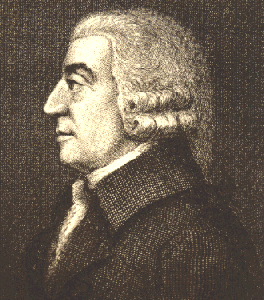
I can’t help but reading a good definition of “anticompetitive foreclosure” in this Adam Smith’s quote:
“To widen the market [NP’s note: through leveraging], and to narrow the competition [NP’s note: through exclusionary tactics] must always be against [the public], and can only serve to enable the dealers, by raising their profits above what they naturally would be, to levy, for their own benefit, an absurd tax upon the rest of their fellow citizens”.
Source: (1776) The Wealth of Nations, Book I Part III § 10.
The Friday Slot (5) – Jean-François Bellis

For this fifth edition of the Friday Slot, Chillin’Competition has interviewed a true master competition lawyer, Jean-François Bellis (Van Bael & Bellis, Brussels). The ITW tells it all, Jean-François is a person with many facets, i.e. litigator, entrepreneur, academic, teacher, etc. And the thing is, on all those fronts, he just stands out… It is a great honour for us to publish today his stimulating, inspirational interview.
“Oscar” of the best competition law book? Non-competition book?
Without question, the Van Bael & Bellis competition law book, now in its fifth edition, should win the prize! Seriously now, in my view, the most influential competition law book ever written is Robert Bork, “The Antitrust Paradox”, which so powerfully contributed to establishing the current accepted wisdom that the aim of competition law is to maximize consumer welfare. It is difficult to find a competition law book that has had as significant an effect on the practice of antitrust/competition law.
On the non-competition side, there is an embarrassment of riches. I have great respect for Orwell who, among other things, deserves the Oscar for the best opening line (“The idea really came to me the day I got my new false teeth” in “Coming up for Air”). But, as a lawyer, my vote will go to “The Trial” by Kafka. Quite fittingly, this book was one of the highlights of the course on literature in the first year of my law studies at the University of Brussels. Since I began practicing competition law, I had the impression of performing in it more than once.
“Oscar” of the best case-law development in the past year? “Oscar” of the worst case-law development?
The KME judgment issued by the Court of Justice on 8 December 2011 may turn out to be a landmark case in that it spells out the concept of full review in competition cases. To some extent, it mirrors the Strasbourg Court Menarini judgment issued on 27 September 2011 which affirmed the consistency with Article 6 of the Convention of administrative enforcement procedures provided that they are subject to full review by an independent court.
In terms of worst case-law development, I am concerned that the Court of Justice’s revisiting of parent liability issues last year may be generating uncertainty, and fear that this could potentially have unintended consequences in other areas of EU competition law (such as the possibility that Article 101 TFEU may be applied to intra-enterprise agreements between subsidiaries of the same group).
Anthem

In her great fiction Anthem, Ayn Rand describes a word where humans cannot use the word “I” on pain of being sentenced to atrocities. This is part of a greater effort of the dictatorship to suppress the concept of individuality.
To some extent, EU competition law shares analogy with Rand’s novell. It is sometimes as if Commission officials were forbidden by the EU Courts’ case-law to use the language of economics. This could be allegedly part of a larger plan to undermine the relevance of economic concepts.
An example: in 2008, a Lithuanian Court asked the Commission whether the proof that an information exchange agreement infringed Article 101 TFEU was conditional on evidence that the market structure was “oligopolistic“. In accordance with Article 15(1) of Regulation 1/2003, the Commission released its opinion.
In an ideal world, where economic reasoning would freely inform legal interpretation, the answer would be a resounding yes.
Yet, according to the Commission, the case-law of the EU Courts does not explicitly request the proof of an “oligopolistic” market structure for a finding of an unlawful information exchange agreement. Given this, and in stark contradiction with modern economic theory, the Commission denies that “oligopoly” is a necessary pre-condition for a restriction of competition to occur in a such setting. Blinded by obedience to murky judicial court-speak, the Commission thus turns its back on a basic economic concept.
This is even more suprising given that in the following paragraph, the Commission itself recognizes that the level of concentration and the structure of supply are important features in the analysis.
Very disappointing.
Strike?

No post last Thursday, Friday and Monday, what happened? Did we try a strike (not at bowling, like on the pic above) to see how a 4 days WE looks like?
Nothing of this kind really: Alfonso and I just got insanely busy. Sorry for this.
Two things nonetheless sprung to mind in the past days:
1. Old (students) habits die hard. At a conference last week, I drove the competition John Turturo mad. I was chatting with my assistants in the back of the room, essentially commenting on speeches. He was working. He did not like it. Misbehavior from me. Am truly sorry.
2. DG COMP’s webpage on cooperation with national courts contains a wealth of relevant information on Article 15(1) and 15(3) of Regulation 1, i.e. requests for information or for an opinion + amicus curiae. It is very unfortunate, however, that this webpage is not translated in EU languages other than English. I can see the point of using English as the competition esperanto in Brussels, but when it comes to national courts seeking online information on what they can do, it would help to provide translation.
Students’ Bests

My ULg students took their oral exam last week. It went fairly well for most of them.
That said, as usual during exams, I heard a bunch of puzzling things. In response to a question on alternatives to fines for competition infringements, I got the following answers:
- Dissolution of the infringing company (or the “slayer” remedy) =>think of the consequences in industry-wide cartels;
- Bringing the infringing company under Commission control (or the “bureaucratic” remedy) => science fiction or just augmented reality?
- Divulge all patents and other trade secrets to other market participants, with the particular illustration of Coca-Cola abusing a dominant position (or the “an eye for an eye” remedy) => you steal market share, we steal your IPRs.
I forgot, I also had a very candid answer when I asked what could be done to foster private enforcement =>make justice free and forbid legal professionals from making money out of cases…
PS: I am the culprit. I spent countless hours encouraging them to be creative.


 Chillin'Competition