Author Archive
A funny video
<object width=”480″ height=”384″><param name=”movie” value=”http://www.dailymotion.com/swf/video/x9o7a6_la-verite-sur-la-religion_webcam?additionalInfos=0″></param><param name=”allowFullScreen” value=”true”></param><param name=”allowScriptAccess” value=”always”></param></object><br /><b><a href=”http://www.dailymotion.com/video/x9o7a6_la-verite-sur-la-religion_webcam”>La verité Sur la RELIGION</a></b><br /><i>envoyé par <a href=”http://www.dailymotion.com/tribaleft”>tribaleft</a>. – <a href=”http://www.dailymotion.com/be-fr/channel/webcam/featured/1″>Plus de vidéos de blogueurs.</a></i>
The funniest market sharing agreement ever (video in French). Thanks to Sonia for the pointer.
Ties that bind

In Tomra sytems and others v. Commission the General Court explained that there is no de minimis abuse:
“the foreclosure by a dominant undertaking of a substantial part of the market cannot be justified by showing that the contestable part of the market is still sufficient to accommodate a limited number of competitors. … the customers on the foreclosed part of the market should have the opportunity to benefit from whatever degree of competition is possible on the market and competitors should be able to compete on the merits for the entire market and not just for a part of it.”
This is not entirely new. Yet, taken to extremes, this reasoning entails that a firm unlawfully abuses when it forecloses 1% of the market (as rivals cannot compete for the entire market). Also, this means that a dominant firm cannot offer exclusivity (or other ties) to any of its existing customer base.
This principle is clearly at odds with §145 of the Discussion Paper, where the Commission rightly noted, in relation to single branding that:
“The potential negative effects will in general depend on the size of the tied market share”
But this is also at odds with the de minimis doctrine under Article 101 TFEU, where exclusivity agreements fall short of Article 101 when the market share of the producer and purchaser is<15%. The de minimis doctrine considers that there is nothing to care about when an agreement ties les than 15% of a market.
Of course, the EU case-law outranks those instruments. Yet, Tomra is not fully in line with the GC’s own precedents such as Van den Bergh Foods Ltd. v . Commission, T-65/98 (in particular its §160 which seemed to imply – a contrario – that a 6% foreclosure would have been de minimis).
(Picture possibly subject to copyrights – am a great fan of this band)
Conference Announcements

Also, the Austrian Competition Authority will host a Panel Discussion on a subject of dear interest to me: “Screening Devices for Detecting Collusion”, with Prof. Rosa M. Abrantes-Metz, PhD. Prof. Maarten Janssen, PhD and Dr. jur. Christina Hummer, will comment. This seminar will take place on Monday, October 18, 2010 in Vienna (see info below).
First course at the BSC this afternoon
Went really well, a good group of students (around 30 of them), mostly in-house lawyers.
Great infrastructure and very stimulating course. Am hungry for more.
Thanks also to Alfonso for accepting to talk to my students in Liege.
EP to discuss fines in competition cases
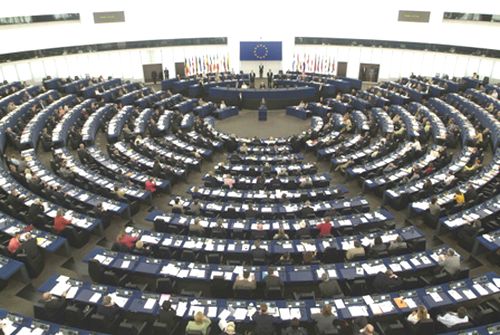
Looks quite unusual, but the European Parliament will host a debate on fines for competition infringements. A well informed friend sent me an email indicating:
“The following items are on the agenda of next week mini-Plenary session, Wednesday afternoon, 6 October:
– […]
– Commission statement – Commission fines in antitrust cases”
Not sure what to expect from this… At any rate, please note that the first conference of the BSC will come shortly, and will be devoted to sanctions for competition law infringements. My own personal viewpoint is that disqualification orders are the most efficient and fair possible penalty.
(Image possibly subject to copyrights: source here)
Chillin’Competition on the Conference Market?

EVENING POLICY TALK
DR. ALEXANDER ITALIANER, DIRECTOR-GENERAL, DG COMPETITION
EUROPEAN COMPETITION POLICY ON THE ROAD TO 2020
12 October 2010 – Marriott Hotel, 3-7 Rue August Orts, 1000 Brussels
See link below for more.
And a question :): with the lunch talk last week, the annual conference next week, and this EPT on 12 October, aren’t we chilling competition?
Evening Policy Talk by Dr. ITALIANER – EUROPEAN COMPETITION POLICY ON THE ROAD TO 2020
A somewhat original objective justification

In reading a French Phd dissertation, I just found a strange case, which dates back to 2005 and was decided by the French NCA.
The facts: a cistercian congregation located on the Island of St Honorat owned a monopoly over maritime transport services between the continent and the island. The congregation had apparently refused to authorize third parties to provide additional transport services, thereby stiffling competition. The French NCA dismissed allegations of unlawful abuse. It found that the limitation of tourists was justified by the necessity to preserve the quietness of the monks. See Cons. Conc. 8 novembre 2005, n° 05-D-60, relative à des pratiques mises en oeuvre par la congrégation cistercienne de l’Immaculée Conception, la société Planaria, l’État et la commune de Cannes.
First day in class today
… and I am exhausted. I have a good group of students (around 50 attending the EU competition law course), and about 23 LL.M. students.
I am also busy preparing for the GCLC annual conference, as well as the first lecture at the Brussels School of Competition.
Slides – GCLC Lunch Talk on Quantification of Damages

I attach the slides presented by A. Lofaro at today’s lunch talk. A great event, which triggered a very interesting discussion.
Some things that arose from the debate with the audience + some ruminations:
- The non binding guidance on which the Commission works will include something on exclusionary abuses
- The Commission is not incline to provide guidance on quantification in its decisions
- The Commission does not intend to make a specific, pro-active use of the instruments under Regulation 1 (article 15) to provide guidance on compensation
- Peter Roth suggested that as part of settlement discussions, the parties to a cartel could also commit to a certain amount as compensation
- On passing-on, I would advise consulting the non-competition EU case law
- In terms of counterfactual price, why not use the price that follows Commission enforcement as the competitive benchmark?
Slides Lofaro – GCLC Lunch Talk – Estimating damages 22 September
Duopoly – A Real Life Example

The idea of this post came while having lunch in the centre of Brussels (I am definitely a competition geek).
Until recently, Noordzee (on the left side of the picture) enjoyed a local monopoly on the market for fast fish-seafood standing meals in the centre of Brussels (my shot at this somewhat original market definition). Their business concept was simple: you eat and drink outside, standing.
I was, with loads of other customers, a great fan of Noordzee. Yet, ordering there involved queuing, eating in uncomfortable conditions,and possibly supra competititive pricing.
A while ago, a restaurant located on the other side of the street (ABC on the right side) decided to replicate Nordzee’s business concept. ABC installed tables on the outside and started to serve customers just as Noordzee had done in the past.
Everyone, including Noordzee seems to withdraw benefits from this expansion/entry. Noordzee has reduced queuing time and increased consumer satisfaction. In addition, the optics of having an increased number of people around the restaurants is good in terms of brand image and advertisement. I am not sure, however, that prices have plummeted. Tacit collusion may be the reason there.
(Picture subject to copyrights. Source: taken with my mobile phone earlier in the day)


 Chillin'Competition

