Author Archive
New Interesting Book
A new book, with follows a very novel perspective on the Commission’s decisional practice, has been published.
“European Commission Decisions on Competition: Economic Perspectives on Landmark Antitrust and Merger Cases” is now available from Cambridge University Press. This reference book offers a classification and analysis of all European Commission decisions adopted pursuant to European antitrust rule (i.e. Articles 101, 102 and 106 of the FEU Treaty) from the Treaty of Rome of 1957, up to and including 2009. It also includes a sample of landmark European merger cases. The decisions are organized according to the principal economic theory applied in the case. For each economic category, we describe in a fixed template format the seminal decision(s) that became a reference point for that type of (anti)competitive behavior. All subsequent decisions in which the same economic principle was applied are listed chronologically.
For more information and to order, click here
New Entrant
We are pleased to announce that we have a new competitor. Pay them a visit, it looks really good.
It’s a Long Way to the Top

See below. Found on LL.M Guide, a website advertising LL.Ms. One student made a strong plea in favour of our LL.M. in Liege. This triggered disagreement on the forum, with a respondent rightly arguing that I am not a “leading competition scholar” (as opposed to other “gods” of competition law, amongst which the amazingly good and esteemed Prof. Richard Whish).
 The chap who replies to him certainly has a point. It is still a long way to the top for me. If one day, I could get only close to Whish’s teaching skills…
Anyway, the funny thing is that I have thought a lot in the past weeks as to how I could improve my way of doing business. At this stage, my conclusion is that I need to refocus a little on things that really matter. To this end, I am facing a number of options on which I would certainly love feedback from my readers.
As far as time management is concerned – am running on scarce resources – shall I
- Stop the blog?;
- Quit GCLC?;
- Quit the new born BSC?;
- Surrender the Direction of the Liege Institute for European Legal Studies?
- Quit other courses which I give on an occasional basis (EDHEC in France, MGIMO in Russia, etc.)
- Stop organizing conferences
As to the selection of my areas of scientific interest, shall I:
- Keep an interest in the various areas of competition enforcement (101, 102 and merger control) or focus only on a micro area of EU competition law?
- Keep following Belgian and French competition laws, in parallel to EU competition law?
- Start writing papers in English only, or continue my 50/50 balance between contributions in French and English?
Happy to get your feedback on the above.
Nota: The picture above is taken from one of the greatest rock LPs of all time (source here). This LP features the title “It’s a long way to the top”, which has one of the most addictive and catchy riffs I have ever heard.
Greek Prize
A most welcome initiative: The Hellenic Competition Commission, wishing to promote competition culture in Greece, and in the context of its competition advocacy efforts, announces an annual prize of 3,000 euros for the best scientific article in competition (antitrust) law or economics written in Greek by young scholars. Below an announcement in Greek and in English, which defines in detail the conditions and process to be followed.
Competition Law Event of the Year

See programme below and link hereafter.
GCLC – Sixth Annual Conference – 7 & 8 October 2010 – Programme and Registration Form.
DAY ONE
9:00 Welcome Words
Paul Demaret, Rector of the College of Europe
9:10 Presentation of the Conference
Bernard van de Walle de Ghelcke, President of the GCLC, College of Europe and Linklaters
9:20 Keynote Speech – The European Union Courts Experience and Role In Dealing With Competition Law Cases
Sir David Edward, KCMG, QC, former judge at the Court of First Instance and at the Court of Justice, em. prof. University of Edinburgh
I. Morning Session – General Issues
Chair: Jacques Bourgeois, Former-President of the GCLC, College of Europe, WilmerHale
09:40 Judicial Review, the Rule of Law, Regulatory Accountability and the courts’ ability to promote policy changes
Damien Géradin, University of Tilburg (UvT) and Howrey, and Nicolas Petit, University of Liège (ULg)
10:05 Discussant: Takis Tridimas, College of Europe
10:15 Coffee Break
10:35 Judicial Review in EU Economic Regulation Cases
Jacques Derenne, University of Liège (ULg) and Hogan Lovells
11:00 Discussant: Ben Smulders, Legal Service of the European Commission
11:10 Reflections on the EU Courts’ Involvement in Competition Proceedings: Status Quaestionis and Main Trends
Marc van der Woude, Erasmus University Rotterdam (EUR) [TBC]
11 :35 Discussant: Eric Barbier de la Serre, Latham & Watkins
11:45 Q&A Session
12:30 Lunch
II. Afternoon Session – The EU Courts’ Scrutiny over the Commission in Competition Law Cases
Chair: Carles Esteva Mosso, Director, DG Competition
13:30 Annulment Proceedings in Antitrust Cases (Article 101 and 102 TFUE) – Standard of Judicial Review over Substantive Issues
David Bailey, Senior Référendaire at the U.K. Competition Appeal Tribunal (CAT) and King’s College London (KCL)
13:55 Discussants: Theofanis Christoforou, Legal Service of the European Commission and Mario Siragusa, College of Europe and Cleary Gottlieb
14:15 The General Court’s Full-Jurisdiction over Fines in Competition Cases
Bo Vesterdorf, Herbert Smith and Plesner, Former President of the Court of First Instance
14:40 Discussants: Wouter Wils, Legal Service of the European Commission and KCL, and Ian Forrester, White & Case
15:00 Annulment Proceedings in Merger Cases
Philippe Chappatte, Slaughter and May
15:25 Discussants: Marleen Van Kerckhove, Arnold & Porter and Marc Pittie, Bredin Prat
15:45 Coffee Break
16:05 Annulment Proceedings in State Aid Cases
Massimo Merola, College of Europe and Bonelli Erede Pappalardo
16:30 Discussants: Vittorio Di Bucci, Legal Service of the European Commission and Leigh Hancher, University of Tilburg and Allen & Overy
16:50 Locus Standi before EU Courts, with Special Focus on State Aid
Josef Azizi, Judge at the General Court
17:15 Discussants: Leo Flynn, Legal Service of the European Commission and Thomas Jestaedt, Jones Day
17:35 Q&A Session
18:00 End of Day One
DAY TWO
Institutional and Procedural Challenges Faced by the EU Courts in Competition Law Cases
Chair: Sir Christopher Bellamy, Linklaters, former Judge at the Court of First Instance and at the CAT
9:00 The Role of the Court of Justice in Ensuring Compliance with Fundamental Rights in Competition Cases since the Lisbon Treaty
Nils Wahl, Judge at the General Court
9:25 Discussants: Dean Spielmann, Judge at the European Court of Human Rights and Denis Waelbroeck, Free University of Brussels (ULB) and Ashurst
9:45 Expert Economic Evidence in Competition Law Cases
Hans van Houtte, Katholieke Universiteit Leuven (KUL)
10:10 Discussants: Simon Bishop, RBB Economics and Luis Ortiz Blanco, Garrigues, University of Madrid and College of Europe
10:30 Q&A Session
11:00 Coffee Break
11:20 The Pros and Cons of Specialized Competition Courts, Chambers and Judges
Roundtable Discussion moderated by Sir Francis Jacobs, KCMG QC, Fountain Court, former Advocate General at the Court of Justice
Discussants: Charles Dhanowa, OBE Registrar of the CAT, Jacqueline Riffault Silk, Court of Appeal of Paris, and Ingeborg Simonsson, Stockholm City Court
12:30 Close of Conference
Oops!… I did it again

Yesterday in a cartel case, the Commission fined 17 producers of prestressing steel a total of € 518 470 750 and again
” accepted three inability-to-pay applications and granted reductions of respectively 25%, 50% and 75% of the fine that would otherwise have been imposed. It had received 13 such applications, under the Commission’s 2006 Fines Guidelines“.
Is this Almunia-driven? Thanks to Kit Brown for pointing out to this intriguing development.
(Image possibly subject to copyrights: source here)
Lol

The Court of Justice was in a facetious mood yesterday. It’s latest joke is plain excellent.
Here’s the background: In Commission / Alrosa, the Court was asked to rule on Article 7 (Finding and termination of infringement) and 9 (Commitments) of Regulation 1/2003.
Now, the Court’s joke goes as follows:
“Those two provisions of Regulation No 1/2003, as noted in paragraph 38 above, pursue different objectives, one of them aiming to put an end to the infringement that has been found to exist and the other aiming to address the Commission’s concerns following its preliminary assessment”.
[… Laughter …]
And the upshot of this:
“47. There is therefore no reason why the measure which could possibly be imposed in the context of Article 7 of Regulation No 1/2003 should have to serve as a reference for the purpose of assessing the extent of the commitments accepted under Article 9 of the regulation, or why anything going beyond that measure should automatically be regarded as disproportionate. Even though decisions adopted under each of those provisions are in either case subject to the principle of proportionality, the application of that principle none the less differs according to which of those provisions is concerned.
48. Undertakings which offer commitments on the basis of Article 9 of Regulation No 1/2003 consciously accept that the concessions they make may go beyond what the Commission could itself impose on them in a decision adopted under Article 7 of the regulation after a thorough examination. On the other hand, the closure of the infringement proceedings brought against those undertakings allows them to avoid a finding of an infringement of competition law and a possible fine”.
On this later §, read again recital 13 of Regulation 1, which says that “Commitment decisions are not appropriate in cases where the Commission intends to impose a fine“.
(Image possibly subject to copyrights: source here)
Competition Quote of the Day

A few years ago, whilst a young undergrad. student, the following quote opened my eyes:
“Antitrust litigation is not a process for deciding who can be rich or poor, nor can it decide how much wealth should be expended to reduce pollution” (R. Bork, The Antitrust Paradox – A policy at war with itself, Basic Books, New York, 1978, p.91).
Now a young under experimented scholar, I still find that it rocks. Thanks to Anne-Sophie Maes for the pointer.
Relaxation

In a decision adopted last Weds, the Commission has put a dent into its conservative position that firms participating to cartels ought not to benefit fines reductions on grounds of financial difficulties. The decision relates to a cartel in the bathroom equipment sector. Hereafter, a quote from the press release:
More exceptionally, the fines of three companies were reduced by 50% and those of another two by 25% given their difficult financial situation. A total of ten companies claimed they would be unable to pay a fine: to assess their claims, the Commission looked at recent financial statements, provisional current year statements and future projections, several financial ratios that measure a company’s solidity, profitability, solvency and liquidity, and relations with banks and shareholders. The Commission also looked at the social and economic context of each company. Finally, the Commission assessed whether the companies’ assets would be likely to lose significant value if the companies were to be forced into liquidation as a result of the fine. The analysis is company-specific and aims to be as objective and quantifiable as possible to ensure equal treatment and preserve the deterrence aspect of EU competition rules.
Obviously, this will not come as a surprise to those familiar with the 2006 Guidelines on fines, which expressly provide for such reductions:
F. Ability to pay
35. In exceptional cases, the Commission may, upon request, take account of the undertaking’s inability to pay in a specific social and economic context. It will not base any reduction granted for this reason in the fine on the mere finding of an adverse or loss-making financial situation. A reduction could be granted solely on the basis of objective evidence that imposition of the fine as provided for in these Guidelines would irretrievably jeopardise the economic viability of the undertaking concerned and cause its assets to lose all their value.
Yet, this decision contrasts with (i) the tough stance on fines that prevailed until recently at DG COMP; and (ii) the Commission’s commitment to keep competition enforcement unaltered in times of crisis.
On top of this, the Commission’s decision will surely add to the debate that is currently raging in France. In CA Paris, 19 janvier 2010 AMD Sud Ouest, Arcelor Profils et autres c Conseil de la concurrence, the Court of Appeals of Paris has reduced the fines imposed by the NCA by €500,000,000 on the ground – inter alia – that the NCA had not sufficiently considered the effects of the ongoing crisis on the infringing firms.
(Image possibly subject to copyrights: source here)
Karel Van Miert
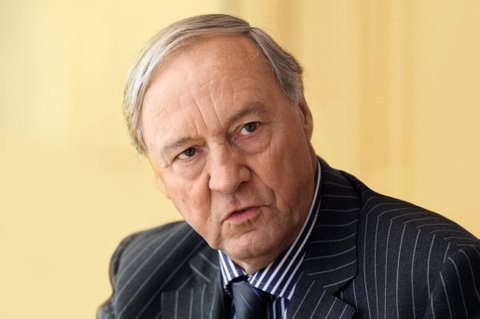
The European Commission held an inauguration ceremony of memorial plinth for Karel VAN MIERT, former European Competition Commissioner. A video of the ceremony is available here. I met him once, at a conference organized by the revue Concurrences three years ago. My impression: his reputation as someone who spoke his mind was not a myth. During the conference, VAN MIERT delivered a tough, vibrant speech against the State-sponsored industrial policy ethos.
As most readers know VAN MIERT was a flemish Belgian (read dutch-speaking). Yet, it seems that most of the ceremony took place in French (see the speeches of Barroso and Almunia). Quite funny, at a time where the country hosting the Commission is on the verge of linguistic explosion.


 Chillin'Competition


