Author Archive
Antitrust Desk Cleaning

Lucky me, I am in London today invited to a conference entitled “C5 Managing Competition Risk and Compliance“:Conference – 612L14_Managing Competition Risk Compliance_S)
The topic is “Key EC reforms and the expected impact on regulatory enforcement“, or “what will be the focus of EC regulatory enforcement in the coming year“.
Unlucky me: I had to take a try at antitrust astrology.
Hereafter is the best I could come up with: Managing Competition Risk & Compliance – N PETIT
New Blog – Emulation/Innovation
My assistant Norman has just started a blog on competition and IP law (in French).
To all the readers of this blog who understand French: subscribe to his feed!
I am sure you’ll find it surprising and insightful.
Congrats to Norman for growing the competition blogging family.
Collective Amnesia

The forgotten reason why national competition laws should – literally – not exist.
Article 3 TFEU: 1. The Union shall have exclusive competence in the following areas: (b) the establishing of the competition rules necessary for the functioning of the internal market;
Or why they should be abolished when the internal market will be effective (will it ever?).
The Article 102 TFEU Bible is Out
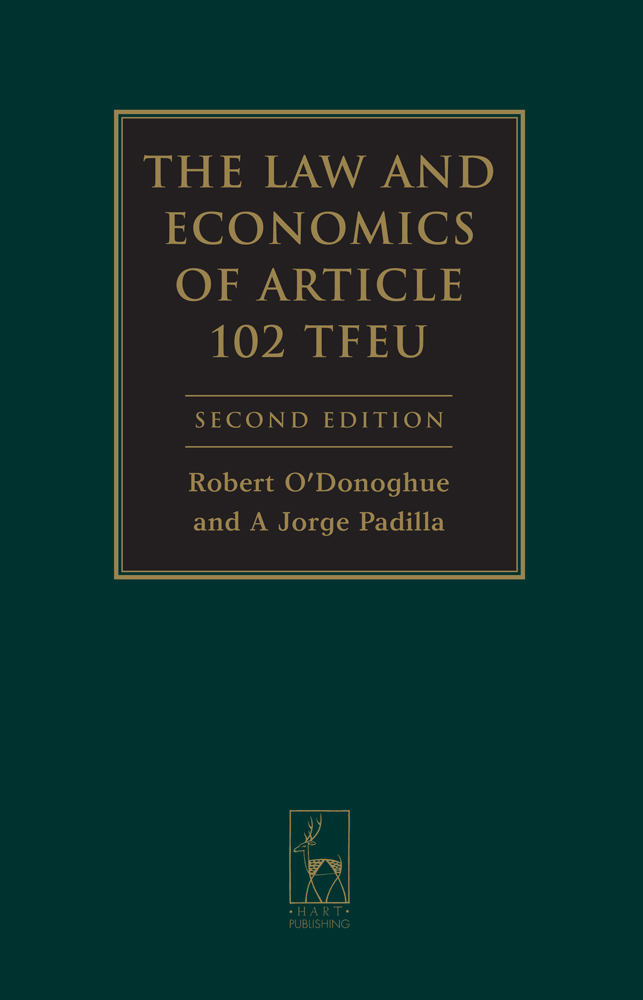
Many competition bibles are released lately.
Today’s bible is clearly, and without the shadow of a doubt, THE reference on Article 102 TFEU.
I guess everyone should thank Robert O’Donoghue and Jorge Padilla for the assistance they have provided to the competition community since the 1st ed.
There is a world before and a world after “The Law and Economics of Article 102 TFEU“.
Clearly, this book should be compulsory reading for anyone approaching the law of abuse of dominance.
I guess it should even be subsidised by agencies.
I paste below the official announcement on Hart Publishing’s website.
The bottom line on what the publishing market tells us: a good bible needs a Spanish author (with the possible exception of this one :)).
New 2nd Edition
The Law and Economics of Article 102 TFEU
By Robert O’Donoghue and Jorge Padilla
The Law and Economics of Article 102 TFEU is a comprehensive, integrated treatment of the legal and economic principles that underpin the application of Article 102 TFEU to the behaviour of dominant firms. Traditional concerns of monopoly behaviour, such as predatory pricing, refusals to deal, excessive pricing, tying and bundling, discount practices and unlawful discrimination are treated in detail through a review of the applicable economic principles, the case law and decisional practice and more recent economic and legal writings. In addition, the major constituent elements of Article 102 TFEU, such as market definition, dominance, effect on trade and applicable remedies are considered at length. Jointly authored by a lawyer and an economist, The Law and Economics of Article 102 TFEU contains an integrated approach to the legal and economic principles that frame policy in this major area of competition law. Although written primarily with practitioners and in-house lawyers in mind, it is essential reading for anyone with an interest in competition law enforcement against monopoly behaviour.
Robert O’Donoghue is a barrister at Brick Court Chambers, London and Brussels.
A Jorge Padilla is Senior Managing Director and Head of Compass Lexecon Europe.
October 2013 1078pp Hbk 9781849461399
RSP: £145 / €188
20% Discount Price: £116 / €150.40
Order Online in the UK, EU and Rest of World
UK, EU and ROW : http://www.hartpub.co.uk/BookDetails.aspx?ISBN=9781849461399
If you would like to place an order you can do so through the Hart Publishing website (link above). To receive the discount please type the reference ‘CCB’ in the voucher code field and click ‘apply’.
Remedy
Assuming that the whole fuzz around the Google investigation is about tactics seeking to abusively deny search scale to rivals, the remedy to restore competition may not be where the Commission and parties are eyeing.
A less intrusive remedy for Google (and its rivals) exists: Unwind the commitment imposed on Microsoft in 2009 to pre-install competing browsers and in particular Mozilla which has Google as the default search engine.
With this Mozilla, and in turn Google, will lose some traction in search.
A possible alternative would be to force Google to install a “search engine ballot screen” in Chrome to overcome end users’ inertia when placing search words in the engine. One could also think of forcing Mozilla to have Bing as its default search engine for a certain share of the market. But this, clearly would be less acceptable to Google.
The bottom-line: there’s more than one option to improve competition in internet search.
NYT

Lucky me, I made it to the NYT again, on the Google investigation. See here.
To be honest, my quote is very lame.
I had a better one though. But it did not make it through.
James Kanter reveals it on twitter: ‘Enforcers risk becoming Don Quixote figures, tilting at windmills.‘
The point is: 4 years to solve a high-tech case under a settlement, come on…
4 years ago, Nokia was the worlwide leader in handsets. And Blackberry was the dominant smartphone player.
In those sectors, 4 years is an eternity…
And antitrust enforcers may not be far from Quixote, who fell into the illusion that he was fighting a cause that matters, i.e. fighting giants which in reality were innocuous windmills.
A question to our readers

Last week at the BSC, Benoit Durand and myself were asked a question that we could not answer.
Does any formal EU act govern the appointment, mission and duties of the Chief Economist? If so, is this act available and where?
Our best guess was that there must be something, as for the decision setting out the function and terms of reference of the hearing officer (see here). But given that we had never seen it, we guessed that it was not publicly available.
We promised we’d do our best this week to get ahold of it.
So if any reader has it or knows how to get it, please let us know.
The Case for some Formalism in Rules of Competition Law

Our economist friends often believe that legal formalism is useless.
I have personally complained about the bad influence that formalistic lawyers had in competition proceedings.
Now, “assume” an economist had written the Treaty rules on Competition. This would give something like:
- Article 101 TFEU: Anticompetitive coordination is unlawful.
- Article 102 TFEU: Anticompetitive foreclosure is unlawful.
With such loose rules, the economic cost of enforcing the law would skyrocket. And so would the economic cost of complying with the law.
The sole saving achieved would be the ink saved in printing and reprinting the Treaty.
Or why too little legal formalism is economically inefficient.
Twilight of the Idols

The Van den Bergh Foods case, aka the Ice Cream case, if often cited as one of the best Article 101 TFEU judgments ever handed down by the General Court.
Many praise its modern, unformalistic approach of vertical ties.
They like its focus on the economic magnitude of the foreclosure yielded by the freezer exclusivity clause.
I too have rallied this optimistic interpretation. In a case note published 10 years ago, I had laudated the General Court for its analysis.
As with novels, I should have applied the rule never read again.
Despite economic improvements in judicial reasoning, the Ice Cream judgment is fraught by several unfortunate logical shortcuts.
A quick reminder: the crux of the case was that Unilever, the largest player in the market (and the incumbent) had given freezer cabinets for free to retailers and forbidden them to store non-Unilever ice creams in those cabinets.
This, in the Commission’s view, yielded anticompetitive foreclosure, in particular in those shops where only one freezer cabinet could be stored because of space constraints.
Interestingly, the typical contract with retailers could be terminated flexibly, under a 2 months notice. Unilever thus made the rather convincing counter argument that as efficient rivals – those who could too offer cabinets for free – were not foreclosed from the market.
The GC and the Commission nonetheless based their case on the fact that despite open termination opportunities, there was a “reluctance” from retailers equipped with Unilever cabinets to terminate their contract. As a result of retailers’ reluctance, rival ice cream producers were harmed.
On cursory analysis, the “reluctance” story was reasonably plausible. But the problem is that the evidence adduced by the Commission and the GC to prove reluctance was quite weak.
Let’s take a look: the reluctance argument seems wholly based on the unproven assumption that retailers who would terminate their Unilever contract would no longer be able to procure Unilever products. Hence, retailers just decided to stay with the contract, as Unilever products were “must store” goods.
But on the facts, the decision and judgment did not exclude that retailers remained free to use a rival freezer and still procure from Unilever without terminating the contract in the first place. This, to me, is a major flaw of the decisions. Retailers could just have trashed the Unilever freezer or tell Unilever to recover it.
An alternative is that the Commission and the GC may have assumed that Unilever would have de facto stopped supplying it products to retailers using a rival freezer cabinet. But this would have been a stand-alone, separate infringement which would have deserved proof under the Brönner standard.
Surely, it may be that the Commission and the GC had in mind a “behavioral” reluctance theory, similar to those used in the Microsoft Media Player and Browser cases or in the ongoing Google investigation.
The idea would have been that retailers were content with their Unilever cabinet, and because of some statu quo bias or of hassle costs, they just reclined on changing freezers.
Again, however, no corroborating evidence of biases and retailers’ ineria appears in the decision and judgment.
A bit disappointing, for a judgment that has been elevated to the hall of fame of competition case-law. But overall, a good ruling.
Hiring

I am looking for a full or (or 2 half time) academic assistant(s), starting on 17 October 2013 at the University of Liege.
This position is for a period of one year.
If things go well, the contract may be turned into a PhD student position.
It offers teaching and publication opportunities.
If you are interested, please send me your CV at nicolas.petit@ulg.ac.be


 Chillin'Competition