Author Archive
Search engine
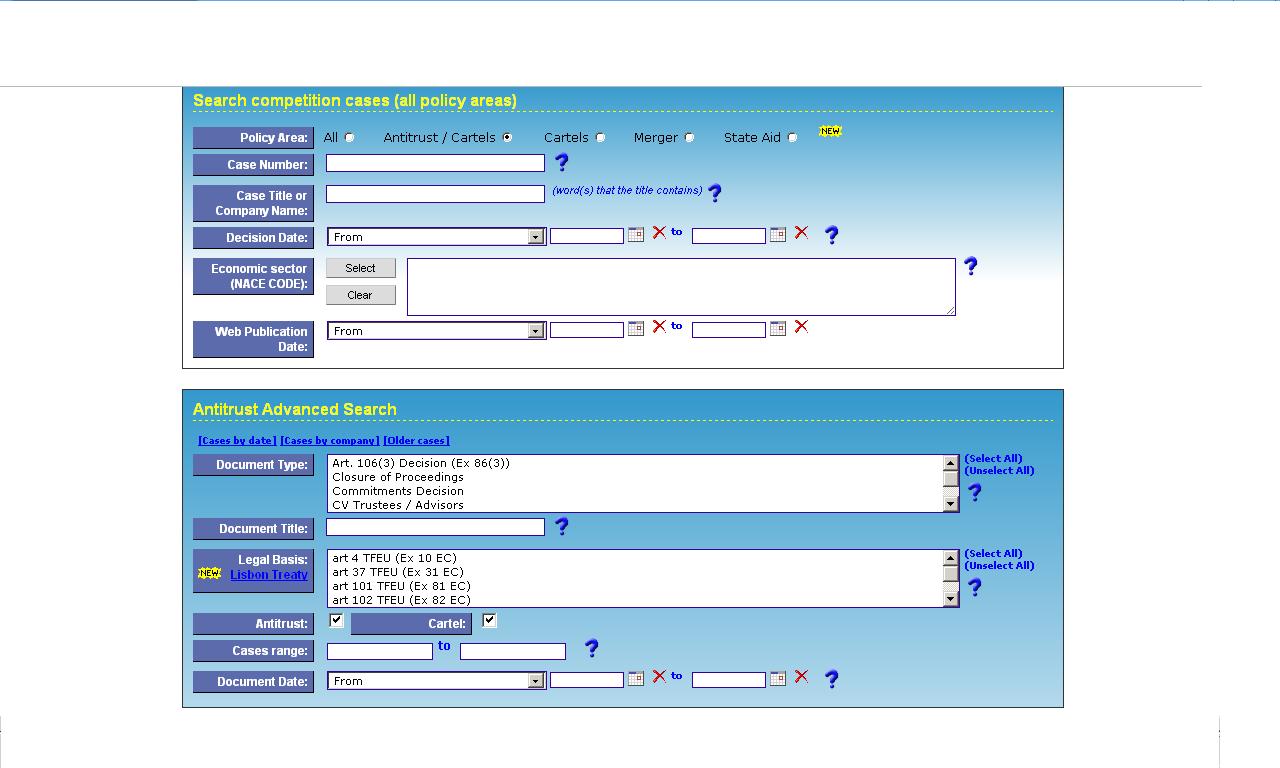
This is not a post about Google.
I had not noticed this earlier, but DG COMP has a new search engine for antitrust, merger and State aid cases. It looks very user friendly and will be undeniably of great help to most competition law practitioners and academics. A welcome initiative.
Outcome discrimination

A Microsoft-related post to compensate for the disappearance of the post uploaded earlier.
Recital 13 of Regulation 1/2003 provides that:
“Commitment decisions are not appropriate in cases where the Commission intends to impose a fine“. The ratio of this rule has to do with the fact that commitments only have corrective effects for the future. Unlike fines, they fail entirely to punish past anticompetitive conduct – behavior that has actually caused harmful effects – and are thus inappropriate in case of lasting competition law infringement.
Think of Microsoft II where the Commission accepted commitments. Take a breath. Now think of Microsoft I: same type of alleged anticompetitive conduct, same company, but in this case a staggering 497 million € fine (for two infringements though). My question: can in such situations the Commission’s discretion over the outcome of a case be challenged on grounds of unlawful discrimination? Although I doubt it, I find the point quite interesting (I allude to it in my last concurrences paper).
Windows

This is not a post on Microsoft.
In a move to make their films available early through various channels (DVD, VoD, etc.), movie distributors – big fishes like Disney – have sought to reduce the x-months exclusivity enjoyed by theatres over the first release of movies (the so called theatrical “window”).
Historically, movie distributors had been reluctant to do this, because the release of movies on a wide number of physical (DVDs) or digital (Internet) formats rang the opening hour of piracy. Moreover, the theatres’ temporal monopoly over the distribution of movies led to fat prices for consumers, and thus appreciable margins for the movie distributors (which normally receive a % on each ticket sold).
Movie distributors are manifestly changing their minds. A plausible explanation of this is that distributors increasingly perceive the theatrical window’s lenghty exclusivity as a key explanation for movie piracy. In addition, in times of crisis, consumers may prefer to stay home to watch movies, so the revenue generated by theatrical distribution decreases as compared to other formats. Think, for a second, to the situation of a budget-constrained family man. To him, watching a movie home is akin to a fixed cost. It is incurred once (renting the DVD) and can be spread over the various members of the family. By constrast, watching a movie in a cinema is a variable cost, which increases with the number of family members brought to the theatre.
So much for the theory. Why a post on this issue? On the occasion of the release of “Alice in Wonderland“, cinema chains have tried to undermine the distributors’ attempts to shrink the theatrical exclusivity window. To this end, they have engaged into the most brazen form of anticompetitive conduct: boycott. In the UK, it has for instance been reported that the three big cinema chains – Odeon, Vue and Cineworld – initially threatened to boycott Alice in Wonderland. The same has also happened, and may still be happening, in a number of European countries (Belgium, the Netherlands).
Under EU competition law standards, such boycott practices may be challenged on two possible grounds. First, they constitute a refusal to purchase movie distributors’ services (or they entail the termination of long lasting commercial relationships) and may thus be tantamount to an unlawful abuse pursuant to Article 102 TFEU (or its national equivalent). Assuming – I sound like an economist – that the theatres hold a dominant position (individual or collective), the interesting issue lies in the fact that theatres do not try to harm competition on a secondary upstream market as in classical “essential facility” cases (where upstream, or downstream, foreclosure is the concern). As a result, the Magill/IMS/Microsoft case-law which requires the elimination of competition on a secondary market should thus not apply to cinema chains practices. Yet, I am tempted to argue that there could nonetheless an abuse pursuant to Article 102 TFUE. In coercing distributors to maintain the current release windows through boycott, theatres artificially forestall the early entry of alternative viewing modes on the market. This in turn is prejudicial to “consumer welfare” in the meaning of competition law since it limits consumer choice and impedes the development of new markets. The increased emphasis of “consumer welfare” under Article 102 TFUE brings support to this interpretation.
Second, such practices may be tantamount to an infringement of Article 101 TFUE (or the national equivalent), provided the cinema chains have jointly decided to boycott movie distributors – again I sound like an economist. EU competition law has a strong enforcement record against collective boycotts. Back in 1974, the Commission held in Papiers peints de Belgique that “collective boycott is amongst the most egregious violations of competition rules”.
Apologies for the long post, but I find the issue fascinating. Thanks to T. Hennen for the pointer.
(Image possibly subject to copyrights: source here)
43rd Lunch Talk of the GCLC – 18 March

The 43rd Lunch Talk of the GCLC will be devoted to The Commission’s Proposed Best Practices in Antitrust Proceedings. We are delighted to have Luiz Ortiz Blanco (Garrigues) and Carles Esteva Mosso (DG COMP), to discuss the Commission’s text. The lunch talk will take place on 18 March at the Hilton Hotel in Brussels (38 Boulevard de Waterloo).
See hereafter for registration form.
Conference announcement
The University of Louvain organizes a conference on international antitrust litigation in March. See here for more.
Drawing Inferences from S&D Law

Many thanks for your answers. Some readers got it right, others not. To be fair, the question was poorly formulated, and many alternative explanations could apply.
Scott Summer from the Money Illusion provides the answer, and comes back on the question:
I teach at an institution that is well above average, and here is what I have found. Almost every single student comes into EC101 knowing the impact of supply and demand shocks. Tell them a frost hits the Florida orange crop, and they can explain what happens to the price of oranges. Tell them millions of Chinese start buying cars and they can tell you what happens to the price of oil.I also find that almost no student comes into my class knowing how to interpret price and quantity data. And what is worse, they leave the course equally ignorant. I often ask the following question to upper level econ or MBA students who have already taken principles:Question: A survey shows that on average 100 people go to the movies when the price is $6 and 300 people go when the price is $9. Does this violate the laws of supply and demand?Very, very few can answer this question, especially if you ask for an explanation. Even worse, I think there is a perception that there is something ‘tricky’ about this question, something unfair. In fact, it is as easy a question as you could imagine. It’s basic S&D. It’s merely asking students what happens when the demand for movies shifts. I cannot imagine a less tricky question, or a more straightforward application of the laws of supply and demand. In the evening hours the demand for movies shifts right. Price rises. Quantity supplied responds. What’s so hard about that? And yet almost no student can get it right. Our students enter EC101 knowing one of the two things they need to know about S&D, and they leave knowing one of the two things they need to know about S&D. Maybe instead of having them memorize mind-numbing lists of “5 factors that shift supply,” and “5 factors that shift demand,” we should just tell them to read something that will explain what economics is all about, something that portrays economists as detectives trying to solve the identification problem, something like Freakonomics.
(Image possibly subject to copyrights: source here)
Basic but Tricky Econ. Question

Question: A survey shows that on average 100 people go to the movies when the price is $6 and 300 people go when the price is $9. Does this violate the laws of supply and demand?
Any idea?
No surprises

Three complaints have been logdged before the EU Commission against Google. The complaints have been introduced by British price comparison website Foundem, French legal search engine ejustice.fr, and – guess who – ciao.de, a Microsoft subsidiary. Frankly speaking, this is everything but surprising.
First, given the mounting degree of antitrust exposure faced by Google in Europe, and elsewhere in the world (think of the GBS in the US), it was just a matter of time for DG COMP to at least scrutinize Google’s conduct. Now, the many press announcements made in this respect shall be toned down a little. If I understand correctly, the Commission has not, as reported by several journalists, “opened a probe”, but simply announced that it will review the complaints. A Commission official is quoted to have said: “The Commission can confirm that it has received three complaints against Google which it is examining. The Commission has not opened a formal investigation for the time being,“
Second, on legal grounds, the fact that Google’s conduct is challenged for a violation of abuse of dominance rules is also unsurprising. It is reported that Google would “unfairly” rank competing websites on its search engine. Whilst I have no particular information on this, I suspect the complaints to describe Google as an operator holding an essential search facility (a disputable argument actually). In turn, the systematic down-ranking of competitors could arguably involve, such as in the case of a physical infrastructure, something akin to a constructive refusal to supply, which squeezes rivals from the market. I would really love to see how the complaints are structured. There might also be issues of unlawful discrimination against competing websites (Article 102 c)).
The good news from Google: it can draw upon, and recycle, a lot of the Microsoft-related antitrust literature on dynamic efficiencies, software integration, refusals to deal, etc. Quite paradoxically, Google and Microsoft may well be foes on the commercial front, but as far as legal argumentation is concerned, they have a lot to share.
(Image possibly subject to copyrights: source here)
Implications of the TFEU on EU Competition Law

Just published in the February Antitrust Chronicle with my Assistant Norman Neyrinck.
Writing this paper involved a lenghty reading of the new Treaties. A lot has changed, and I now believe that all EU lawyers, including competition lawyers, should devote some time to reading them too. The provisions on judicial remedies and the Court of Justice are particularly interesting.


 Chillin'Competition