Author Archive
Jokes on Economists
Presentation on Recent Developments in EC Competition Law

I attach below the slides of a presentation I delivered yesterday at the Federation for Enterprises in Belgium. Nothing groundbreaking, simply an overview of current EC law developments.
Actualité des droits communautaire et belge de la concurrence – FEB Commission juridique
Lost

A year after the inception of the EC settlement procedure, the first settlement in a cartel case is still to happen…
New book – Alternative Enforcement Techniques in EC Competition Law
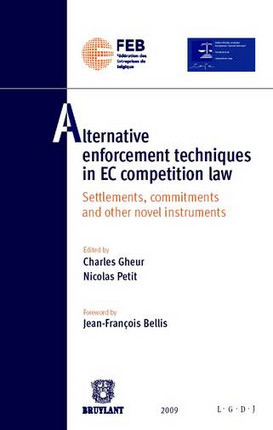 I am the proud co-editor – together with my colleague and friend C. Gheur – of a new book, which comprises the proceedings of a conference held last year in Brussels.
See here for more details and link hereafter for subscription form: 2090419-prosp
Nicolas
Call for Papers on Antitrust in the Energy Sector
Call for papers: OGEL special issue on “antitrust in the energy sector”
6/5/2009
Oil, Gas and Energy Law Intelligence (www.ogel.org) invites submissions for a Special issue covering antitrust issues in energy. The guest editor for this special issue is MYSELF.
The energy sector is one of the areas where antitrust enforcement in the EU has been the most intensive in recent years. In addition to the very significant sector inquiry 2005-2007 and the cases that are now resulting from that inquiry, the remedies (e.g. divestiture of significant network assets, energy release programmes, etc.) that have been ordered by the European Commission in the energy sector have sparked a lot of controversy. Whilst the EU seems to lean towards increased antitrust intervention in energy markets, including access issues, downstream markets, long-term agreements, LNG imports, etc. other jurisdictions, such as the United States, apparently promote less intrusive approaches (as a result, amongst others, of some US Supreme Court decisions such as Trinko). Finally, a number of antitrust agencies inside and outside the EU have a significant record in the enforcement of antitrust rules in the energy sector.
We encourage submission of relevant papers, studies, and brief comments on various aspects of this subject. The topics may cover all aspects of antitrust enforcement (vertical/horizontal cooperation agreements, abuse of dominance, merger control, etc.) relevant for oil, gas, electricity and other energy sub-sectors including LNG and nuclear.
Call for Postdoc researcher at the Catholic University of Louvain
Interesting Postdoc position available at the UCL. See document below.
Nicolas
Antitrust Stories
For all competition geeks, the story behind the ECJ ruling in Stanley George Adams v Commission (Case 145/83 [1985] ECR 3539) is an absolute MUST READ. Sadly enough, in addition to important financial implications, antitrust cases also have all sorts of tragic consequences.
IEJE Working Paper n°3/2009
In this article, Nicolas Petit argues that the adoption of the Commission’s Guidance on article 82 marks a welcome improvement in Article 82 EC enforcement. The effects-based approach promoted in the Guidance places the Commission under mounting evidentiary thresholds. Should it be applied in future Article 82 EC cases, one can expect a likely upgrade in DG COMP’s decisional output.
This notwithstanding, several provisions of the Guidance are problematic like the analysis of consumer harm, which is particularly unsatisfactory. Whilst, from the outset, the Guidance claims that consumer welfare is a pivotal objective in Article 82 EC enforcement, the Guidance’s provisions on the factors and methods relevant to the assessment of consumer harm remain extremely unclear. In the same vein, whilst the Guidance requires the proof of a causal link between foreclosure and the dominant firm’s conduct, it illogically fails to impose a similar causation requirement in respect of consumer harm and foreclosure. Overall, the assessment of the Guidance’s effects-based approach is mixed.
Download: From Formalism to Effects? – The Commission’s Guidance on Article 82 EC (en)
IEJE Working Paper n°2/2009
In line with many economists and legal observers, this Norman Neyrinck’s paper argues that a radicalization of the policies fighting cartels is justified, through an increase of the incentives to report and disincentives to collude.
First, harsher administrative sanctions are needed to deter cartel formation, both directly and indirectly as this would reduce many of the adverse effects generated by mild leniency programs. In this context, the Commission has obviously demonstrated a certain degree of commitment, with increasingly high fines being imposed on cartel infringers. Yet, there is still some way to go. In this regard, a close examination of the fines imposed in the car glass cartel – which have had a resounding impact on the antitrust community – reveals that the alleged elevation of the Commission’s fines policy is largely overestimated (they are partly the result of aggravating circumstances for repeated offenses).
Second, leniency schemes would be enhanced through the introduction of additional features such as rewards for firms, bounties for individuals and criminal sanctions. If well coordinated, those mechanisms can lead to a significant increase of leniency applications and, in turn, achieve an optimal degree of compliance with competition law.
Download: Granting Incentives, Deterring Collusion: The Leniency Policy (en)
The author is a LLM student in Liège University (www.ieje.net)
IEJE Working Paper 1/2009
The first IEJE working paper provides an asssessment of the Belgian competition regime which entered into force 3 years ago. Hereafter, the abstract :
In 2006, a new Belgian competition law entered into force with a primary objective of modernizing the Belgian competition regime. This task was of serious importance as the previous Law on the Protection of Economic Competition was highly criticized, both at national and international levels, for its infamous inefficiency. In order to assess this new regime, we focus on three aspects of this reform: (i) the elevation of merger threshold that should have, in turn, entice the Belgian Council to focus on the assessment of anticompetitive practices, (ii) the strengthening of the Belgian competition law in regard of anticompetitive practices and (iii) a clarification of the Council and other national regulation authorities’ relationships. After careful analysis of the recent Council case law, it appears to us that, even if progresses are certain, the law do not entirely reach those ambitious goals.
En 2006, la Belgique adoptait un texte destiné à moderniser son droit national de la concurrence. Et la tâche était d’importance alors que les critiques sur l’inefficacité de l’ancienne Loi sur la protection de la concurrence économique fusaient de toutes parts, que ce soit au niveau national ou international. Dans cet article, afin d’évaluer l’efficacité de cette réforme, nous nous concentrons sur l’analyse de trois des principales modifications introduites par cette loi : (i) l’élévation des seuils d’analyse des concentrations afin de permettre au Conseil Belge de contrôler les pratiques anticoncurrentielles en plus grand nombre (ii) un renforcement de la loi belge sur la concurrence par rapport aux contrôles des pratiques anticoncurrentielles et (iii) une clarification des relations entre le Conseil et les autorités sectorielles de régulation. Dans ce cadre, après analyse des décisions rendues par le Conseil depuis la réforme, nous concluons que, si les progrès sont indéniables, les objectifs de la loi n’ont été que partiellement remplis.


 Chillin'Competition