Author Archive
The Suspension of the Bundeskartellamt’s Facebook Decision- Part I: What the Order Actually Says

A comment on the suspension of the Bundeskartellamt’s Facebook decision seems like a perfect fit for the start of the new academic year at Chillin’Competition. The Order is truly a must read for anyone interested in competition law, particularly in digital markets. The fact that it’s written in German complicates that a bit. Let’s hope this helps. This post is lengthy, but that’s the price to pay for not reading the full original. If short on time, go to the highlighted bits.
We already commented on this case at the time it was opened (see here) and decided (see here). Last week the Higher Regional Court of Düsseldorf suspended the decision pending a final decision on the case, expressing “serious doubts” as to its legality and using some pretty strong language. This development seems to have surprised many. Not so much us. If anything, we are pleased that it is very much in line with our understanding of the law, as consistenly expressed in this blog.
After reading an excellent Twitter summary (here), I couldn’t help spending some of my last hours of holidays reading a pretty good Chrome translation (available here:) of the German original version and writing this post. The quotes used in this post are based on that automated translation (so please check against the original) and on the input of my colleague Konstantin Jörgens. To help find references, my comments also refer to the numbering of paragraphs in the translation (not present in the original). Note also that the Order discusses German law, but that it relies on principles common to EU Law (and makes an ironic(?) reference in passing to “the desired alignment of national competition law with that of the Union” (para. 29)).
The Court suspended the decision arguing that even a summary examination of the factual and legal situation leads to the conclusion that it will be set aside (para.25). Its (annotated) reasoning follows. [In Part II we will build on these elements to discuss why the Order is a perfect illustration of sensible and necessary judicial review, and by no means an obstacle to proper enforcement in digital markets].
Is there an exploitative abuse? Our first comment on this case said that “admittedly, and theoretically, the Bundeskartellamt could build an exploitative case alleging that Facebook sets infra-competitive privacy terms and conditions. However, this does not seem to be the reasoning underlying the investigation. Perhaps this has to do with the difficulties in determining which is the “competitive” level of privacy (…) possibly in the light of these difficulties the authority is prepared to take a shortcut, automatically equating an alleged “violation of data protection provisions” by a dominant company with an abuse of dominance.
The Court shares the same view, and that’s essentially why it suspended the decision. It underlines that an exploitative abuse may take place when a dominant company imposes business conditions that differ from those which would likely result from effective competition. In line with our first post, the Court understands that there is in theory no reason why one could not run an exploitative case in relation to privacy policies. Crucially, however, it rules that “the [Bundeskartelamt] did not carry out sufficient investigations into an “as if competition” and consequently did not provide any meaningful findings on the issue of which conditions of use would have formed in the competition” (para. 27; the Order comes back to the counterfactual also later at para. 47). Facebook did not have to show what the competitive level of privacy would have been; it was for the Bundeskartellamt to look into it, but it didn’t.
Failure to assess the counterfactual, again. As repeatedly held by EU Courts, and as you will have read us write a thousand times, a proper counterfactual analysis is the best sanity check for any given theory of harm. Contortions to avoid the sanity check suggest that the authority itself is aware of the pitfalls of its case. A competition authority may have a margin of appreciation in conducting complex analysis, but for that very same reason it cannot entirely do away with them. This logic, by the way, is very much in line with the tendency we see in EU Courts (see e.g. here). Most of the discussion that follows, regarding causality, is also in essence about the counterfactual. In addition, the Court also faults the Bundeskartellamt’s assumption that users “prefer a fee-based network to a free but ad-supported one” because the authority “made no reliable and meaningful findings” (para. 78).
Assessing the consumer harm: data processing as a voluntary consideration for free and non-indispensable services. The Court observes that the data gathered by Facebook is duplicable and can also be made available to third parties (para. 31). It also observes that the decision failed to address why “all” of the data collected by Facebook was excessive (para. 32), and that there is “no loss of control” on the part of users because the data processing took place in compliance with Facebook’s terms of use and with users’ consent. According to the Court, the fact that use of the network is conditional on consent to the processing of the data a issue “requires to balance the benefits of using an ad-supported (and thus free) social network with the consequences of the use of the data” (para. 35 and later also at paras. 71 and 85, and more at length at 76) and users remain free to use or not use free-ad-supported Facebook depending on their values and preferences. The Court repeatedly stresses that in Germany there are more Facebook non-users than users, which shows that non-usage is evidently an option. As we said in our comment on the opening of the case, “Facebook is not an unavoidable trading partner and consumers are not locked in to it; if consumers don’t think it’s worth giving data in exchange for the service, they won’t join. So, again, we agree.
What’s essential to a business model? Our post commenting on the decision underlined that the Bundeskartellant did at least not target the processing of data generated by Facebook’s own website because “[t]his is an essential component of a social network and its data-based business model”. Setting the business model as a red line seemed sensible. But the Court here takes a wider –and arguably even more sensible- view of what is essential to Facebook’s business model (described at the very outset in paras. 8 and 9, as well as later in 35 and 71, as offering free services financed via tailored online advertising in exchange for users agreeing to the terms of service). Later at 93 the Court points to a “lack of reliable explanation on if and to which extent the use of the added data boosts advertising revenues to finance the social network”.
What matters (in a sanctioning regime) is the company’s behavior, not users’ psychology. The Bundeskartellamt had argued that users do not read terms of service, but the Court dismisses this argument observing that based on a realistic interpretation , this most probably is due to “indifference or convenience of the Facebook user” and that no one had claimed there was any informational deficit on the part of Facebook (para. 37; at 71 the Court adds that “there is no evidence that Facebook obtains the consent of users through coercion, pressure, exploitation of lack of willpower or otherwise unfair means”). At 84-85 the Court explains that “whether the users act out of indifference or because they do not want to spend the necessary time and effort (…) does not matter” as their decision is ultimately “free, uninfluenced and autonomous”.
Not every legal violation is sufficient to give rise to an abuse. The Court does not agree with the Bundeskartellamt’s interpretation of the German case law. It discusses the Supreme Court’s rulings and explains that only unlawful behavior that has an effect on the protected goods of competition law (freedom of competition and openness of market access) can be equated to anticompetitive conduct. Our first post on the case presented it as part of the tendency “of extending the “special responsibility” of the dominant firm in order to comply with the law, and not just with competition law, with literally any legal provision”. Well, in a quote that deserves a proper translation, it argues that the “special responsibility” only regards competition, and does not extend to legal compliance by way of avoiding any possible violation of the law (paras. 44 and 46).
On Causality. In our comment on the opening of the case we noted that “the Press Release does actually say –or suggest- something which is arguably sensible (albeit contrary to Continental Can and Astra Zeneca) when explaining that it needs to check whether there is “a connection between such an infringement and market dominance”. Well, the Order deals at quite some length with this issue (I spare you the discussions on German case law), noting that a link of causality between dominance and the disapproved behavior (“or at least the anticompetitive effects of its behavior”) is required both under EU and German law (paras. 53-56). The Court observes that the suspected exploitative abuse does not result in a structural weakening of competition (para. 58) and that its effects on consumers are unrelated to dominance (para. 59).
Perfect understanding of “anticompetitive effects”. If you have read Pablo’s posts (e.g. here) or head me speak recently (e.g Lesson 7 here) you will have heard that one of our recent obsessions has to do with the watering down of the notion of effects. Our contention is that according to the case law mere disparity of treatment is not enough, and that there can only be anticipative effects when rivals’ ability and incentive to compete are hindered. Here, the Court explicitly says precisely that, that“not every economic disadvantage inflicted on another company constitutes a hindrance in the antitrust sense. What is needed is an impairment of the competitive and entrepreneurial options for action and decision-making” (90). Amen.
Barriers and effects need to be convincingly shown, not simply assumed. In our comment on the decision we remarked the simplistic approach of assuming, without the necessary analysis, that “practices are problematic because they enable companies to improve their products and offer ads that are more relevant to users (…).But, unfortunately, there seems to be little appetite to deal with complexity and ambiguity these days, particularly when it comes to certain “online platforms”.
The Court in para. 93 argues that the idea that additional data increases barrier to entry because data is relevant to generate advertising revenue is “incomprehensible” and that this is a question that “requires closer examination and a detailed explanation” /”a review and conclusive presentation by the antitrust authorities. That’s what’s missing” Why? Because, the Court explains, direct network effects mean that the value of the Facebook network increases as the number of users increases and the real barrier to entry lies in rival’s need to offer an equally attractive offer capable of gaining a sufficient number of users. The Court takes the view that the decision has not “substantiated and demonstrated” how the processing of the data at issue could affect market entry. It also observes a “lack of reliable explanation on the extent to which and in what scale the use of the data boosts advertising revenues to finance the social network”. This analysis was “indispensable” because the key to entry does not lie in obtaining the highest possible advertising revenues but a sufficient number of users. At the end of 93 the Court explains what type of analysis was required. The same is true about allegations of leveraging in other (not properly defined) markets, where the decision shows a “serious lack of reasoning” (para. 94) “lacking robust and comprehensible explanations” (para. 95).
A competition law problem? The conclusion to our first post on this case was that “there may be a market failure, but one that has to do with asymmetries of information, not market power. In other words, whether consumers know or not what terms and conditions they are accepting may be a public policy issue, but one that, in my humble view, is not for competition law to address”. The Court appears to share this belief. It explains that only with the help of the causality requirement “it is possible to avoid antitrust enforcement beyond the regulatory purpose of abuse control and to prevent the antitrust authority from prosecuting non-competition related infringements”(…) “unfairly disadvantageous terms (…) can also be based on informational market failure and the resulting systematic asymmetry of information to the detriment of customers) (para.61). The Court understands that “this possible alternative causation link justifies both the unlawfulness of the decision” (because the Bundeskartellamt bore “the burden of determination”/proof) (para. 76) and the legitimacy of consumer protection rules. Like. Earlier on the Court had made a point in this regard that we have also made before: the interests of those affected by the same behavior on the part of non-dominant firms are no less worthy of protection (para. 47), which is another reason not to leave these matters to competition law.
***
Stay tuned for Part II, with our comments on the reactions from other commentators and on what this development may/should mean for competition enforcement.
The Amazon Investigation: A Prime Example of Contemporary Antitrust

The Commission announced this week the formal opening of a case against Amazon (see here). It had also informally done something quite similar almost a year ago (see here), and that first news cycle triggered comments from Pablo that remain current and are even more valuable today. In parallel, the competition authorities from Germany, Austria and Luxembourg closed proceedings against Amazon after the company agreed to modify certain clauses.
The Commission’s case is plagued with interesting legal issues and questions that we look forward to exploring. It is a prime (pun intended) example of the issues raised in contemporary antitrust. I’ve received a few press inquiries about this and already had a chance to discuss the development almost live during a lecture at the College of Europe on “Multi-sided platforms: the lessons from the case law”, so I’ll build on what I explained there (off the top of my head, so this is all likely to evolve).
Bear in mind that we have no information as to whether the Commission’s factual suspicions are well-founded or not, so for the purposes of this post let’s simply assume that they are and focus on the law:
Duality at the core. The case against Amazon is premised on the observation that “Amazon has a dual role as a platform: (i) it sells products on its website as a retailer; and (ii) it provides a marketplace where independent sellers can sell products directly to consumers”. The Commission suspects that Amazon collects competitively sensitive information about marketplace sellers and, according to the press release, it “will focus on whether and how the use of accumulated marketplace seller data by Amazon as a retailer affects competition”.
Challenging vertical integration/a business model. Is the Commission challenging a business model or vertical integration itself? To the extent that one argues that the problem lies in “being umpire and having a team at the same time” (see here) in itself, then this would effectively constitute a challenge to a given (hybrid) business model more than to specific practices [on a different note, the referee/player metaphor was the one traditionally used to challenge the Commission’s own business/enforcement model].
If this is the Commission’s thinking (it may well not be), this could have very profound implications, as many companies other than Amazon (including e.g. large offline retailers with private label brands) rely on the same business model. This is particularly true given that the investigation is based not only on Article 102 but also on 101, so its ramifications could extend beyond dominant companies.
As we always say, competition law is business model agnostic. Amazon, for one, has suffered from this when it comes to platform bans (think about it, Coty is also a prime example of the idea that one cannot treat a firm that opts for selective distribution worse than a vertically integrated rival pursuing the same objectives). The use of a given business model, in itself, does not warrant antitrust intervention. It might, if it gives rise to anticompetitive effects in the sense of the case law. As Pablo explained in his post, vertical integration and lack of neutrality is often even procompetitive. Again, that doesn’t mean that specific practices may perhaps be legal/illegal, but one cannot simply presume legality/ illegality just by looking at the business model.
On the threshold of effects. If it’s all about the effects, what effects are we talking about? What legal standard should the Commission apply?
Is the theory then that merchants suffer a competitive disadvantage? The case law tells us that a mere disparity of treatment/competitive disadvantage is not enough to find an infringement (see e.g. Lesson number 7 here ;), MEO, Post Danmark I or Deutsche Telekom (para. 250 where the Court said that the existence of a margin squeeze/forcing rivals to price below cost is in itself, absent anticompetitive effects, insufficient to find an infringement).
Is the theory about unfair trading conditions? If one frames this as an exploitation/unfair conditions/excessive pricing case, one would need to look at whether the price paid by merchants is excessive having regard to the value of the service provided by Amazon’s Marketplace. And that may be pretty hard. Moreover, cases like TeliaSonera also involved unfair conditions and also require a showing of anticompetitive effects. As explained in the previous paragraph, this means something beyond a mere competitive disadvantage.
Isn’t this rather about conditions for access? The idea seems to be not only that Amazon is dominant but that merchants actually depend on Amazon to market their products (if not, it’s clear that there is no foreclosure, right?). In a way, you could say that data allegedly collected by Amazon is part of the price that a merchant pays to be able to sell its products in the marketplace (don’t critics of online platforms actually often repeat that people pay with data?). Amazon may need that data for different purposes, including ensuring that the overall platform/marketplace remains competitive (this is a fundamental point on which I would expect much of the legal discussion to focus). And this is in the nature of the hybrid business model, which has so far worked in this and other sectors. Would we be better off if Amazon re-adopted its previous model and closed the marketplace to third parties? And in that scenario, could a competition authority force Amazon to reopen it again under FRAND terms? The intuitively easy answers to the questions may be telling.
If one thinks about the case law (a big “if” these days), cases like Bronner, Commercial Solvents and Télémarketing all involved similar settings (vertically integrated rivals “favoring” their own services) and all of them require indispensability and the elimination of all competition. Bronner very much emphasizes this point beyond doubt (“self-favour” yourself and read it again).
Are merchants foreclosed/driven out of the market by Amazon’s alleged conduct? At first sight this would not appear to be the case given the continuous growth in merchant sales on the Amazon marketplace and the existence of other channels to market products. In fact, Amazon needs merchants and it is highly unlikely that its marketplace would thrive if merchants didn’t. An automatic assumption of foreclosure would imply presuming that Amazon is somehow an indispensable sales channel, which sounds like quite a stretch (and which, by the way, also appears to be at odds with brands’ appetite for platform bans). It will be interesting to see how the Commission approaches this question.
Increasing competition? If it were true that Amazon really uses merchant data to set its competitive strategy, I guess one could even argue that Amazon would be merely observing where there is scope for greater competition (in terms of price, output or quality) in order to adopt certain decisions, including whether to launch its own product. Under this optic, one could therefore argue that this practice (again, assuming it might exist) would actually enhance competition in every product category.
On similarities with other cases. This investigation is but one more step in a trend/line of thinking that started and peaked with the Google Shopping case (the judicial outcome of which could have a crucial impact on the Amazon case depending on time and on how Amazon plays this). Pablo accurately calls this “common-carrier antitrust”. The irony is that some of the people that propelled and still defend those theories are now faced with their boomerang effect (talk about dual roles…). Expect some creative contortions
Openings and closings. As some commentators have observed, the parallel closing of the German and Austrian cases shows that competition cases can also be quickly and effectively resolved, regardless of their merit, even absent interim measures. But, among other factors, that depends on whether what is at stake is an essential component of the business model or not. This may perhaps be one more reason to focus on cheap exclusion and not second guess business models (which is what some people are now openly advocating for).
To be continued…
Interim Measures: The Revival

Last week the Commission announced the issuance of a statement of objections to adopt interim measures in parallel to the opening of an investigation against Broadcom (see here). The Financial Times published a piece about it that features some of my views on this development (see here).
A few more developed thoughts are in order:
- This is the first time since the adoption of Regulation 1/2003 that the Commission intends to adopt interim measures under Article 8. As you know, this power was not expressly foreseen in the previous procedural regulation. In fact, for some time the Commission held the view that t it did not enjoy the power. In Camera Care, however, the Court confirmed that it did because it was indispensable for the effective exercise of its functions. So in a way the Commission obtained a power it did not want.
- This is hardly a surprise. Many independent
and not-so-independentcommentators had been asking for the application of interim measures, particuarly in fast-moving sectors. Commissioner Vestager had publicly stated that the Commission was looking for a test case. This is it. - For many years the Commission didn’t have an appetite for interim measures. These cases were always exceptional (pretty much confined to ports and ice creams), but trickled out after several Court losses. The scare from the last defeat (in IMS) has finally lasted 18 years.
- The reasonable appetite to bring this tool back to life does not mean that one should forget the lessons from the past. The main one being that interim measures may be appropriate in clear-cut cases, but not where the law is unclear. This is both as regards the theory of harm and the remedy. As IMS shows, interim measures might not be appropriate in cases where a company may be forced to relinquish for good core elements of its business model (admittedly, that would hardly be the case with regard to exclusivity agreements).
- In policy terms, the news that this power is back in the game is a positive one (btw, I wish the same happened with declarations of inapplicability and guidance letters, which were also foreseen in the Regulation and that are yet to be used).
- The Commission’s change of attitude, however, is that: a change of attitude. That does not alter the strict legal conditions to justify interim measures nor does it have a bearing on what really matters: the relevant factual circumstances of each case. In other words, the Commission cannot simply order interim measures because it wants to revive them. This is one of these things that you do when you have to, not when you want to.
- In that regard, whether interim measures were or not justified in this particular case is something on which we can’t have a view, as it depends only on factual and complex market information that we ignore.
- Complainants are likely to insist even more on interim measures, but these can only be adopted ex officio; complainants cannot force the Commission to adopt them and cannot appeal their non-adoption.
- A very positive implication of this development is that parties contesting the measures may get a chance to bring matters to Court from an early stage (in the past several applicants have successfully sought interim measures from the Court to suspend interim measures ordered by the Commission). Greater and earlier judicial scrutiny is always good, and certainly preferable to informal pressure on companies to do or not do something without the possibility of review.
- There is no reason for the Commission not to adopt interim measures when there is a real risk of “serious and irreparable harm”. At the same time, however, this remains an exceptional power that should not be forced upon a particular sector/set of cases.
- The Commission’s view of the circumstances in which interim measures may be necessary at the administrative stage may perhaps also have an impact on the Court’s view of the circumstances in which they are necessary at the judicial stage. Both were very restrictive. If the Commission becomes more flexible ordering interim measures on companies, the Court may perhaps also become more flexible in granting interim measures against Commission decisions…
- If we are concerned about timing remedies, perhaps we should also think about some way of limiting the, at times excessive, duration of investigations.
Summer Courses on EU Competition & Competition and High-Tech (Bruges, July 2019)

Pablo and I were both speaking at the College of Europe’s ELEA Symposium last week, which was great. We actually did the full College experience, attending the last student bar of the academic year (the picture above is of my panel; hopefully no pictures were taken at the bar).
In the course of next month, I’ll also be participating in the College’s various summer courses on competition law. These include the courses for competition officials from China, India, Japan, Korea and ASEAN countries (which are not very likely to be of interest to you), but also the 1 week course on EU Competition Law and a 3-day course on Competition Policy & High-Tech markets.
You can still sign up for these (if you do, you’ll get a free beer from me in Bruges at the best beer pub you will have ever visited…) 😉
Competition law at a crossroads

The June issue of The Lawyer magazine includes a short piece featuring my views on the current debates surrounding competition law, its alleged insufficiencies and its possible reform.
The piece posits that these debates relate not only to the moral underpinnings and ultimate justifications of competition law, but also to wider questions that cut across other areas of law. These have to do with legal certainty, objectivity, the role of expertise in decision-making, the virtues of rule-based system and non-negotiable legal principles.
With The Lawyer’s permission, it is available here. Comments welcome!
Competition law at a crossroads (The Lawyer_Lamadrid)
EU Judicial Review: Major Antitrust Implications of Recent State Aid Cases, Part 2 (Real Madrid, Case T-791/16)

Last week the General Court annulled yet another Commission State aid decision in the Real Madrid case. This is an important development for at least 3 reasons:
1) First, because it is a “we told you!” scenario (add an irritating voice to that). Two months ago we wrote this post about “how the Court approaches judicial review of complex economic assessments when the burden of proof is on the Commission”. The conclusion was that “it won’t be difficult for the Commission to continue to win cases if it incorporates this logic [of not avoiding the examination of any relevant factor when it bears the burden of proof ] into its day-to-day. If that does not happen, we are likely to witness a series of annulments (…) My bet is that I will be making a few future cross references back to this prediction” (underlining featured in the original post). That prediction is faring well after only two months.
[Note that albeit the recent FC Barcelona annulment discussed in that post also had to do with Spanish football, the substance of the cases is completely different: one was about taxes and the other about urban planning].
2) Second, it confirms a trend. Over the past few months the EU Courts have annulled over a dozen decisions. Many of you will have heard me saying that for a few years many of the most interesting legal discussions in EU Law were happening in the field of State aid. All these cases show that EU judicial review is not meaningless. In fact, they show exactly what EU judicial review is about. We’ll discuss all this very soon.
3) Third, it is –sadly- the only thing that Real Madrid has won this year. All the matches I lost to my eldest playing the game picture above over the weekend (no kidding) don’t count…
For exactly the same reasons we outlined in the previous post, the lessons from these judgments are equally applicable to antitrust. Leaving aside all the case specific stuff, here is the general reasoning:
- Recital 89 reiterates the standard of judicial review for complex economic assessments (which, as you know, is the same for all areas of competition law);
- Recital 114 summarizes Real Madrid’s key argument about the implications of bearing the burden of proof: “Relying on various cases, the applicant asserts that the Commission bore the burden of proving that there had been State aid and that it was not for it to evaluate merely some of the benefits of the transaction in a selective and isolated manner”.
- At 116, the Judgment invokes the case law according to which “the Commission is required to carry out a complete analysis of all the factors that are relevant to the transaction at issue and its context”(my emphasis).
- At 118, the Court adds that “to assess the lawfulness of the contested decision, it is necessary to take into account the information at the Commission’s disposal or available to it at the date on which it adopted that decision. In that regard, if it should prove to be the case that the Commission’s assessment is contradicted or placed in doubt by information of which it was unaware during the administrative procedure, it must be established whether such information could have been known to and taken into consideration by it at the appropriate time and, if that were the case, whether that information should as a matter of course have been considered by the Commission, at least as relevant data” (read this together with the two Judgments commented upon in our previous post and you will see pretty much the same language);
- At 123, the Judgment places emphasis on whether a particular point (which the Commission did not explore) had been submitted during the administrative procedure. Interestingly, the Court made sure about this by requiring the applicant to confirm it “in a reply to a written question”
- At 125, the Court finds that “by merely examining the value of Plot B-32, the Commission did not take into consideration all the aspects of the transaction at issue and its context. Contrary to what it was required to do, it thus could not have carried out a complete analysis of all the relevant factors, for the purposes of establishing not only the valuation of the amount of aid, but also, above all, whether there was in fact an advantage resulting from the measure at issue, considered in the light of all the relevant factors (my emphasis).
- Failure to properly examine all the relevant circumstances and context to the measures automatically results in the annulment of the Decision (128): “The Commission therefore has not proven to the requisite standard that the measure at issue conferred an advantage to the applicant”.
The Bottomline(s)
… are exactly the same ones discussed at the bottom of our previous post on this topic.
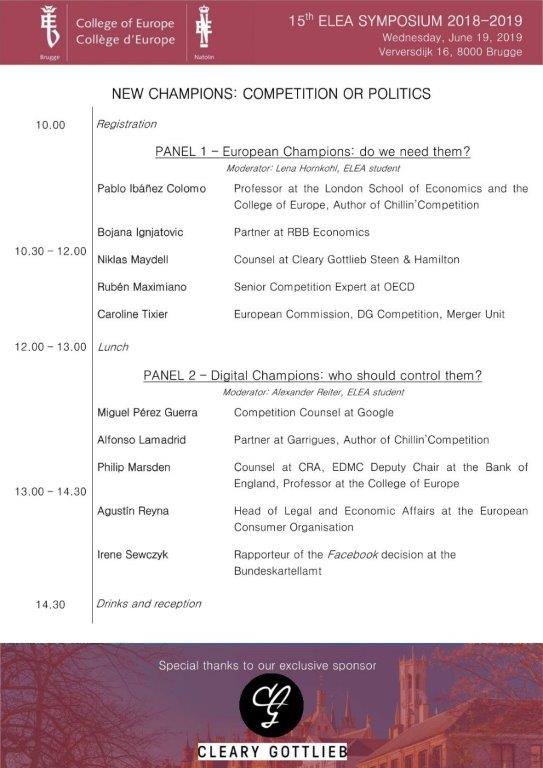
New Champions: Competition or Politics?, ELEA Symposium, Bruges, 19 June
On 19 June, the ELEA students at the College of Europe will be hosting a symposium focused on two of the main themes in competition law these days: Europen champions and industrial policy, and digital platforms.
They have managed to come up with an excellent line-up of speakers. Pablo and I will both be happy to join them.
There are only 10 seats left, so you better hurry up. For additional info and registration, click here.
[New] Urgent Competition- 2 Millon Reward
The good news first: Chillin’Competition just went over 2 million visits. Thanks so much everyone for choosing to come here from time to time.
The competition that we improvised this morning (see here) didn’t quite work according to plan. We received over 1,500 visits in the first half an hour. (!); the system got stuck and did not update for a while, so unfortunately we don’t know who the exact 2 million visitor was.
We have received reports from readers who claim to have tried to refresh the page on several devices and networks. This situation raises important questions, mainly: didn’t you really have anything else to do?! 😉
To make up for it we offer two things:
-Since we know that what truly motivated you was the possibility to introduce more absurdity, some fun, a word in one of Pablo’s academic articles: please write as a comment to this post or in a tweet the word that you’d like Pablo to include in his next paper (I’d go for Oocephalus, my colleagues suggest Dracarys). We’ll then select the best ones and run a poll. The person who suggests the winning word will get the Chillin’Competition sports bag and t-shirt.
-A free round of beers at an open bar to be announced soon.
Urgent Competition- 2 Million Reward

Today Chilling’Competition will attain the 2 million visits mark, which is pretty amazing.
At 9.47 am we are roughly 500 visits away, and we just thought about creating a competition.
If any of you can prove with a screenshot of the blog’s homepage that you are the exact 2.000.000 visitor, you will win:
- A Chillin’Competition sports bag and t-shirt;
- Two tickets for our next conference;
- Most importantly, the possibility to decide on a word that Pablo will have to include in his next academic paper (he has just agreed; no kidding) 😉
(The headline of this post may admittedly constitute clickbait)
Today in the FT: An open letter on EU competition policy

On Chillin’Competition we have always been for fair, objective, neutral and consistent rules and enforcement. Rules and cases should not be designed to favor (nor to challenge) only certain companies.
The debate surrounding the Siemens/Alstom deal triggered important debates around these issues at the legal and political levels. Both Pablo (here) and myself (here) contributed to that debate with our own views.
Today the Financial Times has published an open letter signed by 92 competition lawyers and economists (myself included), organised by Vanessa Turner, standing up for our current and time tested system, based only on the law and on the facts.
The letter is available here. For those with no access, here is a PDF version: Open letter on EU competition policy (FT)


 Chillin'Competition