Author Archive
Events coming soon

In the past few weeks some friends and readers of this blog have asked us to help advertise a few interesting events, so here they go:
-On 2 May 2017 the College of Europe’s GCLC will host its 9th Lunch Talk; the topic is “Algorithms and Markets: Virtual or Virtous Competition”. It is a must-attend, not only because of the subject-matter, but also because of the speakers: Maurits Dolmans, Ariel Ezrachi and our blogger emeritus Nicolas Petit, with Pascale Déchamps acting as moderator.
-On 4 May 2017 our friends at ERA will be organizing an afternoon workshop on Dawn Raids and Requests for Information in Competition Cases: Recent Trends (which, for those interested, will also be streamed live; see here). We had discussed these issues in too many posts to bother including the hyperkinks, but the idea is that they are certainly of interest.
-On the same day, 4 May 2017 the ABA Section of Antitrust Law will be hosting a free event on the very topical issue of merger control and innovation. The event will take place here in Brussels. For more info, click here. [For Pablo’s earlier post on the topic, see here]
-On 12 May 2017, an international conference will be held in Amsterdam on the theme “Economic evidence in competition lawand the future of the” more economic “approach“. The aim of this conference is to make a systematic analysis of the role of economic evidence in competition law proceedings. The speaker line-up is truy excellent and includes representatives of the General Court of the EU, national courts, the Netherlands, UK, and German competition authorities, legal practice and academia, including some good friends.
-On the same day, 12 May 2017, Queen Mary’s Interdisciplinary Centre for Competition Law and Policy (ICC) and Baker McKenzie will be hosting their Annual Conference in Brussels under the title “Trends and Developments in Global Competition Law”. Click here for the very interesting programme.
-On 15 May 2017 the newly launched Lexxion Journal CoRe (European Competition and Regulatory Law Review) will be holding a symposium titled “Competition Law and Regulation: Boosting E-Commerce in the EU’s Digital Economy”. Our very own Pablo will be participating. For more info, click here.
-On 18 – 19 May 2017, ERA will be hosting a most interesting event on State Aid Proceedings and Litigation (ah, an area where litigation is fortunately still relevant!).
-And on 29-30 May Nicolas Petit and his colleagues will be hosting in Brussels the LCII-TILEC Conference on Innovation, Research and Competition. The conference offers an interesting forum for debate on topical issues in SEP licensing and standard setting at the intersection with competition law. The panels consist of renowned experts from European institutions, academia and private practice. The programme is available here Program LCII-TILEC Conference SSO
Derogations from competition law (and yes, endives)

There are good chances that many of you have read/heard me say before (the last time towards the end of this speech) that whilst competition law is important, there are many more important things, some of which should not be subject to the competition rules, or even to competition.
Most jurisdictions contemplate legislative or judge-made specific derogations from application of the competition rules. Those derogations, and the way they are interpreted, are actually quite telling about a given society and its values:
In the EU, for instance, the Treaty provides for derogations for services of general economic interest [something largely and effectively called into question in a stream of cases in which I have been working for some time now; see here for one of them]. for defense or for agriculture. The EU Courts have also recognized that certain areas enjoy precedence over competition law (this is the case, for example, of collective bargaining agreements (in Albany). Then there are also a number of exceptions or special rules that apply regarding some areas (e.g. sports) or national interests (see Art. 21 of the Merger Regulation).
And in the US, well, there is an antitrust exemption for baseball….
The preliminary reference (C-671/15) in the French endives (argh..) case brings these key issues back to the fore. Last week we sort-of-commented jokingly on AG Wahl’s Opinion (see here), but today we want to go beyond easy endive puns and instead put the issues on the grill. Whilst the case is about the boundaries of the agriculture derogation, the rationale applies to policing the confines of any exemption or derogation.
The legislative exemption as such is not the subject of the debate (it is accepted that some forms of coordination and concertation on the part of producers are needed for them to carry out the functions that EU law attributes them, namely those of adjusting production to demand, reducing the costs of production and stabilizing producer prices). In fact, both Art. 42 TFEU and the case law give precedence to the Common Agricultural Policy over competition policy. The case at issue is rather about practices (in this case a fixing of minimum prices, the agreement of quantities placed on the market and the exchange of strategic information) not referred to in the “general derogations” but that are somehow linked to those objectives (some argue that so much that they should benefit from “specific derogations”). In a nutshell, AG Wahl considers that only practices that are strictly necessary for the fulfillment of the tasks attributed to producer organisations may escape the reach of competition law. Conversely, he understands that practices that merely contribute to those tasks cannot be exempted from the competition rules.
This is an approach that fits squarely within the principle that exceptions are to be interpreted narrowly. Actually, a very similar logic has been endorsed by the CJEU, the Commission and national competition authorities regarding collective bargaining in the wake of Albany. Admittedly, as we know well in the competition field, requiring indispensability (something to be “strictly necessary”) equates to setting a pretty high burden, more than a requisite of “necessity and proportionality” more typically applied for State measures to be able to benefit from derogations under EU Law or, within competition law, to sporting regulations following Meca Medina. Another valid analogy could be drawn with Deutsche Telekom, where the Court ruled that the existence of sector regulation only precludes the application of the competition rules when it eliminates any possible scope for autonomous action on the part of the firms at issue.
Interestingly, when attempting to discern what is strictly necessary to the fulfillment of the tasks assigned to producer organizations, AG Wahl places the greater emphasis not so much on the actual necessity link but rather on the identity of the undertaking(s) adopting the practice (or perhaps in doing so he bridges the two elements). In essence, he considers that only practices adopted within a given producer organization (or association thereof) actually in charge of managing the production and marketing of the product concerned can escape the competition rules. On the other hand, he proposes that practices within or with entities not responsible for marketing for their members products be subject to competition law. This is interesting but in my view (and this is just a first thought or a thought in progress) not may always be such a bright line, as some agreements with third parties might in some cases be necessary to practically implement what is decided within a given organization (admittedly, these questions of severability are pretty thorny and largely unresolved; for a related comment on this point see the discussion on “fruit agreements” here).
We won’t go into how he applies these principles to the facts of the case (which at first sight I think makes perfect sense if you agree with the bright lines proposed) as we are more interested in the general logic. More than other times, these are our first impressions after a quick read. As always, your thoughts would be most welcome.
Evidence, Proof and Judicial Review in EU Competition Law

Fernando Castillo de la Torre and Eric Gippini Fournier have produced what I certainly one of the most interesting competition law books on the market. Readers of this blog are already familiar with the authors: Eric is one of our Friday Slots interviewees (see here), and Fernando is the author of the downloadable compendium of cartel law that broke some of our records last year (see here); for those interested in an update on 2016 cartel case law, a gift is available here: Cartel case law 2017 (Castillo)
Their publisher sent us their book for review. Reading the book over the Easter holidays was actually enjoyable (in my defense, I had this review to write; Pablo on the other hand read it out of pure enjoyment…). Admittedly, my review does face a problem, which is my lack of objectivity. They are both friends and some of the people with whom we most enjoy discussing antitrust issues. As President Lenaerts’ notes in his foreword to the book, each of them has acted for the Commission in over 300 cases before the EU Courts (including many of the 102 and 101 seminal cases we have all studied). Few people have their inside-out, theoretical and practical, historical and current, knowledge of the law. Their knowledge is not only encyclopedic, but particularly in the case of Fernando, also based on an scary photographic memory (he knows by heart case numbers, paragraphs and the most tiny details of cases….). And I know well what I am saying: I have worked against and with Fernando on a number of cases, and only at present I oppose Eric in, I think, 32 pending cases before the General Court and the Court of Justice.
In his interview with us back in the day, Eric said that “[t]he best antitrust books are slow food, the result of a long process by one or two cooks, not more”. This book meets both requirements, it was slowly cooked by only two chefs, knowingly for the past 8 years, and unknowingly for perhaps a couple of decades.
Enough about the authors’ authority; let’s move to the substance. Importantly, the book is not about black letter law. The book explores issues of evidence, proof and judicial review based on a systematic analysis of a vast amount of cases. And I mean cases, not case law. Anyone who has experience before the EU Courts is well aware that reading Judgments does not provide one with a full understanding of the case, of the evidence of the debates and, therefore, of proof and judicial review. This book builds on underlying knowledge of facts, techniques, approaches and mindsets that are not always –or almost never- evident from a mere reading of Judgments (not that many people read Judgments in any case…). Their effort to build on that knowledge and systematize it or discuss it comprehensively is particularly important in an area where, as they note, EU Courts “tend to be reluctant to develop general theories and would rather decide on the facts of the case”.
You will find in the book thorough discussions of general rules on the assessment of evidence, specific discussions on single and continuous infringements, duration, defenses and fines, followed by a most useful assessment of the probative value of different types of evidentiary means [these are, by the way, topics on which they had written extensively before and on which I have also given my views, although so far only in relation to cartel law (see here); another friend of this blog and colleague of Pablo, Andriani Kalintiri, has authored two excellent pieces on this, see here].The book also includes two chapters on judicial review centered on how judges assess evidence and on the different standards of review that Courts apply, in reality, beyond semantics.
The book states and summarizes the state of the law, but it does more than that. The authors also provide their personal insights and views on the issues they discuss. This means that reading the book will give you further objective knowledge and also additional elements for debate. It also means that, inevitably, there will be points on which the reader may disagree with the authors or where one would like to go even deeper into the debate. I, for one, share many but not all of their views and would have perhaps liked a more extensive debate on evidence, standard and burden of proof in conducting counterfactual assessments (a topic that is touched upon in the book, but not extensively, despite the Commission’s struggles -and even Court defeats- in past and ongoing cases). For a work with a scope as large as that of this book, however, the authors have remarkably managed to treat a huge number of issues with just the right level of depth.
In the book you will also find a [spoiler alert] reasoned defense of the case law, the current system of enforcement and judicial review. To be sure, they note that “the temptation to argue that courts apply ‘light’ or ‘heavy’ standards, depending on the outcome, is high when the person has represented the losing side” and, whilst there is certainly some truth to this observation, the fact that both authors have represented the winning side in an overwhelming majority of cases may perhaps also influence their view [with this I’m now on the verge of losing a free beer from them for this review….]. But even, or specially, those who may not share the author’s views should read the book, for nowhere else they will find an open, bold and tightly argued explanation and defense of those views, which in their large majority hold sway within the Commission and the Courts. In my view, regardless of agreements or disagreements, understanding these views in indispensable to anyone working in this field.
In sum, this is a one-of-a-kind contribution to the competition law literature and, truly, a must-read not only for litigators, but for any competition lawyer, for I have always believed that any argument in an administrative case should be framed with eventual judicial scrutiny in mind. Unless you are willing to read some few hundred Judgments and process them systematically, the only available option is for you to read the book.
Should you have doubts about my standard of (book) review, I can produce evidence to support my conclusions: the freely downloadable chapter available here should constitute proof of everything I say in this review.
Enjoy!
AG Wahl on endives (Part I)
![Endive-Love[1].jpg](https://chillingcompetition.com/wp-content/uploads/2017/04/endive-love1.jpg?w=212&h=241)
AG Wahl delivered two interesting Opinions last week, one on excessive pricing and one on endives. We will comment on the excessive pricing Opinion next week. For now, we bring you a light endive aperitif that enables us to comment on two of our preferred topics: Mr. Wahl and, well, that vegetable…
Indeed, AG Wahl’s Opinions have provided regular food for thought on this blog. In a very short period, and one of relative scarcity of developments, he has had the opportunity to meaningfully contribute to some of the most interesting debates in current competition law and we have followed it all closely, be it on restrictions by object (Cartes Bancaires, see here and here for our comment), on inspections and fishing expeditions (Deutsche Bahn, here and here for our comment), on the limitations to requests for information (Cement cases, here and here for our comment), on the notion of restriction and on the role of facilitators (AC Treuhand, here and here for our comment) and on exclusivity rebates (Intel, here and here for our comments). He was also kind enough to accept our invitation to speak at our first Chillin’Competition conference as well as, most recently, at a seminar in Madrid.
On the other hand, endives…As odd as it sounds, once upon a time this blog was identified with endives. After all both are relatively successful and no one understands why… The fact is that we were the first to react to the endives cartel (see here, including expert views, recipes and pieces on the role of Belgian endives in US politics), given the great interest we created the “Endive Brainstorming Room” (which triggered some of the most profound thoughts in the history of competition rules, see here), we noted that their relationship with competition law was discussed during French Presidential debates (ah, the days when people discussed endives instead of EU referendums!; see here).
Some of you will even remember that our brave pieces of legal journalism on endives [which should definitely have earned us the Antitrust Writing Award in the Belgian Vegetables category 🙂 ] even brought us legal trouble, when Chillin’Competition faced a legal challenge whereby we were asked to abide by endives’ right to be forgotten (see here).
Given our unparalleled coverage of AG Wahl and of endives, we can’t help but think that this was a perfect (and sadly missed) opportunity for the AG to have introduced blog citations into the practice of the CJEU. I guess I’m nostalgic of the days when the great and late AG Ruiz-Jarabo would refer to, for example, Jack Sparrow and Pirates of the Caribbean in his Opinions (see my comment to this post). And, moreover, don’t they say that blogs have now surpassed law reviews?
Pablo and I are so committed to elevating blogs to the category of proper academic commentary that we hereby commit before all of you to do the following:
If AG Wahl cites this blog in any of his future Opinions, Pablo and I will race each other for 5 laps around the Court of Justice in Luxembourg holding endives and wearing shirts from the Swedish national football team (unless he has other preferences) 😉
*Small print note: this commitment is not solely restricted to AG Wahl. If any other AG cites us before, we will do the same, only with apparel from their country of origin or of their choice.
P.S. Ah, yes, we haven’t yet commented on the substance of the Opinion. We’ll leave that for the next post.
Jurassic case law?

Given our justified absence from the Antitrust Spring Meeting it was only today that I became aware of comments by a former DG Comp Director General, Philip Lowe, referring to the EU Courts’ case law as “Jurassic” [GCR subscribers can read more about them here].
We were planning to comment on two interesting Opinions from AG Wahl issued yersterday, but reading the comment above triggered some thoughts that I think are worth sharing here, if only because you will rarely hear them. The people who still today hold grudges about my earlier posts on the Commission’s Legal Service and on CJEU President Judge Lenaerts will most likely disagree with this one too, but, hey, the reason for this blog is precisely to foster discussion.
Describing the case law as outdated, ordoliberal (one of the most abused and misunderstood notions in competition law commentary) or nonsense often makes lawyers score brownie points with peers and clients. And they are easy points, because it is not like the Court is going to intervene in the debate to defend itself. In my view, however, that criticism is misplaced, unhelpful and misleading. My personal views follow:
On necessary criticism
- First of all let me make clear that I view the criticism of the case law as useful and necessary, even when misplaced. Much like what happens with the press and politics (see here), having lawyers and academics –or Advocates General- commenting on cases and suggesting improvements is indispensable. Judges do not live in an ivory tower (actually some of them do work in an oddly gilded one) and without criticism and friction there would be less progress and fewer refinements. However misplaced the comment, I think the Courts would do well to listen, and, as far as I know, they do.
On being realistic and objective
- Second, I certainly do not think the Courts always get it right. How could they? Does anyone? The Luxembourg Courts, like any Institution or organization where human input is the main factor (including the Commission, law firms and companies) are far from perfect. Justice is supposed to be always blind, and fair, and etc., but justice is administered by Judges, who are human, some of whom are better qualified than others, some of whom have pre-established views, some of whom are more hard working than others or care more than others.
- Actually, and my experience on this has been consistent, once you get to know from up close any institution, organization (company, university, friend) or person you very much admired, you demystify them and their flaws become more apparent. After 10 years dealing with the Commission and the Courts, the ideal image of the Institutions that I had in my mind as a student is no longer there. I have had good and bad experiences with both, sometimes one simply agrees or legitimately disagrees, other times one may be surprised, disappointed or frustrated. I have been there and have had moments (including some pretty recent ones) where you feel you lost your innocence. But having had victories, defeats and a fair deal of frustration is, I would like to believe, what that makes me more objective.
- I do disagree with some Judgments (funnily enough, that happens mostly with the ones I lose) and we actually run a blog where we tend to comment on the contentious cases on which we disagree, much more than with the ones we agree, as some of you have noted in the past. I disagree, for example, with some of the case law on exchanges of information and concerted practices (e.g. T-Mobile and its fruits) or with the recent case law on “behavioral selectivity” in State aid and Pablo has been vocal when it comes to the case law on fidelity rebates. Much of this is inevitable, for we all know what happens with legal principles (see here). And we will continue to voice out our disagreement in individual cases because we think it may perhaps contribute to some advancements.
On the real status of the case law
- In spite, or because, of the above, a general criticism of the case law or of the Courts is entirely wrong and wholly unfair. For all the flaws of some individual cases, the case law, also in the competition field, is for the most part an exercise of common sense. And if there is an Institution that has crucially and steadily contributed to European integration (largely) isolated from petty politics, with clear ideas and progressive Judgments, that has been the Court of Justice.
- The case law is not Jurassic, it is simply not as comprehensive and systematic as we would ideally like it to be and, admittedly, sometimes not as consistent as it may appear. But it arguably can’t be. The Courts decide on the cases, facts, theories and pleas brouught before them, they don’t write competition law textbooks. As brilliantly explained by Pablo here, the reason why the most controversial part of the competition case law (abuse of dominance) remains somehow unsatisfactory has to do with the paucity of cases and, importantly, with the very few preliminary references in the area. It is only in preliminary references that the Court of Justice has the opportunity to craft consistent analytical principles and frameworks (which nevertheless are not always followed upon -think for instance of the “indispensability” requirement in all cases related to “access- ; we should come back to this one day). The preeminence of direct actions against Commission decisions, the margin of discretion granted to the Commission in this setting and certain litigation strategies have resulted in some not entirely consistent Judgments. Also, a careful analysis of the case law unequivocally shows that it does evolve, it is not Jurassic nor fossil, it evolves at its own pace, following consensus. Recent cases like Post Danmark I or Cartes Bancaires, for instance, are good examples. On closer look, the case law makes much sense than is tipically said. In my certainly personal view, failing to see or acknowledge that hinders our ability (and credibility) to advance some refinements of that case law.
On where the real risks lie
- The only risk for the case law to one day become outdated has to do with the ongoing de-legalization of EU competition law. We are now at a stage where the law is perceived as an inconvenience. The Commission prefers to deal with cases on a very factual basis (to maximize its chances on appeal) and to favor out-of-court negotiated solutions), particularly on the most complex cases. Analytical legal frameworks are largely ignored and replaced by remedy negotiations. As rightly noted by General Court Vice-President Marc van der Woude only days ago (MLex suscribers can read it here), there are areas of competition law that are disappearing from the judicial radar screen, with the risk that the case law may stagnate. That is the real problem. As the GC seems to be acknowledging, this is also a result of parties perceiving that going to Court would not yield results, and recent signals suggest something may be about to change. Admittedly, the shift in the center of gravity may lead to more preliminary references and more CJEU intervention on the law, which would be useful, but I would rather not sideline the competition experts also sitting in the General Court and the detailed guidance and that comes from annulment actions.
On how to improve judicial review, and the appearance of judicial review
As everything, judicial review in the competition sphere may be subject to improvements, but not all of them depend on the Courts; some depend on the Commission’s policy and some depend on the ability of applicants and of other parties to judicial proceedings, but there are a couple of things that could be done.
- To me, the most important issue is transparency. I have made this point before (see here, particularly the comments, and here). Judicial review and lawyering (and the assessment of lawyers’ work) would significantly improve if Court submissions/briefs were public and if there were recordings or transcripts of hearings. This would favor the Court above everyone else. The criticism would diminish, as external observers are often unaware of the care with which some (not all) Judges and clerks analyze and understand every argument and detail in a given case. As an example, some of my colleagues had a hearing this week that, regardless of how it is eventually decided, revealed a thorough understanding and study on the part of the reporting Judge that would surprise most. Making Court submissions public would, by the way, also have the side effect of spurring some more consistency on the part of the Commission..
- There are other issues, but admittedly much harder to change, which have to do with how Judgments are written. I, for one, like it much better when I read Judgments such as this one or this one than when you read the ones we are most accustomed to.
To be sure, I am not saying that judicial review is deficient or that these two issues are very problematic; more than anything they are misleading to external observers and may hide the reality that there are many less problems than people usually believe.
On what anyone should do to have an informed opinion on this
- My advice on this is threefold: (1) Don’t pay much attention to what I say 😉 ;(2) buy this book by Fernando Castillo and Eric Gippini that we will review here next week, (3) watch this space for Pablo’s new book explaining the evolution of EU competition law as a story of interaction between the Commission and the Courts.
#ThrowbackThursday
A large number of antitrust lawyers are attending side-parties and receiving all sorts of prizes at the ABA Antitrust Spring Meeting this week.
For those of you who have asked, we are not there as were dissapointed to see that the program did not feature the “high” point from last years’s conference… See here 😉
Career advice for lawyers (II)

If you are a lawyer with some 2 to 5 years of experience in the legal profession you might be interested in the advice of Steve Meier featured below in this post.
A year ago he addressed newly qualified lawyers and, despite being a recruiter himself, his main advice was not to use recruiters. We liked that. This time he is targeting more experienced lawyers who may find a (sensible) recruiter helpful in determining your place in the market. As Steve pointed out in his previous post, there are recruiters who will encourage you to move you to another firm (any firm) regardless of whether it may fit your long-term career or personal objectives. His advice builds on the premise that whilst it is great if you can make a smart move, it is much better to remain where you are for the time being than to make a wrong move. Please feel free to question Steve on the issues he raises or on others by commenting on the post.
And speaking of career advice and smart moves, at my own firm we are growing and have openings, also for experienced lawyers. We are looking for truly outstanding lawyers, regardless of nationality (although excellent English is indispensable and notions of Spanish are helpful). What we offer is plenty of very interesting, varied and boutique-like top-notch work (which explains my scarce substantive contributions here in recent weeks… ) and an unbeatable working environment provided that you can tolerate working with me. If you enjoy EU Court litigation, complex behavioral competition law, cutting-edge State aid and academic opportunities, then feel free to drop me a line at alfonso.lamadrid@garrigues.com (and btw, for my own ideas on what makes a great lawyer, see here).
***
It has been a bit more than a year since my last blog post discussing some recruitment issues facing lawyers from newly qualified (“NQ”) to about two years of post-qualification experience (“2PQE”) This time around I should like to discuss some careeradvancement issues facing lawyers who fall roughly between 2PQE and 5PQE.
NB: Let me first observe that the focus on PQE level is becoming somewhat less important as firms increasingly move away from hard-and-fast rules of seniority. Individual performance, rather than the number of years of experience, is increasingly the metric by which a lawyer’s long-term career development is measured. Thus, for example, it is entirely conceivable within a given firm that an exceptional 2PQE can have more responsibility, faster advancement, better prospects – and higher compensation! – than, say, an “average” 3PQE. Nonetheless, it is useful to keep notions of PQE in mind, inter alia, to benchmark yourself against your contemporaries. Each law firm is different, and a 3PQE lawyer who has spent his or her career at Smith & Jones may have a very different – not necessarily better or worse, just different – set of skills and experience than a 3PQE lawyer at Jones & Smith. That being so, ideas of PQE, while less and less relevant internally, are helpful for both you and potential employers in measuring your capabilities and potential.
While law school taught you about thinking like a lawyer, you have spent the past couple of years actually becoming a lawyer. By the time you are 2PQE you should have developed a solid track record of substantive and meaningful experience and at least the beginnings of a solid technical expertise. You have probably worked in a variety of matters, but have perhaps begun to focus on one or two fields that are of specific interest to you. The next few years, those between 2PQE and 5PQE, are typically when you can really hone your legal skills, home in
on what you especially enjoy doing and, indeed, determine next steps in your professional career and personal life.
As regards competition lawyers, for example, some may have a taste for merger work, while others may prefer behavioral matters, and still others may find a blended competition/regulatory practice more to their liking; some lawyers may yearn for an in-house role where they can be closer to business, while still others will ultimately determine that a career in the law is really not for them at all. However, because you have been working hard to become a lawyer, the chances are good that you have had little time to reflect on your career rajectory, to understand the market or to determine your place in it. Now may be time to take stock of your career and where it is headed.
Whatever you may ultimately decide as your next career step, a reputable recruiter can serve as a sounding board, discussing with you your experience, how it measures up to your contemporaries, and how you can get from where you are to where you want to go. Some less reputable recruiters will be interested only in encouraging you to move so as to generate fees for themselves (see “Introducing . . . “Shotgun Sam”). However, a move may not necessarily make the most sense for you and your situation. Generally speaking, moving simply for the sake of moving is almost never a wise career move and, should you end up in the wrong place, it can do irreparable damage to your longer-term prospects.
You should have some notions about where you want your career to be in a few years, but you should avoid mapping out every step of your career for the next five years. If you stick to an fixed and immutable career plan, you may find yourself having missed some great opportunities.
As noted above, the first couple of years are spent obtaining a fair degree of technical excellence. But as important as being the most technically proficient lawyer possible, that is just the beginning. To the extent that you have not already figured this out for yourself, let me note that being technically excellent will take you only so far in your legal career; there are a number of other facets to the ever-changing practice of law that many young lawyers do
ot discover until it is too late. In addition to intelligence and legal skills, employers will be looking at you for a demonstrable work ethic and for plain old common sense.
NB: The points that follow apply to lawyers throughout their careers; nonetheless, they seem to me particularly important during the early stages of your career, when more senior lawyers are making daily determinations about your suitability for advancement.
Work Ethics
- Doing more than the bare minimum. Employers always look for a willingness to do more than just the bare minimum to get by. For example, do you actively seek out additional work, or do you sit in your office waiting for someone to give you something to do? Conversely, do you turn down an assignment only to slip out the door at 18.00? Have you written articles or offered to help more senior colleagues do so? Have you undertaken research and preparation for business-development activities? These are but a few examples of what you might consider doing to demonstrate that you are prepared to “go the extra mile”
- Owning up to mistakes. You will make mistakes. Everyone does. What is important is the manner in which you handle your mistakes. Do not beat yourself up about them, but never try to hide them. Face up to them and tell someone immediately. Generally speaking, it is okay to make a mistake, but an employer will not keep you if it cannot trust you to admit your mistakes. Clients usually forgive mistakes, but you could ruin an entire attorney-client relationship if you try to hide something from them. If you get into trouble, immediately tell someone more senior. Given that everyone has made mistakes, your mistake may not be as serious as you think. If you sense that you are heading into trouble, say something before you get there. Coming clean about your mistake will demonstrate your maturity and trustworthiness. Good lawyers are not good because they never make mistakes, they are good because they do not make the same mistake twice
- Meeting deadlines. If you see a deadline approaching, do you keep quiet and hope for the best, or do you keep people informed? If you think it likely that you will miss a deadline for a task already given to you, immediately tell someone in charge and explain why. If you cannot meet a deadline on a new task, explain why and offer to speak with other people about shifting priorities.
- Showing enthusiasm. There will be times when you will be bored to utter distraction. Even so, never show boredom. Try to remain enthusiastic, even if the task is less interesting than watching paint dry.
Common Sense
- Understanding and remembering instructions. When you get an assignment, do you write down all instructions, or do you rely on your memory? You should get into the habit of writing down instructions as and when you are given them. Once you have done that, ensure that you understand the instructions by repeating them back to the person giving you the instructions. Do not be afraid to ask questions if you are unsure. There is no stupid question, except for one that you repeatedly ask.
- Being a “team player”. Most employers specifically look for someone who is a “team player” to join them, but what does that mean? In general, it means helping out wherever and whenever needed and pulling your own weight. But it also contains a personal component. Do you actively engage with your colleagues throughout the day, or do you head straight to your office in the morning, close your door and work with as little interaction as possible? Do you get together with colleagues for lunch or after-hours events, or do you isolate yourself from them. Nothing says that you must spend every waking hour with your colleagues, but do make an effort to be an active and enthusiastic member of the group.
- Office relationships and professional behavior. Even as an active and enthusiastic group member, there are certain limits. For example, you should be social and speak with your colleagues, but do not share every intimate detail of your life. Do not get so drunk at office events that you make a fool of yourself. Office relationships, while convenient because of proximity, are rarely a good idea and should be avoided.
- Respect your colleagues. Avoid being competitive with your colleagues (e.g., boasting about how well you are doing and about the incredible feedback you are getting). They may be your rivals in some sense, but they deserve your respect. If you fail this, you will disliked, find yourself missing invitations to social events, and lose a potentially valuable support network.
- Respect the staff. Just because you are a lawyer does not mean that you are superior to the staff. Be nice and polite to everyone, and they will be much more likely to help you when you have a crisis or when you have a stupid question about policies and procedures; if you are an ass to them, you may find that your life can be very difficult. Befriending and respecting staff is an easy and important sign of your own maturity and selfconfidence. Bring the staff the occasional flowers or treats – they will like and respect you for it.
- Dress the part. Dress appropriately. Invest some of your salary in decent clothes. The legal profession is generally conservative and your clothes should reflect that. Do not be a peacock.
And for heaven’s sake, polish your shoes!
The “Interesting” Market Definition Awards

Some of our most successful recent posts have had to do with competition competitions and legal awards. Given that it’s particularly busy and we don’t have time to write something more substantive this interest, we have decided to give awards to the smallest, most absurd or for-whatever-reason funny market definitions used or attempted in competition cases (all jurisdictions count).
In order to get the ball rolling, here are my examples:
–The relevant market for “Bar Mitzvah tours of Israel” discussed in this 1995 7th Circuit Opinion that starts this way: Bar mitzvah tours of Israel. That is the market defined for the antitrust claim in this case. It is an absurd market definition”.
-The relevant market of “Asterix at the Olympic Games” upheld by Austria’s Supreme Court, which noted that any film could constitute a market of its own (see here)
-The one that we discussed in the post “We owe you an apology” (adult-content warning) (the bold is to make sure you don’t click)
–Licenseable ope…sorry, no ongoing cases.
-In this case the funny thing is not so much the market but the alleged dominant entity: the Cistersian congregation of the Immaculate Conception was found to be dominant in the maritime route linking the continent and the isle of Saint Honorat. The congregation had apparently refused to authorize third parties to provide additional transport services. The French competition authority dismissed allegations of unlawful abuse. It found that the limitation of tourists was objectively justified by the necessity to preserve the quietness of the monks. No kidding. See here.
Your contributions will be much appreciated!
P.S. The Bed of Procrustes (tailored to fit its occupant) is pictured above
EU Regulation and Competition Law in the Transport Sector
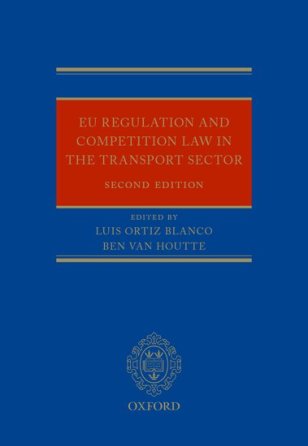
Last week Oxford University Press released the book EU Regulation and Competition Law in the Transport Sector edited by our friend/colleague/many other things Luis Ortiz Blanco and by Ben van Houtte.
The book is a certainly a must for anyone interested in the transport sector and is the most-comprehensive work to date on this subject. The book covers both the regulatory and the competition (antitrust, merger and State aid) aspects of public intervention in inland, maritime and air transport as well as everything related to transport infrastructures.
The book has been written by a number of experts in the field currently working either for the European Commission (including DG Comp, DG Move and the Legal Service) and in private practice (among them, the book features key contributions from our very good friends Elvira Aliende and Mark English, pictured below with Luis, smiling very naturally at my phone’s camera at a seminar last week ). The full list of authors is available here.

P.S. I was trying to think of some sort of transport-related joke to accompany the post, but I guess I hit a roadblock….
Competition Law as Fairness

The upcoming issue of the Journal of European Competition Law and Practice (JECLAP) features an editorial I have written on the use of the term “fairness” in competition law these days. I was particularly happy to contribute to this journal, which and which also boasts the nicest team of editors possible (well, and Gianni too).
JECLAP has very kindly authorized me to publish the editorial here on a free-access basis (any comments will be very welcome!); it is available here: https://academic.oup.com/jeclap/article/doi/10.1093/jeclap/lpx003/2996766/Competition-Law-as-Fairness
Some accompanying explanations are in order:
The term “fairness” seems to have made inroads into public portrayals of competition law (most prominently in salient speeches by Commissioner Vestager and AAG Renata Hesse). Some have reacted strongly into the use of this notion, seemingly due to fear that it may contaminate a realm of the law with even more subjectivity. Whereas I do share the sentiment that references to “fairness” cannot expand the reach of the competition rules, I also believe that a more fair society is a consequence of the right application of the competition rules and there is no reason to shy off from saying it explicitly. Competition law should not -and does not need to- be diverted to pursue fairness because it is already about fairness. Cast in this light references to fairness are not a way to divorce the discipline from economics, but to reconcile it with the public.
The editorial also contains, somehow in passing, the idea that efficiency is more useful as a guiding benchmark than as the ultimate goal of competition law. This idea is relatively common among progressive economists like Amartya Sen (my personal favorite) or Stiglitz, but it is relatively uncommon to hear it from experts in competition law due, I suppose, to the fear of being misinterpreted (which is what I try to avoid with the 8th paragraph of my editorial). Admittedly, general economists tend to see competition law as one more economic policy tool, perhaps failing to entirely realize that competition law may also lead to the imposition of “cuasi-criminal” fines and that one cannot severely punish a firm simply because it is more efficient than rivals (much less for doing things better, which may or may not coincide with being more efficient).
That is why, as I explain in the piece, short term efficiency considerations have a valid and important role to play in our field. But at the same time having efficiency as a sole beacon may chart an unduly narrow path. There are other values, like freedom to compete, choice or equality of opportunity, that may be equally worthy. The challenge in this regard is how to turn these into an operational framework capable of providing the necessary legal certainty.
In this regard I am happy to be in the company of now Judge Paul Nihoul, also General Editor of JECLAP (see here), of some of my favorite specialized economists (see here) and of whom is perhaps the greatest antitrust academic so far, Philip Areeda. In Areeda’s words (quoted from the 6th edition of his Antitrust Analysis textbook and which I did not have space to quote in the editorial):
– “The efficiency concept is at once powerful and weak: powerful because it is arguably the minimum necessary condition of any ideal economic system´s equilibrium, weak because it is not the only value considered important by our society”;
– “The economic model of competition also provides antitrust with a major value: efficiency. Other values impinge, however, to strengthen or retard the force of the unqualified competitive criteria. The task of antitrust, accordingly, is much more complex than simply moving the economy toward more nearly perfect competition”;
– “A free market may be seem as emphasizing competition as an aspect of human liberty. To favor competition for this reason relates to its assumed economic benefits but duffers because it emphasizes the social rather than economic merits of competition and is broader because it emphasizes opportunity and choice for producers and consumers even where fewer opportunities and choices might produce equally or more ‘efficient’ economic results”.


 Chillin'Competition