Author Archive
The e-commerce sector inquiry – cui bono ? (by Thomas Kramler)

The European Commission held a successful event yesterday to present and discuss the findings of the Preliminary Report on the e-commerce sector inquiry (you can watch the recording here). Thomas Kramler (Head of the Digital Single Market Task Force in charge of the inquiry) has kindly agreed to write for the readers of Chillin’Competition about the ongoing inquiry. We leave you with him. [And please note that, as always, the views expressed are his own and do not necessarily reflect those of the European Commission].
***
On 15 September 2016 the Commission published the preliminary report on the e-commerce sector inquiry. The report is based on around 1800 replies by manufacturers, retailers, marketplaces and copyright holders active in e-commerce. 8000 distribution contracts have been gathered by the Commission in the course of the exercise.
So for whose benefit (cui bono) is the e-commerce sector inquiry?
– The Commission
The priorities of EU competition policy cannot be decoupled from the broader EU policy goals such as the establishment of an internal market (see Protocol 27 to the TFEU). Ensuring better access for consumers and businesses to goods and services via e-commerce across the EU is a key goal of the Commission’s Digital Single Market strategy.
The e-commerce sector inquiry allows the Commission to identify potential competition concerns in e-commerce markets and to accordingly prioritise follow-up enforcement. Such enforcement should contribute to removing obstacles to cross-border e-commerce in line with the mentioned goals of the Digital Single Market Strategy.
The Commission has consciously not prioritised cases on vertical restraints in the past 10 years, because the applicable rules (case law, Vertical BER and Guidelines) have been relatively clear and straightforward. With the growth of e-commerce, however, questions on the interpretation of the rules have arisen within the European Competition Network (ECN). The results of the sector inquiry will provide useful factual background for an informed debate on e-commerce related issues within the ECN.
The results of the e-commerce sector inquiry will also be a catalyst for a debate on the Vertical BER and Guidelines in view of their upcoming evaluation and next review.
Last but not least the results of the sector inquiry provide facts and figures which are useful background for the debates on legislative Commission initiatives relating to copyright (for example the proposed “portability regulation“) and the proposed geo-blocking regulation.
– Companies
The Commission is very much aware that a sector inquiry imposes a huge burden on businesses. On the other hand the e-commerce sector inquiry provides the opportunity for companies to review/audit existing contractual relationships and if necessary bring distribution contracts into line with EU competition law. I would image that a pending sector inquiry makes it is easier for in-house lawyers to convince management that such a review/audit is necessary and worth it .
The sector inquiry therefore should provide an incentive for companies to focus on compliance outside the context of a specific antitrust investigation.
Furthermore the sector inquiry allows companies to voice concerns about enforcement trends or unclear rules without being in the spotlight of an antitrust investigation.
– Law firms
Certainly a sector inquiry is welcome by law firms as is generates additional work. These windfall gains aside, I would think that the e-commerce sector inquiry helps to focus clients’ attention on compliance and therefore also provides opportunities for law firms to raise awareness about EU competition law with them.
The e-commerce sector inquiry should also kick-start a dialogue among practitioners and with competition authorities on the workability of the current EU competition rules on e-commerce and on the need for further guidance on specific topics. To this end the Commission has launched a public consultation on the preliminary report which is open until 18 November 2016.
Overall the e-commerce sector inquiry is a valuable exercise that should provide useful background facts, spur the discussion on how to approach restrictions of competition in e-commerce in the EU and allow for informed policy making in the future.
Materials on Competition and Regulation in Digital Markets
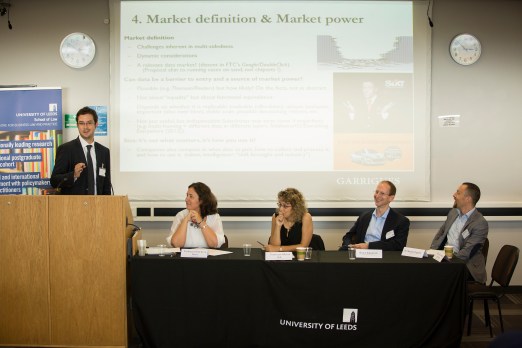
The slides of the conference Competition and Regulation in Digital Markets held at the University of Leeds on 9 September are now available here.
You will see some very interesting materials there (not my slides, which are a slightly modified version of my earlier presentations on the same topic: big data) [yawn intermission]. At least some of the jokes in my intervention (pictured below) were new…
Actually, if it weren’t for the minor issue that that the jokes aren’t really funny I would consider joining Chicago Antitrust Professor Randy Picker in his stand-up comedy events.
By the way, an interesting development regarding the topic of my presentation took place last Friday, when the European Data Protection Supervisor published a new “Opinion on coherent enforcement of fundamental rights in the age of big data“.
The Opinion interestingly acknowledges that “it would be inappropriate for one area of regulation to look to another area to compensate for its own weaknesses. Authorities in each area have limited tools at their disposal, for example competition enforcement can only address abuse of dominance, cartel behaviour and mergers which are not in the consumer interest; abusive conditions of service are not necessarily an antitrust issue”.
At the same time, however, it holds the (now more nuanced) view that “data protection authorities can help shed light on how and to what extent the control of personal data is so crucial for companies in markets. The synergies between the fields of law, which have been discussed intensively in the recent years, could propel closer cooperation between authorities, especially where there is neither guidance nor case law. It is not a question of ‘instrumentalising’ another area of law but rather of synchronising EU policies and enforcement activities, adding value where a supervisory authority lacks expertise or legal competence in analysing“. The EDPS therefore offers “the expertise of independent data authorities in advising on how to assess the significance for consumer welfare in such proposed acquisitions“.
One may or may not agree with the EDPS’s views on this matter (and you know my take), but it him and his team deserve credit for having made a popular issue out of this, thereby reviving some of the old -and most important- debates in EU competition law.
Groovy, baby

Pablo’s exhausting, never-ending, coma-inducing, comprehensive and certainly influential posts on Post Danmark II (see here, here, here, here, here, here, here, here, here, here, here, here, here, here, here, here, here, here, and here) [the fever has passed and he has moved on to a new obsession, Lundbeck (mercy, please!) 😉 rightly emphasized the importance of establishing in any situation a link of causality. Events such as a market share increase may well be attributable to the superior quality of a product but also to non-merit based actions.
When this morning we awoke to a sudden increase in traffic on the blog we first thought that it was attributable to the great interest of our most recent posts. Wrong. The real reason was the traffic diverted to Chillin’Competition by Politico’s Playbook.
Today’s issue of the must-read daily briefing of EU news included a link to our interview with Judge Marc van der Woude (just appointed Vice-President of the General Court; congratulations!) (btw, this in turn has led to quite a few people discovering THE RAID).
And in passing, the Playbook (Ryan Heath) referred to “groovy antitrust blog Chillin’Competition” 😎
Most kind! Politico now joins a rare short-list of people who think Pablo is groovy (a list that until today included only a Greek lawyer). My situation is worse, as not even my wife would remotely think that…
P.S. Busy day at work; tomorrow we’ll be back with something more substantial (and groovy).
As seen in the news

When asked about what it takes to be a good lawyer (you know my take on that one), the former Chairman of my firm likes to say that lawyers must absolutely read newspapers. I think that he might have had in mind the pre-online era press, but anyway, he had a point. This post is about some things I read in the press over the past couple of days.
During a very long night flight on Saturday night I was able to read something not work related, namely the last issue of The Economist and the book How Children Succeed: Grit, Curiosity, and the Hidden Power of Character. I very much recommend the latter, but for the purposes of this post (and since this blog is not about important matters), I will comment only on the former:
The Economist issue places the spotlight on the role played by a handful of very large corporations in today’s economy, arguing that their rise threatens both competition and the legitimacy of businesses (see here). Not surprisingly, after citing interesting figures on increased levels of concentration in the economy, the piece turns its eyes to antitrust. I have often agreed with the way that newspaper has considered antitrust as a means of ensuring “radical centrist” policies (see here and particularly here) to which equality of opportunity is key, but this time I think they may have got it wrong.
The Economist claims that “prudent policy makers must reinvent antitrust for the digital age” and welcomes efforts to prevent “tech firms from unfairly privileging their own services on platforms they control” praising the Commission’s pursuit of Google (a couple of paragraphs earlier it criticizes the Institution for using State aid to go after Apple).
In my view, what prudent policy makers should do is not meddle with a stable –if somehow inconsisent- set of judge made case law that applies across the spectrum to all sectors. It is a defining feature of antitrust law –for the good- that its adaptability comes precisely from its relative isolation from small politics (as I too often say here, it is a distillation of common sense infused with mainstream economics). Also, and as The Economist knows and often claims, legal certainty does have great value, also in economic terms, so changing the rules in the middle of the game might have a cost.
I share the newspaper’s credo of equality of opportunity, but they may have fallen into the tempting trap of equating that with some vague sense of perhaps-not-so-thought-through neutrality. Such reflexes, which are common, nevertheless comfort us in the decision to devote our upcoming Chilling Competition conference precisely to the role of neutrality in competition law. There are plenty of issues in need of fewer assumptions and greater and finer discussions. Even the press, by the way, is also finding out about the perils of ill-conceived neutrality (re, for instance, Brexit or Trump; see e.g. here).
On top of that, I’m not so convinced that some of our current “policy makers” are ideally-suited to “reinvent antitrust”.
Let me give you an example of why I’m saying this, and one that also features in the news today:
As I skimmed this morning through the Financial Times (admittedlty in search of this story quoting my views on State aid law and Brexit) I came across a piece in which the FT criticizes the Commission’s copyright reform initiatives (“The EU takes a backward step on digital copyright”).
As you know, the Commission plans “forcing” news publishers to demand a fee from news agreggators when they show snippets of content. When that happened in Spain (and the Commission took no action; the national competition authority did say something, though) aggregators closed their sites, with the result that news publishers received much less traffic and even claimed that the shutting down of those aggregators could amount to an abuse of dominance.
The Financial Times – a would-be beneficiary of the initiative- argues today that “the kindest interpretation one can place on these proposals is that the commission has simply misunderstood the marketplace. A more cynical view is that it has caved in to fierce lobbying by a number of powerful European publishers”.
When the Spanish law was enacted, the world’s leading IP scholar Mark Lemley said on Twitter: “Quite possibly the dumbest law enacted anywhere this century”. I’m just not sure that putting an EU seal on it may be good thing. In addition, and regardless of political and IP-issues, this initiative raises interesting antitrust issues too: the world’s leading an obscure antitrust scholar said on Chillin’Competition, this initiative could be regarded as the public creation of a watertight cartel.
In sum, if some of our policy makers don’t respect competition law, I’m not that sure that they are well-suited to “reinvent it”. I,for one, like it as it is.
P.S. It did not feature that much in the news, but new judges were sworn in at the General Court yesterday (and Marc Jaeger has been re-elected President). New judges include Paul Nihoul and Alexander Kornezov, a contemporary of Pablo at the College of Europe (which will force Pablo to re-assess his precociousness, professionally speaking)
The Brussels School of Competition

From this year onwards the Brussels School of Competition’s programme in competition law will be jointly organised with the University of Liège (ULg) and Saint-Louis University (USL-B). Students who pass their exams and dissertation will receive an ‘Interuniversity Certificate in Competition Law’ (for more info, click here).
Vey importantly, students will also get to do my simulation of case AT. 98765 Intergalactic droids 😉
On top of the annual programme, the BSC also organizes some of the best conferences in Brussels (second only to the upcoming Chillin’Competition conference…). The next one (on Wednesday 14 September) is about the implications of Brexit for competition law, and the line-up of speakers is remarkable: Richard Whish, Trevor Soames, Robert O’Donoghue, Sir Nicholas Forwood and Jacques Steenberger.
For more info click here: What does Brexit mean for EU Competition Law?
SAVE THE DATE- 2nd Chillin’Competition Conference

We have a date for the 2nd Chillin’Competition conference:
21 November 2016
We are working on the programme and will be contacting speakers throughout the week. Hold your breath; it may be you 😉
We nevertheless have invited one speaker so far, and she very kindly agreed to deliver a keynote. Many thanks to @vestager !
If your law firm or company may be interested in sponsoring the conference please drop us a line (we want to keep it accessibe and ideally not lose money….)
Registrations will open on 14 October (more info on this soon). Last year all available slots were gone in 36 minutes…
On the Apple State aid decision

It seems State aid law is in fashion these days, and that experts in the field are flourishing.
This is in many ways a welcome development for some of us who have been working on tax State aid cases for over a decade (as I mentioned here once, my first contact with competition law 13 years ago while still at university was a not-so-ground-breaking paper on tax competition and State aid, and tax State aid is a significant chunk of our work; see e.g. here and here or my comments below the post here).
The Commission’s decision in the Apple case is responsible for putting EU State aid law under the world’s spotlight (even if some of the issues that are being re-discovered are pretty settled or had already been raised by the previous decisions on tax rulings).
The decision seems to have been mostly welcome, if only for apparent ethical reasons (the message that Apple pays 50 euros in taxes for every million in profits is quite powerful in that regard).
In fact, PR-wise this may be the most effective Commission action in years (well, in this side of the Atlantic and of the English Channel).
However, I’m not sure a morally desirable outcome should be achieved at the expense of stretching the boundaries of the law. The underlying problem here is a political one (tax competition due to lack of tax harmonisation) and should arguably be better tackled at the root.
[After publishing this post I read an article (see here) that makes a similar point but that may be a bit more unexpected and controversial considering its author: former Commissioner Neelie Kroes…]
And as obvious as the advantage in this case may be, adopting a decision with regard to one/some specific company/ies without examining how other tax rulings treat other multinational companies (and whilst claiming that tax rulings in themselves are legal) is risky, as it deviates from the assessment of selectivity as we have always known it. I already made this point on day one.
Those interested in undertanding the legal issues that are key to this case should take a look at this recent presentation by one of the greatest experts in the field, my colleague José Luis Buendía. It illustrates wonderfully (and funnily) the apparent chicken-egg and apple-pear problems in the Commission’s approach:
By the way, the 13 billion figure has proven that my prescient, visionary, specific and detailed quote to the Financial Times in April 2015 was spot on: “We are talking about potentially very significant amounts of money, said Alfonso Lamadrid de Pablo, a senior associate at Brussels law firm Garrigues” (see here)
P.S. And if interested in a timely conference on these matters, check this one out (co-organized by one of the sponsors of our own Chillin’Competition conference, Hart Publishing): http://www.bloomsburyprofessional.com/uk/hart/conferences/ (Early Bird Discount if you book your place before 9 September 2016).
Competition and Regulation in Digital Markets

The University of Leeds has become in recent years one of the most active and ambitious academic institutions in the field of EU Competition Law.
On September 9 they will be hosting a top-level (and free) conference under the title that gives name to this post.
The conference will comprise four panels on: Market Definition and Market Power in Digital Markets, Regulation vs. Competition in Digital Markets, Vertical Restraints in Technology-Driven Markets and Goods and Data in Online Markets (I will be taking part in the latter).
More info is available here:
http://www.law.leeds.ac.uk/events/2016/competition-and-regulation-in-digital-markets
Hope to see a good number of you there!
Curso de Derecho de la Competencia 2017

The EU and Spanish Competition Law Course is turning 20 this year (I was a student back in its 9th edition and started co-directing it in the 14th).
The course will run between 13 January and 17 March and it will once again feature an impressive line-up of international lecturers that includes Judges, officials from the European Commission and the Spanish authority and top-notch academics, in-house lawyers and practitioners. Lectures will be conducted in English and Spanish.
On top of the classic modules on cartels, vertical and horizontal agreements, abuse of dominance, merger control, State aid and the competition-regulation interface, we are putting together 3 one-day seminars (one focusing on all noteworthy developments that took place in 2016, one focused specifically on transport-related matters, and a final seminar looking back at the main cases of the past 20 years guided by those directly involved in them).
It is sponsored by the main international and national law firms and economic consultancies active in the Spanish market.
More information on the course will be out soon; for the time being, here is some advanced essential info in English and Spanish:
XX Curso de Derecho de la Competencia Europeo y Español
XX EU and Spanish Competition Law Course
If you want to know more feel free to drop us a line at competencia@ieb.es
A reasonable solution, for no problem? Advance rate increase announcements under EU competition law (by Luis Ortiz Blanco)
Intro by Alfonso: When the Commission recently announced the adoption of a commitments decision in the liner shipping case I asked my colleage Luis to write a post about the legal issues at stake (he was not involved in it, but wrote an expert academic report for a law firm involved). Luis, as you know, is a partner at Garrigues, a reputed academic, and the person responsible for me working in competition law (not sure that’s a good thing). But what you may not know is that for 10 years he was a case handler at DG Comp dealing with transport cases, that he wrote his PhD on liner shipping and that he is about to publish the book “EU Regulation and Competition Law in the Transport Sector” (Oxford University Press). We leave you with him:
***

On 7 July this year the European Commission adopted a Decision (not yet published) declaring legally binding the commitments offered by 14 container liner shipping companies allegedly aimed at increasing price transparency for customers and reducing the likelihood of coordinating prices and consisting on (i) stopping publishing and communicating General Rate Increases (GRIs) announcements, (ii) announcing figures including at least the five main elements of the total price, in order for price announcements to be useful for customers, and (iii) the binding character of the price announcements as maximum prices for the announced period of validity.
The European Commission formally opened infringement proceedings in November 2013 against container liner shipping companies that have regularly carried out similar price announcements (the General Rate Increases or GRIs), allegedly intentionally aligning them with the ones announced by other carriers.
The Commission had concerns that these GRIs announcements did not provide full information on new prices to customers but merely allow carriers to be aware of each other’s pricing intentions and make it possible for them to coordinate their behaviour, what may lead to higher prices for container liner shipping services and harm competition and customers.
Although no infringement has been identified, there are some aspects of the Commission’s intervention in this case that are worth noting:
First, the fact that more than two years elapsed from the inspections to the first requirements for information sent to the lines gives the impression that the initial intention of the Commission was not to put forward the theory of harm finally adopted; but rather that it was initially seeking to establish some form of explicit collusion and that this novel theory of harm might aim at not seeing the extensive efforts made by the Commission go to waste.
Second, the Commission is taking a very bold step, beyond the T-Mobile Netherlands and Wood Pulp case law. Indeed, the Commission’s case does not fit into what Wood Pulp would require to establish a concerted practice; neither does it fit into T-Mobile Netherland’s conditions required for a concerted practice to amount to an infringement by object. In fact, the Commission may have considered price announcements as an infringement by object in themselves and not as an evidence or sign of contacts or meetings between competitors as in Wood Pulp. Furthermore, while T-Mobile Netherlands established that the information exchange must be considered capable of harming competition depending on its legal and economic context, the European enforcer has refused to even consider such frame, eluding its duty to set up the whole picture of the case at hand.
Finally, the Commission has admitted that contrary to T-Mobile Netherlands, the information was disclosed to the public – making possible customers to benefit from it – and no evidence of contacts between the lines has been established.
The Commission apparently relies on ¶63 of the Horizontal Guidelines – which states that for unilateral announcements to constitute a concerted practice they must be shown to be a strategy for reaching a common understanding about the terms of coordination – and it seems to believe it has nothing to prove beyond that which is obvious and no one denies, i.e., that shipping lines make advance price announcements which they are not always able to implement. The Commission’s theory is not impossible, but clearly less likely to believe than alternative, simpler explanations of the facts.
Leaving aside all the above, the crucial question is whether the object or the effect of the announcement of GRIs is to create conditions of competition which do not correspond to the normal conditions of the market in question regard being had to the nature of the products or services offered, the size and number of the undertakings involved and the volume of that market (T-Mobile Netherlands, ¶33), as established by the Court of Justice case law. The Commission may believe it is indeed the object of these advance announcements to restrict competition in the internal market, on the basis that they allegedly do not benefit consumers as much as shipping lines, at least when they are made too far in advance.
In this respect two issues must be highlighted. Firstly, if the purpose of this practice is not clearly to restrict competition because it prima facie has a different purpose – to inform customers on future prices –, then it should not be considered a restriction by object. Secondly, and if the length of time between announcement and implementation of GRIs is of importance in determining whether this practice is restrictive or not, what is the maximum period of notice at which announcement is deemed to be restrictive (and possibly neither redeemable under Article 101(3) TFEU)?.
Considering that it is not really obvious that price announcements enable shipping lines to know the market positions and strategies of their competitors (T-Mobile Netherlands, ¶34) (as in the end many of them are not implemented as announced) and assuming both that there is a sufficient degree of parallelism in shipping lines’ conduct and that that parallelism is suspicious, it is necessary to determine whether this parallel conduct can be traced to the fact that competitors have adopted a concerted action with an anti-competitive object, [in this case] an exchange of information capable of removing uncertainties between participants as regards the timing, extent and details of the modifications to be adopted by the undertakings concerned (T-Mobile Netherlands, ¶41).
The answer to this question must necessarily be negative. Indeed, price transparency in respect of base rates and surcharges – a simple point of departure for real prices – is a fact in this industry and any non-public advance price announcement is bound to be known by all market participants very soon anyway, so that publicizing them simply makes lines’ lives easier given the number of customers they have.
Last by not least, according to the European Court of Justice case law, a concerted practice is a form of coordination between undertakings by which, without it having been taken to the stage where an agreement properly so called has been concluded, practical cooperation between them is knowingly substituted for the risks of competition (T-Mobile Netherlands, ¶26). Therefore an element of consciousness is required. Accordingly, the Commission should have at least gathered a reasonable amount of evidence showing that a non-negligible number of lines did knew that what they were doing might be anti-competitive.
All the above elements seem to indicate that price signaling is not the most obvious explanation for advance GRIs announcements; rather, the most obvious explanation is clients’ convenience and the dynamics in a market where list prices are easily available, with or without public announcements, but effective prices are not.
Will the commitments enhance the opacity of the market? One could think so. But will they solve a competition law issue? Many would say there was nothing to solve.


 Chillin'Competition