Author Archive
Chillin’Competition goes to Cannes
A few weeks ago some of my statements on the impact of the Commission’s Pay TV case featured in The Hollywood Reporter (see here).
In essence, I explained that in spite of appearances, this case is not about TV licensing but about the financing of film productions, and that if the case were to go forward, the fragile financing structure of European filmmaking would collapse.
Back in January we tried to make the same point to the Commission. At the oral hearing I shared my floor time with Rebecca O’Brien, producer of Ken Loach films, who explained (this has all been made public elsewhere) how delicate the financing ecosystem of independent filmmaking is, and how the Commission’s case could put the EU industry at risk. She explained that without the current legal framework governing territorial exclusivity of films, Ken Loach’s films would simply not exist.
Well, yesterday Ken Loach’s new film won the Palme D’Or at Cannes. That’s a useful reminder of the importance of what we are talking about.
And Chillin’Competition was there to celebrate. This is one of the perks of our job. To see Pablo and myself marching on the red carpet (admittedly, I may have used too much facial make up….) 🙂

Conferences (including the theme of the 2nd Chillin’Competition conference)

We have already decided on the topic of the next Chillin’Competition conference. The common thread will be “Neutrality Everywhere“. The dates are yet to be determined (not likely to happen until after the summer). If any of you have original ideas (for a panel, for a paper you would like to present, for sponsors or even for a venue), please send them our way!
And speaking of conferences:
On 27 May the Brussels School of Competition will host a morning briefing on the very timely topic of mobile network consolidation. For more, see here.
On 2 June there wil be a couple of most interesting events in Brussels. First, Global Competition Review, Baker Botts and Shearman&Sterling will be holding the GCR Live 4th Annual IP and Antitrust event, and have managed to come up with a great program. That same day, a bit later, the Academy of European Law (ERA) will host a seminar under the title: What’s New in Art 102 TFEU? Latest Issues on Price and Non-price Related Conduct: for more info, see here.
On 8 June the GCLC and UCL have organized a conference under the title Competition Policy at the Intersection of Equity and Efficiency Honoring the Scholarship of Eleanor Fox. The programme is available here.
On 10 June Pablo will follow my footsteps 🙂 and will address the Association of European Competition Law Judges which this time is meeting in Madrid. The conference will address the competition – IP interface.
On 13 June Concurrences will host the New Frontiers of Antitrust Conference in Paris. The conference has been promoted with a teaser-interview with Nicolas Petit, available here.
On 14 June the College of Europe will hold the annual symposium organized by the ELEA (European Law and Economic Analysis) students. There will be a panel on geo-blocking that will feature big names such as Thomas Kramler and Mike Walker and small names like Pablo 😉
The big global event on 23 June will be the British referendum my intervention in a symposium titled Online platforms, Big Data and privacy: What role for competition policy?. It will be hosted by the Centre for Studies on Media Information and Telecommunication (SMIT) & the Brussels Centre for Competition Policy (BCCP) at Vrije Universiteit Brussel (VUB), Brussels. Those of you interested can download the program here.
On 4-8 July I will also be teaching at the College of Europe’s Summer Course on Competition Law taking place in Bruges. For more info, click here. I will also be lecturing at the College of Europe’s Summer Competition Law School for Chinese officials, but I fear you may not be eligible for that one…
And during 2016/2017 (and beyond) Pablo will be… Actually, he can tell you himself.
The ECJ’s very own smartphone app
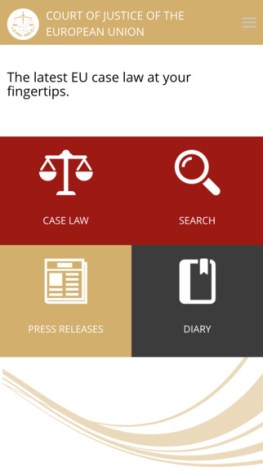
The ECJ has just launced its own app, CVRIA for smartphones and tablets, running on both iOS and Android. And no, we are not kidding.
As noted in the ECJ’s press release (see here), the app is available in 23 languages and has several functionalities, giving easy access to recent case law, press releases, judicial calendar and the Courts very own search tool covering all its case-law.
It is available here and here.
Not everyone must be happy about this app coming out. People like my-co-blogger Pablo or like Fernando Castillo, who know by heart case numbers, dates and paragraphs will from now onwards have it more difficult to impress people while having beers. All Court info is now a click away.
Glamour: Cement? Star Wars, Hollywood and lawyers’ rankings
Last week Pablo wrote a post describing his week of talks around Europe (Athens, Amsterdam for the Competition day, Bruges, etc) where he had been invited to discuss about the effects-based approach, recent 102 case law and online platforms.
My longest trip of the week was to Rue Ravensteim in Brussels (at the premises of the Brussels School of Competition –BSC-) to talk about cement. Life is unfair.
The talk at the BSC on the ECJ’s Judgments in the cement case was very interesting. I participated in the panel together with Manuel Kellerbauer (from the EC`s legal service) and Christian von Koeckritz, from Gleiss Lutz (the downside of speaking with two Germans is that I was the only one who didn’t get to be called “Dr.”). I did not innovate much from what I already said in my three posts on this case (here, here and here). Essentially, and given that –most likely due to procedural economy reasons- the ECJ annulled the decisions on the grounds of lack of motivation (only plea common to all applicants), the best we got out of this case were the sensible and well-reasoned Opinions of AG Wahl. If only for their persuasiveness, those are likely to be very influential in the future with regard to issues that, despite their importance, are unlikely to be raised before the Court again in the near future (certainly not in a case as extreme as this one). Most important of all, I believe that in the light of the General Court’s Judgment in case T-296/11 (see the first hyperlink above) and the Opinions (see second hyperlink), the criterion of “necessity” contained in Art. 18 of Regulation 1/2003 might from now on be interpreted objectively and, in my view, correctly. The slides presented at the talk are available here: Dr. Christian von Köckritz, Dr. Manuel Kellerbauer, Alfonso Lamadrid.
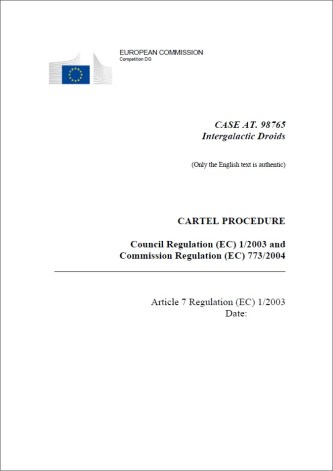
Btw, I had also been lecturing at the BSC a couple of weeks before and on that occasion I did innovate a bit more. We spent practically the whole 4 hour lecture on procedure, running a practical case (from inspections to decision) where students took different roles and were free to set strategies; they did great. I’m likely to repeat that a few times in the future, if only for the vast amount of materials (evidence, fake evidence, Commission documents) that were created for students to do the case. The case involved intergalactic droids, and all documents and email chains related to “real” characters and companies that exist at the very least in the Star Wars Wikipedia (or so I’m told by the extremely competent geek who helped me). The result of this exercise is pictured above.
And speaking of Hollywood. If my cement lecture in rainy Brussels was not as glamorous as Pablo’s trips through Europe, I compensated a bit with some extensive quotes in the Hollywood Reporter this week. At first, when my colleagues tried to transfer the call from the publication I thought it was a prank (we run a prank scoreboard at the office in which I hold an unassailable lead 🙂 sorry Sam….), but it turned out that it was true. This time it was not about the rumors linking me to Monica Bellucci (please respect our private life), but about the Commission’s Pay TV case. Should you be interested, the piece is available here.
Also this week the new Chambers Europe 2016 guide came out ranking lawyers, including competition lawyers. I was very well treated, as “star associate” in Spain and sole “associate to watch” in Brussels (the office teasing that followed is actually what led me to suspect the Hollywood call was a joke..). I read this week that happy people don’t talk badly about others. If that’s the case Chambers researchers must be very happy people, as it is remarkable to find such an extensive publication that only says positive things about so many lawyers about whom there are not so many positive things to be said 😉 So I would take all that with many pinches of salt. Not that I complain, but I wouldn’t mind losing a title that only identifies me as the lowest paid guy in the rankings! 😉 Be that as it may, this reminded me of two earlier posts I wrote some time ago on What makes a great lawyer, and on Sunshine lawyering; there you’ll see my views on all these things.
Enjoy the weekend!
Breaking news: Pay-TV investigation- Paramount offers commitments

It has just been announced that Paramount Pictures has offered commitments to address the Commission’s concerns in the context of the high-profile Pay-TV investigation (in which, for full disclosure, I represent a third party, PACT -British Independent Producers-). Pablo has also in the past commented on this case in some detail (see here and here).
This looks like surprising news, as until now Paramount, like every other affected party, strongly disputed the Commission’s allegations. As you may remember, the allegations in this pilot case (with potential huge ramifications) relate to clauses present in bilateral agreements between Hollywood majors and Sky pursuant to which Sky must ensure that content is not broadcast outside of the territory covered by its license. The case relates both to satellite transmission and to online transmission, even if the two are subject to different copyright regimes (more on this in a second).
This is being portrayed as big news in the press, but is it really that relevant? Let’s see:
-For Paramount: I can’t judge on whether yielding makes business sense for Paramount. Surely they have their reasons (which are seemingly financial rather than legal). They are paying a price but they’re the only one who can judge whether the compensation is worthy from a business standpoint. Thus, logically, no comments on our part.
-For other companies: If this were a standard poker game appearances could suggest that Paramount is folding in the light of a strong hand on the part of the Commission. I doubt this is the case given the specificities of Paramount’s situation, but arguably that’s only an outsider’s impression. The only objective, legally relevant fact is that commitments do not imply the admission of an infringement, so the debate remains entirely open and this does not legally place others in a worse position.
Much to the contrary, it could even be argued that once the Commission has accepted commitments with regard to one undertaking, it could now not impose fines on others for exactly the same practices. This is because, as you know, commitments are only appropriate in cases where the Commission does not intend to impose fines. In fact, unless I’m mistaken there has never been a case or cases involving the same practices where the Commission accepted commitments and imposed fines. Last time a “hybrid” comparable scenario arose (in the Samsung and Motorola cases; see here for my comment on this point), the Commission decided not to impose fines on Motorola but rather to limit itself to declaring an infringement.
-For the Commission: For the Commission this means good press (it did get something out of the case), a bit less work (but not that much less since most of the work was done). As explained, it also arguably could mean that perhaps it cannot now impose fines on others. At the same time, it could also be argued that this move would somehow set the Commission on a pre-judged inevitable path (as it would appear odd that charges were withdrawn with regard to others after one has yielded), but in my personal view that would be a great mistake, as cases are not to be decided on the basis of a company’s strategy, but rather on the merits, and the Commission should continue examining the feedback it received in the replies to the SO and at the hearing, as I’m sure it is doing.
But forget about PR, and about winning or losing a specific case; is this offer something that changes anything in the marketplace or that achieves the Commission’s wider objectives? I’m not so sure.
Even if every major studio (or even every copyright holder in the world) were to offer similar concessions -which imply renouncing to given clauses that enforce their IPRs in a given way- the copyright legislation would still be in place (unless changed by the legislature, which is unlikely). This means that even if all geo-blocking clauses were suppressed, the “passive sales” that the Commission would like to see would not exist, because they would still be precluded by the regulatory framework (which in the online world grants copyright holders the right to authorize or prohibit communications to the public in every territory of broadcast; see Art. 3.3 of the Copyright Directive). I already hinted at this here.
That is why, at least in my view, the only concessions with which the Commission could achieve something meaningful in this case would be those of Member States in the context of the legislative process.
The Commission’s Statement of Objections in the Android case

The competition news of the past couple of days have just been confirmed. The European Commission has annnounced that it has addressed Google and its parent company Alphabet a Statement of Objections regarding its Android mobile operating system and apps. The Commission’s press release is available here.
Here are all of the previous posts that Pablo and I have written on the case. In the light of today’s press release they would still appear to be relevant and valid:
- More on Android (includes presentations on the case positing contrarian views, including one by Microsoft’s lawyer in the case)
- A comment on the Microsoft/Skype Judgment (although not directly related to this case, it dealt with many of the issues relevant to it. It seems I was among the few who read it attentively and took it seriously…).
- Also, you should check out this recent piece on “Systemic Efficiencies in Competition Law: Evidence from the ICT Industry” by Konstantinos Stylianou (who did the Harvard LLM with me and who is now at the University of Leeds).
P.S. 1- We have some new ideas on the bundling aspect of the case, but we still need to decide whether these should be “open source” or “licenseable” 😉
P.S. 2- In addition to the bundling allegations discussed in our posts above, the press relese refers to two other challenged practices concerning the anti-fragmentation policy and alleged exclusivity arrangements. These are new to us and we don’t yet have a view on them.
Burning issues at the ABA’s Antitrust Spring Meeting

This year’s ABA’s Antitrust Spring Meeting featured a panel on the antitrust issues faced by the marijuana industry (see here).
This is no joke; it seems that following its legalization by 23 States marijuana is the fastest growing industry in the U.S., currently worth $4 billion-per-year but this budding economy is expected to grow tenfold in the near future.
As in any rapidly growing semi-regulated industry, marijuana is poised to be an interesting green field for the application of competition law. Some report instances of boycotts, price fixing, false advertising, output limitation, distributor concentration and state-mandated vertical monopolies. Some of you may actually remember how alcohol provided many of the most interesting cases in EU Law (see here)
Since many of these issues remain in a doobious, funny smelling nebulous state, even expectations were high.
And mysteriously enough, although we are told that this was attended by the entire army of MLex journalists present in D.C, there is no public information about the content of the panel.
This is why we at Chillin’Competition have enquired among those who attended about what it was that happened there.
Their testimony is as follows:
- LC. Anonymous MLex Chief Correspondent , “We did our best. If anyone tells you that they remember what went on at the panel, they’re lying”.
- Mary Jane Green, Senior Associate, Wandon & Scott: “It was a very disappointing panel. Bingham´s “Port and Chocolate” reception always delivers what it promises, but the marijuana panel was a fraud; talk about false advertising! ”.
- Adam Smith, Senior Economist: “Nothing special went on. You know, people of the same trade seldom meet together in smoke-filled rooms, even for merriment and diversion. There’s nothing wrong with that”
- S. Senate aide: “It was half baked. The transatlantic perspective was missing. All the European officials interested in the topic were attending the panel on tax rulings…”.
- Panel moderator: “Let’s roll !
- Curro Farlopez, Partner, Baked and Stoned: “I swear I never tried that and I’ll never do it again”
- Senior Associate, Herb Smithsonian, “Best discussion on “Joint” ventures I ever attended“.
- Two LLM students at a Washingdon D.C college, who were denied entry to the panel: “We can’t help you. We toke a joint decision to attend, but the organisers really made a hash of the registrations.”
- Partner, Housefed, “ I smell the greatest collective action case in history”.
If any reader finds out more, please drop us a line.
Announcements and upcoming events

We have been silent for a few days, including, for once, on April Fool’s day (which last time around played out quite well; see here). It somehow felt strange to focus on narrow competition law issues with everything happening around, particularly after the Brussels attacks. But here we are, ready to pretend competition law is so important as to deserve your (and our) free time too.
Those of you who attended the Chilllin’Competition conference might remember that in my opening speech I mentioned in passing that a few of our speakers would be changing jobs in the coming weeks. You all know that Jacques Derenne soon after moved from Hogan Lovells to Sheppard Mullin; Alvaro Ramos (then at Cisco) went on to head Qualcomm’s busy global antitrust team, and it has now been made public that another friend of this blog, Kevin Coates, has left the European Commission to join Covington&Burling. Best of luck to all of them, and congratulations to their new employers for their terrific hires!
We will soon be announcing other new positions 😉
And speaking of announcements, a number of friends and readers of the blog have recently asked us to advertise some events; here they are:
-On 15 April the 10th Junior Competition Law Conference (put together by Sarah Long and Molly Herron) will be taking place in London. This is one event that we have always very gladly advertised. The programme is available here. The topics of this year’s edition are: Brexit? Divergence and convergence in UK and EU competition law & Private enforcement: calm before the storm?
[Regarding BREXIT, you should read the excellent report drafted by Lawyers In for Britain, a coalition of lawyers -including competition lawyers, like John Davies, the aforementioned Kevin Coates or Stephen Kinsella, among many others. See here. Their efforts show that lawyers can actually be useful to good causes sometimes. Although now that I think about it, if the UK were to leave my firm would probably be the largest EU firm, which should come in handy to our EU and competition law practice 😉 ]
-On 22 April I will be intervening at a Brussels School of Competition Morning Briefing in Brussels to discuss the impact of the ECJ’s Judgments in the cement case. For more info and registrations, click here. I’ll also be teaching there this Friday.
-On 13 June Concurrence’s New Frontiers of Antitrust conference will take place in Paris. It has established itself as one of the big events in the field. Tickets are still available here and you can get one for just above 1,000 euros.
-On 11 and 12 July Newcastle Law School will be holding a conference on “Fossilisation & Innovation in Law”. Among the speakers, there will be a premature fossil in the making (Pablo) and a constant innovator (Bill Kovacic)
The ECJ annuls the General Court’s Judgments and the Commission’s decisions in the cement case (on the limits of information requests)

The European Court of Justice rendered this morning its Judgments in the cement case, concerning the Commission’s decisions requesting information to companies with a view to finding enough evidence to establish an infringement. See Cases C-247/14 P HeidelbergCement/Comission, C-248/14 P Schwenk Zement/Comission, C-267/14 P Buzzi Unicem/Comission and C-268/14 P Italmobiliare/Commission.
The Judgments have annulled the General Court’s previous rulings as well as the Commission decisions. In that sense, they are a blow to the Commission, but not one as far reaching as the Commission feared one would have thought.
When the Commisison won in first instance, it issued this press release noting that “these judgments are important because they confirm the scope of the Commission’s powers to investigate suspected antitrust infringements” and that “the Court confirmed that it is for the Commission to decide what information it considers necessary to request from companies when investigating potential anticompetitive practices”.
Today, after having lost, the Commission’s spokesman has stated that “the implications of the judgments are likely to be confined to the present case, as the ECJ pronounced itself only on the issue of reasoning”. In my view, this is only partly true.
Let me explain why:
A (downloadable) compendium of cartel law
Few people read Judgments nowadays and much less cartel Judgments, in spite of these being the large majority of competition-related output on the part of EU Courts.
It is not difficult to keep track of developments in, let’s say 102, because precedents are scarce and manageable (i.e. one can easily identify any deviations in e.g. the law on refusal to deal, as there are only a handful of well-commented cases on it). But the exercise becomes practically impossible when it comes to cartels, as there are many more (lengthy and sometimes tedious) Judgments, concerning very fact-specific situations and because developments may come in various fronts (ranging from evidential issues, to parent-subsidiary relations, fining, leniency, settlements, etc).
Accordingly, in the course of the past few years in order to identify relevant developments in cartel law many people have relied on one main source of info: the yearly presentations on cartel case-law delivered by Fernando Castillo de la Torre (Commission’s Legal Service) at Les Mardis de la Concurrence a the Université Libre de Bruxelles (also repeated later internally at the Commission). I actually know of various cases where lawyers pleading before EU Courts had the slides in front of them…
The amount of work and knowledge that Fernando puts into reading and making sense out of the case law for no other reason than openly sharing the information is admirable, and perplexing if one considers that he left the Legal Service’s competition team already a few years ago. And what borders with the paranormal is that he’s also got it all in his head and could recite by memory a large chunk of the content of the presentations, including case number and paragraph (I have actually seen that happening in Court).
The problem with those presentations was that, until now, they only were available in the gray market; one needed to know somebody who knew somebody who had registered for the talk and had received the materials.
In order to address this market failure, we have asked Fernando whether we could make available the presentations from the past few years, and he didn’t hesitate to accept.
Here they are:


 Chillin'Competition