Author Archive
On the (mis)application of Article 101(3): of judicial capture and cross-market assessments

We competition lawyers are probably more stupid than other lawyers (and that’s saying something!). Think about it, on the behavioral side many lawyers essentially work with only two provisions (Arts 101 and 102 TFEU) and they don’t really know what to do with them. Granted, I’m oversimplifying, but perhaps not so much: how many people have a clear idea of what a restriction of competition is? [my previous experiment on this point was used by some to criticize our discipline; see here] How many know how to extract the consequences of Article 101(2) [see here for my take]? And how many know how to apply Article 101(3)?
Today I’ll focus only on the last of these questions, to which the answer is: very few, and I’ll give you an example.
(Note: the first half of the post is mere background; the more interesting stuff is emphasized in bold at the end. The following may be a bit dense, but I bet that if you manage to read it you’ll find it quite interesting)
In the early days the Commission essentially did what it pleased with 101(3), using it often with common sense but with very little, and often divergent, reasoning, thus bordering on the arbitrary. The Court didn’t put much order in that mess: starting with Consten & Grunding it devised the manifest error of assessment test to review the legality of “complex economic assessments”, a label which was said to apply to the application of Art. 101(3). The result of this approach is that prior to the adoption of Regulation 1/2003 the Court only rendered a handful of Judgments (30 approximately) dealing with this sub-provision, which nevertheless is at the core of our enforcement system.
Following the adoption of Regulation 1 the Commission ceased applying Article 101(3) as well, seemingly acting under the assumption that its Guidelines on the application of what then was Article 81(3) would fill the void. But the Guidelines didn’t fix much and, in fact, as will be seen in a second they also created new trouble. Also, Article 5 of Regulation 1/2003 (later interpreted by the ECJ in Tele2Polska effectively precluded national competition authorities from adopting individual exemption decisions under Article 101(3) TFEU (they can only conclude that there are no longer grounds for action)
The result is that the Commission seldom undertakes a serious evaluation of 101(3) in its individual cases, that EU Courts very rarely have the chance to review its application and that national competition authorities can’t do it to a full extent either (in spite of the fact that decentralization was intended precisely to empower them to do it…). Passivity in this regard is so extreme that even when the ECJ has instructed the Commission to perform a 101(3) assessment, the Commission has felt free enough to take a pass (we’re currently working on a case wich is a perfect example of this).
Far from being unimportant, I often contend that many of the problems encountered in modern competition law (like the object/effect debate and the discussions on how far into the “legal and economic context” one must look within 101(1)) (see here, for instance) derive from the fact that 101(3) isn’t taken seriously in individual cases.
But what is even worse is that the very exceptional cases in which Article 101(3) is indeed applied, it doesn’t seem to be properly applied.
I’ll give you an example, resorting to an issue I dealt with in my presentation on two sided markets at the Swedish Competition Authority’s Pros and Cons conference a few weeks ago and which, I realized, not many seem to be aware of.
Let’s take a simple question which should have a straightforward answer:
Can you balance the efficiencies obtained in one market against the restrictions of competition caused in a different market?
–When this question first arose before EU Courts it was made it pretty clear that any positive effect should naturally have to be considered, regardless of the relevant market in which it occurs:
“For the purposes of examining the merits of the Commission’s findings as to the various requirements of Article [101(3)] of the Treaty (…) regard should naturally be had to the advantages arising from the agreement in question, not only for the relevant market (…) but also, in appropriate cases, for every other market on which the agreement in question might have beneficial effects, and even, in a more general sense, for any service the quality or efficiency of which might be improved by the existence of that agreement” (Case T-86/95, Compagnie Générale Maritime and others, [2002] ECR II-1011, paragraphs 343 to 345).
Sounds pretty unequivocal, right? Well, again, keep on reading….
– Then came the Guidelines on 81(3) and ruined it. Para. 43 of the Guidelines states that “[n]egative effects on consumers in one geographic market or product market cannot normally be balanced against and compensated by positive effects for consumers in another unrelated geographic market or product market. However, where two markets are related, efficiencies achieved on separate markets can be taken into account provided that the group of consumers affected by the restriction and benefiting from the efficiency gains are substantially the same”. In other words, they said precisely the contrary to what the case law said. And, cunningly enough, the Commission did so citing in its support the very same case law that it was departing from (not that EU Courts haven’t occasionally done the same regarding their own case-law…) Indeed, the footnote (57) accompanying this paragraph refers to Compagnie Générale Maritime (quoted above) but adds a long explanation aimed at confining the Court’s ruling to the very specific situation at issue in that Judgment, in which the group of consumers affected by the restriction and the efficiencies is said to have been the same. Read it for a good example of manipulation a lawyer-like interpretation of the case law.
– This very same issue returned to the EU Courts in the post-guidelines era with the Mastercard case. And instead of correcting the Guidelines’ intendedly wrong interpretation of the earlier case law, the Courts endorsed it, and I’m not sure that they did so consciously.
Click here to continue reading about how the Commission lawyered everyone:
Antitrust Writing Awards 2015

Concurrences has launched the 2015 edition of the Antitrust Writing Awards.
Among the roughly 50 articles selected for each of the “academic” and “business” categories there are many written by friends of this blog, and also some authored by Pablo (namely this one), Nicolas Petit (see here) and myself (here and here) (btw, if you click on any of those you might as well give us a 5 star vote 😉 )
Regardless of the degree of importance that you may give to these things, scrolling through the list of selected articles is a great way of catching up with some of the best scholarship of the past few months (and also with our writings). Being the sort of person that reads a competition law blog, you’ll surely find some stuff of interest in those lists.
P.S. An additional thought: I just saw once again the pic of Pablo that appears in the Concurrences website (at one point in time he was the most read author in that site) and couldn’t help thinking that it’s well suited for a before-and-after Men’s Health cover…
Coming soon…

– On Friday 30 January we, at the IEB course, will be holding a seminar in Madrid, coordinated by Fernando Castillo and Eric Gippini, which will feature three panels: one on judicial review in competition cases (with Manuel Campos -Spanish Supreme Court-, Santiago Soldevila -former GC judge, now at the Spanish Audiencia Nacional- and Helmut Brokelmann -MLAB-; another on the application of competition law to public conduct (with Francisco Marcos -IE Law School-, Fernando Castillo – EC’s legal service- and José Luis Buendía -Garrigues-); and a third one on “Life after Cartes Bancaires“ (with Nicholas Khan -EC’s Legal Service-, Xavier Ruiz Calzado -Latham & Watkins- and a handsome lawyer going by the name of Alfonso Lamadrid -Garrigues-). For more info please click here or send an email to competencia@ieb.es.
– On Friday 6 February the editors of the Competition Law Journal will hold the 9th Junior Competition Conference, which will have two themes, namely “Control of unilateral conduct and ‘the Goldilocks dilemma’: too much, too little or just right?” and “The new frontier: competition law in the financial services sector”. The conference programme can be found here. Those interesting in attending may contact the organizers at operations@catribunal.org.uk
– On Thursday 19 February ERA will host a workshop in Brussels on “Dawn Raids in Practice: Developments in Case Law and Enforcement”. The workshop will examine the latest enforcement trends and the impact of recent case law from the CJEU and the ECtHR on the conduct of dawn raids by the European Commission and national competition authorities. More info is available here.
– On Friday 20 February we, again at the IEB in Madrid, will host a seminar on recent developments in abuse of dominance and merger control coordinated by Cecilio Madero -Deputy Director General, DG Comp-, Nicholas Banasevic -Head of Unit at DG COMP- and Milan Kristof -Référendaire at the ECJ-.
– A bit later, on 15 May, the University of Leeds will hold a (free) conference on Contemporary Challenges in Competition Law featuring, among top-notch speakers, Pablo and Nicolas. More info is available here.
– And, in a few days, Chillin’Competition will be resuming its Friday Slot section with a quite special interview. More info coming soon…
And the 2014 winner is…
(by Sam Villiers, Garrigues, Brussels, not pictured below)

With the Golden Globes this weekend and the Oscars fast approaching, the 2014 awards season is officially upon us. In this light, the FT ran an interesting piece yesterday (see here) on the highlights of 2014….in the world of cartel fines. I don’t know whether one can accurately describe there being ‘winners’ and ‘losers’ in cartels, but the article – based on a report by A&O (see here) – certainly highlights some interesting general trends in global cartel fining.
The report explains that total cartel fines dished out by the world’s competition authorities in 2014 reached a new level of $5.3bn, up 31% on the previous year’s (record breaking) total. And the nominees are…..sorry, I mean…the markets handing out the most fines in 2014 are:
- Europe leads the way, having handed out €1.7 bn ($2.3 bn), although didn’t quite make it to the giddy heights of its 2013 level of €2.5bn. The report picks out the German and French competition authorities as having enjoyed particularly vintage years.
- Brazil’s CADE (Administrative Council for Economic Defense) had a record-breaking year, with cartel fines totaling $1.6 bn. This figure includes the imposition of the second largest fine ever given by a competition watchdog, that of $1.39 bn for a decades-long cement cartel.
- South Korea’s KFTC also broke its fining record, doling out an impressive $1.01 bn worth of fines.
- In the 2014 fiscal year, the US DOJ Antitrust Division imposed a modest $861m of fines, 15% down from the previous year. Plus, the lion’s share of this total came from fines handed out to the auto parts cartelists.
It is quite hard to discern too many long-term trends from these isolated 2014 numbers as cartel investigations are characterised by such long gestation periods; the time between the opening of a case file and the final decision by an authority or court can take years. It would perhaps be more indicative of general trends if one could look at the total fines given over 5 or 10 year cycles. In any case, the numbers are interesting in themselves.
One general trend that did particularly catch my eye – in the context of the debates around reform of competition enforcement in Europe – is the seemingly large number of jurisdictions allowing individual offenders to face prison sentences. It is interesting to note that in 2014 a Brazilian court imposed a 10 year prison sentence (and a $156m fine) on an executive for bid rigging. At the level of DG Comp, I would imagine that we are some time away from this.
Oh, and one final point: according to the FT, bistros (the noisy, French variety one would presume – easier not to be overheard ;-)) and hotels were shown to be the preferred cartelist meeting spots. Not surprising I guess, but zero points for imagination… That said, if anyone reading this is in search of a cartel venue, I hear Alfonso’s parents have a special offer for cartellists at their hotel 😉
A review of recent EU competition case-law
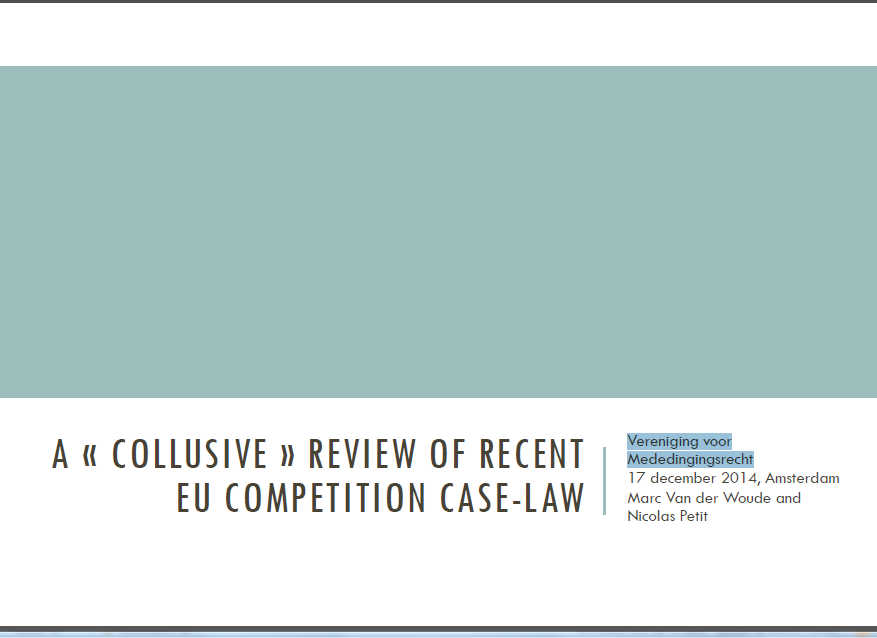
Last week General Court Judge Marc van der Woude (click here to read his Friday Slot interview with us) and Nicolas Petit did a joint presentation on recent EU competition case-law at the Vereniging voor Mededingingsrecht (Dutch Competition Law Association).
The must-read slides are available here: Slides -17 December – Van der Woude and Petit
(A teaser: the slided identify an apparent misquote in the Cartes Bancaires Judgment…).
International Conference on Cartels- Materials

The Universidad San Pablo CEU (which thanks to the work of Prof. Jerónimo Maillo has always paid an unusual attention to competition law) and the Spanish Competition Authority recently held an international workshop on Cartels in Madrid which I hear was a great success.
I couldn’t make it, but I’m told that my colleague Konstantin Jörgens did a great job discussing a piece I’ve co-written on the assessment of evidence in cartel cases.
All materials are now available at the website of USP-CEU’s Institute for European Studies , but since we know you’re a bit lazy (no offence) we’ll save you the effort of an additional click:
- Opening Speech
Eduardo Prieto
Download pdf - Integrating Regulatory and Antitrust Powers
Juan Delgado
Download pdf - Calculating fines: Practical problems
Alberto Escudero
Download pdf - Lessons from the Damages’claims in the Spanish sugar cartel
Francisco Marcos
Download pdf - EU Antitrust Damages
Evelyne Ameye
Download pdf - European Commission’s settlement procedure – a success story
Eric Van Ginderachter
Download pdf - Leniency programmes and the problematic use of confidential information
Javier Guillen
Download pdf - An economic assessment of the judicial review of the CNMC’s fines
Javier García-Verdugo
Download pdf - Cartel Settlements
Jean-François Bellis
Download pdf - Leniency and Cartel Detection
Juliane Schulze
Download pdf - Sanctioning hard core cartel infringements in EU Competition Law: towards a more compliance-driven approach
Aaron Khan
Download pdf - Fines and Evidence in Cartels
Konstantin Jörgens
Download pdf - Prosecutorial & Non-Prosecutorial Systems and the Fight against Cartels
Marianela Lopez-Galdos
Download pdf - Leniency – Dutch experience
Pablo Amador Sánchez
Download pdf - ‘How (Not) to Design a Criminal Cartel Offence: Learning from the UK Experience’
Peter Whelan
Download pdf - Swedish Competition Authority
Karin Montelius
Download pdf - EU Judicial Architecture Facing Anti-Cartel Enforcement
Georges Vallindas
Download pdf - Leniency Plus: a Building Block or a Trojan Horse?
Marek Martyniszyn
Download pdf - Class Actions to Claim Antitrust Damages
Pablo Gutiérrez de Cabiedes
Download pdf
On Salt and the Role of Monopolies in History

A few days ago the Chinese government announced that it will put an end to what is perhaps the oldest monopoly in the world, that of salt, which has been in force for well over 2,000 years (see here).
As of 2016 salt prices will be liberalized in China, and in 2017 the government will commence to grant new licences to operate in the market. Many citizens have expressed their reluctance to see the salt monopoly go (see here).
The salt monopoly was adopted in China by the Han dynasty in 119 B.C. with a view to funding the largest expansion in the history of China. Over the years, salt came to be the origin of 80-90% of the public revenues in certain Chinese states. The role that the salt monopoly has had in Chinese history, at all economic and even philosophical or religious levels is determinant, having been at the roots of major debates on foreign relations, wealth and inequality and the role of the State in the organization of the market. Or that’s at least what I’ve read…
Interestingly, salt monopolies also played a key role in other parts of the world, as, btw, did salt taxes (with the British salt tax in India eventually leading to Gandhi’s Salt March or Salt Satyagraha in 1930 and the French “Gabelle” contributing to the uprise that became the French Revolution). Salt is not the only monopoly that has had a transforming impact in history; think of the East India Company or the Casa de Contratacion (among many others).
I started reading about all this stuff almost by accident, and then spent part of Sunday evening reading a bit more with the idea to write a post on the role of monopolies in history.
On a second thought, that’s too ambitious a goal, but the subject is -I think- fascinating.
If any of you knows of any books or studies that touch on the role of monopolies in history, please send them my way and we’ll give them due publicity here.
Prof. Whish on the Intel Judgment

Professor Richard Whish (click here for his Friday Slot interview with us) has just written an editorial piece for the Journal of European Competition Law and Practice commenting on the General Court’s Intel Judgment (for our previous publications on the Judgment, see Pablo Ibañez´s “Intel and the problem with wrong economic assumptions” as well as the post on Wouter Wils’ piece, available here) [Btw, Pablo has written a proper article on the subject that will be out in a few days].
The editorial, which we are making available with the consent of both Prof. Whish and JECLP (thanks very much to both), predicts that “the Court of Justice will uphold the judgment of the General Court, not because it believes in the Dark Ages and enjoys wreckage, but because the judgment is perfectly sensible“. It then goes on to develop the reasons why he finds some criticism targetting the Judgment unconvincing.
The piece is as succint as it is interesting, so instead of summarizing it, we leave you with it:
Playing for the gallery- On the European Parliament’s resolution on the unbundling of Google

I’m typing on Sunday morning, on my plane back from Stockholm, right after reading the excellent pieces by The Economist on market power in the digital age (the image above comes from it), which summarizes many of the things we have been discussing here for quite a while in relation to the Google case (too many links to cite them here), the Microsoft/Skype Judgment (here), to the practical articulation of the economic theories on two-sided markets (here among others) and the interface between competition law and privacy (here and here). If you haven’t read it yet, we suggest you to do it here.
The Economist pays particular attention to what has been the talk of the town these days, European Parliament’s approval of a resolution that suggests the Commission “to consider proposals with the aim of unbundling search engines from other commercial services”. I’d told myself some time ago that I would reduce my coverage of Google related news (despite the increased number of visits they attract to the site) because I had the impression that it had ceased being about the law (admittedly, I´m not sure it ever was), but since everyone’s taking about it, and since I have been asked for my views on this quite a few times (Reuters actually published some of them in this piece), here you have them:
On the politicization of competition law. I very much like politics, and I very much like competition law, but I don´t like them together, at least when it comes to individual cases. In previous posts I have written about competition law and big politics (see here for “Antitrust and the Political Center” and here for a follow-up CPI interview on it) as well as, more recently, about competition law and “small politics” (see “On Competition Law and Politics”). When the new Commission structure was unveiled, we also wondered whether it meant that competition law would become more permeable to other policy areas (see here). Interestingly, last week I read that Commissioner Vestager had talked to Henry Vane at GCR about how she was concerned about lack of democratic accountability in competition law and believed that “building bridges with European Parliament is key”. I was intrigued by these words, and am curious as to how this will play out in practice.
On separation of powers (and Montesquieu’s death). My initial reaction was of surprised by the superficiality of the exercise; I thought it was remarkable that that 384 MEPs have voted for this resolution without undertaking any prior inquiry and without apparent due reflection on an issue that would require very careful scrutiny (unbundling cannot be taken lighltly; think of the debates about the energy and telecom sectors, where the remedy is far less controversial than it would in a rapidly moving industry). On second thought, I realized that that is not even the real issue: the true problem is that something is wrong with separation of powers (even in the peculiar EU context) when the legislative branch steps into the application of the rules and puts pressure on the executive -acting as quasi judiciary- to interpret and enforce the rules in a given way.
I, for one, am much more comfortable leaving competition law enforcement in the hands of perhaps less accountable, but independent, well trained and specialized DG Comp officials, who are, for good reasons, the ones empowered to apply the rules.
A bias against US companies? We’ve discussed this before in some depth (see here). Aside from the irony in politicians in the US telling politicians here not to politicize the debate (not the first time, though; see here), I find that particular criticism without merit. The EU doesn’t play industrial policy with competition law. If you look at the fines imposed in the EU and the US for antitrust violations, you’ll see that whilst most fines imposed in the EU affect EU firms, those imposed in the US are imposed on non-US firms. In my view, MEPs were certainly sought to protect certain interests, but not those of the EU versus those of the US.
As I told Reuters last week, the investigations don´t have to do with nationality bias but rather relate to the fact that “in most cases U.S. firms are the allegedly dominant players worldwide. I wish more European firms were in a position to be subject to similar investigations in the U.S.” I was glad to see The Economist making the exact same recommendation in their piece (“Europe’s leaders should ask themselves why their continent has not produced a Google or a Facebook.”)
The underlying strategy. Despite the significant media attention, I doubt that many people have taken this “suggestion seriously”. The way to spin it will be to say that even if a break-up seems excessive, the resolution shows that Google’s, sorry, search engines’ dominance has become too much of a problem. This is yet another smart move on the part of Google’s complainants (which, as I’ve always said, have played the game exceptionally well), but I guess I can’t say the same for the Parliament.
Overdoing criticisms might give one visibility, but only at the expense of credibility. The Parliament has always been on a quest for more recognition and powers, and, frankly, these things don’t help.
The Double Duality of Two-Sided Markets

I’m typing live from the Swedish Competition Authority’s top-notch Pros and Cons conference, which in this 13th edition deals with the pros and cons of two-sided markets.
Despite the fact that the conference has been opened by myself and will be closed by Nicolas Petit, I promise this is a serious and highly reputed event.
In my intervention I have focused on what I’ve called the double duality of (practices carried out in) two-sided markets. A paper on the subject is in the pipeline (to be finished when work and baby allow), but most of the views I just developed are contained in this presentation (comments would be very welcome):
Lamadrid_The Double Duality of Two Sided Markets


 Chillin'Competition