Author Archive
Milton Friedman and EU Competition Law. Did you know?

That the Chicago School has had a profound and lasting impact on competition law analysis is well-known. That Milton Friedman, the intellectual leader of the most legendary of Economics Departments, played a (minor) role in the creation of an EU competition law system, is probably ignored by many of our readers.
As they explain in their memoirs, Milton and Rose Friedman spent some months in Paris in 1950, working for the Marshall Plan agency. Milton’s main task during his time in France was to analyse the Schuman Plan. He expressed concern that the project would lead to the ‘substitution of a single super-monopoly for the present collection of monopolies’ and that the ‘fine words about “competition” and “single market” have been interpreted to mean centrally directed and controlled industries’.
This passage is useful to put things in perspective. Many contemporary commentators tend to see the ordoliberals and the Chicago School as two extremes in a continuum. Against the widespread view, Milton Friedman’s account suggests instead that he shared with the ordoliberals of the time a concern with central-planning and with the cartelisation of key industries. Both saw competition as necessary for the emergence of a genuinely free and democratic society. And the rest is after all just details 😉
BIICL’s merger conference + AIJA’s tech conference + a pub-related question

The British Institute of International and Comparative Law will be holding its 11th annual conference in Brussels tomorrow. The line-up of speakers is quite impressive and the topics extremely timely; you can check them out here: 11th_BIICL_merger_conference
In case you’re too lazy to click on the above hyperlink to the program, just know that the panels will address the following subjects:
– Screens and inferences in mergers: has DG Comp opened the Pandora’s box of price pressure tests?
– Remedies and Efficiencies – What Really Compensates for the Loss of Competition?
– Hot topics: Minority Stakes, Procedural Simplification, the Rise of MOFCOM.
Apologies to Philip Marsden, to whom I said I’d advertise this a bit more in advance…
Also, be aware that the early bird rate offer for AIJA’s must-attend Bruges conference on Antitrust and Technology is expiring today. For more info, click here: https://chillingcompetition.com/wp-content/uploads/2013/12/antitrust-2-0-competition-law-and-technology1.pdf
P.S. And speaking of Bruges, on Wednesday I’ll be visiting the College of Europe as part of Garrigues’ recruitment process. I was told yesterday that De Garre (the real reason why I wanted to go to Bruges) is closed these days; if any student can give any inside-information, that’d be much appreciated 😉
Follow-on thoughts on (and beyond) Microsoft/Nokia (by Luis Ortiz Blanco)

[Note by Alfonso: A few weeks ago I wrote a brief post regarding one particular aspect of the Commission’s press release about the Microsoft/Nokia decision that caught my attention. Before posting it, I discussed the matter with two of my bosses’ colleagues: Luis Ortiz Blanco and Marcos Araujo, both with significantly more merger experience than myself, and both of whom initially agreed with the point I was trying to make. A few days ago this question came up again, and I managed to extract from Luis the commitment that he would write his views on a guest post here (all previous attempts to get him to do that and a Friday Slot interview were unsuccessful…). Luis needs no introduction; he’s an exceptional person, professor, lawyer, and was even also one of the best men at my wedding… He’s also the reason why I work in competition law, but that’s a long story. I leave you with him].
Readers of this blog may by now be familiarized with Alfonso’s and Nicolas’ well-known “persistence”. I admit to be and old-school guy, more prone to do my writings with time, pen and paper rather than swiftly and informally on blogs, but this time they caught me off guard and suggested an interesting topic, so here I am, giving blogging a try.
Despite the title of this blog entry, my intention is not to comment on the Microsoft/Nokia decision specifically, not the least because the decision is not yet available and I have not directly or indirectly worked on the case. My intention is to discuss an interesting theoretical point that appears to have arisen in that case and that prompts very relevant legal question for practitioners, academics and competition authorities which go beyond the facts of a given matter: do or should merger control rules and remedies apply also to impediments to competition that a transaction may generate on the seller’s side?
Alfonso already touched on this issue in a previous post. In my view, he rightly identified what I also see as an erred reasoning in the European Commission’s press release, according to which:
- “The Commission considers that any possible competition concerns, which might arise from the conduct of Nokia, following the transaction, in the licensing of the patent portfolio for smart mobile devices which it has retained falls outside the scope of the EU Merger Regulation. The Commission cannot take account of such concerns in the assessment of the current transaction. Indeed, Nokia is the seller whereas the Commission’s investigation relates to the merged entity.
Now, do really merger control rules really relate only to the merged entity, to the exclusion of the seller?
Prior to providing you with my answer to this question, I would remark that, in my experience, it is most unusual to see the European Commission (or any other competition authority for that matter) self-limiting its own powers. Competition enforcers often tend to do the contrary, that is, to explore the powers they have, even if at the risk of perhaps going beyond them at times.
If among the readers of this blog is the one person that bought my book Market Power in EU Antitrust Law, she or he might recall the criticism I directed (pp. 77-78) at a few cases (ExxonMobil, and particularly at Grupo Villar Mir/EnBW/Hidroelectrica del Cantábrico and EnBW/EDP/Cajastur/Hidrocantábrico in relation to the ‘third-party dominance theory”) in which the Commission had intervened aggressively on the market in order to address effects unrelated to the transaction. In those cases the Commission extended and arguably exceeded its powers because of its will to address what it saw as a competitive problem. In its Microsoft/Nokia press release, however, the Commission does the contrary: it appears to restrain or limit the powers it has in order to justify not evaluating what many saw as a competitive problem.
This stance is all the more surprising if one recalls that in the past the Commission has accepted/required some “soft commitments” in Oracle/Sun and, in a more similar setting, on the part of Google at the time it acquired Motorola Mobility. The theory of harm in both the latter case and Microsoft/Nokia related to the alleged possible anticompetitive use of patent portfolios. If anything, Microsoft/Nokia would seem to give rise to increased suspicion [the deal was structured in a way that has resulted in an unusual situation: Microsoft buys Nokia’s mobile device business but not valuable mobile device patents, which it will only license. Nokia, in turn, will be under pressure to assert its patents aggressively, may possibly also act under the influence of Microsoft, and would be immune from possible retaliatory strategies because it will not manufacture smartphones anymore. The move is smart, but, in my personal view, maybe also a bit obvious too].
The sole argument seemingly adduced by the Commission to justify its different treatment of the two deals seems to be the precisely the one we are discussing in this post. But, think for a second, would it make sense to endorse an interpretation of the merger regulation that would enable parties to avoid scrutiny by carefully tailoring the structure of a deal?
Now, and more importantly, why do I say that the Commission must have the power to assess the effects of a merger on the selling party?
First of all, because it makes sense. If a merger does affect the incentives of the players in a given market in such a way that competition may be significantly impeded, there would seem to be no valid reasons for competition authorities not to look at the problem and, where necessary, accept (i.e. demand) commitments The contrary would undermine the effectiveness of the merger control system. Why could not the Commission condition the authorization of a transaction to a commitment from one of the parties to it (the seller)?
Secondly, because as Alfonso pointed out in his previous post, the letter of the Merger Regulation supports this idea. He referred to recital 25 of the Horizontal Merger Guidelines; I would also argue that the references in articles 6(2) and 8(2) to “modifications [of the concentration] by the undertakings concerned” shall logically encompass the parties to the transaction (the only ones that can modify it), which obviously would include the seller.
Thirdly, because the Commission’s practice reveals that in the past remedies have been required from the selling party. Think of cases such as E.ON/MOL, where the commitments accepted by the Commission concerned the seller (interestingly, the commitment was drafted in a way such that E.ON would “undertake to procure MOL to dispose of [certain shares in the transferred companies]’. Think also of Alcatel/Telettra, where assurances by a third-party (Telefonica) were relied on by the Commission in accepting commitments. This is not to mention the cases in which the Commission relied on Member State’s (i.e. third parties) assertions and declarations of intentions in support of certain commitments.
Perhaps the Commission would benefit from a third party appeal (not that these have been successful lately) prompting the Courts to rule that the Institution has more powers than it now purports to have. Once again –just like it happened in Camera Care regarding interim measures (a story that I always like to tell my students about)- the Commission could experience the serendipity of obtaining increased powers without even seeking them.
An announcement and a nomination

The announcement: On 15 February my co-blogger Monsieur le Professeur Nicolas Laurent Max Petit (no kiddin’) will be joining DG COMP for a 6-month stint. I’m curious as to how this experience will impact his views on the Europen Commission’s work.
Btw, Nico took care of the inaugural lecture at the IEB course in Madrid on Friday and did a great job. Tomorrow he’ll be delivering a must-attend presentation on Art. 102 at Les Mardis de la Concurrence in Brussels (the PPP will be made available here).
The nomination: Chillin’Competition has been nominated as one of the best foreign legal blogs in a competition ran by our favorite German site (Kartellblog) (as if we were able to read German…). Thanks to Johannes Zöttle and to whovever nominated us. Since it’s always nice to win something (or so I’m told 😉 ) you can vote for us here: http://kartellblog.de/2014/01/06/poll-beste-jurablogs-2014/
Pomposity v Social Value in Legal (and Antitrust) Scholarship

I just saw this graph on Prof. Einer Elhauge’s LinkedIn account; the original source is Eric Posner’s blog (yes, the son of Richard Posner and a big name in his own right too).
I’d be curious to know about the underlying methodology (economic analysis seems to favor economy-related disciplines). It would seem as if an antitrust legal scholar had asked an economist to come up with a seemingly scientific study corroborating a given thesis. Not that this would ever happen in private practice… 🙂
ADS

In the course of the past few days and weeks some friends have asked us to advertise a few upcoming Competition-related happenings. We’ve taken our time, but here’s a compilation of stuff worth knowing about:
The 3rd edition of Concurrence’s Antitrust Writing Awards is now ongoing. You can vote for your favorite piece before the 1st of March.
Harvard’s European Law Association (HELA) has scheduled its first Antitrust conference, to be held on 24 March. It will deal with the informal application of competition law in the U.S. and the EU. Click here to check out the call for papers and to find out more info: Hela_Call_Abstracts_updated (and apologies to Zena Prodromou for not having done this before!)
On 30 January the ABA’s Section of Antitrust Law will be holding a networking reception + a panel (Inquiries into Competition and Alleged Misconduct in UK Financial Services) in London. Click here for more info.
The annual junior competition lawyer’s conference will take place on 31 January. This is an initiative that we’ve always supported and that would be nice to see replicated in places other than the UK. Click here for more info.
And also on 31 January we will be hosting the first seminar within the competition law course that Luis Ortiz Blanco and I co-direct in Madrid. It will be devoted to Recent developments regarding the application of Article 101 TFEU (including damage claims, anti-competitive agreements in the pharma industry and the fight against cartels in a context of economic crisis), and will feature Fernando Castillo de la Torre (EC’s Legal Service), Eric Gippini Fournier (EC’s Legal Service), (Carlos III University, EAGCP and CEPR), Mario Mariniello (Bruegel), Helmut Brokelmann (MLAB), Maria Luisa Tierno (DG Comp), Natalia Fabra (Universidad Carlos III, EAGCP), Flor Castilla (EC’s Legal Service), Borja Martínez (Uría Menéndez), Antonio Martínez (Allen&Overy), Jesús Alfaro (Linklaters) and Gerald Miersch (DG Comp). I’ll post the final program here as soon as it’s ready.
Very importantly, a reminder is in order: on February 7-8 AIJA and the College of Europe will be holding the not-to-be-missed conference Antitrust 2.0 Competition Law and Technology.
P.S. We’ve also been asked to mention that the Swedish Competition Authority is taking steps to publish decisions in English. Our source suggests to present this as one of the major 10 developments on the year, which I’m a bit hesitant to do 😉 However, the Swede’s move is commendable, particularly when compared to what other national competition authorities do (the new Spanish authority doesn’t even have an English version for its webpage…)
Exclusionary Effects in Google: Are They Relevant at All for the Outcome of the Case?

[Thanks to Alfonso and Nicolas for allowing me to post yet more thoughts on the Google investigation]
We have now entered the fourth year of the investigation into Google’s practices (and this without even a statement of objections being issued). The latest statements by the Commissioner suggest that the final decision will most probably not be issued any time soon. Because the proceedings are taking (objectively speaking) so long, one is tempted to think that, were Google’s practices truly exclusionary, negative effects in the marketplace would have already materialised. Arguably, the time elapsed since the opening of the investigation is long enough to establish whether the initial concerns were justified.
As a complete outsider, I do not have the means to know whether action by the Commission is based on figures suggesting the likely exclusion of rival services. But I know that I make compulsive use of Amazon (the immense success of which is no secret to anyone), that I regularly check reviews on Tripadvisor (which seems to be a healthy business with a growing number of unique visitors) and that, every now and then, I use Expedia (which is facing increased competition, including from Tripadvisor). As everybody else, I read newspapers mostly online, and I notice that the above and other search-related services advertise their sites prominently through the media. And I also know that some firms are alive enough to claim before the Commission that the concessions offered by Google are insufficient.
If it were really based on the exclusionary effects of Google’s practices on competing services (or if the Guidance were to be taken as the expression of a serious long-term commitment), the likelihood of these effects would be the central aspect of the investigation. However, I am again – I cannot help it – under the impression that the outcome of the case depends on other factors. As is true of the legal framework (Where’s the Law?) under which they are (if at all) being assessed, the likely effects of the alleged practices seem plain irrelevant in this regard. The only question that seems to matter –and this is a real pity, given the exciting and novel issues raised – is whether the commitments offered by Google are acceptable for the Commission.
Happy 2014 everyone!
DG Comp releases a show-off comic
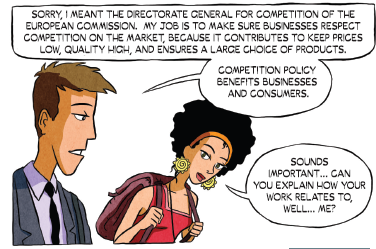

Those of you who have been following this blog for a while might remember our series of posts about antitrust-related entertainment (videos, comics, etc).
Well, a couple of hours ago Aoife White (Bloomberg) sent us the ultimate comic, one that has actually been done by DG Comp.
I was planning to write a few jokes about it even before having read it (my first idea was a fake news story, along the lines of “Belgian association of comic drawers sues DG Comp for giving away comics for free at Christmas time”) but I’ve just read the actual comic (it’s 9 pages and takes 3 minutes, no more), and I wouldn’t know where to start!
The story is about a busy, handsome (I guess, although I’m not really an expert on the beauty of drawn men) and passionate DG Comp official who wants to pick up a girl at an airport with the chat-up line “I work at DG Comp” and then starts showing off about how important his job is.
And I’m not kidding.
It’s available here: DG Competition Comic
“I work at DG Comp”, the ultimate pick-up line…
A thought on Microsoft/Nokia

As you know, a few days ago the European Commission unconditionally authorized the Microsoft/Nokia deal. I’m looking forward to reading the decision, which isn’t yet public. Whereas I expect to see nothing odd in there, a doubt did spring to mind when reading the press release last week.
When explaining its approach to the concern that Nokia could become a troll-like entity, the Commission’s Press Release says the following:
“The Commission considers that any possible competition concerns, which might arise from the conduct of Nokia, following the transaction, in the licensing of the patent portfolio for smart mobile devices which it has retained falls outside the scope of the EU Merger Regulation. The Commission cannot take account of such concerns in the assessment of the current transaction. Indeed, Nokia is the seller whereas the Commission’s investigation relates to the merged entity. However, the Commission will remain vigilant and closely monitor Nokia’s post-merger licensing practices under EU antitrust rules, in particular Article 102 (…)”. (Emphasis added).
Please correct me if I’m wrong, but isn’t that a wrong/arguable over-simplification? (although, to be sure, it wouldn’t be a crime for a press release to over-simplify). Does merger control really relate solely to the merged entity to the exclusion of other actors in the market? Isn’t it rather about the effect that the transaction may have on the structure of the market? I mean, can’t the Commission assess the effects that a concentration would cause on the market power of parties to the transaction as well as on that of third parties? Perhaps the press release only intended to refer to the Commission’s remedial powers, and not to its assessment powers, but even assuming that, the short explanation may be incorrect. Although infrequent, third party post-merger conduct may be potentially relevant in deciding a case.
Look, for instance, at recital 25 of the horizontal merger guidelines “under certain circumstances, concentrations involving the elimination of important competitive constraints that the merging parties had exerted upon each other, as well as a reduction of competitive pressure on the remaining competitors, may even in the absence of a likelihood of coordination (…) result in a significant impediment to effective competition”.
Don’t get me wrong: I’m not challenging the outcome of the Decision (it seems prima facie reasonable for the theory of harm at issue in that case to be monitored ex post), but, in my view, the explanation would have had to do with “causality” (à la Tetra Laval or GE/Honeywell), not with the scope of merger control. Perhaps this would seem to make no practical difference in principle (as we’ve learnt recently, in real life ends justify means, and reasonings aren’t really worth paying attention to), but inconsistencies in the formulation of policy positions might eventually come at a cost.
P.S. Following the advice of some of you, last night I created a Twitter account: @LamadridAlfonso; it’d now be nice to know how to use it and what for!
[Image possibly subject to copyright]
The Concept of Abuse in EU Competition Law
Note: The new release of Competition Law Journal features a book review that I wrote this past summer about Pinar Akman’s interesting book: The Concept of Abuse in EU Competition Law: Legal and Economic Approaches. I took advantage of the opportunity to voice out some perhaps not-so-frequent views on competition law in general and Article 102 in particular, mainly casting doubt on the convenience of upholding efficiency as its single, sacred, overarching goal and raison d’être. It is reproduced below:
The interest, apparent complexity and the peculiar nature of competition law stem to a great extent from the abstract nature and impreciseness of its main concepts. Most other areas of law have settled and well understood central notions. Competition law, by contrast, is premised upon particularly nebulous or malleable concepts (fortunately for those of us that make a living out of it, and perhaps not so much for those directly subject to it). Ask most lawyers about what a ‘restriction of competition’ is and you will get a surprising variety of theories, and most likely some striking silences. And whereas competition law concepts are open enough to accommodate different – often conflicting – interpretations, no other concept gives rise to the same level of controversy as the notion of ‘abuse of dominance’.
Indeed, despite longstanding efforts – including some notable recent ones by enforcers on both sides of the Atlantic – we still lack a precise idea of what an abuse of dominance is. Moreover, it has become common for partisans of different schools or viewpoints to point at the obvious irrationality of their counterparts: those ‘irrational ordoliberals’ on the one side, or those ‘irrational neoliberals’ on the other, both cross-criticized for obviously lacking any merit in their arguments. Article 102 elicits passions that move discussions away from ideally Cartesian legal debates and closer to those touching on more profound and vital issues such as religion, politics and football.
Our inability to come up with satisfactory rules to distinguish legitimate and illegitimate unilateral conduct by dominant firms has provided fertile ground for the creativity of both practicing lawyers and academics (and, to be sure, of competition enforcers as well). Focusing only on the academic domain, Pinar Akman’s book is preceded by an endless list of publications having as their object – but perhaps not as their effect – the clarification of Art 102 TFEU.
Against this background, Pinar Akman’s book stands out as a particularly original contribution to this debate, and one that is definitely worth reading. The book is very innovative in its approach, it is well written, and it visibly is the result of thorough research, reflection and drafting. Akman’s work is deliberately theoretical; it is not aimed at providing a systematic and thorough account of cases; it stays true to its stated purpose of proposing a ‘completely fresh approach’ to Art 102 TFEU, and it does indeed submit thought-provoking ideas.
The Concept of Abuse in EU Competition Law is grounded on the author’s arguable assumption that “the approach that has been adopted by EU authorities to date is far from desirable or appropriate and sometimes is even far from rational“. Consistent with this critical stance, the book seeks not to provide an analysis of the case law and decisional practice, but rather to propose its radical overhaul. This is boldly announced in its very first paragraph:
“The reader of this book is invited to put to one side her preconceptions of the prohibition of abuse of a dominant position in Article 102 TFEU, in particular those directly resulting from the judgments of the Court of Justice (ECJ). Fortunately, this is not asking for too much; after all, the ECJ is not legally bound by precedent.”
It is often said that the first phrase in any literary work should create a tension prompting the reader to continue the story. I acknowledge that the bold view of precedents as preconceptions made me read the rest of the book with increased interest.


 Chillin'Competition