Author Archive
Thought of the day

The Law and judicial review would improve significantly if Court submissions were public.
The ultimate conference on competition law and technology
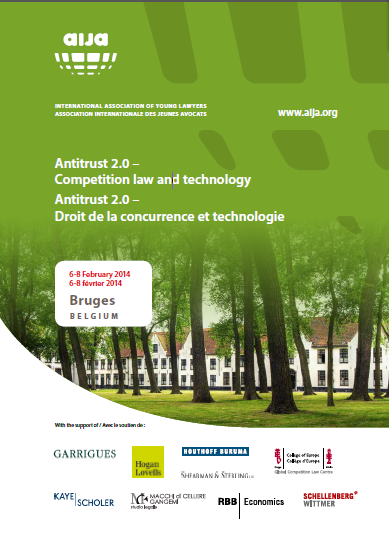
As anticipated a few days ago, on 7-8 February AIJA -with the collaboration of the College of Europe- will be holding a two-day conference on: Antitrust 2.0- Competition and Technology.
The conference will cover all hot issues in current antitrust enforcement in the IT sector, and will feature an impressive line-up of panelists (and then also Nicolas and myself).
It will be very much worth the visit to Bruges. The program is available here: Antitrust 2.0- Competition law and technology
P.S. Two other not-to-be-missed events (ones that I’ve been anxiously awaiting for quite some time) will be taking place in the next 24 hours: see here and here 😉
AG Wathelet’s Opinion in the Greek lignite case

The Opinion of Advocate General Wathelet in the very interesting Greek lignite case came out yesterday. This is the second time in recent weeks that the AG’s Opinion makes an impact in the competition scene with a tightly argued proposal (the previous one was his Opinion in Teléfonica).
You might remember that sometime ago we held our first and so far only ménage à trois debate precisely in relation to the General Court’s Judgment in the Greek lignite case:
For the moment, the AG’s Opinion essentialy sides with what José Luis Buendía wrote in his contribution to this debate a year ago (see here), and criticizes the solution adopted by the General Court.
There are however other very valid contrarian arguments, all brilliantly outlined in the pieces we published from Marixenia Davilla (part I ), and Assimakis Komninos (part III).
Television Rights, Matches – pun intended – and Bad Competition Law
[Guest post by Pablo Ibañez Colomo]

It would seem that the Spanish super-quango is more active than one would have assumed (in particular given what is currently going on within the tax authority of the country). The newly-created CNMC has fined four football teams (including Real Madrid and Barcelona) and the broadcaster Mediapro EUR 15 million for concluding exclusive licensing agreements for a period exceeding three years. Such terms contravened a previous decision adopted by the – then – CNC in 2010.
The case is interesting, first, because the Spanish government passed (in 2010, at pretty much the same time that the original decision was adopted) legislation that set a four-year term for exclusive licensing agreements between teams and broadcasters. One could claim that, insofar as the contentious agreements complied with the relevant sector-specific legislation, they were concluded in good faith. Accordingly, the fine would be unjustified. In light (pun intended) of Consorzio Industrie Fiammiferi (pun intended, I’m on fire!), it is clear, however, that this is not a valid defence. Legislation did not preclude undertakings from concluding agreements for a shorter period and thus from complying with Article 101 TFEU (which was clearly applicable in this case).
A second reason why the case is interesting is because it shows that the three-year limit for exclusive licensing agreements is now set in stone. There is no reason why this should be the case. A three-year term is not necessarily pro-competitive. It all depends on the context in which the licensing agreement is concluded. If the goal of this bright-line rule is (as I assume) to preserve the contestability of markets for the acquisition of television rights, then it may sometimes be too short. A new entrant (as BSkyB was back in the early 1990s) may need a longer period to reduce uncertainty and recoup its investments. By ruling out any flexibility, a rigid interpretation of Article 101(1) TFEU can very well have the perverse effect of protecting the incumbent. These are the problems of applying competition law as regulation, which I highlighted elsewhere, and of assuming that UEFA Champions League, Bundesliga and Premier League were rightly decided, in spite of the overwhelming evidence suggesting the opposite.
An eventful day

On 20 November we wrote a post on cartel fines saying the following:
“In spite of temporary appearances, though, one should not expect these figures to remain as they are. The upcoming LIBOR decision will certainly inject some significant (record breaking?) “capital” into this years’s numbers. On top of that, there appear to be a number of cartel decisions stuck somewhere in the pipeline (interestingly, only one cartel decision has so far been adopted in 2013)!.
We got it right (not that it was very difficult):
On the 27th, the Commission adopted a cartel decision fining North Sea shrimp producers [BAD JOKE ALERT] -what you’d call shellfish cartellists- with 28 million euros.
And yesterday, the Commission imposed the highest fine ever (1.7 billion euros) on a number of banks within the framework of the LIBOR investigation (still ongoing in relation to a number of parties who chose not to settle).
An interesting coincidence: yesterday representatives of the troika “advising” Spain on economic issues recommended that banks avoid any price wars (no kidding). Anyone sees mixed signals??
Also yesterday, the Commission unconditionally authorized the Microsoft/Nokia deal. It’ll be interesting to appeal (this time I’m kidding… or not) read the decision once it’s published 🙂
Finally, yesterday we had a reception to celebrate the launching of the procedural bible. A great evening all round.
The Groupe Gascogne Judgment (see both sides of the story)

Last week I wrote a post about the Groupe Gascogne Judgment (and other stuff) which has elicited some interest. Somehow oddly, I will now present counter-arguments against all those who… actually agreed with me.
Given that I wrote about the Judgment within minutes of its publication I obviously hadn’t thought the issue through. My initial reaction was (and regarding these points it still is) that by endorsing the De Grüne Punkt solution (i.e. choosing actions for damages as the procedural path to compensate breaches to the right to be judged within a reasonable time) instead of the Baustahlgewebe one (under which the ECJ itself would reduce a fine on account of the said breach when ruling on an application brought before it), the Court of Justice was adopting the less practical solution, and one that could provoke strange situations. Some of you have developed this last point in several comments to that post.
Now, after some reflection (although not much, to be frank) I think I may see what the Court and one of the commentators to the post meant, even if the Judgment’s reasoning may perhaps not have been crystal clear (please note the understatement).
In my post I only gave one view, and I believe that it’s good that readers also get to see the contrarian arguments. Not that I’m second guessing myself, but I don’t like it when we criticize Judgments/decisions without trying to understand first the reasons underlying the choice of a given approach (believe it or not Judges, clerks and Commission officials are actually clever enough not to be producing absolute nonsense all the time, as some lawyers like to claim). In other words, in some cases they may choose the wrong solutions (particularly if they ever rule against me in one of my cases -not that this actually would ever happen-; please note the implicit advertising claim), but there are always reasons for every approach they chose, and it’s healthy for us to try to identify them and debate them on their merits.
Cutting to the chase: it could be argued that endorsing Baustahlgewebe would have implied creating a specific regime that could only address the problem (a) only in competition cases [given that it is the sole area where the Commission enjoys the power to impose sanctions; in all other cases (frozen assets, for instance) actions for damages would be the only practicable solution], and (b) only in cases where a given company were to lose a first instance appeal before the General Court. Also, c) an assessment of damages by the ECJ would require it to rule on factual issues (namely harm quantification), when its jurisdicion is limited by the Treaty to points of law only. Furthermore, d) by providing that excessive delay in itself may open the door for an action for damages/a remedy, the ECJ could be effectively avoiding the possibility that “victims” might go to the ECHR (according to the ECHtR’s case law, there’s no “victim” in the sense of Art. 34 of the ECHR when the national legal system already envisages a remedy/compensation for the breach).
I can see how all these might have resonated within a Court like the ECJ. And it is probably true that Gascogne may be more “legally perfect”, albeit arguably at the cost of practicality and risking the odd situations pointed out in the previous post.
In spite of those perfectly valid arguments, I think I liked other solutions better, for instance:
a) one under which both Courts could assess the existence of excessive delays without it being necessary for parties to bring an additional action (the Commission, in fact, has done this in several past cases, and Courts could too). This is not legally unorthodox; it would not not be a matter of damages as such, but a reason to mitigate an initial sanction made more burdensome by the passing of time in the absence of judicial review. A solution of this sort is common to many national criminal law systems and is justified not on the actual damages suffered, but rather on the fact that there was an additional element (excessive time) subsequently added to the intended outcome of condemnation (i.e. the sanction). To counter-argue again against myself: admittedly, the quasi criminal nature of competition law may not be criminal enough for these purposes.
or
b) a compromise, middle-way and probably less legally controversial solution under which the ECJ would be competent to declare a violation of the right to a fair proceeding by account of excessive delays on the part of the GC (as it arguably did in this specific Judgment). Only quantification would then be left to the GC itself should the party wish to lodge an additional action for damages. For full disclosure: this is an alternative solution that we’re actually advocating before the ECJ in a pending case. But it’s reasonable, isn’t it? 😉
Case C-58/12 P Groupe Gascogne v Commission + some other stuff
– Fresh off the Court. This morning the ECJ handed down a Judgment in which it has ruled that the Court itself is not supposed to reduce the fine imposed on a company whenever judicial review by the General Court exceeds a reasonable time. This Judgment effectively and explicitly overrules the Baustahlgewebe Judgment, in which the ECJ had followed the opposite (and in my view much more reasonable approach). Today’s Judgment is premised on the idea that an application for damages brought against the EU would in all circumstances constitute an effective remedy to compensate for any damages caused by the GC’s failure to adjudicate within a reasonable time.
For those of you with less background on general EU law, actions for damages against the EU shall be brought before the General Court. In other words, parties who believe that the duration of proceedings before the General Court was excessively lenghtly should, by means of a different application, ask the General Court itself to ascertain whether its own behavior was appropriate in the light of the circumstances specific to the case and whether the parties suffered any harm. Good luck with that…
– Save the date! On February 7th and 8th AIJA [Association Internationale de Jeunes Avocats) (a generous institution according to which lawyers below 45 qualify as young] will be holding a two-day conference in Bruges under the title “Competition Law 2.0- Competition Law and Technology“. A not-to-be-missed excuse to spend part of the weekend in Bruges and pay a visit to the greatest beer bar ever discuss hot topics in current antitrust. Both Prof. Petit and myself will be speaking there.
– Speaking of current antitrust debates: the last number of the Journal of European Competition Law and Practice (a great journal that has rightly earned a prominent place in a saturated? market) features various very good articles, including one by our guest blogger Pablo Ibañez on State aid litigation. At another level, it also features a brief piece of mine [the hyperlink only leads to the abstract] about Google’s commitments (you already know my views). Ironically, my comment was written in relation to the first version of the commitments but features in the “current intelligence” section of the journal. Fortunately I did explicitly envisage “likely further tweaks over specific details” and all comments are applicable to the new (leaked) proposal.
Cartel fines (an illustrative graph)
These are the stats available in DG Comp’s webpage for cartel fines imposed in the period 2009-2013.
Do you see anything remarkable?
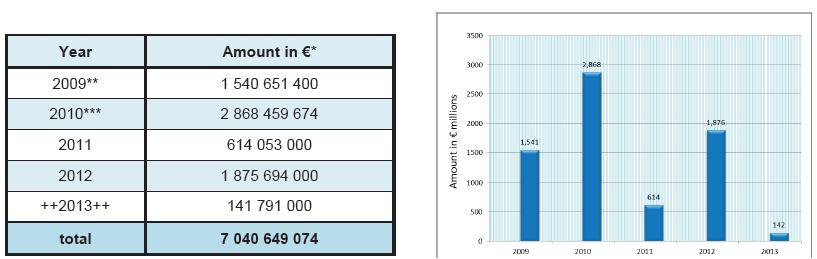
After years of lawyers whining about sky rocketing fines, will we now see a reverse trend of lawyers whining about too few cartel decisions and too small fines?? We are funny whining beings…
In spite of temporary appearances, though, one should not expect these figures to remain as they are. The upcoming LIBOR decision will certainly inject some significant (record breaking?) “capital” into this years’s numbers. On top of that, there appear to be a number of cartel decisions stuck somewhere in the pipeline (interestingly, only one cartel decision has so far been adopted in 2013).
P.S. For the one true masterpiece on cartel fines –Fine Arts in Brussels- click here (the fact that I co-wrote it doesn’t of course compromise my objectivity…).
XVII edition of the EU and Spanish competition law course

For 16 years now Luis Ortiz Blanco has been directing a top-notch competition law course in Madrid, which is actually where Nico and I first met. I followed this program as a student quite a few years ago, have lectured on it since then, and last year I started co-directing it together with Luis (which comes handy as a justifications to travel to Spain a bit more).
The line-up of more than 50 high-profile guest speakers who come every year from all over Europe to enjoy Madrid lecture in Madrid is a true Who’s Who of EU competition law experts. Moreover, the 115 hours of scheduled classes allow for a more detailed coverage than that offered by many other competition law courses on the market. About half of the course is lectured in English. Price wise the course is unbeatable: full registration is available for only 3,000 euros.
The final program for each module and seminar has yet to be confirmed, but the overall structure and dates have been set, so I’ve included the info below. Anyone interested can register both for the full program or just for specific module/s or seminar/s. Anyone interested in more information can contact me at alfonso.lamadrid@garrigues.com
The 2014 program will be structured as follows:
– An inaugural/introductory session by the not-so-good Professor Nicolas Petit will take place on January 10.
– A module on cartels (coordinated by myself) will be held on 13-15 January.
– A module on other restrictive agreements and practices (coordinated by Juan Andrés García Alonso; Peugeot) will take place on 20-22 January
– On 31 January there will be a seminar on recent developments in relation to Art. 101 (coordinated by Fernando Castillo de la Torre and Eric Gippini Fournier, both from the Legal Service of the European Commission).
– A module on abuse of dominance (coordinated by Nicolas) will take place on 3-5 February.
– A module on merger control (coordinated by Jerónimo Maíllo; San Pablo CEU University) will be held on 10-12 February.
– A seminar on recent developments in abuse of dominance and merger control coordinated by Cecilio Madero (Deputy Director General, DG Comp), Nicholas Banasevic and Per Hellström (both Heads of Unit at DG COMP) and Milan Kristof (Référendaire at the ECJ) will be held on 21 February.
– A module on competition law and regulation in network industries (coordinated by myself) will be held on 3-5 March.
– A module on the application of competition and state aid rules to public entities (coordinated by José Luis Buendía and Jorge Piernas) will take place on 13-14 March.
– A seminar on the application of competition law by judges and arbitral tribunals (coordinated by Francisco Manuel Serrano, Garrigues) will take place on 21 March.
Google’s revised commitments proposal leaked

Consumer Watchdog, a US organization traditionally positioned againts Google, has just made available leaked on its website the (supposedly confidential) new version of Google’s proposed commitments (see here: http://www.consumerwatchdog.org/resources/googlesettlment102113.pdf ) together with the Commission’s questionnaire to interested third parties (see here: http://www.consumerwatchdog.org/resources/euquestions102113.pdf).
This organization had threatened Google with making the proposal public in case Google didn’t do it (see here: http://www.consumerwatchdog.org/newsrelease/consumer-watchdog-challenges-google-make-eu-antitrust-settlement-offer-public-us-public). Julian Assange and Edward Snowden would may applaud the move, but I’m not so sure as to DG Comp (the fact that the names, telephone numbers and emails of its case handlers have also been made public as part of the questionnaire might contribute to flooding -even more- their inboxes…).
I’d bet that Consumer Watchdog has received some sort of advice under EU law and learnt that, interestingly, the Commission has no legal basis to act in a situation like this. Isn’t that a significant procedural gap?
You already know my thoughts about the substance of the previous proposal (if not, click here: https://chillingcompetition.com/2013/06/13/preliminary-thoughts-on-googles-proposed-commitments/ ), so not much else to say on that front.


 Chillin'Competition