Author Archive
Missing in action
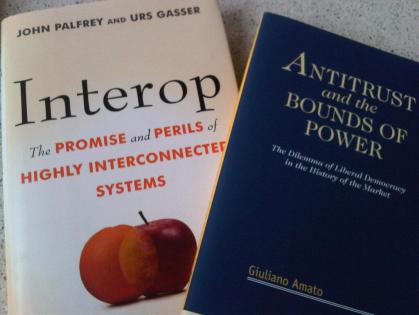
We are a disgrace:
Nico is missing in action in some lost island, and I’m on forced semi-vacation in Spain due to a humerus fracture provoked by a humorous ski fall, and unable to do anything but bad jokes (see above) and read (on the antitrust-related side I’ve particularly enjoyed the two in the pic above -Interop, and Antitrust and the bounds of power- which I would recommend you to read whenever you injure yourself..).
I’m telling you this because since Nico and I are unfit (that is, even more) to take care of the blog as we’d like, our friend Pablo Ibanez Colomo (LSE) has accepted to write some stuff in the coming days. We’re grateful to him, even if we know there’s a risk that you’ll like his posts more than ours! 😉
Write to you soon!
Google reaches a settlement with the FTC

Google has reached a settlement with the FTC! Details can be found here.
The settlement concerns the licensing practices of some key technologies to competitors and the management of campaigns by online advertisers. The investigation into Google’s search-related practices, on the other hand, has been closed (by a 5-0 vote).
According to the press release, Google’s ‘Universal Search’ and other changes can be ‘plausibly justified as innovations that improved Google’s product and the experience of its users’.
We are all wondering the impact this outcome will have on the (European) Commission’s ongoing investigation (although we presume this did not catch DG Comp’s officials by surprise).
Btw, I will be speaking soon about antitrust and search engines, so these developments come in handy (not sure if that’s the right expression considering that for a couple of months I’ll be a one handed man..)
Nicolas Petit- an Ordinary Professor

I’ve just realized that I forgot to share some good news with you.
A few days ago I learnt that Nicolas had been promoted to Professeur Ordinaire. To be frank, given my absolute ignorance about Belgian academia (among vety many other subjects), going from Professor to Ordinary Professor rather sounded like a downgrade.
But nope, Google tells me that Nico has managed to attain the highest possible academic position at age 33, which is very hard to understand impressive. While writing this I’ve realized that he also turned 34 on Saturday (which of course I forgot).
Congrats and best of lucks, Nico!
Death Star economics: on market power and technological innovation

A couple of days ago the FT published an interesting piece on how market power in the tech sector might disprove assumptions about technological rates of progress. According to the author, science fiction had long anticipated the trends we are seeing today.
I could dsummarize the piece, but since (i)I broke my arm/shoulder skiing; (ii) it’s taking me ages to type with my left hand (not that there’s much else I can do..), and (iii) many of you are probably on holidays, you can probably spare a couple of minutes to read it here.
Btw, happy new year !!!!
Antitrust law blogs

Competition law blogs are mushrooming. This means that Chillin’Competition is now subject to intense competitive pressure, and that Lindsey McSweeny will start having problems to pick the monthly posts for CPI’s Blogs o’ Blogs.
Some of you might remember that when Nico falsely announced that we were done with Chillin’Competition a new blog called Chilled Competition was rapidly created. Its first (and only) post was entitled “Low barriers to entry”. And it was very right: ayone can enter this market; in fact, as you will see below there are already a few entrants challenging incumbents.
– Kartellblog. We have the intuition that it’s a great blog. Unfortunately we cannot confirm it because neither of us can read German…
– Prof. Sokol’s blog: The best source of information for new antitrust-related publications. We don’t know how he does it, but he finds out about almost anything that is published.
– The Antitrust Hotch Potch. As you know, prior to starting Chillin’Competition Nicolas used to run the Antitrust Hotch Potch with Damien Geradin. Damien kept the blog and the trademark and has since then re-started it (about 3-4 times in the past few months) 😉 Damien has an admirable ability to surround himself with smart people (like Nico back in the day) and this time he has been joined by young Covington associates, namely John Wileur, Christos Malamataris and Jennifer Boudet. It’s a great initiative, so good luck! We will be happy to generate some debate with them (a piece of humble advice: in our experience it’s important to identify the person writing each post!).
– Kluwer Competition Law Blog. This one features very good stuff. It currently has more than 20 co-authors (including people who we know well and like, such as Thomas, Damien, José, Gavin…. ). In spite of the different styles it generally features very interesting stuff. The only thing we miss is more regular updates.
– Competition Bulletin. Written by 10 authors (Blackstone Chambers barristers + Oke Odudu) this blog features very interesting stuff, notably on UK competition law. I should have mentioned them here before (my apologies for the delay).
– Truthonthemarket. It not only covers antitrust issues, but also wider economic or IP-related issues. Its posts are always timely and insightful.
– Derechomercantilespana. Written by Jesús Alfaro, who does an amazing job covering all sorts of corporate and competition related development several times a day. How he gets the time is beyond me. The content ranges from a Judgment by a lower Court in a tiny village in Spain, to comments on EU to good music Non-spanish speakers won’t be able to enjoy it though.
– There are also a handful of blogs covering jurisdictions other than the US and the EU. Harün Gündüz once asked us to help advertise TurkishCompetitiionBulletin (well done!). Lalibrecompetencia is an excellent source of info on Latin American issues.
– Chillin’Competition: Written by two freak weirdows. One is a University Professor who spends his life in a car and likes to have his pic on his browser’s address bar. The other is a lawyer who somehow tricked his firm into letting him spread nonsense in the public domain. We frankly would not recommend you to ever read it. For each decent post they write there are dozens of nonsensical ones.
Breaking news – Chillin’ leaks

Following the political turmoil caused by Mario Monti’s announced resignation, and in order to achieve a compromise solution to Italy’s political deadlock, Silvio Berlusconi has been nominated as the new Italian Judge before the European Court of Justice.
In a press release issued a few minutes ago, the Italian Government states that:
“Berlusconi is the ideal candidate for the job: there is no other Italian citizen with more experience in Court proceedings, and his contribution to European criminal law is beyond question“.
Chillin’Competition has learnt that Mr. Berlusconi has already initiated the recruiting process for his new clerks. We have had exclusive access to a picture taken outside the villa where the interviews are being held; the picture conveys the sense of excitement and urgency prevalent among candidates to the job (see here).
The content of the tests remains confidential, but our sources tell us that there will be no written part.
Chillin’Competition’s Christmas contest
This is obviously a joke, but it’s also the opening post for a new game. Some of you certainly are (or should) be familiar with sites such as The Onion (Spaniards woud rather follow Elmundotoday). We want to play after them. That’s why we are setting up a contest for the funniest competition law fake news 😉
We are giving out a special pack of Christmas delicacies from my family’s bakery to the person who sends us the funniest fake news. We donñt care about length: they can be one page, one line, even just a headline could do the trick.
We’ll hold a public vote next Friday.
You can get some inspiration from some of our previous fake news, such as: Reactions to the endives cartel; The post of a fresh summer day; or An Antitrust Challenge to God.
Career advice

No gym in 3 weeks; no free weekends in a few months (a bit of an exaggeration, but whining goes with the profession); quite few after-work beers, and then Mark English and Sarah Ashall send me this….thanks for the advice!
Btw, if you have 5 free minutes I would very very much recommend you to read this: How will you measure your life?
ECJ’s Judgment in Case C-457/10 P Astra Zeneca

[There are too many things going on this week on which we would like to comment (not least yesterday’s record fine in the CRT cartel) and we hear that next week may be even more interesting… We had another post planned for today, but current news rule, and we wanted to provide you with the first comment of today’s Judgment in AstraZeneca. So, here’s a subjective and hastily written summary + comments. It might be a living-post, meaning that it might be updated as further thoughts come to mind. Anyone who might want to use this to draft client alerts: please consider this as a Sint Nicholas gift 😉 ]
It could make sense to hold a ménage à trois discussion on this Judgment; candidates are welcome…
Today the European Court of Justice (“ECJ”) issued its long-awaited Judgment in the AstraZeneca (“AZ”) case. The ECJ has upheld the 2010 Judgment from the General Court, which in turn had endorsed the Commission’s 2005 infringement decision.
Background
As most of you know, the Commission had found that AZ abused its dominant position by (a) making misleading representations to patent offices of several Member States with a view to extending the period of patent protection for its product Losec (an omeprazole-based medicinal product used in the treatment of gastrointestinal conditions); and (b) requestintg the deregistration of market authorisations for Losec capsules in Denmark, Norway and Sweden. These conducts were ultimately aimed at keeping manufacturers of generic products at bay, as well as at preventing parallel trade.
In 2010 the General Court dismissed most of AZ’s arguments, but reduced the fine from € 40.25 million to € 12.25 million on the grounds that the Commission had not proved that AZ’s conduct had prevented parallel imports of Losec in Norway and Denmark. AZ appealed this Judgment, and in doing so brought before the ECJ some issues which are of crucial relevance to the very notion of abusive conduct.
Today’s Judgment
– Market definition is discussed in paras. 31-60. I had started to summarize it, but it would take too long. Unless you represent AZ you can skip (lots of factual stuff, there’s nothing that will rock your world)
– The first abuse
The logic in the GC’s Judgment was that AZ deliberate (intention plays a key role here) submission of misleading information to public authorities with a view to obtaining the grant of an exclusive right to which it was not entitled falls outside the scope of competition on the merits, and therefore within the category of abusive conduct.
AZ and EFPIA argued that AZ had simply failed to disclose to patent offices its bona fides and allegedly reasonable interpretation of the patent rules, and that this could not be equated with “objective misleading”. In their view, even if AZ’s interpretation ultimately proved wrong, it was not aimed at misleading. The applicants claimed that pursuant to the GC’s standard, dominant companies would have to be infallible in their dealings with regulatory authorities, which, in turn, would impede and delay patent applications in the EU. [i.e. the basic trick of trying to scare the Court alleging that hell will break loose; as if it had since the Decision was issued in 2005….]
The ECJ’s Judgment -like the GC’s- is solidly grounded on Hoffman la Roche’s rather unhelpful definition of abuse as conduct different from “competition on the merits”. It does not require the abusive conduct to flow directly from the exercise of the undertaking’s dominanat position; on the contrary, it assumes that the presence of a dominant company already implies that the degree of competition in a market is hindered (the clearest formulation of this idea appears in para. 150, with respect to another ground of appeal), and that therefore it has a special responsibility to ensure that competition is nor further undermined.
The ECJ does a good job in setting out the objective reasons why AZ’s conduct was consciously motivated by the desire to mislead public authorities in order to maintain its dominant position (see paras. 79-93). The Court notes in paras. 94-100 that if AZ’s interpretation had been reasonable (as AZ claimed), then it should have disclosed the relevant information informing its interpretation (the Judgment doesn’t put it this way, but the idea seems to be that the intentional failure to disclose that info provides a valuable indication of the merits that AZ seemed to attribute to its own reasoning). Para 98 makes it clear that even if you have a “legally defensible interpretation” this is not excuse resorting to highly misleading representations with the aim of leading public authorities into error.
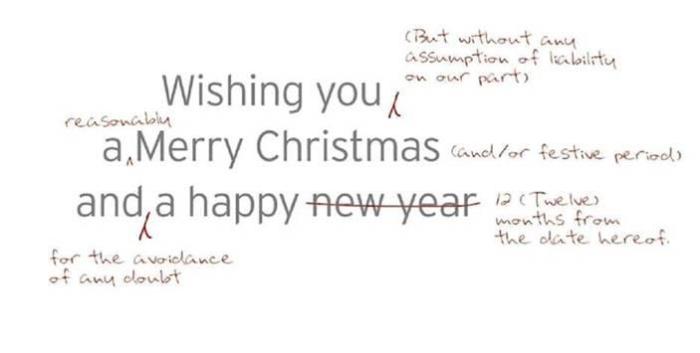
In para 99 the Court responds to the “hell will break loose argument” (see my second word crossing above) stating that the GC did not require infallibility in patent applications (“it thus cannot be inferred from that Judgment that any patent application made by such an undertaking which is rejected on the grounds that it does not satisfy the patentability criteria automatically gives rise to liability under Article 102“), and that the Judgment is confined to the specific circumstances of the case. There’s a difference between requiring infalibility and reprehending someone who obviously and intentionally fails to act right.
The Court then deals with the argument that AZ’s conduct (its apliccation for SPCs) was labelled as abusive regardless of its lack of effects. It states that the “examination by the General Court is not in any way based on the assumption that the practice in question constitutes an abuse in itself regardless of anticompetitive effects” (para. 106). The ECJ confirms that AZs misleading interpretations were liable to lead the public authorities to grant it a right to which it was not entitled, and that this in fact happened in several Member States (paras. 107 and 108). In para. 110 the Court makes it clear that even if the effects of the abuse were also felt at a period in which AZ was not dominant anymore, this is irrelevant for the assessment of the legallity of a practice carried out while AZ was dominant. The Court also upholds the GC’s conclusion that AZ did not achieve its goal in some Member States its conduct was “very likely to result in the unlawful SPCs” (para. 111).
The ECJ makes it cleat that in Art 102 cases there is no “requirement that current and certain anticompetitive effects be shown“. Citing para. 64 of TeliaSonera the ECJ states that “although the practice of an undertaking in a dominant position cannot be characterised as abusive in the absence of any anti-competitive effects on the market, such an effect does not necessarily have to be concrete, and it is sufficient to demonstrate that there is a potential anti-competitive effect” (para. 112) (unlike in TeliaSonera, there is no reference to the exclusion of “as efficient competitors”, but this is probably due to the different factual settings in the two cases).
Groundhog day, self-restraint, and shooting one’s own foot
I’ll give you a sneak peek into how the editorial process of this blog works:
I frankly wasn’t planning on posting anything on the blog for the rest of the rather busy week. But then I attended a conference, and an idea spurred to mind: why not write a post on how a few -not all-competition conferences (topics and speakers) are starting to make us feel inside a time loop, sort of like in the Groundhog day movie…
Maybe not, I thought later; perhaps some of the usual suspects frequent speakers in the conference market wouldn’t like it (there are categories among these: (i) those who never refuse invitations out of politeness -which I find laudable- and who are also tired of speaking always about the same stuff, however convenient; and (ii) those who pay for speaking slots -which I understand less- and who wouldn’t appreciate the comment). Moreover, we had also bragged about how we would do something different announced our own conference and have not yet arranged it, so it’s probably wise not to write on this. So, as you see, I’m not. 😉
But now Gianni de Stefano (from Latham and antitrustitalia) sends us a GCR piece titled: “Spain fines antitrust complainant” joking that we should write about it. And he’s right, we could not let this pass by without a post…
You see, I don’t want to write too much Spain-related stuff, and so a few days ago I resisted the temptation of writing anything about prioritization and allocation of resources when the CNC sanctioned 5 distributors of Magic cards with 7,000 euros (one party received a 148 euro fine, another a 748 euro fine; the highest fine was 3,424 euros). I won’t comment on this either (as if it was necessary…). But this silence exhausted my self-restraint capacity.
So let’s focus on yesterday’s news. What happened is the following: the association of canned fish producers [yes, those responsible for the death of the sole responsible of Spain’s victory in the 2010 World Cup: Octopus Paul –evidence of the murder available here-] lodged a complaint against mussels producers alleging that the latter had entered into price-fixing agreements. The CNC sanctioned mussels producers with 1.7 million. So far so good (except for mussels producers). The fact of the matter is that within the framework of the investigation the CNC discovered that the complainants had themselves decided to react to the cartel by agreeing on a collective boycott. And now the complainants have received a 2.1 million fine. Once again, no comment. [Query: could you complain about a cartel and ask for leniency regarding another reprisal cartel?]

Actually, there’s one comment. If the accusations are true there is nothing to object to the CNC’s decision. But I have been involved in a few other cases where the complainants were also the instigators of the agreements complained of, but they weren’t sanctioned. Curiously enough, in all of these cases the complainants were not companies, but individuals, labor unions or public bodies. There is probably a reason for this: sanctioning companies has the political advantage that when they get pi.. crossed they don’t do this…
P.S. The food sector has given us so much food for jokes thought that the European Commission’s statement that there are no particular competition problems (after having set up a task force, drafted this report, and done all this) was a surprise to us.


 Chillin'Competition


