Author Archive
A CHALLENGE FOR THE COMPETITION COMMUNITY

We tried to put an end to the 2020 nightmare with a bit of humor, and with an award in memory of someone we lost. Chillin’Competition now wants to follow up with a bit of hope, and with a challenge.
We have often claimed that the competition community is special, and that the people in it are special too (mostly in a good way ;-)). We would now like to prove this. When we ran our meme contest, Isabelle de Silva (President of the French Competition Authority) suggested that we should again use the best memes to produce mugs. This gave us the idea to refocus a light hearted contest – and actually to leverage whatever reach this blog may have – towards supporting other much more serious, important and worthy initiatives, like KickCancer.
KickCancer is a public interest foundation devoted to combatting childhood cancer. KickCancer finances these innovative research projects aimed at understanding and curing paediatric cancer. Their cause could not be more important, or more fitting given the various extraordinary colleagues we sadly lost to cancer this past year. KickCancer is also an organization that is doing its best to turn an adverse event into a force for change (which in a way symbolizes what we want to get out of this pandemic too). It is an organization that finances projects with a European scope. It is an organization that approaches the most serious possible cause with humour. And since no organization is perfect, this one is largely run by lawyers 😉
Chillin’Competition has partnered with KickCancer to sell customized mugs featuring the winners of our meme contest, as selected by our devoted jurors (Foo Yun-Chee, Lewis Crofts, Javier Espinoza, Thibault Larger and Aoife White).
YOU CAN NOW BUY THE WINNING MEME MUGS HERE
All funds will go directly to KickCancer, and the (evident) overprice will be devoted to financing paediatric cancer research.
We would encourage you buy mugs for your colleagues, employees, clients, students, friends or for yourselves. It will cost you little, and it would help a lot. To facilitate logistics, we would also encourage you to collude, make a joint purchase and set a single delivery point for various mugs (shipping costs are free if you buy more than 10). You will be able to buy these mugs until 19 March.
The mugs are obviously nothing but an excuse. You can contribute to KickCancer in any way you can, also through direct donations (which will get you a tax deduction instead of a mug). You can do that in less time than it would take you to read one of our posts, for less than the cost of a takeaway meal (or for a very small fraction of a billable hour), and it will have a much more positive impact than either of those 😉
It would be nice to demonstrate that the competition community can beat all others not only in numbers of conferences, webinars and awards per capita, but also at joining forces in support of something that truly matters.
Recent developments in EU Competition Law (5 February 2021)
It has become a long-established tradition for our friends Fernando Castillo de la Torre and Eric Gippini-Fournier to coordinate a high-level, one-afternoon seminar in the context of the annual IEB competition law course.
This is the first year where participants will not be travelling to Madrid. While we very much hope that this will change next year, the online format (we will be using Microsoft Teams) will give you the opportunity to discover one of the best kept secrets in the world of competition law events. The program speaks for itself:
Friday, 5 February 2021
Moderators: Fernando Castillo de la Torre & Eric Gippini Fournier. European Commission, Legal Service.
16:00 –18:00: Competition investigations in the digital era: recent case law and practice about powers of investigation
‐Marc Van der Woude. President, General Court of the European Union.
‐Cani Fernández. President, Spanish Competition Authority (Comisión Nacional de los Mercados y la Competencia).
‐Nathalie Jalabert Doury. Partner, Mayer Brown.
‐Anthony Dawes. European Commission, Legal Service.
18:00 –20:00: Article 102 –Looking past (beyond) “GAFA”: recent cases and current issues outside digital markets
‐Pierre Régibeau. Chief Economist, European Commission.
‐Evelina Kurgonaite. Secretary General, Fair Standards Alliance.
‐Luc Gyselen. Partner, Arnold & Porter.
‐Ekaterina Rousseva. European Commission, DG COMP.
***
Registration information is available here:
Should you have any questions, you can also write to competencia@ieb.es
Announcing the Winner and Finalists of Chillin’Competition’s 1st Rubén Perea Award

On 1 April 2020 we lost Rubén Perea, a gentle and kind young man and a bright lawyer who had just graduated from the College of Europe and was about to start a career in competition law. The loss of Rubén after a brave fight against cancer and missed surgeries due to the Covid-19 outbreak in a way symbolizes for us what we lost in 2020.
We decided to set up an award to honor his memory, and to recognize the work of other promising competition lawyers/economists under 30.
We received a large number of submissions. These were reviewed by a devoted jury composed of reknown experts, some of whom were also friends, former teachers or colleagues of Rubén, namely Damien Gerard, Lena Hornkhol, David Pérez de Lamo, Michele Piergiovanni, Gianni de Stefano and myself (our gratitude goes to all of them for devoting part of their time to this project).
It was a tough job, but the Jury has now selected a winner who, when the circumstances allow it, will receive the Award from Executive Vice-President Vestager, who very kindly and immediately accepted our invitation.
And the winner of the 1st edition of the Rubén Perea award is…
VLADYA REVERDIN, for her paper: “Abuse of Dominance in Digital Markets: Can Amazon’s collection and use of third-party sellers’ data constitute an abuse of a dominant position under the legal standards developed by the European Courts for Article 102 TFEU?“
The Jury also selected other 4 papers of particularly high quality. JECLAP will publish these papers in a special issue that will also feature Ruben’s LLM paper and an introduction from his friends. The selected papers and authors are:
–The Selective Advantage Criterion in Tax Rulings: The Path Towards a More Coherent and Thorough Analysis of Selectivity (by Nieves Bayón Fernández)
-When does Algorithmic Pricing Result in an Intra-Platform Anticompetitive Agreement or Concerted Practice? The Case of Uber in the Framework of EU Competition Law (by Hubert Bekisz)
–At the Mercy of the Gatekeeper: the Theory and Practice of Undertakings’ Fundamental Rights in the EU Cartel Settlement Procedure (by Stefan Ciubotaru)
-Which Sustainability Agreements are not Caught by Article 101(1) TFEU? (by David Wouters)
Our warmest congratulations go to Vladya, as well as to Nieves, Hubert, Stefan and David!
And thanks a million also to all those who submitted their work for this award; you truly made the Jury have a hard time.
2020 Competition Memes Competition (V)
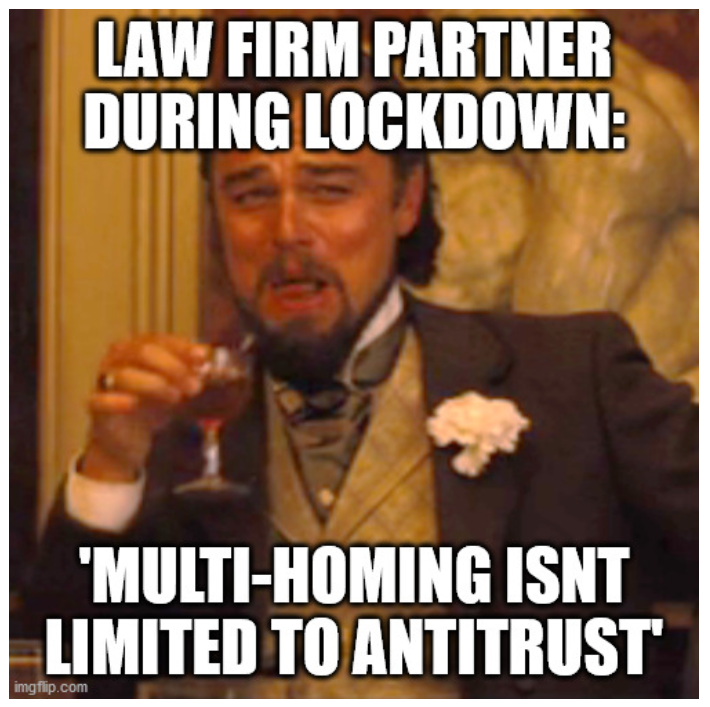
This is the final round of our 2020 Competition Memes Competition (click here for the first, second, third and fourth posts in these series). We hope that these may have brought some smiles to your faces. Our expert meme jurors (Aofe White, Foo-Yun Chee, Lewis Crofts, Javier Espinoza and Thibault Larger) will now devote all of their free time to selecting the winner(s). We have an idea to put these memes to use for a good cause. More details coming soon…


10 Comments on the Commission’s DMA Proposal

The DMA proposal is a bold and ambitious attempt to rewrite the rules applicable to (some) digital platforms. While competition law has proved dynamic and capable of constant evolution to address these and other challenges, this proposal would bring about a revolution. There are very different views on whether this may be a good or a bad thing (certainly no expert-consensus either way). All views are legitimate. Here are mine, surely influenced by my work.
1) EU legislators are not afraid of taking up an extraordinarily difficult task, and of breaking new ground, in addressing some of the anxiety about these markets; that is not necessarily a bad thing. EU legislators have the right to try, but also the responsibility to get it right. With great regulatory powers also comes great responsibility.
2) The DMA proposal will first need to overcome legal and political hurdles, but its practical implementation would pose even greater challenges. Managing such a far reaching tool, and managing expectations, could prove a daunting task.
3) The proposal makes a commendable effort to make rules more efficient. The combined promise of far-reaching remedies and relaxed intervention standards (i.e the perception that the sky is the limit) may, however, expose the Commission to continuous and unprecedented pressure and lobbying on the part of stakeholders. We are already witnessing this phenomenon regarding remedies in some specific cases. The proposal would turn this into the new normal. Imagine a world of evergreening investigations and remedy disputes. It is important to realize that the limitations imposed by the law are also meant to protect Institutions from possible pressures.
4) The criteria to identify what companies would qualify as “gatekeepers” will no doubt attract much of the attention given that the proposal would appear to cover companies other than just the five or six that you may have had in mind. The Commission explains that companies meeting the proposed objective thresholds may be able to rebut the “gatekeeper” presumption, even if it is unclear exactly how they might be able to do that. Conversely, the Commission proposed to have the power to identify as gatekeepers companies that do not meet all of these thresholds following a market investigation and “on the basis of a qualitative assessment”. Given their potentially very broad implications, the legislators might need to think very carefully about the relevant criteria to govern these exercises.
5) The DMA proposal incorporates some ideas worth considering that could make users better off while not compromising trade-offs (e.g. an example of low hanging fruit concerns the prohibition for users to complain to agencies). With some exceptions (e.g. MFNs), the list of absolute prohibitions in Art. 5 is an improvement by reference to the leaked previous drafts. The recognition that compliance with other prohibitions (those in Art. 6) would require regulatory dialogue would also seem positive, in that it reflects the complexity inherent to some of these practices (e.g. self preferencing) and could leave room for a more nuanced approach.
The problem, in my view, lies not so much on the very existence of absolute or relative blacklists (even if various competition authorities have cautioned against them), but on the various provisions overlapping with competition law. As observed by competition authorities like the CNMC, this overlap is premised on the assumption (fueled by the parallel publication of various reports) that competition law’s reach may be insufficient. This premise is questionable, but it perhaps reveals what may be the object, or at the very least the effect, of the proposal. The Impact Assessment transparently acknowledges the overlap, but notes that ”competition law is not always an ideal solution due to challenges in applying the market definition concept in multi-sided markets, lengthy timeframes, high legal thresholds to prove abuse, and the backward-looking nature of intervention” (emphasis added). The current proposal would certainly do away with those difficulties and thresholds. It would create a new competition regime under the guise of regulation and free from legal constraints (Ceci n’est pas competition law). At the time the expert reports came out my comment was that one could not aspire to change competition law (shifting the burden of proof or lowering standards to intervene) without the participation of the EU Courts. Admittedly, that was naive, because this proposal is a smart way of obtaining the very same result, only in relation to a limited category of companies.
6) Under the proposed DMA, the Commission would be able to challenge the very same practices that it is now challenging in ongoing cases, only faster, avoiding the limits set by the EU Courts, not having to define markets, show likely potential effects (competition law is not backward-looking!), deal with ambiguities, or indeed bear the burden of proof. Simple rules for a complex world, I guess. At the same time, the Commission would be able to impose the same sanctions and the same remedies as under competition law. In these circumstances, one may wonder whether the Commission or complainants will have any incentives to choose to challenge alleged anticompetitive behavior of “gatekeepers” via Articles 101 and 102 TFEU. National competition authorities, on the contrary, would not get to benefit from these shortcuts. The law and the Courts would also be largely displaced to the benefit of more discretion (giving rise, in passing, to a new mixed breed of lawyers/lobbyists and economists/lobbyists). Once again, there are different views or whether this may be a good thing or not.
7) It is fair and legitimate for the proposal to be informed by the experience acquired in recent cases. For the very same reasons, it would also be convenient not to dismiss the experience acquired in earlier cases (and in future Judgments). It is often wise to first try to understand what one intends to dismiss. And it is important to understand that the limits set by the EU Courts are not capricious, but the result of a steady and incremental evolution, of slowly distilled common sense over decades of experience, fact-finding, balancing of trade-offs and learning from mistakes. Those limits, moreover, do not appear to have been an obstacle given the Commission’s almost immaculate track-record of success in Court.
8) As anticipated, the proposal is based on Art. 114 TFEU (harmonization of national rules to avoid regulatory fragmentation). This legal basis has the advantage of avoiding the unanimity requirement in the Council, but it also implies certain limits to EU action, and it may make the DMA vulnerable to a possible legal challenge (for more on that, see here). As I told Politico, to be on the safe side, Member States and the Parliament would need to ensure that the final version of the DMA does not go beyond its declared goal of preventing regulatory fragmentation across the internal market.
9) The proposal refers to a new set of “harmonized rules”, but it would appear to leave Member States’ margin of legislative manoeuver intact. The Impact Assessment, in fact, observes that some Member States may adopt additional parallel rules (“[a]lthough some national administrations such as those in France and Germany, have taken steps to implement national measures, these may be seen as supportive of and potentially complementary to EU solutions”).
10) This is only the start of a long legislative process which should hopefully contribute to a sensible, balanced and effective solution. As arduous as the legislative process may be, an eventual DMA would face greater challenges. One may disagree with some of these proposals, as I do, but one should also applaud the Commission for launching a necessary debate on how to regulate the digital world.
[Disclaimer: my clients include various companies that could potentially be subject to these new rules. The comments above should coincide with the views I share with my clients, but certainly do not reflect their own views or those of my firm]
2020 Competition Memes Competition (IV)
Here is the 4th batch of 2020 competition memes (click here for the first, second and third posts in these series). Given the very large number of contributions received we will not be able to post all of of them on the blog (the jury will see them all, though; we feel sorry for them…). Please remain assured that the selection below has been made pursuant to unfair, unreasonable and discriminatory criteria (and by a committee, which makes it even worse).


Revisiting Alrosa: Today’s CJEU Judgment in Canal+ (Case 132/19 P)

Ruling today on the Canal+ case (click here for the Judgment, not yet available in English) the CJEU has effectively corrected some of the excesses of its 2009 Alrosa Judgment, whose effects on competition enforcement over the past decade are difficult to understate. Today’s Judgment is equally poised to have a major impact on future competition law enforcement.
In Alrosa, the CJEU quashed a GC ruling that had, in turn, annulled a Commission decision for (i) failing to comply with the principle of proportionality, and (ii) for failing to respect Alrosa’s right to be heard on the proportionality of the individual commitments offered by De Beers (the GC took the view that the complete prohibition of all commercial relations between the two parties with effect from 2009 was manifestly disproportionate).
On appeal, the CJEU held that in the context of commitment decisions the principle of proportionality plays a different role than in infringement decisions, requiring only that the Commission ascertain that the commitments addressed its concerns. The Alrosa Judgment enabled the Commission to make binging remedies that would go beyond what would have been possible in infringement decisions and, in a way, changed our mindsets about how far competition law could reach.
Today’s Judgment nuances, and in a way implicitly reverses, part of the Alrosa ruling. The CJEU again quashes the GC’s Judgment in first instance, but this time for the opposite reason; that is, for failing fully to consider the impact of the commitments on the contractual rights of third parties.
The CJEU does not explicitly recognize that this Judgment in any way corrects Alrosa. AG Pitruzella’s Opinion, however, hinted that the Court’s interpretation of the principle of proportionality in Alrosa had been particularly restrictive (para. 120) (for Pablo’s comments on the Opinion, see here).
The CJEU’s reasoning, in fact, is that today’s Judgment does not necessarily depart from the letter of Alrosa. At para. 106 the Judgment makes a distinction between assessing proportionality by reference to the Commission’s competition concerns (where Alrosa would still apply) and assessing proportionality by reference to the impact on the contractual rights of third parties (where, as explained below, today’s Judgment kicks in). This is in line with the AG’s Opinion (para. 122). Admittedly, the Alrosa Judgment did make the point that third parties rights should be taken into consideration.
Specifically, today’s Judgment observes that Paramount’s commitments in the Pay-TV case (on which we commented here and here) automatically imply that it would not fulfill its contractual obligations, vis-à-vis third parties, like Canal+. In the circumstances of the case, this meant that Paramount would not be able to act against any violations of the territorial exclusivity obligations protecting its licensees.
The Commission had argued, and the GC had accepted, that this would not be a problem, because affected third parties could always seek to enforce their contractual rights against Paramount before a national Court. After all, as you know, and as made further clear in Gasorba, the existence of a commitment decision to address competition concerns created by certain practices does not prevent national competition authorities and national courts from assessing the compatibility of those same practices with Articles 101 and 102.
The CJEU, following the recommendation of the AG, finds that this possibility cannot ensure an adequate and effective protection of third parties’ contractual rights. This is because pursuant to the Masterfoods case law, now codified in Art. 16 of Regulation 1/2003, national courts would not be able to require an undertaking to contravene commitments made binding by a Commission Decision.
Importantly, the Judgment makes use of the possibility to directly rule on the merits of the case instead of remanding the case to the GC. This is because the commitments accepted by the Commission affected an essential element to the balance of the contracts at issue (para. 126) that would devoid of substance the contractual rights conferred upon Canal + (para. 127).
A few additional comments:
- It is clear that going forward the Judgment will constrain the Commission’s discretion to accept commitments (as well as the proposal of those commitments by undertakings) and that it will increase the relevance of third parties. The extent to which this will have a material effect is hard to anticipate. It is possible that the Courts may generally defer to the Commission’s analysis of proportionality, but the very obligation to conduct a proportionality assessment is likely to result in better-designed remedies (and possibly in more litigation).
- Today’s Judgment, and notably the idea that remedies altering the essential balance of contracts are by definition disproportionate, could arguably have some implications beyond Art.9 commitment cases. Proportionality nonetheless would need to be checked against the public interest, and the situation will arguably be different in cases involving clear infringements.
- The commitments offered by other Hollywood Studios in this very same investigation, which were made binding by a different Commission decision, are the subject of a separate pending Canal+ appeal before the GC in Case T-358/19. It seems safe to say these are now doomed.
- A particularly interesting question is whether this Judgment may have an impact on other pre-existing commitment decisions, but this is one that requires some more reflection.
- This is a Judgment from the CJEU’s Second Chamber, including competition experts like Nils Wahl and, importantly, featuring President Lenaerts acting as a Judge.
DISCLAIMER: I have represented PACT, the UK Producers Alliance for Cinema and Television, one of the third parties affected by the Commission’s Decision, whose members might be directly affected by today’s Judgment.
The Key to Understand the Digital Markets Act: It’s the Legal Basis

The question of the legal basis might be the single most important legal and political issue when it comes to the design and adoption of the future Digital Markets Act (as anticipated here). Yet, it has been largely overlooked by external observers.
The desire to come up with a new tool that would enable enforcers to operate free from the constraints imposed by the competition case law may have obscured the fact that EU legislators also operate under legal constraints. These constraints are not the bread-and-butter of most competition lawyers (much less economists) so it is only understandable that many commentators might have missed it. Unsurprisingly, these legal concerns have not escaped the Commission’s internal reviewers.
Press reports (see here) suggest that the Commission’s proposal may have been delayed and somewhat watered down due to internal “legal basis concerns”. These were to be expected. In my view, it is impossible to properly understand or discuss the upcoming DMA proposal absent some context about the legal basis debate.
This should hopefully help you understand what is happening, and anticipate what might happen going forward:
What is the issue?
The EU can only legislate within the confines of the powers conferred upon it by the Treaties. Each legislative proposal needs to have a “legal basis” in the Treaty. Different Treaty provisions provide the legal basis for legislative action in each area. The choice of the legal basis will determine the legislative procedure (including who acts as legislator) and the possible scope of the act.
In the field of competition law, Art. 103 TFEU enables the Council, on a Commission proposal, to legislate in order to “give effect to the principles set out in Articles 101 and 102”. That legal basis, however, would not allow the EU to go beyond Arts. 101 and 102, which was precisely the idea here. So this legal basis would, at least in itself, be insufficient.
The Treaty contains a specific Protocol (Protocol 27, on the internal market and competition) indicating that, should the EU need new powers to protect competition in the internal market, it can resort to Art. 352 TFEU. This is a legal basis envisaged precisely for situations like the one at issue here. It was actually the legal basis used for the adoption of the merger regulation, which was also adopted to fill gaps in Arts. 101 and 102 TFEU. Art. 352 TFEU would, evidently, appear to be the appropriate legal basis for the creation of new and far-reaching powers. BUT, it requires unanimity among Member States, and it would not enable the Parliament to act as co-legislator. Either to bypass the unanimity requirement or because the Commission wants to involve the Parliament, the Commission prefers an alternative legal basis: Art. 114 TFEU. It seems clear that this will be the legal basis of the proposed Regulation.
What the Commission can (and cannot) do under Article 114 TFEU
Art. 114 TFEU enables the EU to adopt “measures for the approximation of the provisions laid down by law, regulation or administrative action in Member States which have as their object the establishment and functioning of the internal market”. Under Art. 114 TFEU, the proposal would be dealt with under the ordinary legislative procedure (with Council and Parliament acting as co-legislators), and it would not require unanimity among Member States. The choice of this legal basis nonetheless carries some constraints.
There is plenty of EU case law on Art. 114. This case law makes clear that measures which do not harmonize national rules (e.g. because they aim at introducing new legal forms and/or leave unchanged the different national laws in existence) cannot be adopted under Art. 114 TFEU. And even when reliance on Art. 114 as a legal basis is justified, any legislative measure should comply with the principle of proportionality (i.e. the measure must be appropriate for attaining the objective pursued and not go beyond what is necessary to achieve it).
The Commission is obviously aware of this (awareness may be particularly acute within the Legal Service and the Regulatory Scrutiny Board). To rely on Art. 114 TFEU as the legal basis and avoid the unanimity requirement, the Commission needs to argue that the proposed legislation’s primary aim is not about protecting competition beyond Arts 101 and 102 (which was widely assumed to be the goal of the proposal, as also suggested by the digital reports and the myriad webinars on this new legislation) but to harmonize national rules. In recent weeks the Commission has made all possible efforts to emphasize this message (for two examples, see here and here; there are many more).
For this to be correct, the proposal would need to (i) show a risk of likely regulatory fragmentation liable to distort competition; (ii) be designed to prevent regulatory fragmentation within the internal market; and (iii) not go beyond what is necessary to attain that goal.
What to look for in the proposal
At this stage it is unclear how the adoption of the DMA would prevent Member States from adopting or maintaining in force divergent national rules (e.g. German plans to amend national competition rules). In fact, some competition authorities such as the CNMC have warned (see here) that the new EU rules themselves could cause, rather than prevent, regulatory fragmentation. To validly rely on Art. 114 TFEU, the DMA would need to set limits for Member States to deviate from the DMA’s provisions. Keep an eye peeled for that.
The Commission has some discretion to choose the specific harmonization method, and this may include preventive measures and even imposing obligations upon private parties. To validly rely on Art. 114 TFEU, however, the proposal would also need to ensure that the eventual provisions of the DMA do not go beyond what is necessary to address appreciable distortions arising from regulatory fragmentation. The proportionality analysis may be particularly relevant in relation to both the definition of the DMA’s scope and the articulation of the more far-reaching measures proposed (e.g. “blacklisted” practices). The Nordic competition authorities and the CNMC, among others, have also expressed doubts about the proportionality of such an approach, so it will be interesting to see how this will be framed in the upcoming proposal.
What can the European Parliament do?
The Parliament is arguably the Institution with the greatest interest in operating under Art. 114 TFEU to preserve its role as co-legislator (under Art. 352 TFEU the Parliament would only be able to give or deny its consent to the Proposal). The Parliament, understandably, has a history of pushing for Art. 114 TFEU in the face of doubt. The need to remain within the confines of this provision might rule out the most far-reaching amendments that some may have had in mind. If anything, the Parliament would need to ensure the proportionality of the Act by reference to its stated aim.
And then what?
Until the proposal is out and these details (among others) are clear, it would not be prudent to express an opinion about the chances that it might withstand Court scrutiny, if it ever comes that.
[DISCLAIMER: As explained here, I advise a number of companies that could be affected by the new rules. The views in this post are exclusively mine and while they may coincide with the advice I have provided to clients, they do not in any way reflect any client’s views].


2020 Competition Memes Competition (II)
Thank you all for your enthusiasm about the 2020 Competition Memes Competition (if only you were so enthusiastic when we discuss hybrid settlements, selectivity, or the actual implementation of the AEC test…).
We have so far received an impressive number of great contributions (keep them coming!). For your own good, we will be rationing them on a weekly basis. Here is the second batch:


“Commission officials are here! They asked for your phone and your laptop!“


Competition lawyer after explaining the RPM concept to the client’s sales department.


 Chillin'Competition