Author Archive
Antitrust Writing Awards

The Institute of Competition Law – the publisher of the journal Concurrences and the e-Competitions Bulletin – and George Washington University Law School, are giving, for the first time, Antitrust Writing Awards. Congrats to Concurrences (with whom, by the way, we have a “partnership” agreement) and to GW University for this great initiative.
Now, the competition for these awards takes place within two distinct relevant markets: there is a category for “Academic Articles” (articles published in academis journals) and another for “Business Articles” (published in professional magazines, alert memos or newsletters). As with all market definitions, this one also entails some debatable elements: in the category for “Academic Articles” thereare 5 pages online papers competing against 50 papers published on reputed journals? Do these belong within the same relevant market?
The decisions with regard to the shortlist of eligible articles were made by the Editorial Committee and then by the Steering Committe of the Institute for Competition Law. The final decisions on the winners are made by the members or the Board of the Institute, who take into account reader’s votes as registered by the Concurrences website.
Nicolas is nominated in the category for Academic Articles. You can click here to vote for his article on Credit Rating Agencies, the Sovereign Debt Crisis and Competition Law
P.S. I’ve never said this here, but if I wasn’t an antitrust lawyer I wouldn’t have mind being a campaign manager, so this is my chance to put at test the use of blogs in campaigning 😉
New seminars in Madrid (and a secret)

I´m flying to Madrid today to speak tomorrow at a seminar coordinated by Eric Gippini and Fernando Castillo de la Torre (both from the European Commission´s Legal Service) within the XV European and Spanish Competition Law Course directed by Luis Ortiz.
The day program for tomorrow features (i) a discussion on “Investigative meaures and fundamental rights” with Ralf Sauer (European Commission´s Legal Service), Salomé Santos (British Foods), Rafael Baena (Ashurts) and Diego Castro Villacañas (Spanish Competition Authority); (ii) a panel on the functioning of the European Competition Network and the evolution of the decentralized enforcement system during 2011 with Ewoud Sakkers (Head of Unit at DG Comp), Rafael Allendesalazar (MLAB) and Diego Castro Villacañas (CNC); and (iii) a debate on novelties and case-law developments with regard to vertical agreements with Andrés Font (Gibson Dunn), Bernard Mongin (European Commission´s Legal Service) and myself. All the panel discussions will be moderated by Eric and Fernando. Registrations are now closed, but if any of our Spain-based readers is interested in attending you can drop me a line and we can try to arrange it.
Not that I´m objective, but coming to Madrid for this is always great fun. I´ll tell you a secret: one of the greatest attractives of coming to speak at this course are the post-conference dinner+drinks social events (in fact, Nicolas is still on a diet since his last visit two weeks ago; he´s back on Tuesday, so he´ll have to quit soon). The pic illustrating this post is actually from the entrance of the place where such events generally kick-off. (It´s also probably one of the places where I spend more time when I´m around, right after the office and home).
On February 24th there will be another seminar on “Recent Developments on Abuse of Dominance and Merger Control” coordinated by Cecilio Madero (Deputy Director General at DG Comp) and myself. Amongst other topics, this seminar will feature an interesting discussion on the prohibition decision adopted by the Commission in the Deutsche Borse/NYSE Euronext merger. The program for this seminar will soon be out. We´ll keep you posted.
Chinese Antitrust Law- The Year of the Rabbit in Review (Part 2)

(As you will recall from last week, with occassion of the Chinese New Year we are publishing a year-in-review trilogy by our friend and “China correspondent” Adrian Emch. This is part two of Adrian´s review of 2011. Enjoy!)
The investigation by the National Development and Reform Commission (NDRC) into the practices of China Telecom and China Unicom had a significant impact inChina. It was one of these cases that people outside the antitrust community actually notice.
The reasons for the high-profile nature of the case may be manifold. For one, most consumers in China will have been a customer of one of the two, in one way or another. Two, the fact that an NDRC official talked to the press while the investigation was ongoing and said that the fine could amount to 1 to 10% of the companies’ annual turnover might have contributed to drawing attention to the case. But, three, perhaps most significantly, the media’s focus on this case may stem from the fact that China Telecom and China Unicom are state-owned enterprises (SOEs), and very powerful ones at that. Therefore, it is possible that the main reason for their interest in the case is the surprise, or even disbelief, that someone like NDRC’s antitrust officials would dare take on the two SOEs.
Hence, perhaps the most fundamental underlying question in the China Telecom and China Unicom case is whether and to what extent the Anti-Monopoly Law (AML) applies to SOEs – in law and in practice. For the international audience, the answer to this question is important: if the AML were in practice not to apply to SOEs, then the targets of the agencies would be private Chinese companies and foreign companies. For the former, many of them are young companies, which generally do not enjoy much support by the State. So their market position inChina’s “transitional” economy may not be too prominent, as a general rule. Which would leave …foreign companies as enforcement targets.
The fear that the AML would be used as a weapon against foreign companies was there from the very beginning of its enforcement. So let’s take a good look to check whether or not this fear was justified.
Our very own disclaimer

After reading the post written by Nicolas on Friday, I realized that we need a disclaimer too. Here it is:
The views reflected in our posts do not necessarily represent the views of Chilling Competition or of its authors. They merely reflect the thoughts that crossed our minds at the exact date and time that appears under each post. Those thoughts may actually be radically opposite to the ones that crossed our minds on the following second.
– If anyone feels offended or dislikes any of our posts, then we suggest that you assume that our opinion has evolved since the date of publication and that we have embraced more reasonable opinions.
– If, on the other hand, you like what we say, we recommend that you assume that since our opinions were sound, we will not have felt the need to change them.
And the answer is….
Las Siete Partidas, passed by Alfonso X, El Sabio (1265) [Alfonso “The Wise”].
Congrats to Tatiana Siakka, David Mamane, Andrey, and Lorenzo Climenti! (Nico: you can afford 4 beers, right?)
Here is an explanation extracted from their answers:
Title 7 within Law 2 of the Fifth Partida, entitled “Of the shortages and bids that merchants create between themselves through oats and guilds” was the legal provision prohibiting traders from engaging in price-fixing and output restriction.
The Code was elaborated in Spain (Castile), but it was in force in Latin America until the modern codification movement (1822–1916). Until the beginning of the 19th century, they were even in effect in the parts of the United States, such as Louisiana, California or Nevada, that had previously belonged to the Spanish empire and used civil law. Furthermore, they served as the legal foundation for the formation of the governing juntas that were established in both Spain and Spanish America after the imprisonment of King Fernando VII during the Peninsular War.
Below you will find a scanned version of the relevant part by courtesy of José Luis Buendía.
[The text appears in Spanish and Latin. Since the short bios available at Brussels-based law firms suggest that all competition lawyers are fluent in practically every language, we trust that many of you will be able to understand it 😉 ]
P.S. Could someone please edit wikipedia´s entry for History of Competition Law?

A (kinda tricky) quizz

If we asked you what was the first antitrust legislation ever in force in part of the territory of what is now the United States you would probably respond that it was the Sherman Act.
This answers is wrong.
What then was the first antitrust law ever in force in America??
We can give you two hints: (i) it was drafted in the 13th century; (ii) the person who promoted its drafting is one of the 23 lawmakers depicted in the marble bas-reliefs of the House of Representatives chamber of the United States Capitol.
Our quizz will be open for 24 hours. You can submit your answers either as comments to this post (they won´t be made public until tomorrow) or via email to alfonso.lamadrid@garrigues.com (I anticipate that I won´t be able to reply; actually, the reason why we´re posting a quizz is because these are busy -and fun- times at work).
Those who get the answer right are entitled to a free beer.
P.S. Since, as you know, “free” products are rarely ever free, the beer will be paid by Nicolas, who doesn´t yet know about it 😉
An”toy”trust

It was reported yesterday that construction toy manufacturer Mega Brands has lodged a federal antitrust complaint against its competitor Lego in order to “stop Lego’s illegal efforts to monopolize the construction toy market through illegal anti-competitive practices including, but not limited to, use of fraudulently obtained IP [intellectual property] rights to interfere with Mega Brands’ right to continue to import certain competitive products [cylindrical studs] into the United States.”
More information is available here. The original complaint is available here.
PS. The picture above is supposed to be one of a Lego Courtroom, although I´m a bit confused by the cook handing a pizza to one of the strangely-dressed members or the Jury…
I wish I was…

During a recent conversation with a Judge, he mentioned that he felt envious of competition agencies (we were talking about the European Commission) because they could easily behave in a “schizophrenic” way, taking one stance in one case and a completely different one in another. He argued that courts are much more concerned about respecting their own precedents (as I pointed out, there are also some nuances to this view) than competition authorities are. In my view, there is a lot of truth to this statement; competition enforcers do not feel bound by their decisional practice because the Court has endorsed the view that each case must be dealt with in light of its specific circumstances. Moreover, progressive interpretations of the law (notably with regard to unilateral behavior) show that some national competition authorities as well as the European Commission do not necessarily feel obliged to follow the case-law neither. To a certain extent, much of this could be understood, but only provided that adequate reasoning is offered to justify that the circumstances merit a change of approach. Sadly, this is not always the case (although, to be fair, the Courts are not a paradigm of transparency when they overrule their previous case-law neither). I´m sure you can think of quite a few examples of radical unexplained shifts.
This conversation made an idea spring to mind: we should ask you who or what (within the antitrust world; yeah, we know, that´s pretty limited, but..) do you wish you were?
Here are a couple of ideas to get the ball rolling:
– I wish I was one of those economists who can say “this is an economic model that we developed for this particular case“. I´m waiting for the day when I can say “this is a legal principle that we developed for this particular case“!.
– I wish I was NOT the lawyer (or rather the former lawyer, I suppose) of the Austrian company that has requested a preliminary ruling from the ECJ on whether having obtained wrong legal advice can exempt a company from responsibility…
Anyone else?
Christmas miscellanea
We will be closing the shop for a few days, but there are a few things that we would like to tell you first:
– Our personal Christmas wishlists appear in a special issue from Competition Policy International. They´ve done a great job with editing our pictures (“thanks” to all those of you who have written to say that I need to change the one I use for these things), and we´re grateful for having been placed in such good company. I´m also grateful for the opportunity to do some free advertising of my family´s bakery: thanks to this they will now start seeing some usefulness to my job! Nicolas also profited from this occassion to make it (more) evident that he´s a competition law freak geek.
– Nicolas and I had some pre-holiday drinks last night together with some good friends. Not only all of us were competition lawyers, but the place we went to was also packed with competition lawyers from a well-known firm. We´ll keep the name of the firm confidential, but we can give you a hint: what do you see in the second row of the image below? 😉
– Many other lawyers in Brussels and elsewhere are also getting some last-minute Christmas gifts. Our thoughts will be with all those who, like our friend David Henry, will have to be stuck at the office with a merger filing…
– The Spanish CNC also received a Christmas gift the day before yesterday, when the names of the members of the new Spanish government were made public. The new minister for the economy is Luis de Guindos, who was the Secretary General for Competition between 1996 and 2002. The CNC is certainly poised to play an important role in the coming years as Spain makes an effor to boost competitiveness. (By the way, the CNC has joined the list of national competition authorities resorting to animated cartoons to explain their job and the benefits of competition. Check it out here).
– A reminder of some events coming up right after the holidays: Nicolas will be opening the new edition of the IEB´s Competition Law Course in Madrid on 13 January (we´ll profit from our visit to Madrid to plot a couple of interesting projects on which we´ll report right after the holidays). The BSC will also be holding a very interesting conference on “Costs in Competition Law” on 25 January.
– A light piece of Christmas reading: Freedom to Trade and the Competitive Process by A. Edlin and J. Farrell. This short article is perhaps the most insightful paper I´ve read in a long time. It´s cool to see two top-notch U.S. economists saying sensible stuff that in Europe would be received with the worst of all insults: Ordoliberal!
– Finally, we want to thank whoever had the idea of improving the search tool in the webpage of the European Court of Justice. You made our lives easier.
– To be frank, there were more issues on which I was planning to comment, but I need to run to the airport…Merry Christmas to all and our best wishes for 2012!!
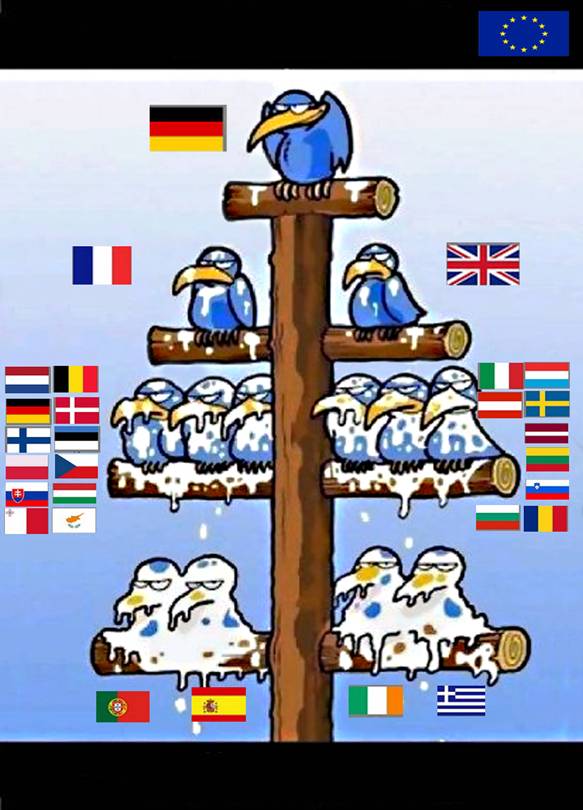
P.S. We leave you with the image of the European Union´s Christmas tree:
The laugh test

A prominent practitioner once explained to me the usefulness of the “laugh test” (a.k.a. “red face test”) in our profession. He said that lawyers often have to defend arguments about which they are not very confident, but that there should be a limit to the “originality” of these arguments. According to him, this limit could only be drawn with the aid of the laugh test.
The practical instructions are easy: whenever you come up with what you fear to be a far-fetched argument, ask yourself the following question: will the addressee of the argument in question have a laugh when she/he reads it? If the answer is no, you may as well give it a try. If the answer is yes, then you´re better off keeping it to yourself.
Sounds easy, right? If you´d read some decisions and submissions that I´ve been reading this week you´d realize that not everyone applies the laugh test properly!
Since I can´t talk about the examples that are currently on my desk, I will refer to a case that´s being heard today in the U.S. in which it appears legitimate to ask whether the laugh test has been applied or not.
Take a look at this piece (Price-fixing or good manners? Jury might decide) and reach your own conclusion 😉


 Chillin'Competition