Archive for the ‘Other interesting papers’ Category
Yet another well-timed complaint against Google

It has been reported by Reuters that Microsoft and other companies are behind a new complaint against Google before the European Commission. Microsoft has denied having lodged any formal complaint. Regardless of whether Microsoft is involved or not, the news raises some thoughts:
Timing:
Once again, this complaint seems to have been strategically timed. Rumor had it that the European Commission would be adopting a preliminary position on the ongoing investigation by mid-March. No matter the merits of the complaint, whoever is behind it deserves credit for outstanding timing; they know how to play the game.
It reminds me of a well-known scene of my favorite movie saga, when in The Godfather III (yes, my taste for movies is absolutely mainstream) Al Pacino screams “Just when I thought I was out, they pull me back in!” (doesn’t he look a bit like Sarkozy in the pic above?) (it also brings to mind the “Yet another on-time flight from Ryanair” pre-recorded phrase that follows that “sweet” melody that you get when you land..).
In our previous posts on this pending case we have always highlighted the good timing of complainants (see here). Also, last April Nicolas wrote here that the “chief, and maybe sole merit [of Microsoft`s complaint] is to throw some mud at Google in the press, at a moment when (i) Google has been reported to be close to a settlement with the Commission; and (ii) Google has suffered a major setback last week, when its settlement with US publishers and authors was annulled by a NY judge” (this opinion by Nicolas was also reported in the press).This time, the complaint not only comes a few days before the Commission is expected either to drop the case or send an Statement of Objections. It also comes a few days after Microsoft lodged another complaint against Motorola (only a week after the Commission and the DOJ gave green light to its acquisition by Google). Per Hellstrom and his unit must be swamped with so many complaints being brought in relation to IT markets.
Substance:
The new complaint apparently focuses on a new function recently introduced by Google (“Search, Plus Your World”) that integrates information (photos, news and comments) from Google’s social network (Google+) within Google’s search results. Those opposing the new function apparently claim that it constitutes anticompetitive tying on the part of Google. This would be intended to reinforce allegations that Google uses its search engine to promote its own services.
According to the Commission’s initial Press Release, the alleged conduct subject to investigation is “unfavourable treatment of [other search service providers’] services in Google’s unpaid and sponsored search results coupled with an alleged preferential placement of Google’s own services” . Following the initiation of the investigation by the Commission there have been various attempts at enlarging its scope.
In the past both Nicolas and myself have been very critical with the allegations against Google (we have no direct/indirect involvement whatsoever in the case and only comment on info that is in the public domain, so we may lack relevant information). For our previous comments on this case, see here, here, here and here; see also here for a guest post by Pablo Ibañez Colomo on this same issue. We understand that the Commission had no choice but to investigate it thoroughly, given that an eventual rejection of the complaints would with all certainty be challenged in Court. Nonetheless, we are concerned that a case against Google would imply either a significant lowering of standards of intervention or the acceptance of the theory of “Karate Competition Law“.
I’m not aware of any evidence pointing out to the fact that Google does or doesn’t discriminate, but let’s move away from the facts, let’s leave aside important issues such as the question of whether Google is dominant and the ease of switching to competing services, and let’s focus on a matter of legal principle: can we require absolute neutrality from a company, even if it is dominant?
The mere term “discrimination” carries extremely negative connotations (if you look at is as “differentiation” it sort of looks a bit more acceptable). It also implies some sense of inherent unfairness. Nonetheless, there is a significant difference between what is unfair and what is questionable under the antitrust rules. Many things in life are unfair, but I can’t complain saying that they’re illegal; or can I?
As we have both written in previous posts, discrimination does only run afoul of the antitrust rules provided that it gives rise to foreclosure (i.e. elimination of competition) (as with most antitrust debates, the best way to find a solution is often to go back to basics). Foreclosure is is the usual standard of intervention and we see no compelling reason for abandoning it in this particular case. Let’s apply this criterion to the reported new complaint: is the fact that information from Google+ will appear in the results enough to eliminate competition from, let’s say, Facebook? It seems like a very long shot.
Given the above, and in light of the limited information at our disposal, we tend not to see any grounds for intervention.
Some suggested readings:
I spent a few hours of the weekend in the train from Brussels to Luxembourg (I would have gone by car, but I never told you that my car got burn by skinheads who felt like burning a trash can right next to my parked car..). The train takes ages, but it allows for some good reading time. The subject of this trip’s readings (aside from an incredibly good novel in Spanish) was precisely search neutrality.The three pieces I read are highly recommendable:
– If Search Neutrality is the Answer; What is the Question? (by G. Manne and J. Wright);
– “Non-Discrimination in Communications and IT Regulation: Understanding the Rise of a Transformative Principle” (forthcoming; can’t say who the author is because the paper is currently undergoing a blind-peer review).
– Search Neutrality as an Antitrust Principle (by D. Crane).
Christmas miscellanea
We will be closing the shop for a few days, but there are a few things that we would like to tell you first:
– Our personal Christmas wishlists appear in a special issue from Competition Policy International. They´ve done a great job with editing our pictures (“thanks” to all those of you who have written to say that I need to change the one I use for these things), and we´re grateful for having been placed in such good company. I´m also grateful for the opportunity to do some free advertising of my family´s bakery: thanks to this they will now start seeing some usefulness to my job! Nicolas also profited from this occassion to make it (more) evident that he´s a competition law freak geek.
– Nicolas and I had some pre-holiday drinks last night together with some good friends. Not only all of us were competition lawyers, but the place we went to was also packed with competition lawyers from a well-known firm. We´ll keep the name of the firm confidential, but we can give you a hint: what do you see in the second row of the image below? 😉
– Many other lawyers in Brussels and elsewhere are also getting some last-minute Christmas gifts. Our thoughts will be with all those who, like our friend David Henry, will have to be stuck at the office with a merger filing…
– The Spanish CNC also received a Christmas gift the day before yesterday, when the names of the members of the new Spanish government were made public. The new minister for the economy is Luis de Guindos, who was the Secretary General for Competition between 1996 and 2002. The CNC is certainly poised to play an important role in the coming years as Spain makes an effor to boost competitiveness. (By the way, the CNC has joined the list of national competition authorities resorting to animated cartoons to explain their job and the benefits of competition. Check it out here).
– A reminder of some events coming up right after the holidays: Nicolas will be opening the new edition of the IEB´s Competition Law Course in Madrid on 13 January (we´ll profit from our visit to Madrid to plot a couple of interesting projects on which we´ll report right after the holidays). The BSC will also be holding a very interesting conference on “Costs in Competition Law” on 25 January.
– A light piece of Christmas reading: Freedom to Trade and the Competitive Process by A. Edlin and J. Farrell. This short article is perhaps the most insightful paper I´ve read in a long time. It´s cool to see two top-notch U.S. economists saying sensible stuff that in Europe would be received with the worst of all insults: Ordoliberal!
– Finally, we want to thank whoever had the idea of improving the search tool in the webpage of the European Court of Justice. You made our lives easier.
– To be frank, there were more issues on which I was planning to comment, but I need to run to the airport…Merry Christmas to all and our best wishes for 2012!!
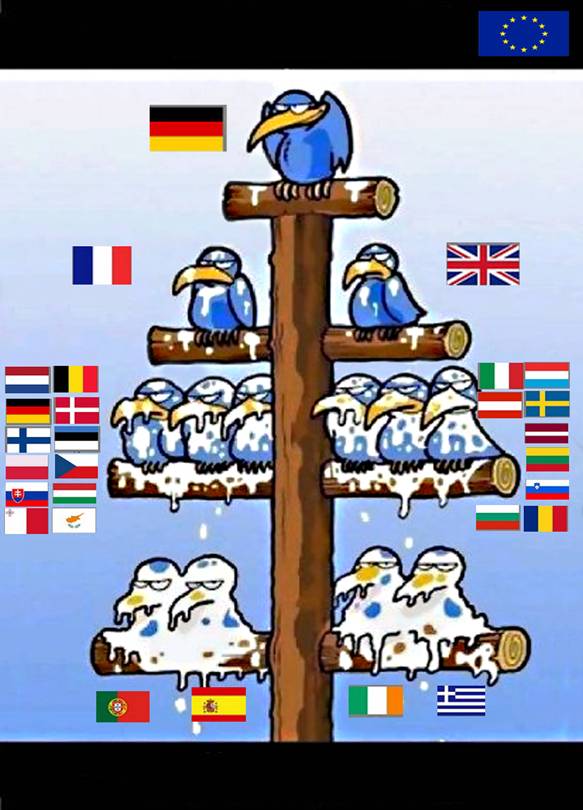
P.S. We leave you with the image of the European Union´s Christmas tree:
Economic advice for Christmas shopping

This morning, as I was doing a some last-minute airport shopping for a “Secret Santa” gift for my firm´s Christmas dinner in Brussels tonight, I received an email announcing that Frontier Economics has released a paper on the economics of Christmas. It wasn´t so useful for me because I had severe budget constraints, but it has the sort of fun approach that we like, and we thought you might find it useful or at least entertaining. As they explain on their web page:
It’s easier to think of economists as the prophets of trading doom than as Santa’s little helpers – too busy telling everybody what’s happening to productivity, energy demand and like-for-like sales to provide any insights into the annual exchange of goodwill and good-or-ill gifts to family and friends. So Frontier Economics has been scouring the academic literature of behavioural economics for tips to make that last struggle with your present list a little easier…
If interested in economic advice for Christmas shopping, click here: Present values- The economics of Christmas.
And if you´re one of those who likes to “shop around” for the best deals, you can also check out Waldfogel´s seminal paper on this matter (which Nicolas already recommended last year) and The New York Times´ collection of stories about the economics of Christmas.
By the way, this week is a nervous time for competition lawyers all over Brussels waiting to see if their Christmas break will be wiped out by unexpected Christmas gifts from the Commission!
P.S. This morning we crossed the 200.000 visits threshold. Once again, thank you for taking the time to read us!
Weekend reading and a confession

For those of you who can get some time off to do some reading this weekend, this is a real must: Why (Ever) Define Markets? , by Louis Kaplow.
PS. I was reading last week a piece on the identity of the real people behind many tweets, facebook status updates and posts attributed to celebrities, politicians and others. It made us reflect and feel bad for not having been completely open to our readers. We too have a ghost writer who does most of the work for us. He´s quite shy, but as a exception, has admitted to have a picture taken: here he is.
The Law of Unintended Consequences

With rising fines for antitrust violations, there’s been a lot of fuzz about the adequacy of the current EU penalty system.
The EU fines system is generally lambasted on two counts. First, it would be inefficient because the average level of fines currently slapped by competition authorities would still be far below the optimal deterrence level. Second, it would be unfair because it targets companies as a whole, rather than the individuals which have secretly engaged into unlawful conduct. In so doing, administrative fines would thus harm a range of third parties (shareholders, workforce, etc.) which have nothing to do with the infringement. Interestingly, increasing fines to satisfy the efficiency concern would further exacerbate the unfairness concern.
The upshot of this has been a renewed interest for alternative penalties (director disqualification, individual fines, etc.). In a recent paper published in ECLR, our esteemed colleague Prof. Alan Ryley (City University London) puts forward a creative, and somewhat radical proposal:
Thirdly, the expulsion of aliens from EU territory: Most international business executives need to be able to travel into the European Union, the world’s largest single market. Prohibition from entering EU territory for a term of years would make it difficult for them to act as senior level executives, as well as significantly damaging their reputations.
Now a question: beyond preventing business executives from making Xmas shopping in Paris and London – which I do not view as a particularly strong deterrent – I fail to see how this could really dissuade guilty alien executives to operate cartels within the EU. Paradoxically, those executives will be increasingly incentivized to negotiate cartels targeted at the EU outside of the European territory, with the unintended side-effect that the Commission’s will face mounting difficulties to gather evidence of unlawful conduct.
The full reference of Prof. Riley’s excellent paper is “The modernisation of EU anti-cartel enforcement: will the Commission grasp the opportunity?”, E.C.L.R. 2010, 31(5), 191-207, 2010.
Thanks to my assistant N. Neyrinck and my student B. Boggaerts for the pointer.
The picture above is taken from one of the worst French movies ever.
Recent publications

In the past few days there have been several publications on which we hadn´t had the chance to comment:
Some days ago the European Commission published a document stating its position regarding the nowadays common claims on inability to pay made by undertakings on which a fine has been imposed. Interestingly, the document was published on a Commission´s site on transparency, but not on DG Comp´s website.
Last week, DG COMP also launched the public consultation on collective redress (thanks to P. Sabbadini for immediately pointing us to this).
On the European Courts side (and aside from an arguably insufficient but nevertheless welcome fine reduction that some colleages of mine got in the Spanish raw tobacco case), Advocate General Kokott issued a very important Opinion in the Greek decoders case (the one concerning Karen Murphy, the owner of the Red White & Blue pub in Portsmouth, who cancelled her licence with BSkyB -who holds the right to broadcast live Premier League games in the UK-, and instead signed up with a Greek provider and imported its decoders). The matter eventually arrived at the ECJ by way of a reference for a preliminary ruling. In her Opinion, AG Kokott considers that “territorial exclusivity agreements relating to the transmission of football matches are contrary to EU law“. Were the Court to follow its Advocate General, its Judgment would constitute a revolution that would shock the world of sports in a way only comparable to the Bosman Judgment, not to mention its potential implications for the cinema and TV industries in general. We´ll post a comment on the Opinion here as part of our “Competition Law & Sport” series as soon as we get the time to read it and think it through.
And speaking of publications, there´s a new journal which might be of interest to many of us: the Journal of Universal Rejection They will reject absolutely everything submitted to them 🙂


 Chillin'Competition