Archive for the ‘Subversive Thoughts’ Category
Cartel fines (an illustrative graph)
These are the stats available in DG Comp’s webpage for cartel fines imposed in the period 2009-2013.
Do you see anything remarkable?
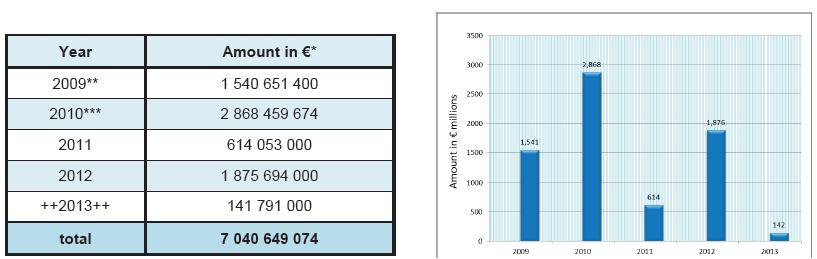
After years of lawyers whining about sky rocketing fines, will we now see a reverse trend of lawyers whining about too few cartel decisions and too small fines?? We are funny whining beings…
In spite of temporary appearances, though, one should not expect these figures to remain as they are. The upcoming LIBOR decision will certainly inject some significant (record breaking?) “capital” into this years’s numbers. On top of that, there appear to be a number of cartel decisions stuck somewhere in the pipeline (interestingly, only one cartel decision has so far been adopted in 2013).
P.S. For the one true masterpiece on cartel fines –Fine Arts in Brussels- click here (the fact that I co-wrote it doesn’t of course compromise my objectivity…).
Random thoughts

In the past few days I haven’t been very diligent at keeping up with posting. My bad conscience has led me to write the hastily written random thoughts below. I might come back to develop some of them in posts to come:
1) On joint v individual assessment of (incriminatory v exculpatory) evidence in cartel cases. For some time now I have been (intermittently) attempting to finish a lengthy piece about evidence in cartel cases (surprisingly enough, there are only a handful of publications worth reading on this subject). One of the interesting things I’m observing is that EU Courts and the Commission [please note that I’m being critical with them; as some of you have reproached me, that doesn’t happen so often] is that whereas the principle of “joint assessment of evidence” is consolidated and very much followed when it comes to assessing the evidentiary value of incriminatory items, the same cannot be said about exculpatory ones.
In most cases, a bunch of elements are put together and assessed jointly in order to declare that an undertaking has committed an infringement. I’ve nothing to object to this logical approach (even more so in cartel cases otherwise these could hardly be brought). My concern on this particular point is limited to the fact that [in another illustration of the tendency of many legal principles to expand themselves until a point of absurdity that eventually must lead to their nuancing] the principle of joint assessment of evidence is often resorted to as an easy escape to avoid discussing individual evidential items that the parties consider worth discussing. In my view, the Commission and the Courts should always first engage in the individual assessment of each evidentiary item, and only then (once the value or lack thereof of every standalone item is established) move on to the joint assessment of all available evidence.
Interestingly, the contrary tendency can at times be observed regarding the assessment of exculpatory evidence. I’ve come across a few Judgments that address exculpatory items one by one concluding that “x is not in itself sufficient to rebut whatever”, that “y is not sufficient to prove whatever” or that “z cannot on its own lead to whatever conclusion”. The “joint assessment” of x, y and z as exculpatory items sometimes just doesn’t happen. For some examples, take a look at recent cases in which parties tried to rebut the AEG (parent liability) presumption (which, btw, turned 30 a few days ago). I hope to develop –and substantiate- my thoughts on this soon.
2) A suggestion to improve the Court’s rules of procedure. Nicolas has lately pushed for reform of EU Courts’ rules of procedure regarding conflicts of interest. We have not agreed much on that issue, but I too have a suggestion to improve the rules of procedure. Unless I’m wrong, the current rules do not envisage any sanctions nor any other sort of legal consequences for parties that provide the Courts with false information to (let’s leave misleading aside, for the concept is arguably too wide, for lawyers at least). Most legal systems do envisage such rules. Imagine the Court were to ask a question (written or oral) to a party, and that the information given in response were not only inaccurate, but untrue; should that not have any consequences?
3) A solicited response to Nico’s views about the effect on trade between MS criterion. In a recent post Nico referred to the effect on trade criterion, complaining that in the eBooks case the Commission had not undertaken any serious assessment, and had swiftly concluded that the conduct at issue did affect trade between Member States. He wisely noted that I’d probably have a divergent view, and I do (he knows me well…). If you ask me, in that case the effect on inter-State trade was crystal clear, as the Commission’s reasoning in paras. 91 and 92 (noting that the conduct at issue was implemented in the whole of the EEA and that agency agreements covered UK, France and Germany) sufficiently shows. Nico says that “[w]ith this kind of reasoning, everything may affect trade between Member States (though I understand Alfonso has a dissonant view on this”. Since I’m asked, my view is that with that reasoning, practices that are implemented throughout the EEA and that manifest themselves with a certain intensity in 3 Member States will be deemed to affect trade between Member States, which, to me, could not be more logical. In fact, as the Decision shows, no party ever challenged this specific point.
4) A great read. Finally, I confess my (very) geekish action of the month: I’m currently reading R.Odonoghue and J. Padilla’s book on The Law and Economics of Article 102 from beginning to end, as if it were a novel (in my defense: I hadn’t done that in a very long time). The book is a monument; it’s smart, balanced, exhaustive, very well thought and written and deserves (although doesn’t need) all possible publicity. Hats off to the authors. In fact, as soon as I’m done publishing this post I’ll send both authors an invite to participate in our currently lethargic Friday slot section.
Interesting statements
The past few days have left us some interesting statements on the competition front. Here’s a personal selection. Happy to add any others any of you might have.
A) The French Industry Minister said last week that EU’s competition rules are “stupid and counter-productive“. I can understand part of the point, but the view that ”Europe organized the balkanization of its companies by chasing down state aid” is peculiar, given that the State aid control regime seeks precisely to eliminate barriers to inter-State trade. As put by José Luis Buendía in another often quoted statement, “State aid ‘DNA’ shares more chromosomes with internal market rules than with antitrust rules“.

This disrespect towards misunderstanding of competition law seems to be a non-partisan feature of French politics. Many of you might remember Sarkozy’s comments about endive producers not being Apple or Microsoft (see here) (the statement was not without consequences: it led our friend Mark English to stop wrapping his iPhone in ham).
B) Slow, ignorant’ lawyers charge by the hour to inflate bills, says President of British Supreme Court. A statement that adds up to a controversy we’ve often echoed regarding billable hours (see our previous post “Is associate lawyer the unhappiest job?“)

C) Have law blogs surpassed law reviews? That’s not really a statement, but rather an interesting (and interested) read.

D) The tone of the comments regarding Google’s proposed commitments has increased and reached new heights. A few days ago, an “anonymous” (no wonder!) lawyer representing one of the complainants said: “All we have to go on at the moment is what Almunia has said and it is absolutely not encouraging. Putting lipstick on a pig does not mean it is not a pig (…). “It’s starting to look like he just wants to get a deal before his term as Commissioner is up next year.”

Samsung offers commitments to appease DG Comp

The most important (antitrust-related) news last week was the European Commission’s announcement that it will market test a commitment proposal submitted by Samsung regarding the enforcement of its SEPs (Standard Essential Patents) related to mobile communications.
As you know, the Commission considered in its December 2012 Statement of Objections that the seeking of court injunctions by Samsung in relation to SEPs which it had committed to license on FRAND terms, or that third parties (i.e. Apple) were apparently willing to agree to license on FRAND terms, could amount to an abuse of dominance, because “access to patents which are standard-essential is a precondition for any company to sell interoperable products in the market” (press release dixit; we’ll come back to this phrase at the very end of the post). The theory goes that the challenged enforcement of SEPs could allow Samsung to obtain licensing terms that the licensee wouldn’t have agreed to absent the threat, and that this “undue distortion of licensing negotiations” would harm consumers in a number of different ways.
[Query 1: is this an exclusionary abuse? an exploitative one? both?; Query 2: Would an alleged abuse of this sort lend itself to the application of the Guidance paper?; Query 3: If the answer to query 2 is “no”, then what are the criteria to undertake a legality assessment of a situation like this? Query 4: How does one assess the likelihood of anticompetitive effects in a situation like this?; Query 5: can you distinguish a willing licensee from a non-willing one without taking a view on what’s FRAND? (I guess the proposed solution arguably gives an answer to this 5th question; if someone’s willing to accept the proposed framework… ); Query 6: Was Apple -the de facto complainant- a willing licensee in this case?].
Samsung (which just before receiving the SO had unilaterally withdrawn all its European SEP-based injunction claims) has now offered to refrain from seeking injunctions for past, present and future mobile (smatphone and tablet) SEPs for a period of five years againts any company adhering to a given licensing framework. As explained by the Commission itself (and here I’m “scraping” its Press release) “the licensing framework consists of: (i) a negotiation period of up to 12 months and (ii) if no agreement is reached, a third party determination of FRAND terms by either a court or an arbitrator, as agreed by the parties. If the parties cannot agree on either submitting to court or arbitration, the parties will have to submit to arbitration“.
The Commission has also published a Q&A document. The full version of the proposal is available here.
Some well known commentators in the patent blogosphere swiftly commented on the proposal in a critical manner (see “EU Commission market-tests totally insufficient FRAND commitments offered by Samsung“). My preliminary take is that, even if some issues may (inevitably?) be left open, this proposal would shed some welcome light on a much contentious subject.
We’d be happy to host a discussion in Chillin’Competition, and welcome the views that any of you might have with regard to both the case and the commitments proposal.
Let me get the ball rolling:
Must reads

I’ve been rather inactive here in the past few days due to work-related obligations, and my sense of guilt has been increased by the merits of other competition law bloggers:
– In the past few days the main media outlets in Spain have echoed a controversy related to creation of the new competition authority (see here and here for my take on the reform; btw, the new competition watchdog is operative since yesterday) that has unfortunately culminated in the stepping down of a very able Director of Investigation. A voice that has resonated very specially has been that of a fellow-blogger (and frequent commentator on this blog), Jesús Alfaro. You may or may not agree with everything or anything of what Jesús says, but you certainly won’t read anything as bold and fearless as his blog post and his article on the subject (in Spanish though). Only for that it deserves that we bring it to your attention. See here and here.
– On another front, one of the most worthy people I’ve come to meet thanks to this blog has started his own: http://www.twentyfirstcenturycompetition.com/ (not saying the authors’ name to force you to satisfy your curiosity by clicking the link…). Congrats to him (and compliments to DG Comp for having authorized him to do it). We’ll try to maximize cross-fertilization of ideas (and possibly charge an interchange fee, given that, according to basic economics, the ideas in Chillin’Competition -needless in a haystack- should be more valuable due to their scarcity) 🙂
Twilight of the Idols

The Van den Bergh Foods case, aka the Ice Cream case, if often cited as one of the best Article 101 TFEU judgments ever handed down by the General Court.
Many praise its modern, unformalistic approach of vertical ties.
They like its focus on the economic magnitude of the foreclosure yielded by the freezer exclusivity clause.
I too have rallied this optimistic interpretation. In a case note published 10 years ago, I had laudated the General Court for its analysis.
As with novels, I should have applied the rule never read again.
Despite economic improvements in judicial reasoning, the Ice Cream judgment is fraught by several unfortunate logical shortcuts.
A quick reminder: the crux of the case was that Unilever, the largest player in the market (and the incumbent) had given freezer cabinets for free to retailers and forbidden them to store non-Unilever ice creams in those cabinets.
This, in the Commission’s view, yielded anticompetitive foreclosure, in particular in those shops where only one freezer cabinet could be stored because of space constraints.
Interestingly, the typical contract with retailers could be terminated flexibly, under a 2 months notice. Unilever thus made the rather convincing counter argument that as efficient rivals – those who could too offer cabinets for free – were not foreclosed from the market.
The GC and the Commission nonetheless based their case on the fact that despite open termination opportunities, there was a “reluctance” from retailers equipped with Unilever cabinets to terminate their contract. As a result of retailers’ reluctance, rival ice cream producers were harmed.
On cursory analysis, the “reluctance” story was reasonably plausible. But the problem is that the evidence adduced by the Commission and the GC to prove reluctance was quite weak.
Let’s take a look: the reluctance argument seems wholly based on the unproven assumption that retailers who would terminate their Unilever contract would no longer be able to procure Unilever products. Hence, retailers just decided to stay with the contract, as Unilever products were “must store” goods.
But on the facts, the decision and judgment did not exclude that retailers remained free to use a rival freezer and still procure from Unilever without terminating the contract in the first place. This, to me, is a major flaw of the decisions. Retailers could just have trashed the Unilever freezer or tell Unilever to recover it.
An alternative is that the Commission and the GC may have assumed that Unilever would have de facto stopped supplying it products to retailers using a rival freezer cabinet. But this would have been a stand-alone, separate infringement which would have deserved proof under the Brönner standard.
Surely, it may be that the Commission and the GC had in mind a “behavioral” reluctance theory, similar to those used in the Microsoft Media Player and Browser cases or in the ongoing Google investigation.
The idea would have been that retailers were content with their Unilever cabinet, and because of some statu quo bias or of hassle costs, they just reclined on changing freezers.
Again, however, no corroborating evidence of biases and retailers’ ineria appears in the decision and judgment.
A bit disappointing, for a judgment that has been elevated to the hall of fame of competition case-law. But overall, a good ruling.
Android, Google and bundling: some follow-up thoughts

[By Pablo Ibañez Colomo (LSE)]
The following thoughts were inspired by Alfonso’s recent post on bundling allegations against Google. As usual, it is tightly argued and persuasive. I wish competition authorities took such points into consideration when assessing tying and bundling claims. My objections are of a different nature. The fact that I agree with most, if not all, of what he writes does not mean that his points would be conclusive or even relevant in practice after the Microsoft saga. More than anything, Alfonso’s post reminds one (or at least me) of the uncertainties that remain in the field of Article 102 TFEU even after the adoption of the Guidance Paper.
Alfonso starts by wondering whether the complaint brought by Google’s rivals involves a bundle in the first place. Following the GC judgment in the first Microsoft decision, I would be tempted to reply by saying that anything under the sun can be constructed as a bundle or, put differently, that the legal construction around third party claims need not make sense for Article 102 TFEU to apply. If a tying claim is valid even when nobody wants an operating system without a media player or a web browser, it probably follows that the plausibility of the bundling claim would not be – unfortunately, may I add – a conclusive aspect in the hypotheticals he discusses.
He goes on to argue that Google Play is not the only means through which one can download applications. I am sure more than a reader reacted to this argument in the same way I did. Could not one also claim that it is possible to download web browsers or media player and that the tying of these applications with an operating system are unproblematic as a result? Well, of course, but this fact did not prevent the Commission from taking action against Microsoft not once but twice. All that remedial action would require is an analysis of consumer behaviour allegedly inspired in behavioural economics (the flavour-of-the-month that I fear most, by the way).
If the above arguments are not decisive, we are left with the issue of foreclosure (the ‘everybody does it’ and the ‘business rationale’ arguments would not be relevant even before the wisest of competition authorities, as what matters in contemporary competition law, or so I want to believe, is not the motivation behind the behaviour, but its effects on the market). Besides the fact that foreclosure is plain irrelevant in tying cases according to the General Court, I will mention that, according to what I read the other day, Android’s market share is approaching 80%. This does not mean in any way that Android is dominant, let alone superdominant (and, again, very sensible arguments can be developed to show why this is not the case). But we all know strange things happen to law and policy when firms reach such market share levels.
What conclusions do I draw from the above? It seems to me that self-restraint is the only limit to the ability of the Commission to interfere with product design in high-technology industries. The second reflection relates to the behaviour of complainants. They cannot be blamed for taking advantage of the confusion created by the Microsoft saga around tying and bundling (i.e. for behaving opportunistically). One could even go as far as to claim that this saga created the expectation that the Commission will intervene when a firm’s market share approaches or exceeds 80%.
Some thoughts on the new anti-Google (Android) complaint (Post 3/3): Bundling allegations

[This is the third post in a series; click here for Post 1 (on background + market definition), and here for Post 2 (on predatory pricing claims)]
Even though the allegations over the free distribution of Android have predominantly caught the public’s eye, the complaint also appears to argue that Android is a “Trojan Horse” (a non-innovative yet effective metaphor…) used to pre-load Google apps. According to FairSearch’s press release, “Android phone makers who want to include must-have Google apps such as Maps, YouTube or Play are required to pre-load an entire suite of Google mobile services and to give them prominent default placement on the phone”.
This is, at least at first sight, more interesting than the allegations about predatory pricing. Tying/bundling issues in the smartphone industry have so far received some attention from enforcers -remember the investigation involving Apple and Flash?- and academics, but not so much. And yet they raise antitrust questions that take the discipline outside of its comfort zone.
One of the problems with this leg of the complaint is that publicly available info is scarce and that some issues are fairly technical. So don’t take what we say for granted. This is no more than an exercise for me to brag about Enrique’s industry/technical knowledge to discuss a case in detail on the basis of knowledge that not everybody has (at least I didn’t), and that I thought was worth publishing here. At the very least it has helped me learn about the industry (for some odd reason I only reflect properly about things when I write about them…). As always, happy to discuss. Btw, the post is again lenghty because I haven’t had time to write a shorter one.
1) In search of the bundle
Our understanding is that Google does not preload its apps in Android (like Microsoft actually does, for instance, with Skype and SkyDrive in Windows). This means that OEMs are free to take the Android OS without having to pre-install any of Google’s Apps (for example, Amazon has done so with the Kindle, and so has Barnes&Noble with Nook; a number of other examples are mentioned here). Android’s code is publicly available here and all OEMs can do what they please with it.
If our understanding is correct, it’s only when OEMs wish to pre-load the Google Mobile Services suite (“GMS”) that they need to pre-install its “core-apps”. In sum, if OEMs want a non-Google Android experience they can have that. If they want a sort-of-Google experience on Android (i.e. if they want the GMS) then Google asks them to preload (on a non-exclusive basis: they can preload any others) a minimum set of apps. Accordingly, it’s difficult to argue that there is a bundle of Android+Apps; at most there could be only a bundle of apps.
[Intermission 1: It’s not easy to find out exactly what’s included in the GMS/ “core apps”. The references that we’ve found (page 12) seem outdated as, for instance, they refer to Android Market (now Google Play), Google Talk (now Hangouts) and call “apps” things that we understand are rather non-user facing services (like the service that synchronizes contacts or the calendar with the cloud)].
But is there really a bundle of apps? In order for “pure bundling” to exist it would be required that the components of the bundle are not also available outside of the bundle, but that doesn’t seem to be the case either. Most of the apps in the GMS can be obtained separately from the bundle and for free (that’s the case of Youtube or Google Maps).We may be wrong here, but we think that Google Play may be the only exception, or at least the only relevant one (on this, see our point number 2 below).
Finally, since OEMs’ decision will not be affected by any financial incentive on the part of Google (because the “core apps” in the GMS are all free of charge apps), there’s no mixed-bundling either.
[Intermission 2: in my view, and in contrast to this case, mixed bundling of proprietary non-free software by certain dominant firms can actually pose serious competition problems (due to the existence of market power, the ability to toy with monopoly prices, resale prohibitions, switching costs and higher barriers to entry) and nevertheless remains mostly unaddressed by enforcers, but that’s another story].
That said, the complainants may have a point in that most OEMs will in practice want to have the GMS (see below).
2) It’s all about Play
If any of the complainants were to read the reasoning above, they would probably respond: “sure, the choice for OEMs is theoretically there, but OEMs that choose Android would always want to have the GMS, because otherwise they wouldn’t have Google Play, which means that they’d be renouncing to the very large number of apps written for Android (indirect network effects, etc)”
[A bit of background: Google Play is an application clearinghouse, an Appstore or app marketplace. These apps are a repository of other apps that you can download with a simple click. This avoids users having to obtain software from every developer; instead, there’s an intermediary that facilitates finding/acquiring/installing software. The intermediary (Google in the case of Play, Apple in the case of Appstore, etc) obtains a percentage of sales of non-free apps and facilitates the sale of free ones].
We don’t know whether the complainants have focused on that point of not. If not, they should hire us to give them more ideas 😉 . If they have –as we’d assume- then that’s a fair point.
And so what? On the other hand, however:
Some thoughts on the new anti-Google (Android) complaint (2/3): Predatory pricing claims

This is the second post in a series; click here for Post 1 (on background and dominance)
According to FairSearch (see here) “Google’s predatory distribution of Android at below-cost makes it difficult for other providers of operating systems to recoup investments in competing with Google’s dominant mobile platform“.
Unsurprisingly, this claim has spurred very strong reactions from the FOSS community, which regards it as a direct attack to the Open Source/FreeSoftware development model (see notably here, here and here). Android is indeed FreeSoftware, meaning not only that it is distributed for free, but also that it adheres to the so-called 4 freedoms: (i) the freedom to run the program, for any purpose; (ii) the freedom to study how the program works, and to adapt it to the user’s needs; (iii) the freedom to redistribute copies; and (iv) the freedom to improve the program and release the improvement to the public. This means that asking Google to start charging for Android would be akin to force it to stop supporting FreeSoftware.
A quick look, however, would reveal that this is a non-issue. It is undisputable that given Android’s FreeSoftware/public good nature Google doesn’t have the ability to set a price. The price is 0.
There are certainly interesting pricing issues to be discussed in the software industry, but, in our view, they arise with respect to proprietary software, not free software.
This should be enough to end the discussion, but if this interests you, click on the hyperlink below for more developed thoughts (if you’re lazy you can just stick to the arguments in bold to get the general idea):
Some thoughts on the new anti-Google (Android) complaint (Post 1/3)

At Chillin’Competition we have paid considerable attention to a number of IT-related competition developments, and –like most other followers of these matters in Europe and elsewhere- we have shown predilection to comment on the pending EC investigation over Google’s search practices. Nicolas, Pablo Ibañez-Colomo and myself have devoted tenths of posts to offering our –often conflicting- views on a number of issues raised in that case.
We –or at least I- had until now not really paid attention to the more recent FairSearch complaint regarding Android, and this despite the repeated warnings of Enrique Colmenero (our new associate and a geek who knows a bit about Android (he says not sufficiently well, I say it’s unbelievable), who was also the real author of my Google ppt), and who kept on telling me that the allegations in this complaint merited some public discussion. I first looked into it last week while writing the post about Skype’s integration with Windows, and realized that he’s right.
Given that all things Google raise the number of visits to the blog and spur more debate than other topics, we’re decided to comment on this yet non-case. We devoted a weekend to writing our preliminary views, and since the result is fairly lengthy we’ll be breaking the discussion into three separate posts: Today we will provide some background and deal briefly with market definition issues. Tomorrow we’ll discuss the predation claims. And Monday we’ll address the bundling allegations.
Before getting into substance, four disclaimers are necessary. The first is that by myself I wouldn’t have had the required technical knowledge to comment about this, so I’m borrowing Enrique’s (any errors, however, are only mine). The second is that we are not working for any party interested in this case and therefore comment on the basis of publicly available info (for fuller disclosure, some time ago I had two chats with someone on the complainants side as well as with someone working for Google; in both cases they let me know their views on the complaint). The third is that since we don’t want this blog to be a place to discuss cases in a seemingly one-sided way (much less when they are ongoing, like this one), we’ll be happy to open this platform to anyone willing to reason any disagreement with the opinions provided below. We don’t intend to defend a given position, but to reflect on issues that interest the antitrust community, and we are more than open to be persuaded that what we say is wrong. The fourth is that even if now criticize a complaint lodged by Microsoft FairSearch in the past we’ve also heavily critized complaints targeting Microsoft, like this one.
Bored already? If you’re stil reading I guess not, so let’s get started:
Some background to the complaint
Back in April the anti-Google alliance FairSearch (in this case only two of its members Microsoft and Nokia [Note: after I was done writing this post I learnt the news that Microsoft is acquiring Nokia’s mobile business] seem to have a real interest in the case) lodged a complaint with DG Comp alleging: (a) that by giving Android to device-makers for “free” Google engages in predatory conduct (making it difficult for rivals to recoup the investments made in developing competing mobile operating systems; and (b) that “phone makers who want to include must-have Google apps such as Maps, Youtube or Play are required to pre-load an entire suite of Google mobile services, and to give them prominent default placement on the phone”. Click here for FairSearch’s Press Release.
Rumor has it that the Commission recently sent out requests for information in relation to this complaint.
A business problem model?
In our view, this complaint can only be properly understood once one is aware about the existence of essentially 3 different business models for mobile operating systems (OSs). One is Apple’s vertically integrated model (iPhones run on Apple’s own iOS), another is Microsoft’s licensing model (OEM’s wishing to have smartphones running on Windows have to pay for a license), and the third is Android’s free software model (Android is distributed for free under a an open source license which enables licensees to do whatever they wish with the code), which has also been the model adopted by all new market entrants (Ubuntu, Firefox OS, Jolla’s Sailfish or Tizen –backed among others by Samsung and Intel-); Nokia’s Symbian (the market leader until 2011, now maintained by Accenture) was always and is also open source.
Manufacturers that are not vertically integrated at the OS level like Apple or Blackberry had to find a competitive OS, there being, until now, essentially two reliable options: Microsoft’s Windows (which they had to pay for), and Android (which OEMs obtain on a free-license basis; even if they have to pay some royalties….to Microsoft! ; some even say that Microsoft makes more money from Android than from the Windows mobile OS). Not surprisingly, the market tends to favor the open source model and, quite logically, Microsoft doesn’t like that (you’ll recall that it also “had issues” with open source OS for PCs). It’s against this background that the complaint comes, in what some see as an attempt to reverse the course of the business model that is proving most successful.
On market power/dominance as a pre-requisite.
Every press-clip citing FairSearch’s allegations refer to the claim that Android enjoys a market share of 70%. This is a bit equivocal. In reality, the fact appears to be that 70% of smartphones (leaving tablets, led by Apple, aside on the assumption that they belong to a different market) shipped in the last quarter of 2012 had Android. And in reality, usage market shares appear to show a duopoly of iPhones and Android phones (see here or here) rather than an Android monopoly; moreover, revenue-baded market shares clearly tilt the balance in Apple’s favor (as explained here) [As to the future trend: Android is certainly doing spectacularly well lately, but we bet iPhone sales will increase once Apple abandons its (rather Steve Job’s) exclusive-good marketing strategy, which is very profitable (see previous hyperlink) but has costs in terms of market share. Android phones sell very well, among other reasons, because they are often subsidized by operators; iPhones on the other hand have traditionally been quite costly. The moment iPhones are cheaper Apple’s share should increase significantly] So, in reality, Android seems to face rather intense competition from Apple’s iOS, Windows, Blackberry; even its main customer (Samsung) has also developed its own OS Bada/Tizen (it also “multi-homes” by licensing Windows for some devices).
Against the background of what would appear to be a competitive smartphone market, the way to come up with a monopoly-like share would require 1) to distinguish separate markets for tablets (where Apple is the leader) and smartphones; and 2) to also take Apple and Blackberry out from the smartphone-only calculation by defining a relevant market for licensable mobile OSs, which intuitively seems a bit of a Procrustean move.
More importantly, forget about market shares for a second. The truly relevant question is: does Android enjoy significant market power? Can it profitably raise prices or decrease output or innovation? Because Android is OpenSource/FreeSoftware (obtainable for free, its source code is entirely disclosed, it can be freely modified/”forked” [see here for “what the fork is forking”?] and appropriated by third parties: just look at Replicant, CyanogenMod, MIUI or at Amazons’ Kindle) we don’t see how Google would be able to exert market power in any way. Even Microsoft and Nokia could take Android and do what they please with it (they could even try to fork/improve it and compete with Google).
Actually, could we even say for sure that there is a “market” for licenseable OSs when all licenses (except Microsoft’s) are FreeSoftware licenses?
Moreover, and as regards innovation, there are very few markets with innovation cycles as fast as the one for smartphones’ OSs having featured a number of leaders in recent years: Palm, Symbian, iPhone, Blackberry and now Android. And this is because given the prevalence of FreeSoftware barriers to entry are extremely low. The moment someone comes up with a more innovative (better) product (including an improved version of Android unrelated to Google), Google would also lose its current lead.
But, for the sake of discussion, let’s assume that Android is dominant and look at the theories of harm, which bring up some interesting issues In our second post we’ll discuss the predatory pricing claims, and in our third post we’ll deal with the bundling aspects of the case.


 Chillin'Competition