Archive for the ‘Subversive Thoughts’ Category
The ‘Tu Quoque’ Fallacy – Some more thoughts on Commission v Google
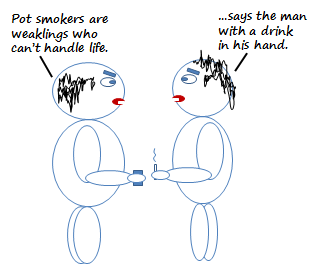
Heard at today’s GCLC lunch talk, seemingly in defense of Google’s search manipulation tactics: Bing is also linking preferentially to its own related services (maps, etc.). So the complainants, and Microsoft in the first place, should take a pass.
On further thoughts, this is a pretty weak argument.
First, the idea underpinning this argument seems to be that Google’s strategy is standard industry practice. And the upshot would be that Google’s conduct has a rational business justification. But the fact that a course of conduct is frequent within an industry, and that it has been replicated by rivals, does not make it presumably lawful. Many drivers breach the law by speeding everyday, yet this is no reason to hold their conduct lawful. Similarly, the fact that conduct is rational is not a cause of antitrust immunity. Collusion is often rational, yet it is strictly forbidden.
Second, this argument actually works in favour of Microsoft’s allegations. It is precisely because preferential placement of links on search engines has the ability to steal competitors’ market share – and in turn to foreclose – that Microsoft uses this strategy. But Microsoft does this to penetrate the market and/or avoid market marginalisation. And there’s no cause for concern here: given Bing’s very low market share, the preferential placement of links at best yields minor foreclosure effects. You may call this procompetitive foreclosure. In contrast, Google has a paramount market position. Hence its conduct is likely to exert anticompetitive foreclosure effects.
On the link between the magnitude of dominance and the intensity of anticompetitive effects, see §20 of the Guidance paper:
“in general, the higher the percentage of total sales in the relevant market affected by the conduct, the longer its duration, and the more regularly it has been applied, the greater is the likely foreclosure effect”
And on the fact that not all foreclure is unlawful, see §22 of the CJEU ruling in Post Danmark:
“not every exclusionary effect is necessarily detrimental to competition”
Finally, the argument surmises that competition law should treat market players equally. But in this industry, Google is seems dominant, Bing not. Those two firms are thus in distinct situations, and the argument again does not fly. It is indeed well settled that pursuant to Article 102 TFEU, dominant firms are subject to a “special responsibility” (whatever this means) possibly for the reason set out in my second point. Like it or not, competition law imposes higher constraints on dominant firms than on non-dominant firms.
The sole possible way to make sense of this argument boils down to a moral issue, best expressed in the maxim: “nemo auditur propriam turpitudinem allegans”. But it is well known that this argument has no traction in competition law, which has no moral content, a point forcefully made by Bork – a late pro-Google advocate – in his early Antitrust Paradox. And this, in any case, would not bar the Commission from taking over the investigation on its own motion.
Overall, by trying to counter argue that Bing also manipulates search results, Google is falling into the well-known Tu Quoque fallacy.
PS: the Lunch Talk was great. We heard two economists, Anne Perrot and Cedric Argenton, speaking very clearly to lawyers. We also watched a lawyer, Alfonso, morphing into a complete hi-tech geek. The introduction of his presentation was simply hilarious. I rarely laughed so much at a conference. The slides will appear on the blog very soon.
PS2: link to the above pic here.
Antitrust and the political center

A few weeks ago I published a post called “Antitrust and political imbecility“. The raw ideas in it had been in my mind for a while, but conscious that I would likely not take the time to refine them, I chose to publish them on this blog with the hope that they would benefit from public discussion. I wasn’t particularly proud of this post, but Lindsay Mcsweeney (Competition Policy International) thought it was original and asked me to develop it for a special issue of CPI’s Antitrust Chronicle to be published right after Christmas. I accepted thinking that it would only take a few hours of my holidays; little did I know that I would break my arm and go through some pains to finish it! (btw, I’m back on track as of today). In any event, and thanks to Lindays’s pressure encouragement, it’s done.
Those interested in reading my take on why antitrust law can be regarded as sensible centrist economic policy can do so here. Non-CPI suscribers can read it here (courtersy of CPI): Antitrust and the political center-
Any critical feedback would be most welcome!
On judicial appointments

We’re quite frustrated at the attitude of some Member States with regard to judicial appointments, which, to put it mildly, is disgraceful
First, because in spite of having been urged by the Court to confirm whether they would maintain or replace their judges, many Member States have remained totally inactive, thus effectively hampering the Court from planning its activities for the upcoming months. Second, because they fail to realize that continuity is a positive thing at an institution of this sort. Third, because they have found it impossible to agree on an increase in the number of judges and continue to lose time fighting as kids over who gets to nominate more judges. Fourth, because they fail to grasp the relevance of the Courts and of their members, and therefore take appointments lightly (hence the rejections of several unsuitable candidates proposed by Malta, Bulgaria, Sweden and Greece by the 255 Committee, which are shameful not for the individuals concerned, but for whoever nominates them).
We’ve said it before, but WE’LL SAY IT LOUDER NOW: WHY ON EARTH CANNOT MEMBER STATES FOLLOW THE EXAMPLE OF, E.G.,THE NETHERLANDS, THE UK, SLOVENIA OR CROATIA AND START SELECTING CANDIDATES PURSUANT TO OPEN MERITS-BASED FRAND COMPETITIONS?
Nailing Mittal?

Last week, the giant steel maker Arcelor Mittal announced the shutting down of several plants in Liege. 1,300 jobs are threatened.
This news has taken many by surprise. Politicians cry betrayal. Last year, Mittal had promised to invest millions of € in Liege.
In fairness, the posture of politicians is naive and cynical.
In Europe’s volatile and distressed economic context, how could politicians ever believe – and try to make believe – in the oral commitments made by Mittal (why did not they ask him to put commitments to paper?). All the more considering that since 20 years, industry analysts keep making cassandresque predictions, describing the steel industry in Liege as morribond.
At university, several colleagues asked me whether EU competition law could possibly undermine Arcelor Mittal’s proposed strategy. In the past hours, the debate has focused on whether a proposed nationalisation of the Liege plants by the Belgian State could constitute lawful/unlawful State aid. I am no State aid expert, so I’ll conveniently decline to answer.
A more powerful, yet wholly uncertain possibility would be to apply Article 102 (b) TFEU or its national equivalent under Belgian law. On its website, Arcelor Mittal says it enjoys a “leading market position and market share” in Western Europe and Eastern Europe. Under a narrow market definition, one may thus well find a dominant position. And given that the stated purpose of Arcelor Mittal’s strategy is to reduce overcapacities on Western steel markets and stabilize (or raise) prices, why not hold the shutting down of steel plants akin to unlawful abusive exploitation?
After all, if Mittal believes he can influence prices – and on this we may trust him – by closing off some plants, then this is implicit recognition that he enjoys some degree of monopoly power.
The bottom line: on cursory analysis, the law provides a legal basis to nail Mittal. But are the facts supportive?
Where’s the Law? (or Google and the European Commission)

I said to myself I would keep up the promise I made to Alfonso and continue writing in the blog until Nicolas is back or he recovers (which we hope will be very soon) and starts posting notes again (I failed to anticipate that he wouldn´t stop…)
More to the point: as a complete outsider, I find the lack of publicly available information on the European Google case frustrating, as it is fascinating on more than one level. I just thought that the best way I could rebel against this situation is by making my views on the ongoing proceedings publicly available.
The behaviour of the European Commission in the past few months is interesting (if not puzzling) in at least three important respects:
- The Commission has repeatedly asked Google to submit commitments. One could very well argue that nothing prevents the Commission from doing this. At the same time,this conduct is at odds with the logic of Article 9 of Regulation 1/2003. At least it shows (as if we did not know it already) that the ECJ judgment in Alrosa (as well as AG Kokott’s opinion) ignores how negotiations between firms and competition authorities are conducted in reality.
- A commitment decision is the only acceptable outcome for the Commission. In his public statements Commissioner Almunia suggests that the case will only be closed once the authority accepts the commitments submitted by Google. Put differently, we have reached a point where the case is not so much about an authority establishing an infringement by a firm but about a firm proposing a settlement that is acceptable for the authority.
- The Commission assumes that the alleged discriminatory conduct is an abuse of dominance: The whole case seems to be based on the premise that the fact for Google to favour its own services is an abuse of dominance within the meaning of Article 102 TFEU. Commissioner Almunia has even been explicit about this matter. This conclusion is very far from straightforward to reach. It is a factual scenario that can be approached in many different ways. It raises novel and complex questions to which different (and contradictory) lines of case law seem to apply .Unfortunately, the Commission has never even attempted to articulate the legal framework potentially applicable to this case. This would be most desirable, if only because it would make it possible to ascertain whether the Guidance Paper was just the expression of a moment of temporary folly, and not (as I assumed it would) a pre-commitment device designed to preserve long-run legal certainty.
I do not think an expert poker player would advise the Commission to take these moves. Even outsiders like me cannot avoid inferring from them that the (legal) case is probably weaker than the Commission appears to suggest. As an academic, it is the fact that the law has disappeared from the case that I find most worrying, in any event. The question of whether, and why, Google’s conduct would be abusive seems to be no longer of relevance for its outcome. In this sense, this case shows the dramatic impact that the abusive recourse to commitment decisions (in particular where, as is the case here, genuinely novel legal questions are at stake) can have on the evolution of our discipline.
Pablo
Antitrust Clone? Or Why the Google case is Stronger than the Microsoft Case…

Despite intense media coverage, little has filtered on the content of the EU Google investigation.
That said, the fragments that leaked in the press led me to draw a puzzling analogy: would the ongoing EU Google case be a rerun of the Microsoft tying cases (2004 and 2009)?
Take a look: in Microsoft, the Redmond giant was accused of using its dominant facility – Windows OS for PC – to preferentially distribute related softwares – WMP and IE – and exclude rivals from those later markets. And this strategy could work effectively because consumers are lazy animals often satisfied with default or automatic settings. For various reasons – which included barriers to searching, choosing, and installing a competing software which could stem from a lack of technical skills or simply because of hassle costs – the Commission explained that users only rarely looked for better alternatives. This phenonemon had been labelled “end-users’ inertia“. For more on this, see my paper with my assistant N. Neyrinck.
Now, the search discrimination allegations levied against Google look strikingly similar. To frame them simply: Google seems accused of using its dominant facility – its well-known search engine – to preferentially display links to related services – Google maps, Google News, Gmail, Google Finance, Youtube, etc. – and exclude rivals from those markets. Interestingly, a key aspect of the theory of harm seems based on the fact that users disproportionately click on the first links displayed by Google’s search engine, and only rarely click on links that rank lower (see chart below). In other words, search users are also lazy creatures who fail to compare the full range of alternatives displayed on the screen. A study found on the web suggests that 94% of users click on a first page result and less than 6% actually click to the second page and selecting a result displayed there.

But, there’s a key, critical difference between the two cases. In so far as the Microsoft case is concerned, offering pre-installed related softwares was a natural business strategy for MSFT. After all, the OS and related sofwares – which came for free BTW – are complements. The pre-installation of such softwares enriched the functionality of the OS, which was in the consumers’ best interest. This argument, which has been made time and time again ties in with the traditional shoe&laces/car&radio metaphors. But what is more is that in the browser case, the pre-installation was a necessary evil. Absent a readily available Internet browser, consumers indeed could not access the Internet and in turn download competing software. Now, some may counterargue that the problem stemmed from the fact that the pre-installed softwares were Microsoft’s own products. But how could it be any different? Given the number of complementary softwares running on an OS, and the myriad of alternatives for each software, it would be all to weird, and possibly unworkable, to enjoin dominant software companies to pre-install competing products on their own motion: how to select them? in what range? on what terms?
In the Google case, however, the preferential ranking of Google’s related services is NO natural business strategy. Rather, the allegation concocted by the complainants, and possibly endorsed by the Commission, is that Google artificially fiddles with its algorithm to display links to its own related services on top of search results pages. In the “but for” search engine world – i.e. absent algorithm manipulation – Google’s related services would not systematically over-rank competing services (yet consumers would still enjoy links to complementary services). Contrary to Microsoft, there is here no clear objective, natural justification to what Google is allegedly doing. This, in my opinion, makes the Google case different from, and possibly a tad bit stronger than, the Microsoft case.
PS: With this background, I feel a sense of compassion for Microsoft’s lawyers. Since 2004 and 2009, they must be in real trouble, trying to understand how, and to what extent, complementary softwares can be pre-installed on Windows.
On Beer and Competition

There’s competition policy everywhere (Alfonso was there before BTW).
Last Saturday, at the Grain d’Orge – in passing, the best blues music bar of Brussels – I was confronted with a real-life example of a deadweight loss.
Orval, the famous brewery that produces the eponym Trappist beer is currently reducing, and in some cases has stopped, supplying domestic Belgian retailers (i.e. bars and other retail channels).
The explainer: Trappist beers are a very trendy export product. They now sell at comparatively higher prices in big metropolis like New York, Hong Kong, etc. Orval, which is reported to have fixed short-term capacity, has therefore decided to prioritize supplies towards high price, export markets, and to limit quantities sold in Belgium. Belgian bars and restaurants, whose reservation price still remains superior to Orval’s costs, are thus excluded from consumption as in the textbook model of monopoly pricing.
Interestingly, it seems that some quantities of Orval can be sourced on a secondary market, where bars with surplus resell to other bars.
Is this refusal to supply akin to unlawful abuse? Undeniably, a funny question, which could be an exam topic for my LL.M students. Market definition on such a highly differentiated product market is not straigthforward. And whilst this type of refusal to supply does not seem to fall within the good old ‘essential facilities‘ doctrine, it has exploitative effects which in theory are caught under Article 102 TFEU.
Groundhog day, self-restraint, and shooting one’s own foot
I’ll give you a sneak peek into how the editorial process of this blog works:
I frankly wasn’t planning on posting anything on the blog for the rest of the rather busy week. But then I attended a conference, and an idea spurred to mind: why not write a post on how a few -not all-competition conferences (topics and speakers) are starting to make us feel inside a time loop, sort of like in the Groundhog day movie…
Maybe not, I thought later; perhaps some of the usual suspects frequent speakers in the conference market wouldn’t like it (there are categories among these: (i) those who never refuse invitations out of politeness -which I find laudable- and who are also tired of speaking always about the same stuff, however convenient; and (ii) those who pay for speaking slots -which I understand less- and who wouldn’t appreciate the comment). Moreover, we had also bragged about how we would do something different announced our own conference and have not yet arranged it, so it’s probably wise not to write on this. So, as you see, I’m not. 😉
But now Gianni de Stefano (from Latham and antitrustitalia) sends us a GCR piece titled: “Spain fines antitrust complainant” joking that we should write about it. And he’s right, we could not let this pass by without a post…
You see, I don’t want to write too much Spain-related stuff, and so a few days ago I resisted the temptation of writing anything about prioritization and allocation of resources when the CNC sanctioned 5 distributors of Magic cards with 7,000 euros (one party received a 148 euro fine, another a 748 euro fine; the highest fine was 3,424 euros). I won’t comment on this either (as if it was necessary…). But this silence exhausted my self-restraint capacity.
So let’s focus on yesterday’s news. What happened is the following: the association of canned fish producers [yes, those responsible for the death of the sole responsible of Spain’s victory in the 2010 World Cup: Octopus Paul –evidence of the murder available here-] lodged a complaint against mussels producers alleging that the latter had entered into price-fixing agreements. The CNC sanctioned mussels producers with 1.7 million. So far so good (except for mussels producers). The fact of the matter is that within the framework of the investigation the CNC discovered that the complainants had themselves decided to react to the cartel by agreeing on a collective boycott. And now the complainants have received a 2.1 million fine. Once again, no comment. [Query: could you complain about a cartel and ask for leniency regarding another reprisal cartel?]

Actually, there’s one comment. If the accusations are true there is nothing to object to the CNC’s decision. But I have been involved in a few other cases where the complainants were also the instigators of the agreements complained of, but they weren’t sanctioned. Curiously enough, in all of these cases the complainants were not companies, but individuals, labor unions or public bodies. There is probably a reason for this: sanctioning companies has the political advantage that when they get pi.. crossed they don’t do this…
P.S. The food sector has given us so much food for jokes thought that the European Commission’s statement that there are no particular competition problems (after having set up a task force, drafted this report, and done all this) was a surprise to us.
Ménage à trois (part III; Makis Komninos): Case T-169/08 PPC v Commission
This third part of our inaugural ménage à trois discussion on the Greek lignite Judgment features (see part I and part II ) another good friend of this blog: Assimakis Komninos. Makis is a great guy, a partner at White & Case, and was a successful co-counsel in the case we’re they are discussing, so he was an obvious candidate for our triad of guests. As you will see, Makis sides with Marixenia Davilla in praising the Judgment. In doing so, he replies to José Luis Buendía’s more critical views.
To illustrate Makis’ post we have chosen the image of another famous lignite-related (look at gift in the middle) ménage à trois. 🙂

First of all, it is such a great pleasure to be invited to comment on the Greek lignites case. I should disclose at the outset that I represented, as co-counsel, the Hellenic Republic in its intervention in support of PPC during the written proceedings stage.
My personal view is that the General Court did the right thing and annulled a decision that was going a step too far. There is no doubt also, in my view, that the Commission was using this as a kind of “test case” against a carefully selected target.
The intellectual starting point is, I think, the very nature of Article 106 TFEU. This is a rather curious provision and I certainly agree with José Luis that it is essentially about State measures, but the sure thing is that the Treaty fathers wanted to give it a carefully circumscribed scope. A systematic interpretation of the Treaty does not support that there is general prohibition of all State measures that may – even indirectly – impact on competition and business activities. Article 106 TFEU restricts the behaviour of Member States only by reference to the scope of some other Treaty provisions, such as Article 102 TFEU. This is the provision that the Commission chose to rely on by reference.
Then, if one reads the Commission’s decision, one fails to see how Article 102 TFEU would come into play here, albeit by reference. Would the theory of harm refer to a leveraging abuse, to a refusal to supply, to a failure to satisfy demand (exploitation), to discriminatory treatment on the part of PPC? Not clear at all. The Commission thought that it did not have to specify this. By the way, I am not suggesting that in Article 106 TFEU cases, the Commission need to show anti-competitive effects etc. This is not what I argue. Instead, I submit that the Commission should be able to demonstrate with a sufficient degree of intellectual clarity that the State measures are connected with a specific kind of actual or potential abusive behaviour by the undertaking in question. This is all the Court says and I fully agree with Marixenia.
With respect, I do not agree that the previous case law gave the Commission leeway in not being obliged to identify a specific kind of actual or potential abusive behaviour. On the contrary, if we look at RTT and even Connect Austria, while we see references to “equality of opportunity” and to RTT’s “obvious advantage over its competitors”, that by no means leads to the conclusion that the mere existence of inequality of opportunity is sufficient for an Article 106 TFEU violation. In both cases, the Court spoke about specific anti-competitive phenomena. In Connect Austria, the problem was that the undertaking in question was allowed (through the inequality of opportunity) to expand its dominant position onto a related market and, in RTT, the Court is very clear and explicit as to the kind of abuse of dominance that was at stake: “an abuse within the meaning of Article [102] is committed where, without any objective necessity, an undertaking holding a dominant position on a particular market reserves to itself an ancillary activity which might be carried out by another undertaking as part of its activities on a neighbouring but separate market, with the possibility of eliminating all competition from such undertaking”.
In the PPC case, the Commission seemed to build its case on the grounds that PPC’s lignite rights are not sufficiently counter-balanced by significant deposits of its competitors, even though lignite is not an essential input to compete downstream. I am actually being kind to the Commission, when I say this, because this theory is not clearly articulated within the txt of the decision. The Commission then identified a remedy: PPC’s competitors needed to gain access to 40% of the total exploitable lignite reserves. In a nutshell, the Commission was seeking to use competition law to unbundle the Greek electricity generation market. However, this instrumentalisation of the law, in order to redesign a market structure, lacked both a legal and a sound economic basis. Moreover, it would lead to a dangerous precedent by permitting the Commission to attack market structures it dislikes by invoking the vague concept of “inequality of opportunity”.
The Commission misinterpreted the case law and its decision deserved to be annulled. I do not think this is the end of Commission enforcement under Article 106 TFEU, as some commentators have argued. It will only have to do a better job next time and articulate also a clear theory of harm that refers to an actual or potential abuse of dominance by a public undertaking or an undertaking with special or exclusive rights, as a result of certain State measures.
Expert economic evidence(?) in competition cases

On 21 November Concurrences, A&O and MAPP will be holding a worskshop on “Standard of Proof for Economic Evidence” (registration is free and still possible through this website).
The topic is very interesting. I don’t know whether I’ll be able to attend, so I’ll make a point in public here (or rathe repeat what I co-wrote on a piece published here) in relation only to the assessment of economic evidence in judicial proceedings. To me, it’s more appropriate to refer to “economic argument” than to “economic evidence”. Unless the expert is appointed by the Court (off the top of my head I can only remember this being done in Woodpulp) or comes from the Commission (which has the winning hand enjoys a margin of discretion in this regard), I do not see many differences between legal and economic argument put forward by the parties in competition proceedings, and no one would call lawyers´ pleadings “legal expert opinions”.
Certainly, in some cases there will be a hardcore of economic data which is not contested by opponents (be it the Commission, the parties, or complainants), but a great part of the “evidence” will be opinion and based on each one’s assumptions, not strictly evidential. An expert presenting evidence is supposed to act as a translator for the judge on areas on which the latter lacks the appropriate training. However, in real life, expert economic evidence has a “strong tendency” to favor the argumentation of one particular party, and is often contradictory with that presented by other parties.
In the end, economic evidence offered by the parties will be assessed by the European Commission and EU Courts as a friendly (former CFI Judge Huber Legal would call it “sisterly”) statement commanded by the interested party with a view to making its case more palatable to the deciding authority or court. Its value will depend on how persuasive the economist in question can be, just like lawyers and their plaidoiries. In the words of Hubert Legal at the 2006 Fordham conference “[T]he way we proceed is compatible with our Rules of Procedure because [economists] are not pleading under oath; it is only a part of the pleading, like you would have the possibility to ask a member of the board of a company to speak, or your sister or whoever is interested in the case”.


 Chillin'Competition
