Archive for the ‘Archive’ Category
Enforcement menu: shrimps

Last Friday the European Commission confirmed that it has addressed a Statement of Objections to four traders of North Sea Shrimp over a suspected cartel. We learnt the news through one of the sites that we check several times a day: www.seafoodsource.com; see here).
Some of you have conveyed to us the suspicion that, in reality, DG Comp has sent this SOs in an attempt to force us to write about it. According to this theory, the guys at Bubba Comp, DG Gump. DG Comp were worried about our silent week and decided to resort to the big guns: a food case. Judging by precedents (notably our well known endive saga), they knew that we wouldn’t let it pass by without a comment.
As credible as this theory may sound…. the sending of these SOs at this time of the year is in reality a classic piece of July desk clearing on the part of the Commission. Getting one of these right before the holidays is one of the occupational hazards of being a competition lawyer in private practice in Brussels (the other one coming the run up Christmas).
In any event, we should not be making jokes about this. It is a serious matter. Nicolas – a renowned shrimp consumer may moreover be a victim of this alleged shrimp conspiracy- One nonetheless wonders: have they caught the big fish? It certainly isn’t small fry!
PS. A Chillin’Leak: We have been told by very reliable sources that the Commission found the evidence for this case during a “fishing expedition”.
On inactivity, records, and Chillin’Competition becoming a real estate portal

Last week we broke two records.
First, we broke our inactivity record. Christmas holidays aside I believe this was the first “blank week” in the two years of existence of this blog. The reason: I took a week off (some days of calm before a storm, or at least that was the idea…it didn’t quite work) and asked Nicolas to take care of the blog. You saw how diligent he was. In any event, we hope you were entertained by the comments to the last of our posts (they were practically posts in themselves, and from extremely qualified commentators).
Second, in spite of this inactivity we were rewarded by readers, by reaching 310,000 visits we overpassed Nicolas’ former blog The Antitrust Hotch Potch in terms of historical number of readers. For the sake of transparency: our 20,000 visits during June yielded $ 3.60 of revenues, unfortunately not enough for the two monthly beers we had hoped for 😦
One more thing: A few days ago I had a conversation with Conor Maguire (who is doing a great job at Brussels Matters) about what we try to do at Chilling’Competition, how we try to do it, and where we get our ideas from. He mentioned in passing that he had liked one post where we acted as intermediaries for the sale of a competition lawyer’s car and one in which I “advertised” my parents’ hotel. This conversation, as well as the fact that you tend to click more on gossip links than on serious ones (stats don’t lie!) spurred an idea: to act as an intermediary for the sale of my co-blogger’s former house. I already showed you his desk one (see here), but those of you curious enough potentially interested can check out the whole house and ad here. (Btw, the pic at the top of this post is that of the house’s terrace).
The usual incentive applies: anyone who contributes to an aventual sale of Nicolas’ house will be rewarded with 3% of the price of the house… in Belgian beers.
Legal films and series

Many of you are aware about our taste for antitrust videos. In previous posts we commented on “The Informant” and on the OFT’s own production, we awarded Chilling Competition’s Antitrust Oscars, and we brought to you the wonderful classic”The Raid“. Many of those posts rank high in our list of most visited posts, so there are reasons to believe that you share our “geek” taste for these movies.
Our “Friday Slot” guests also seem to be fans of legal movies. In the interviews published so far some of them have confessed that legal movies rank among their favorites [e.g. “12 Angry Men” (Eric Gippini Fournier); “12 Angry Men”, “Philadelphia” and “The Verdict” (Johan Ysewyn), or “To Kill a Mockingbird” (Maurits Dolmans)].
The American Bar Association has a list of the 25 Greatest Legal Movies of all times [headed by “To Kill a Mockingbird” and “12 Angry Men”, which reveals that Maurits’, Eric’s and Johan’s taste for movies is not as original as their legal constructions 😉 ] Other websites have posted lists of the top-15 film/TV lawyers in history. The image that oursiders sometimes have from our job is often dictated by these movies and these characters. Whether or not they portray reality is generally a contentious issue. I went to Harvard Law School thinking that it would be like in “Legally Blonde” (I even died my hair and let it grow…here is the evidence), but it actually was closer to the scary “The Paper Chase“. Actually, it didn’t ressemble any of them. But it didn’t ressemble “The Social Network”s constant drunk partying neither..
Nowadays the good stuff has moved from the big screens to the TV. There’s a surprising number of “legal” TV series (see here for a list). Not having ever watched most of them, I have to confess that I’ve a clear favorite: The Good Wife. For the past couple of months watching an episode (sometimes a couple, sometimes even one or two more…) has been a late-night vice routine. I know for a fact that other competiton lawyers are going through the same problem right now with this series. I even know someone in the US who called in sick the day the last season was released in DVD and watched the whole thing in one day. Maybe that was a bit too much, but you really should watch it. I’m now done with all available episosed and opened to suggestions for a new series. Anyone?
Sunday readings

There’s generally a moment every Sunday in which I try to catch up reading newspapers and magazines that I haven’t had the time to check out during the week. I’m doing this right now (while, btw, I listen to great music that Nicolas recommended me yesterday) and I’ve come accross something which deserves a comment here.
Today’s edition of El Pais features an interesting piece by Paul Krugman called “Europe’s Economic Suicide” (originally published in The New York Times) in which he argues that fiscal austerty imposed by Germany is pushing other Member States -and very particularly Spain- to the disaster. I cannot but agree with practically everything he says.
Krugman’s article has spurred a thought (not a brainy one; after all it’s Sunday):
It is funny (and funny may not be the adequate term) to realize that the people in charge of getting the EU economy out of trouble are competition economists. I bet that a most of you reading this will immediately think of Mario Monti (former Competition Commissioner who is now Italy’s Prime Minister), of Spain’s Minister for the Economy -Luis de Guindos-, who used to head of the competition authority, and maybe even of Spain’s Secretary of State for the Economy -Fernando Jimenez Latorre- who was also in charge of competition policy in Spain and who prior to his recent appointment directed NERA’s business in Spain.
What you may not know is that there is another well-known competition economist who is not in the first political line but who probably has even more influence on the European economy than any of the above-mentioned. This would be the person who inaugurated the Chief Economist post at DG COMP, Lars-Hendrik Röller, and whose current position is Economic Advisor to Chancellor Angela Merkel. A few months ago The Economist had a piece which read as follows: “Mrs Merkel may be lacking high-quality advice. Her newish economic adviser is Lars-Hendrik Röller, known for his writings on competition rather than high finance“.
I respect Röller as a competition economists and I believe he did well during his period at DG Comp but, to be frank, I think that him and the German government are not getting it right nowadays. This makes me share The Economist’s concerns that there might be different relevant markets for competition economics and for macro economics.
P.S. More on politics: the French presidential election is being held today. We are worried, because we have realized that apparently one of the candidates -Marine Le Pen- shares our concerns with regard to endives and cat food cartels and is campaigning on them (see here). Thanks to Caroline Si Bouazza for mentioning Chillin’Competition in her comments about this curious video!
European Competition Football Championship 2012
[Note by Alfonso: That competition authorities compete to be among the world-class enforcers is something we all knew (see for instance GCR’s Ranking Enforcement Special Issue). What you probably didn’t know (and, frankly, we didn’t either) is that there is a football championship in which competition authorities also sweat out their competitive spirit. We have been asked by the organisers of the upcoming edition to help promote this event among competition authorities, and we’re glad to do it; it looks like sure fun!]
After two highly successful and memorable events hosted by the NMa and the Bundeskartellamt in 2010 and 2011, the Hungarian Competition Authority (GVH) has the pleasure to announce that the 3rd European Competition Football Championship (ECFC) will take place in Budapest this year.
The GVH is pleased to invite all European competition authorities to the 2012 ECFC in Budapest, which will be organised together with a workshop on sports and competition law.
Workshop on sports and competition law
3rd European Competition Football Championship 2012
7-8 September 2012
Budapest, Hungary
Should you have any questions, don’t hesitate to contact the organisers at ECFC2012@gvh.hu. Any interest in participating at the event should be made by the end of April.
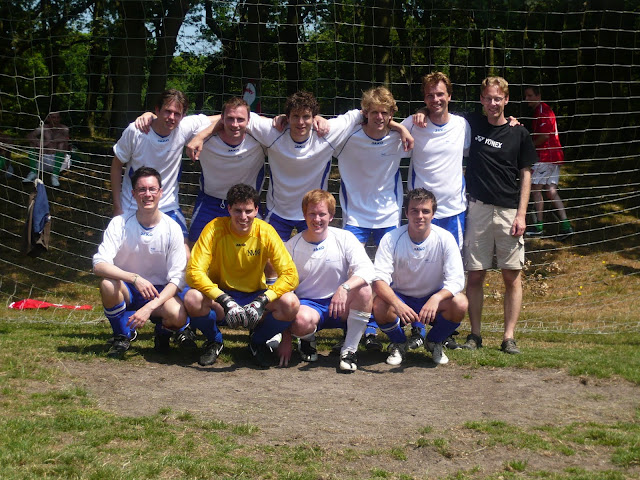
Here are some pics from the winners of the previous editions: The Ducth NMa (2010) and the Hungarian GVH (2011).

Christmas miscellanea
We will be closing the shop for a few days, but there are a few things that we would like to tell you first:
– Our personal Christmas wishlists appear in a special issue from Competition Policy International. They´ve done a great job with editing our pictures (“thanks” to all those of you who have written to say that I need to change the one I use for these things), and we´re grateful for having been placed in such good company. I´m also grateful for the opportunity to do some free advertising of my family´s bakery: thanks to this they will now start seeing some usefulness to my job! Nicolas also profited from this occassion to make it (more) evident that he´s a competition law freak geek.
– Nicolas and I had some pre-holiday drinks last night together with some good friends. Not only all of us were competition lawyers, but the place we went to was also packed with competition lawyers from a well-known firm. We´ll keep the name of the firm confidential, but we can give you a hint: what do you see in the second row of the image below? 😉
– Many other lawyers in Brussels and elsewhere are also getting some last-minute Christmas gifts. Our thoughts will be with all those who, like our friend David Henry, will have to be stuck at the office with a merger filing…
– The Spanish CNC also received a Christmas gift the day before yesterday, when the names of the members of the new Spanish government were made public. The new minister for the economy is Luis de Guindos, who was the Secretary General for Competition between 1996 and 2002. The CNC is certainly poised to play an important role in the coming years as Spain makes an effor to boost competitiveness. (By the way, the CNC has joined the list of national competition authorities resorting to animated cartoons to explain their job and the benefits of competition. Check it out here).
– A reminder of some events coming up right after the holidays: Nicolas will be opening the new edition of the IEB´s Competition Law Course in Madrid on 13 January (we´ll profit from our visit to Madrid to plot a couple of interesting projects on which we´ll report right after the holidays). The BSC will also be holding a very interesting conference on “Costs in Competition Law” on 25 January.
– A light piece of Christmas reading: Freedom to Trade and the Competitive Process by A. Edlin and J. Farrell. This short article is perhaps the most insightful paper I´ve read in a long time. It´s cool to see two top-notch U.S. economists saying sensible stuff that in Europe would be received with the worst of all insults: Ordoliberal!
– Finally, we want to thank whoever had the idea of improving the search tool in the webpage of the European Court of Justice. You made our lives easier.
– To be frank, there were more issues on which I was planning to comment, but I need to run to the airport…Merry Christmas to all and our best wishes for 2012!!
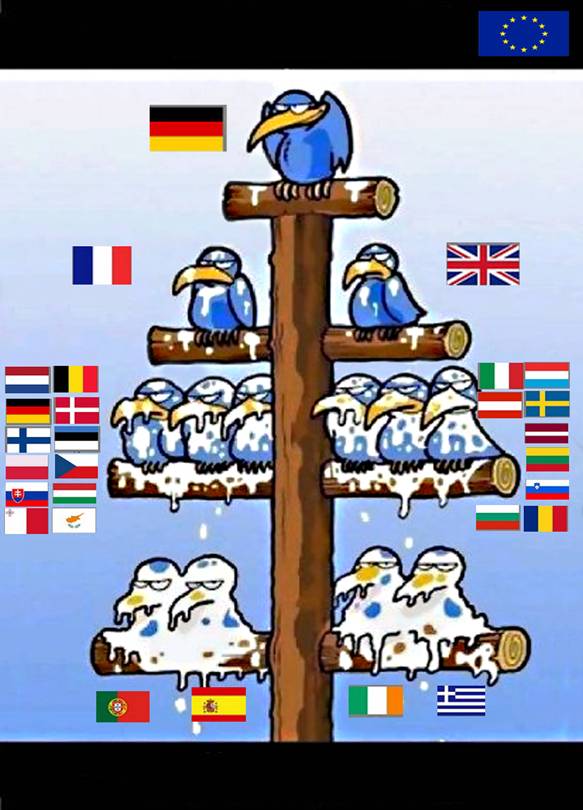
P.S. We leave you with the image of the European Union´s Christmas tree:
The language of competition law

In a comment to a recent post we recently engaged in a discussion about the meaning of words and the importance of the proper use of terminology in light of the crucial meanings, nuances and attitudes that words often implicitly or explicitly convey. Words often “carry dynamite”, we said. A few days earlier, we had also written another post which -perhaps in a manifestation of wishful thinking- highlighted the fact that the Court had used the term “objective justification” in an area (Art. 101 TFEU) where it had never resorted to it before. In our view, words matter. A lot.
All this sprung a reflection about the importance of words and of languages when it comes to understanding, teaching or applying law in general, and competition law in particular:
The crucial influence of the use of certain words, metaphors or narratives has already been noted in the past by some of the most prominent antitrust scholars. Excellent examples of this can be found, amongst others, in the influential piece by late Prof. Areeda on “Essential Facilities: An Epithet in Need of Limiting Principles“; in “Antitrust Doctrine and the Sway of Metaphor” by Michael Boudin (who, btw, was my antitrust professor at HLS); or in Newberg´s “A Narrative Construction of Antitrust“.
One of our blogosphere colleages (Prof. Sokol) also wrote a post some time ago about The Language of Sex and Antitrust (if cheap advice on how to increase online readers is right, this is the link that most of you will be clicking…).
But beyond words, the language in which the law is conceived, drafted, learnt, taught, and interpreted or applied also makes a huge difference. I am not aware of the existence of any study on whether and how languages compete to shape the law, but it is undeniable that they do shape it, and that their influence can be much greater than that of words, because languages (i) are also vehicles for the diffusion of certain values; and (ii) because they are subject to very strong network externalities (if any enforcer is reading this, then languages -as beneficiaries of network externalities- may have just become a new antitrust suspect…).
Many of you may have first-hand experience of the fact that law is very often learnt, taught and understood differently depending on the language used. Nicolas and I, for instance, are currently working on competition law textbooks in our own languages, and it is not always easy to transform the input we normally receive (typycally in English) to our output. Mere translation is not always enough because the language strongly influences the way in which the information is rationalized. Examples abound:
Some posts ago we wrote about the future reform of the General Court and noted that more than 40% of référendaires (clerks) at the GC are of French nationality. This is obviously due to the fact that the official language at the Court is French, but, as we noted in that post, those numbers have implications far beyond the merely linguistic. In that case there are also cultural elements involved (in as much as the language may be associated to the values of a country), but the influence of the French values through the French language can be traced in many of the Courts attitudes and Judgments.
Now English has become the lingua franca (a fact of which this blog stands as evidence). This may have had some disadvantages for the English language (because being used by non-natives it risks deteriorating, as this blog also illustrates..), but overall it offers many advantages to anglosaxon values and ideas which enjoy an “unparalleled competitive advantage” (to use the words of the CFI´s Judgment in Microsoft). Ask the Financial Times or The Economist…
But competitive advantages arising from the use of language in competition law are not merely enjoyed by ideas and policies, but also by firms. One example of this could be the legal market, where anglosaxon firms enjoy a competitive advantage on the worldwide market just because they´re anglosaxon firms. I´m not necessarily criticizing this; my firm, for instance, also benefits from a competitive advantage derived from huge brand recognition in its main market. I do nevertheless have a problem with the legal market becoming a “luxury” market where brands matter more than quality and outcomes (and I know many examples where this is true in the EU competition law world), but this is another matter that perhaps we´ll deal with in another future post.
On Cartels and Beers

Yesterday´s post was about Services of General Economic Interest and Sausages. Today´s deals with cartels and beers.
Some days ago we anticipated that we would comment on the latest cartel Judgment issued by the General Court in Case T-235/07, Koninklijke Grolsch v Commission in relation to the Dutch Beer Cartel, which was sanctioned by the Commission back in 2007. When we announced that we would comment on it we hadn´t yet read the Judgment but rather the Court´s press release about it, but the notice about the annulment of a Commission´s decision is something that always turns us on attracts our interest).
Those interested in an objective summary of the relevant facts and of the GC´s reasoning can read the Court´s Press Release. Those interested on some not objective opinions can keep on reading:
In our opinion, the annulment of the decision as regards Grolsch is, in a sense, quite logical: that is what happens when you conflate distinct legal entities into one (a temptation too often seen in EU competiton law) and distinct infringements into one single and continuous infringement (also quite usual) and then mix it all together. But there are two interesting aspects of the case that are worth commenting.
One is the manner in which the GC dismisses the validity of the evidence concerning the parent´s company possible participation in the infringement: After noting that the majority of the evidence put forward by the Commission related in reality to the participation of Grolsch´s subsidiary, the Court was left with a couple of evidentiary items that could be used to support the accusation against the parent company (see recital 61 of the Judgment). The GC however dismisses those elements in an interesting manner (in recitals 62-71 of the Judgment). In essence, the GC decomposes the elements of the single and continuous infringement into three, and, departing from the Commission´s summary description of each of those components, it attempts to check whether the evidence can fit into any of them (this is an interesting, and welcome, deconstruction exercise that I´d never seen before regarding “single and continuous infringements). The GC then underlines that some of the evidence (documents found at Heineken relating to telephone conversations with one of the parent company´s employees) did not fit into the description provided by the Commission and therefore dismissed it. The Court was then left with one piece of evidence (notes taken at a meeting by that same employee of the parent company), but this evidence was also considered insufficient on the basis of another interesting reasoning (see recitals 65-66). In essence, the GC´s stance is that a complex concertation necessarily involves regular contacts throughout a long period of time, and that a single element cannot prove the participation of one company over the whole of this period. Does this imply a raise in the evidentiary standard for complex and long infringements?
The other aspect worth mentioning is the Commission´s lapsus (probably due to a certain overconfidence) , that has cost the EU budget 31.66 million euros. As it is clear from the Judgment, the participation of Grolsch´s subsidiary in the infringement was clear and there was enough evidence to prove it. If the Commission had addressed the decision to both the parent company and the subsidiary (as it normally does, and as it did in this case with regard to all other groups of companies involved) the sanction would´ve been upheld. Ooops.
According to one of our favorite sources: beveragedaily.com, the Commission is pondering whether to appeal the Judgment before the ECJ.
More on cartels and beers:
On 10-13 October the International Competition Network will be holding a Cartel Workshop in Bruges (Nicolas is attending, and I wouldn´t mind accompanying him if someone at DG COMP considers me -when I wear my blogger hat- as a stakeholder and kindly sends an invitation…). If any of our readers is attending the conference, I will now disclose one of Bruge´s most precious secrets: the most amazing beer that I´ve ever had can only be found in Bruges at a place called DeGarre. 
This is a traditional place for students of the College of Europe (because, you know, there are so many other things to do in Bruges…). Luis Ortiz Blanco also traditionally invites the students attending his seminar at the College for some beers at the end of the academic year. You really shouldn´t miss it.
PS. And speaking about the ICN´s Workshop, we very much recommend you to check out their blog at www.icnblog.org . It really is a great source of information on international antitrust.
We´re back
 We´re back. Our holidays away from blogging took a little longer than expected, but these past days turned out to be quite busy for both of us. Nico has already explained that he´s been working on his “big book” and
 on bashing credit rating agencies. On my side, apart from some ongoing cases on which I will eventually comment, I attended Fordham´s annual antitrust conference in NY last week. As expected, it was excellent. In a few days I will comment on what happened there as well as on the paper that Luis Ortiz Blanco and myself drafted during a considerable part of what were supposed to be our summer holidays, and which relied heavily on the impressions and ideas conveyed to us by readers of this blog.
Some interesting stuff occurred in our absence. Amongst others, the following: as we had anticipated, on August 5th the European Commission initiated a formal investigation concerning the luxury watches market (in essence, it will seek to further investigate whether what it said was ok for companies to do in 2005 is still ok in light of the parameters for market definition in aftermarket settings laid down by the General Court in CEAHR); on September 1st the US DOJ filed a suit to block AT&Ts merger with T-Mobile; on September 9th the General Court issued Judgments in the Italian Raw Tobacco case (most of what is said on the Judgment is business as usual; the news is that the Court has endorsed the Commission´s withdrawal of the conditional leniency that had been granted to Deltafina before it disclosed the fact that it had applied for leniency to other members of the cartel). Today, the General Court has also issued some interesting Judgments in a couple of cartel cases, but that can wait until tomorrow.
More stuff that happened during our holidays: those diffuse entities called “the markets” (which in the past few weeks have been reported to be attacking my country..) kept on giving us bad news. But contrary to financial markets, the legal market for competition lawyers is thriving: on Monday it was announced that Johan Ysewyn (previously Head of Competition at Linklaters and, like Luis, Professor at the BSC) has been hired by CliffordChance; Assimakis Komninos made a timely move and returned from the Greek competition authority to White&Case as a partner. Another significant move(s) to a new entrant in the Brussels market will be announced in the coming days (it involves a couple of well-known names). (Can´t say much more; you can consider this to be an incomplete Chillin´Leak).
Competition authorities are also doing some very smart hiring: in October Miguel de la Mano (with whom, btw, I will most likely co-author a text on abuse of dominance soon) will be joining the UK´s Competition Commission as its Chief Economist while on a secondment from DG Comp. I kinda like competition authorities who (like the CC, the OFT, the Dutch NMa or the Autorité de la Concurrence) hire qualified officials even if they´re non-nationals of their respective countries. Maybe one day we will end up with a new relevant market of an EEA dimension for competition enforcers…
Closed for the summer

It is time for Chillin´Competition to take a summer break.
The past few months have been hectic for Nicolas and for me both at work (we´re working on really interesting cases, books and papers on which we´ll comment in a few weeks) and on this blog (where we´ve managed to publish a post a day; this is our 429th post!)
Chilling Competition has already accomplished most of the objectives that we set at the beginning of the year, and has exceeded all our expectations in many ways. Thanks to you, we recently crossed the 150.000 visits threshold; we currently have nearly 500 visits a day, 200 members in our LinkedIn group, and more than 150 subscribers from all over the world. We´re even having lots of visits on our new youtube channel thanks to “The Raid“!
Most importantly, we´ve had a lot of fun. If you enjoyed what you´ve read too, then we have so far succeeded.
We´re committed to getting better, and for that reason we´ve got some quite interesting new projects on the pipeline that we´ll be announcing right after the holidays.
It´s a pity that we won´t be able to provide you with timely coverage of any competition law related developments that may take place in the coming days, such as the first-ever non-consensual Commission decision withdrawing an NCA´s competence to handle an ongoing case under Art. 11(6) of Regulation 1/2003, which should be out soon (you can consider this to be the last Chillingleak of the season..)
Have a great summer!
Nicolas & Alfonso


 Chillin'Competition
