Archive for the ‘Breaking – Antitrust – News’ Category
EP to discuss fines in competition cases
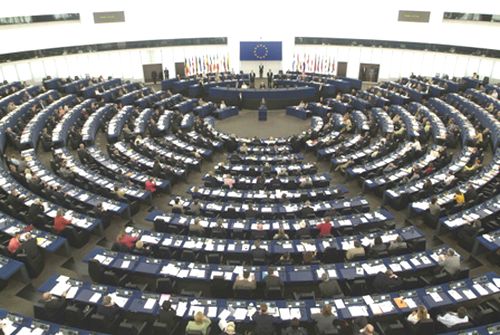
Looks quite unusual, but the European Parliament will host a debate on fines for competition infringements. A well informed friend sent me an email indicating:
“The following items are on the agenda of next week mini-Plenary session, Wednesday afternoon, 6 October:
– […]
– Commission statement – Commission fines in antitrust cases”
Not sure what to expect from this… At any rate, please note that the first conference of the BSC will come shortly, and will be devoted to sanctions for competition law infringements. My own personal viewpoint is that disqualification orders are the most efficient and fair possible penalty.
(Image possibly subject to copyrights: source here)
Thoughts

Living and working in Brussels offers the opportunity to talk and meet with practitioners from all sides. In this context, a lunch with colleagues may help bring new perspectives on issues.
On second thoughts, and as a matter of principle, one may question whether the appointment of a former official of the Commission’s legal service as hearing officer is as appropriate as mentioned in my tweet two days ago. Nothing to do with Wouter Wils’s brilliant legal skills (I am a great fan of his academic work). But in terms of neutrality, it is somewhat odd to appoint as a referee someone who spent years defending the Commission’s decisions in Court against companies. I guess this may create a bias (or am I the one with a suspicious bias )? Much to the advantage of the companies facing Commission proceedings, however, is the fact that this particular hearing officer knows the case-law on fundamental rights inside out.
Heard on the Grapevine
Our friend Pablo Ibanez Colomo was apparently appointed as a lecturer at the London School od Economics (“LSE”). TBC, but congrats already.
For those of you who do not know him, Pablo is a promising competition lawyer, who recently defended a Phd at the EUI in Florence. The subject of his Phd was: “European Communications Law and Technological Convergence. Deregulation, Re-regulation and Regulatory Convergence in Television and Telecommunications“.
Back in Black
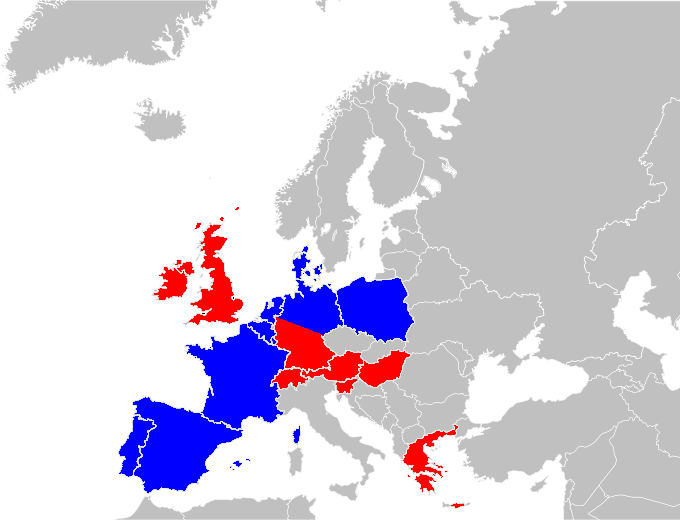
Back from hols with a sad story. During the summer, Theo Albrecht, one of the founders of the Aldi group – a sort of German Wal Mart – passed away.
Wikipedia has a full entry on Aldi. In addition to espousing the low-cost business model, Aldi has built part of its success on what seems to be a blatant market partitioning strategy. The Aldi group is indeed composed of two financially independent firms, Aldi Markt and Aldi Süd, which respectively serve northern and southern territories (see map above: Aldi Markt in Blue and Aldi Sûd in red). As explained in Wikipedia, the companies describe their relationships as a “friendly relation“…
Thanks to L. de Muyter for the pointer.
New Notice on Verticals – Switzerland

Our good friend David Mamane has informed us that just a few weeks following the reform of the EU rules on verticals, the Swiss Competition Commission had published its own new notice on vertical agreements. The Notice outlines the basic antitrust rules applicable to the drafting and assessment of distribution agreements that relate to Switzerland. A number of rules have been brought in line with the new EU regime (e.g. the double market share treshold).
David’s law firm has published a short memo which nicely summarizes the content of the new notice (see attached document below).
Verticals Notice Newsflash Schellenberg Wittmer
(Image possibly subject to copyrights: source here)
New Entrant
We are pleased to announce that we have a new competitor. Pay them a visit, it looks really good.
Oops!… I did it again

Yesterday in a cartel case, the Commission fined 17 producers of prestressing steel a total of € 518 470 750 and again
” accepted three inability-to-pay applications and granted reductions of respectively 25%, 50% and 75% of the fine that would otherwise have been imposed. It had received 13 such applications, under the Commission’s 2006 Fines Guidelines“.
Is this Almunia-driven? Thanks to Kit Brown for pointing out to this intriguing development.
(Image possibly subject to copyrights: source here)
Lol

The Court of Justice was in a facetious mood yesterday. It’s latest joke is plain excellent.
Here’s the background: In Commission / Alrosa, the Court was asked to rule on Article 7 (Finding and termination of infringement) and 9 (Commitments) of Regulation 1/2003.
Now, the Court’s joke goes as follows:
“Those two provisions of Regulation No 1/2003, as noted in paragraph 38 above, pursue different objectives, one of them aiming to put an end to the infringement that has been found to exist and the other aiming to address the Commission’s concerns following its preliminary assessment”.
[… Laughter …]
And the upshot of this:
“47. There is therefore no reason why the measure which could possibly be imposed in the context of Article 7 of Regulation No 1/2003 should have to serve as a reference for the purpose of assessing the extent of the commitments accepted under Article 9 of the regulation, or why anything going beyond that measure should automatically be regarded as disproportionate. Even though decisions adopted under each of those provisions are in either case subject to the principle of proportionality, the application of that principle none the less differs according to which of those provisions is concerned.
48. Undertakings which offer commitments on the basis of Article 9 of Regulation No 1/2003 consciously accept that the concessions they make may go beyond what the Commission could itself impose on them in a decision adopted under Article 7 of the regulation after a thorough examination. On the other hand, the closure of the infringement proceedings brought against those undertakings allows them to avoid a finding of an infringement of competition law and a possible fine”.
On this later §, read again recital 13 of Regulation 1, which says that “Commitment decisions are not appropriate in cases where the Commission intends to impose a fine“.
(Image possibly subject to copyrights: source here)
Relaxation

In a decision adopted last Weds, the Commission has put a dent into its conservative position that firms participating to cartels ought not to benefit fines reductions on grounds of financial difficulties. The decision relates to a cartel in the bathroom equipment sector. Hereafter, a quote from the press release:
More exceptionally, the fines of three companies were reduced by 50% and those of another two by 25% given their difficult financial situation. A total of ten companies claimed they would be unable to pay a fine: to assess their claims, the Commission looked at recent financial statements, provisional current year statements and future projections, several financial ratios that measure a company’s solidity, profitability, solvency and liquidity, and relations with banks and shareholders. The Commission also looked at the social and economic context of each company. Finally, the Commission assessed whether the companies’ assets would be likely to lose significant value if the companies were to be forced into liquidation as a result of the fine. The analysis is company-specific and aims to be as objective and quantifiable as possible to ensure equal treatment and preserve the deterrence aspect of EU competition rules.
Obviously, this will not come as a surprise to those familiar with the 2006 Guidelines on fines, which expressly provide for such reductions:
F. Ability to pay
35. In exceptional cases, the Commission may, upon request, take account of the undertaking’s inability to pay in a specific social and economic context. It will not base any reduction granted for this reason in the fine on the mere finding of an adverse or loss-making financial situation. A reduction could be granted solely on the basis of objective evidence that imposition of the fine as provided for in these Guidelines would irretrievably jeopardise the economic viability of the undertaking concerned and cause its assets to lose all their value.
Yet, this decision contrasts with (i) the tough stance on fines that prevailed until recently at DG COMP; and (ii) the Commission’s commitment to keep competition enforcement unaltered in times of crisis.
On top of this, the Commission’s decision will surely add to the debate that is currently raging in France. In CA Paris, 19 janvier 2010 AMD Sud Ouest, Arcelor Profils et autres c Conseil de la concurrence, the Court of Appeals of Paris has reduced the fines imposed by the NCA by €500,000,000 on the ground – inter alia – that the NCA had not sufficiently considered the effects of the ongoing crisis on the infringing firms.
(Image possibly subject to copyrights: source here)
Tweets

A welcome initiative: under the impetus of its creative chairman, Dr. Theodor Thanner, the Austrian Competition Authority has started to communicate on twitter. The account is BWB_WETTBEWERB. Some of you will have noticed that we have drawn inspiration from this. A twitter box appears in the right column of this blog. Unfortunately, GSM service is not yet available in Belgium. I will try to get fully familiar with the interface in the coming weeks. Amongst other things, the plan is to tweet during competition law events.


 Chillin'Competition


