Archive for the ‘Case-Law’ Category
Case C-58/12 P Groupe Gascogne v Commission + some other stuff

– Fresh off the Court. This morning the ECJ handed down a Judgment in which it has ruled that the Court itself is not supposed to reduce the fine imposed on a company whenever judicial review by the General Court exceeds a reasonable time. This Judgment effectively and explicitly overrules the Baustahlgewebe Judgment, in which the ECJ had followed the opposite (and in my view much more reasonable approach). Today’s Judgment is premised on the idea that an application for damages brought against the EU would in all circumstances constitute an effective remedy to compensate for any damages caused by the GC’s failure to adjudicate within a reasonable time.
For those of you with less background on general EU law, actions for damages against the EU shall be brought before the General Court. In other words, parties who believe that the duration of proceedings before the General Court was excessively lenghtly should, by means of a different application, ask the General Court itself to ascertain whether its own behavior was appropriate in the light of the circumstances specific to the case and whether the parties suffered any harm. Good luck with that…
– Save the date! On February 7th and 8th AIJA [Association Internationale de Jeunes Avocats) (a generous institution according to which lawyers below 45 qualify as young] will be holding a two-day conference in Bruges under the title “Competition Law 2.0- Competition Law and Technology“. A not-to-be-missed excuse to spend part of the weekend in Bruges and pay a visit to the greatest beer bar ever discuss hot topics in current antitrust. Both Prof. Petit and myself will be speaking there.
– Speaking of current antitrust debates: the last number of the Journal of European Competition Law and Practice (a great journal that has rightly earned a prominent place in a saturated? market) features various very good articles, including one by our guest blogger Pablo Ibañez on State aid litigation. At another level, it also features a brief piece of mine [the hyperlink only leads to the abstract] about Google’s commitments (you already know my views). Ironically, my comment was written in relation to the first version of the commitments but features in the “current intelligence” section of the journal. Fortunately I did explicitly envisage “likely further tweaks over specific details” and all comments are applicable to the new (leaked) proposal.
Chilling Case

In hot Brussels, our friend Johan Ysewyn kindly points us out to a “chilling” case: abuse of dominance by freelance ski photographers. Seems I am not the only competition geek on this planet
The facts are cool (cheap punning again). CAPSA runs the ski lift infrastructure of Cerro Catedral, Argentina.
CAPSA has contractually reserved the provision of photography services to DEFOTOS.COM.
And CAPSA has imposed an an extra fee for the use of lifts by freelance photographers.
The Argentinian Competition Commission and the Ministry of Commerce have found abusive discrimination.
This looks to me like the Argentinian version of Aspen Skiing Co. v. Aspen Highlands Skiing Corp., 472 U.S. 585 (1985).
However, unlike the US gem, this case is about a secondary line injury discrimination (the sole type of discrimination covered under Article 102 c) TFEU).
Weapon of Constitutional Destruction

On 5 July, the French Constitutional Court (FCC) issued a decision that may have massive repercussions in France (and which may trigger debate elsewhere).
In Société Numéricable et autres, the FCC was asked to rule whether the sanctioning powers bestowed upon the French regulator for Telecommunications (ARCEP) were compatible with the Constitution.
In brief, the litigated provision entitles the ARCEP to remove market authorisations and/or to slap financial sanctions on electronic communications operators.
The FCC analysis is straightforward, blunt, brutal:
“Considérant que, selon le premier alinéa de l’article L. 132 du code des postes et des communications électroniques, les services de l’Autorité de régulation des communications électroniques et des postes sont placés sous l’autorité du président de l’Autorité ; que, selon l’article D. 292 du même code, le directeur général est nommé par le président de l’Autorité, est placé sous son autorité et assiste aux délibérations de l’Autorité ; que, par suite et alors même que la décision de mise en demeure relève du directeur général, les dispositions des douze premiers alinéas de l’article L. 36-11 du code des postes et des communications électroniques, qui n’assurent pas la séparation au sein de l’Autorité entre, d’une part, les fonctions de poursuite et d’instruction des éventuels manquements et, d’autre part, les fonctions de jugement des mêmes manquements, méconnaissent le principe d’impartialité ; que celles de ces dispositions qui sont de nature législative doivent être déclarées contraires à la Constitution“
In English now: the disputed provision does not provide for the separation of investigative and decisional functions within ARCEP. This breaches the principle of “impartiality” . As a result, the sanctioning powers of ARCEP must be declared contrary to the Constitution.
The French competition authority will likely not be impacted by this ruling, given that it is built on the bifurcated agency model.
And other integrated competition agencies can sleep tight (e.g. DG COMP), given the lack of FCC jurisdiction over non domestic affairs.
However, the merit of the FCC decision is to show that the “prosecutorial bias” issue is not a rethorical invention, concocted by disgruntled EU antitrust lawyers at grips with DG COMP.
Even in a country like France, where there is a considerable sympathy towards public institutions and where government agencies are almighty, some fundamental procedural safeguards are to be observed. And it starts with the idea that “he who prosecutes shall not judge (and sanction)“.
Thanks to Elise for the pointer.
Reverse payments (Pay for delay settlements) in EU and US antitrust law (Part I)

I’ve somewhat of a bad conscience for not having been able to cover this topic before (not least because one of you has been pestering me with emails asking when I’d write about it…)(btw, the same person has also gently and repeatedly reminded me to post a link to his new –and actually very interesting (really)- paper, so here it is; titled The Law of Abuse of Dominance and the System of Judicial Remedies).
As you may have read, within a lapse of two days the US Supreme Court (SCOTUS) and the European Commission issued, respectively, an opinion (in FTC v Actavis) and a decision (against Lundbeck and others) addressing reverse payments.
Most of the superficial client alerts analyses I’ve seen merely note the time coincidence and suggest a certain convergence in the US and EU approaches to the issue. The headline goes that the Commission imposed its first fine for this practice, and that the SCOTUS reversed a Circuit clash, holding that reverse payments are subject to the rule of reason and dismissing the “scope of the patent test”. In my view, this reading, although right, is also incomplete and hides a few of the interesting issues that have surfaced in these cases.
If I were to start explaining what reverse payments are, the background to these cases and the content and implications of the opinion and the decision you’d probably be tempted to stop reading after a few lines. In order to avoid that, instead of following the normal structure of a post, this will be a reverse post on reverse payments:
Today we will provide you with some comments on these developments and of why they can be relevant beyond their specific context. Tomorrow (if I’ve time) or on Friday (more likely) we’ll offer you our vision on the background to these cases and an overview of the opinion and the decision. I trust this will enable (i) connaisseurs to skip the background stuff; and (ii) those not initiated in these issues to grasp their relevance and to become interested in reading more about them.
Some reactions to the SCOTUS opinion and to the Commission’s decision
– Leaving the pharma sector aside, and looking at things from a broader perspective, the underlying philosophy of the Opinion in relation to the IP regulation/antitrust interface (condensed in this statement: “it would be incongruous to determine antitrust legality by measuring the settlements anticompetitive effects solely against patent law policy, rather than by measuring them against procompetitive antitrust policies as well”) appears to be at odds with the principles governing the interface between sector-specific regulation and antitrust established in Trinko . It’s therefore not surprising that Justice Scalia, that wrote the majority opinion in Trinko, has joined Roberst and Thomas in a dissenting opinion here. So, does this signal a change of trend in the way the SCOTUS interprets antitrust law? The 3 dissenting Justices at least do seem to see it that way, and argue in strong terms that the opinion overturns understood antitrust.
– On a very related but more specific note, although I haven’t read any comments on this point I see common link between these two recent cases on reverse payments and other landmark cases like Linkline US) and Telia Sonera (one of the most controversial EU cases in recent years). In all these cases some party relied on the idea that “he who can do the most can do the least”. In Actavis and Lundbeck the argument was that a patent holder was entitled to exclude competition provided that it remained within the limits of the “scope of the patent”; and in TeliaSonera and Linkline it was that if refusing to supply would not be deemed abusive, there could be no room to find an abusive margin squeeze.
This argument, however, had only been accepted by the SCOTUS in Linkline, with European Courts taking a different line in the most criticized TeliaSonera Judgment, so it’s not surprising (at least to me) that the Commission has rejected it in Lundbeck, but it’s remarkable that the SCOTUS has taken a different line in Actavis.
By the way, I leave one provoking thought I heard from someone the other day discussing TeliaSonera: “I don’t have an obligation to let anyone into my home, but once they’re inside it would be illegal for me to kick them out violently…”. (I expect some virulent reactions to this; happy to discuss).
– Are the EU and US approaches converging with regard to reverse payments, or even with regard to the assessment of horizontal agreements more widely? Not really (leave aside the synchronized summer desk cleaning timing coincidence). Sure, both the SCOTUS and the Commission see a margin for potential restrictions of competition in reverse payments, but they have chosen very different approaches. And whereas the theoretical difference does not appear to be large, the practical consequences hugely differ. In the US reverse payments will need to be assessed under the rule of reason –which imposes a very considerable burden on plaintiffs- (as we will explain in our forthcoming post, the Supreme Court has dismissed the “quick look approach” proposed by the FTC). In Europe, on the contrary, the Commission has decided to take the usual “object” shortcut. This is key, for an “amorphous rule of reason” (an expression actually used in the dissenting opinion in Actavis) analysis normally means difficulties for the plaintiff, whereas a “bifurcated” 101(1) / 101(3) analysis generally results in condemnation because of the (anticipated and worrysome) death of Art. 101 (3).
(Interestingly, the FTC wasn’t able to give a satisfactory answer to a very pertinent question asked by Justice Sotomayor at the hearing: “Why is the rule of reason so bad?”)
If you ask me, I would have no objection to the EU solution if Art. 101(3) were an effective possible way out (this was basically the ECJ’s stand in GlaxoSmithkline) and I would have no objection to the US approach if the burden of proof incumbent upon plaintiffs was a bit less burdensome. As things stand, it was probably not feasible to strike the right solution in theory (where I think the SCOTUS’ one is preferable) as well as in practice (where the Commission’s will likely yield better results) for these cases.
To be continued…
Law Firms = Cartels
From Judge Bork himself:
“The typical law partnership provides perhaps the most familiar example [of agreement on prices and markets]. A law firm is composed of lawyers who could compete with one another, but who have instead eliminated rivalry and integrated their activities in the interest of more effective operation. Not only are partners and associates frequently forbidden to take legal business on their own …, but the law firm operates on the basis of both price-fixing and market-division agreements. The partners agree upon the fees to be charged for each member’s and associate’s servicse (which is price fixing) and usually operate on a tacit, if not explicit, understanding about fields of specialization and primary responsibility for particular clients (both of which are instances of market division)” The Antitrust Paradox, 1978, p.265.
Bork used this example to criticize the blanket per se prohibition of price-fixing and market division schemes. Cartels formed amongst lawyers yield redeeming efficiencies (the combination of complementary skills, notably) + there are many law firms and all compete fiercely. Hence, output restriction is not a tenable hypothesis.
This later point ties in well with C‑226/11 Expedia Inc. v. Autorité de la concurrence, a judgment poised to earn a “worst antitrust development Oscar”. Bork’s example casts a bright light on the judgment non-sense: in this case, the Court held at §37 that conduct with marginal market coverage (<10%) ought to be deemed to have appreciable anticompetitive effects as long as it can be categorized as a restriction by object:
“It must therefore be held that an agreement that may affect trade between Member States and that has an anti-competitive object constitutes, by its nature and independently of any concrete effect that it may have, an appreciable restriction on competition“
In other words, a price-fixing scheme that covers 5% of the market is per se illegal under Article 101(1) TFEU. Again, a dispairing judgment…
Death of the Google Case – A Big Win for the Commissioner?

With the anticipated settlement in the Google search case (amongst other things), journalists keep asking whether this represents a major win for the Commissioner. Like I have said before, the best way to address this question consists in assessing the substantive merits of the case. The settlement certainly represents a major win if one believes that the case is meritless (I have argued this elsewhere). The FTC’s decision to do nothing on search supports this theory.
In contrast, this settlement is not a major win if one believes that the case is strong, and that the Commission could have easily pushed for an Article 7 decision (I have also made arguments to this effect, given the loose substantive and judicial review standards promoted by the EU courts in abuse cases).
But there’s one thing which may have dissuaded the Commissioner and his administration from using the conventional Article 7 track (remember, he actually voiced his disinterest for the Article 7 procedure and pleaded that fast moving markets need fast enforcement mechanisms (read Article 9): the protracted duration of such proceedings. The Commissioner’s mandate expires somewhere in the Fall of 2014. Under an Article 7 procedure, he might no longer have been in office to sign the prohibition decision. In short, to put the Google case on his hunt list, Almunia needed a settlement.
But is it really true that it takes so much time to adopt an Article 7 prohibition decision in an abuse case? After all, we are now 3 years and 2 months after the initial complaints in the Google case (they date back to February 2010), and the supposed celerity of Article 9 decisions seems all the more relative.
I made a quick check on the duration of Article 7 proceedings in abuse cases since 2005 (using COMP’s case search tool):
- Intel, 9 years following complaint
- Microsoft, 6 years following complaint
- Astra Zeneca, 7 years following complaints
- Tomra, 6 years since complaints
- GVG/FS, 4 years following complaint
- Wanadoo, 4 years following investigation
- Telefonica, 4 years following complaint
- Telekomunikacja Polska, 3 years following investigation
- Clearstream, 3 years following investigation
Two things stand out of this review: 1. Article 7 decisions can be adopted in 3-4 years; 2. cases with formal complainants are much longer than cases without.
Against this backdrop, the Commission could thus not have conceivably adopted an Article 7 decision before the term of Almunia’s mandate.
So if the Commission is ever to settle with Google, this will clearly be a big win for Commissioner Almunia.
PS: for a funny paper on Google death inactive account manager service, see here.
PS2: for yet another ordinary interview of the author of this post in the press, see here.
Thoughts on the Commission’s Decision in UPS/TNT

My back of the envelope analysis of the Commission’s prohibition decision in UPS/TNT, following yesterday’s GCLC lunch talk.
Some facts first – With this decision, the Commission prohibited a merger to duopoly in the express mail business. The Commission found that the merger would have given rise to an overly powerful n°2 – DHL being the leading player – and to the disappearance of a “maverick“, TNT (a so-called “gap case” ). Whilst efficiencies were deemed sufficient to outweigh the restrictive price effects on a number of geographic markets, the balancing test in central and eastern European markets yielded a negative outcome. The parties did not manage to convince the Commission that their “last minute” proposed remedies package (divestiture of parts of TNT’s business to La Poste + 5 years’ access to UPS/TNT’s aircraft fleet) would allay its concerns. The Commission had thus no other choice but to block the merger. The deadline for appeal exprises next week. My feeling – based on smoke signals – is that the parties will appeal before the General Court. Unfortunately, the decision is not yet published. But the Commission has published a press release and a comprehensive MEMO on the decision.
On a possible toughening of EU merger policy – Contrary to what has been written in the press, the case does not suggest a harder merger policy. The headcount of prohibited mergers for Almunia currently lurks at 4, where Van Miert and Monti respectively had shot down 9 and 8 mergers. Rather, this decision shows that merger scrutiny remains effective, even in a period of merger morass and of depressed capital markets.
On the alleged protectionist instrumentation of EU merger policy – In the US, journalists were prompt to compare the EU with China, arguing that “the Commission uses antitrust enforcement to curb the efforts of American companies to expand in their countries”. To me, this is ill-thought: the prohibition decision also protects FedEx, a US company, from the fierce competition of DHL and UPS .
On the missed opportunity to “industrialise” EU merger policy – The Commission refused to view La Poste as a “suitable purchaser” for the parties’ proposed divestiture. From an industrial policy angle, one may argue that the Commission has thereby counter productively prevented the rise of a second European giant in the parcels business, besides DHL (Deutsche Post). Now, it is well known that the Commission also seeks to open postal markets to competition. A further strenghtening of La Poste may have undermined the Commission’s parallel liberalisation agenda.
On the perils of economic analysis in EU merger policy – Let’s be frank: in this case, the parties awkwardly offered to the Commission the rope to hang them. To prove that the disappearance of TNT would lead to price increases, the Commission relied on the price concentration study initially provided by UPS and TNT. It seems the Commission just had to tweak some numbers, and what looked like a minor positive correlation according to the parties became a significant impediment to effective competition (the parties did not deny the existence of a price effect, but they argued that it was de minimis in magnitude) which could only be offset by redeeming efficiencies. In other words, by pushing this price concentration study forward, the parties lifted the burden of proof away from the Commission, and placed themselves immediately in the uncomfortable position of having to argue efficiencies. The bottom line: economic analysis can backfire.
On the interpretation of the “efficiency defense” in EU merger policy – This case is probably one of the first merger cases in which the Commission accepted that – at least on some markets – cost efficiencies would be passed on to customers. So far, the Commission had often accepted the existence of efficiencies, yet rejected them as either insufficient in magnitude or on the ground that they would not be transferred to customers. This is a very positive evolution in merger policy.
On the fallacious distinction between fixed and variable costs in the context of the “efficiency defense” – The Commission rebuffed the administrative efficiencies (overheads) advanced by the parties on the ground that they constitute fixed cost efficiencies, i.e. one-offs which have no impact on prices charged to customer. To me, this is bad policy. Whilst firms do not seek to recoup ALL their fixed costs in their short term prices, most firms try to recoup some of their fixed costs in their short term prices. So if, with a merger gives rise to fixed costs reductions, then there is less to recoup on customers in the short term. The bottom-line: fixed costs efficiencies have an influence on short term pricing. Moreover, “one-offs” fixed cost efficiencies have an additional beautiful feature: they are “structural” efficiencies that benefit to consumers forever, regardless of market evolution (growth or decline). They are thus more plausible, and likely to unravel, than “conjonctural” variable costs efficiencies.
On the interface between EU merger policy and Article 102 TFEU – To reject the proposed remedy package, the Commission speculated that La Poste would likely not develop its own aircraft fleet, so that after the expiration of the 5 years’ access remedy, it would not exert significant competitive pressure on the integrators (DHL, UPS/TNT and FedEx). This is not very convincing, for both factual and legal reasons. First, La Poste has already started a process of vertical integration. Second, after the expiry of the 5 years commitment, the Commission remains able to maintain an access remedy under the Article 102 TFEU essential facilities doctrine.
On conflicts of interests in EU merger policy – Rumour has it that at the hearing, the parties infuriated a big fish from DG COMP. The reason? The official who previously held his position had dared appearing as consultant for the parties.
On the scope of the UPS/TNT decision – The Decision concerns only 29 countries in the EEA, and not 30. The explainer it that the Commission did not manage to get any significant data on Liechtenstein, so it decided to drop this country from its investigation.
For more on this, see A. Lofaro’s excellent RBB Brief here.
The ppts of the speakers at yesterday’s lunch talk will shortly be made available on the GCLC’s website.
And thanks to Stephan Simon for suggesting to title the event after AC/DC’s “TNT“, rather than after Queen’s “Another one bites the dust“.
ECJ’s ruling on France Telecom’s State aid case (Joined Cases C-399/10 P and C-401/10 P)
Note by Alfonso: As some you may have noticed, I’ve taken an unusually long blogging break from which I’m now back. As every time I’m out of combat, Pablo Ibañez Colomo (who, by the way, has recently been fast-track tenured -major review- at LSE and has just received a major review teaching prize; congrats!) comes up with a replacement post that’s better of what I would’ve written (we have a luxury bench at Chilin’Competition…). A few days ago Pablo sent us this post on France Telecom that we(I)’ve been slow to publish due to the easter holidaus and to to the frenchy’s posting frenzy 😉 We leave you with Pablo:

Some readers wll remember that during my short-lived tenure as a substitute blogger a few months ago, I wrote about a pending State aid case involving France Telecom. I guess that at least a fraction on those readers will be interested in knowing that the Court of Justice delivered its Judgment in the case on 19 March.
Unsurprisingly, the judgment is in line with AG Mengozzi’s (very sensible) opinion. The General court annuled the Commission’s decision on grounds that the Commission had not identified a clear link between the advantage deriving from a shareholder loan offer in favour of France Telecom and the State resources allegedly involved by virtue of the measure. As I argued in my previous post, the Court of Justice takes the view that the General Court’s interpretation of Article 107(1) TFEU would leave outside the scope of the provision measures suh as guarantees departing from market conditions (see paras 107-111). Such measures do not immediately place a burden on the budget of the State, but a ‘sufficiently concrete risk of imposing an additional burden on the State in the future‘. According to the Court, it is sufficient to identfy such a ‘sufficiently concrete risk‘ for State aid rules to come into play.
The broader picture is aguably more interesting than the outcome of this case. As I mentioned in the previous post, the Court of Justice has sided with the Commmission (thereby departing from the analysis of the General Court and the theses advanced y Mmember States) in some key cases revolving around the notion of selectivity. France Telecom, arguably the single most important case of the past years on the notion of State resources, seems to confirm this trend. The old principles of Article 107(1) TFEU case law, if anything, seem more solid following these high-profile disputes
Lost in Translation

[Please read this post with caution] Heard from a seasoned German-speaking Member of the Court of justice of the EU.
The fuzz about the object-effect dichotomy that has kept generations of EU competition lawyers busy would be a moot issue. We dumd: last year, at the GCLC, we devoted a full conference and book to this issue.
This is because this distinction arguably does not exist [following Hans, Petra and Rainer’s clarifications, I suspect this eminent person meant is “not really relevant”] in the German-language version of the Treaties. Hence the Court’s reluctance to consider effects in antitrust cases.
Puzzled by this assertion, I ran my investigation. At this juncture, I must mention that I am a complete German illiterate.
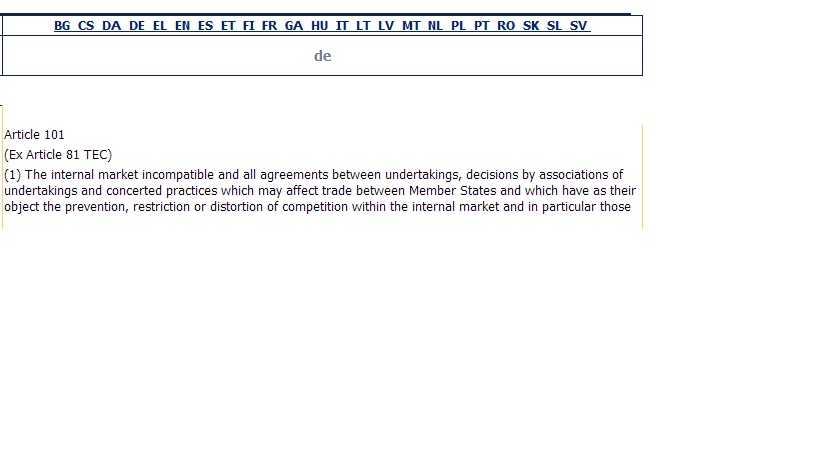
So here we go: I first consulted the wording of Article 101(1) of the Treaty in German:
“(1) Mit dem Binnenmarkt unvereinbar und verboten sind alle Vereinbarungen zwischen Unternehmen, Beschlüsse von Unternehmensvereinigungen und aufeinander abgestimmte Verhaltensweisen, welche den Handel zwischen Mitgliedstaaten zu beeinträchtigen geeignet sind und eine Verhinderung, Einschränkung oder Verfälschung des Wettbewerbs innerhalb des Binnenmarkts bezwecken oder bewirken, insbesondere”
Then I asked Google to translate this text to English:
“(1) The internal market incompatible and all agreements between undertakings, decisions by associations of undertakings and concerted practices which may affect trade between Member States and which have as their object the prevention, restriction or distortion of competition within the internal market and in particular those”
No trace of the word “effect“.
I did the same in French:
“(1) Le marché intérieur incompatibles et interdits tous accords entre entreprises, toutes décisions d’associations d’entreprises et toutes pratiques concertées qui sont susceptibles d’affecter le commerce entre États membres et qui ont pour objet d’empêcher, restreindre ou de fausser la concurrence au sein du marché intérieur et en particulier ceux”
Again, no trace of the word “effect“.
A weird finding. All the more so given that the official Treaty translation explicitly talks of “effect“.
So here I am, pondering whether I am making this up or if, as this distinguished Court Member hinted, there is a linguistic reason for the absence of serious effects analysis in the Court’s case-law.
Now, if the other language versions of the Treaty talk of “effect“, which version of the Treaty is the right one?
Gee, me completely lost in translation.
PS1: On this, I’d advise Google to manipulate its translation service, and reintroduce the “effect” word in all Treaty translations.
See below for more evidence (a print of my screen).
Post Danmark – More than just One Case

Our friend Christian Bergqvist has offered us a most interesting post on the national sequel of the CJEU judgment in Post Danmark. Christian is an associated professor at the University of Copenhagen/Faculty of Law. He holds a PhD in competition law and has specialized in particular on dominant firm conduct and the interplay of Article 102 TFEU and sector specific regulation. For more, see here.
PS: for a good reminder of the ruling and of its implications for future competition policy, I advise the reading of the excellent piece of E. Rousseva and M. Marquis (which suggests (in my view rightly) that the Court eventually embraced the Commission’s approach set forth in the Guidance paper).
About a week ago, on Friday 15 February, the Danish Supreme Court delivered its ruling in Post Danmark vs Konkurrenceraadet. This judgment settles the national case behind the (fabulous) 2012 CJEU ruling Post Danmark (C-209/10). Given the strong pronouncements made by the CJEU it does not come as a surprise that the Danish Supreme Court eventually decided to quash the challenged (national) decision on grounds of an incorrect material test. Rather than concluding that discriminatory conduct was per se able to exclude a competitor, the Danish Competition and Consumer Authority, should have conducted an “equally efficient competitor test”, or something close (the latter being my interpretation). Absent this, nothing conclusive could be decided on the existence of an abuse.
The ruling of the Supreme Court leaves little space for ambiguity. Yet, the final word might not have been said on the matter. First, the Danish Competition and Consumer Authority can at least theoretically reopen the case and conduct a proper analysis. This, however, looks quite unlikely. Second, back in 2009, the alleged “victim” of the exclusionary behavior (Forbruger-Kontakt) had successfully filed an action for damages, and was subsequentely awarded DKK 75 million (app. EUR 10 million). Unsurprisingly, Post Danmark has appealed this decision to the Danish Supreme Court, which is yet to decide on the matter.
This short post seeks to offer some thoughts on this issue. Prior to this, I provide some background information on the initial EU case.


 Chillin'Competition