Archive for the ‘Guest bloggers’ Category
10,000 Visits
We officially launched this blog on 9 September 2009. In a little more than 2 months, we got 10,000 visits.
Thanks to all of you for reading us.
Nicolas and Alfonso
Predictably Irrational – Behavioral Economics and Competition Law

I’m currently reading Predictably Irrational, an extremely interesting and thought provoking book on behavioral economics. It challenges traditional assumptions regarding, amongst others, price theory and rational profit maximizing behavior, precisely the tenets of economic thinking that underpin competition law’s design and application.
The subject of the possible uses of behavioral economics for competition law purposes remains largely unexplored, even if now seems to be on the rise. Nevertheless, the controversy over the validity of rational choice theories is by no means new. Challenges to such theories have been rebutted in the past, sometimes brilliantly and even humoristically, by some of the most prominent antitrust scholars:
Skimming through ‘The Antitrust Paradox‘ I came across Bork’s dismissal of the objection that business are not purely, or even primarly, rational profit seekers. Bork argues -quoting Friedman- that price theory does not require the assumption of effective profit maximizing behavior, but rather that firms ‘generally behave as if they were engaged in maximization. But, in addition, he has a somehow more interesting argument when he states that:
‘[i]f required I should not hesitate to impute conscious profit maximizing to businessmen -experience with businessmen, and even more, with antitrust lawyers and consulting economists should convince anyone that profit is a goal not only consciously but constantly borne in mind‘.
(There we are, us, poor innocent antitrust professionals, turned into the quintaessential rent seekers….)
This notwithstanding, this book on behavioral econ. certainly has a valid point. Whilst behavioral econ. is ill-suited to replace rational choice theory as the theoretical framework for competition law, this rising discipline can surely contribute to raise our awareness about the existence of unavoidable flaws in traditional analysis.
Moreover, there are surely some direct applications of behavioral economics which could be useful for competition law purposes. Let’s illustrate this through a few examples.
First, behavioral econ. may help identify systematic biases or deviations from rational prescriptions which would aid in determining whether in some instances firms are more or less likely to engage in non-profit maximizing strategies than we generally tend to believe (e.g. predatory pricing when recoupment is unlikely).
Also, some studies aim at explaining why ‘overconfident entrants’ may decide to enter into a given market ignoring unfavorable conditions and high barriers and therefore tipically fail in their attempt (if that were so, then reliance on entry rates to qualify market power should be replaced by the sole study of successful penetration).
Another possible use of behavioral econ. relates to ex post assessment of predictions on the effect of mergers. Competition authorities could increase their efforts to empirically evaluate ex post how accurately economic models used in merger control predict the effects of mergers in order to explore whether systematic deviations might also take place. I understand that US authorities are starting to follow this path (after all, the laxity of the Bush administration in the area of merger control provides for a favorable environment for such exercise), but I am not aware of such developments in other jurisdictions.
Finally, the possible uses of this disciple in the area of competition law must not necessarily be confined to analyzing why businessmen and firms engage in irrational behavior; it would surely be interesting to study when and why competition authorities behave irrationally.
(Image possibly subject to copyrights: see here)
Anti-Monopoly
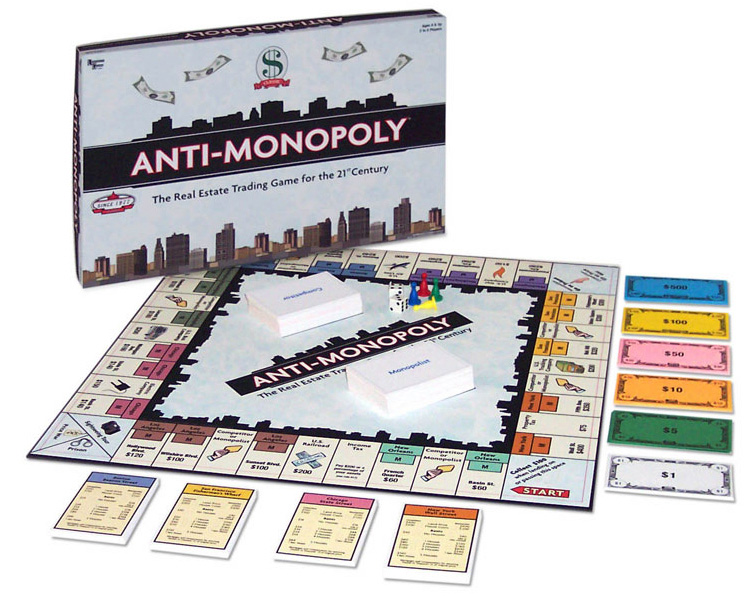
As anticipated in previous posts, we continue feeding up a ‘leisure time for competition geeks’ section.
This post is about a board game, ‘Anti-Monopoly’, a different version of ‘Monopoly’ with an ‘anti-monopolistic’ theme.
In Anti-Monopoly®, players play either by or competition rules fixed at the beginning of the game:
COMPETITORS … charge fair rents, build as soon as they own a property, put five houses on their properties and occasionally go to Price War.
MONOPOLISTS… extort monopoly-high rents from their poor tenants, build only after they have monopolized a color grouping, restrict supply by putting only four houses on their properties and occasionally go to Prison.
The good guys are the small business entrepreneurs and the bad guys are the monopolists. Since players do not play by the same rules, fairness is achieved by a patented probability technique, has given each side equal chances to win.
OBJECT OF THE GAME: To be the richest competitor after all monopolists have been bankrupted or to be the richest monopolist after all competitors have been eliminated.
There is actually a great deal of controversy surrounding the creation of the game, which includes a 10 year long legal battle between the creator of Anti-Monopoly (Ralph Anspach) and the owners of the ‘Monopoly’ trademark. After more than 37.000 copies of ‘Anti-Monopoly’ were destroyed pursuant to a District Court’s order which found a trademark infringement in the use of the word ‘Monopoly’, the 9th Circuit Court of Appeals ruled in 1979 that the trademark ‘Monopoly’ was generic and thus unenforceable. Nonetheless, this wasn’t the end of the story. Soon after the 9th Circuit’s decision, the US Congress amended the Trademark Act to protect longstanding marks against generic claims, thereby allowing Hasbro to assert again its rights to the mark ‘Monopoly’ and its variants.
A settlement was eventually reached and the game is now marketed under a license from Hasbro.
For more info on the game as well as on the underlying legal story, click here
Thanks to Anne Dostert for the pointer (and indirectly to Scott Hemphill, from Columbia, who apparently has a copy of the game in his office) .
Spanish Court of Appeal strikes down CNC’s Inspection Practices

The Audiencia Nacional (‘AN’) – i.e. the Spanish Court in charge of the review of acts and decisions adopted by the Spanish National Competition Commission (‘CNC’) – recently delivered an important judgment quashing some of the CNC’s investigatory practices, which had elicited a great deal of controversy over the past few months.
Background: In a raft of recent cases, the CNC investigatory branch made use of the new investigatory powers provided for under Competition Act 15/2007. Those cases triggered a stern opposition from the legal community, which voiced that the CNC’s inspections might have deviated (i) from the standards set out by the ECJ in relation to inspections under EC competition rules, as well as (ii) from the limitations imposed by Spanish Courts with regards to police/and or administrative inspections, thereby breaching the rights of defense of the inspected undertakings. Disregarding the criticism, the CNC’s Council nonetheless adopted a number of decisions supporting the interpretation of the CNC’s Investigation Directorate.
The judgment: the AN’s Judgment originates in an appeal against one of those decisions. In essence, it can be summarised as follows:
1) The Court observes that many of the documents obtained -collected pursuant to the copying of computer hard drives- are unrelated to the sector under investigation as identified in the mandate as well as in the judicial authorization granted to the CNC, and therefore cannot be deemed to be covered by them. Consequently, the Judgment declares that there was a breach of the right to inviolability of the domicile of the undertaking inspected.
2) As to the consequences of the said breach, the Court rejects the claim that the whole inspection should be declared void. Instead, it holds that the documents related to the subject matter of the investigation did fall within the scope of the mandate and of the judicial authorization and were thus lawfully collected, and orders the CNC to return all other documents.
3) The Judgment affirms the rights of firms subject to an inspection to have access to the search criteria used to retrieve information stored in hard drives (allegedly no search criteria had been used in the inspection at stake).
4) The AN dismisses the claims related to the alleged violation of legal privilege arguing that the CNC has merely collected possibly privileged documents but has not made use of them.
5) The arguments related to a possible breach of the rights to privacy of correspondence of the undertaking’s employees are also dismissed on the basis that the inspection was not aimed at collecting such documents. Accordingly, the Court holds that any extra-limitation with regards to employee’s private documents stored in computers located at the undertaking’s premises must be subsumed within the breach of the rights of the undertaking inspected.
In my view, this is a most welcome judgment if only because it narrows the gap between the standards applied by the CNC and those of the European Commission.
However, the non-conformist lawyer that sleeps inside me has a couple of comments:
– First: the AN’s argument that there cannot be a breach of the rights of defense unless privileged documents are effectively used as evidence seems to be at odds with the ECJ’s ruling in Akzo with regards to the ‘cursory glance’ practice.
– Second: in this case, unlike in a number of other recent ‘dawn raids’ in Spain, the subject matter of the investigation had been clearly defined in the mandate as well as in the judicial authorization. Both identified the specific conduct under investigation, the product and geographic market affected, as well as the years during which the agreement was thought to have been implemented. Nevertheless, for the purpose of determining which documents can be deemed to be comprised within the scope of the mandate, the Judgment prescinds of those and merely takes into consideration whether it is related or not to the sector under investigation without any further qualifications, which is arguably still a wide criterion.
See below for link to the judgment.
(Image possibly subject to copyright. Source)
First Ever Hollywood Competition Law Movie?

For those of you who are brave enough to take an additional drop of competition law stuff over the WE (if you’re reading this you’re probably within the category), rush to the theatre watch ‘The Informant’.
This movie -directed by Steve Sodenbergh and based on Kurt Echenwald’s book- tells the story of the DOJ’s investigation inthe lysine cartel from the perspective of the executive who blew the wisthle, Mark Whitacre (played by Matt Damon).
The lysine cartel was also sanctioned in Europe, and in fact Whitacre is also a relevant character in the Commission’s decision (see paragraphs 336-341).
You may already have watched the videos of the cartel’s meetings, taped thanks to Whitacre. In case you haven’t, the transcripts are available here in different segments: 1, 2, 3, 4, 5, 6 (the part in segment one where they joke about the FBI and the FTC being present at the meeting is particularly good).
P.S. If Nicolas keeps recommending books and I get started with movies we might build a “leisure time” section for all competition geeks.
Apple, Google, and more on Interlocking Directorates

Last Monday, Arthur Levinson -until now a member of the board of both Apple and Google- resigned from the board of Google. The resignation follows that of Eric Schmidt (Google’s CEO), who abandoned his position on the board of Apple in August. Both moves were aimed at addressing the FTC’s concerns over the possible anticompetitive effects arising from the close inter-personal nexus between the two companies.
Even though the FTC’s investigation on this matter may have reached its end, Google has not moved away from the antitrust spotlight. The initial book settlement was derailed pursuant to the numerous objections put forward against it, and the District Court has required a new version to be delivered by November 9th for preliminary approval. Meanwhile, the DOJ’s investigation concerning hiring practices at Google, Yahoo and Apple is ongoing. And some suggest that this could only be the beginning…
Those cases, as well as last week’s announcement of the opening of an investigation about IBM’s conduct in the mainframes market, have been seen as consequences of the stricter approach undertook by antitrust enforcers under the Obama administration regarding high-tech markets, particularly in the presence of network effects.
Now, coming back to the Google/Apple issue: in the US, the Google/Apple investigation constitutes the second challenge to interlocking directorates brought by the FTC under Section 8 of the Clayton Act over the past two years (the case brought against Commscope was resolved by a consent decree in December 2007).
In Europe, the ECJ and the European Commission have acknowledged that interlocking directorates and, more generally, minority shareholdings, could wield anticompetitive effects. It has also been held that such effects could be dealt with under Articles 81 and 82 EC (see the Judgment in cases 142 and 156/84, British American Tobacco and Reynolds v. Commission, and the Commission’s decision in case 93/252, Warner-Lambert/Gillete).
However, in spite of recent evolutions in merger control (see the Ryanair/Aer Lingus decision, currently pending before the CFI), to my knowledge, the Commission has never initiated any proceedings challenging the acquisition of minority shareholding and/or interlocking directorates since the Gillete case in 1993.
As a consequence of this lack of interest on the part of antitrust authorities and, to a certain extent, of commentators too, this remains, one of the under-explored areas of EC competition law. In contrast with the clear prohibition contained in Section 8 of the Clayton Act, companies in Europe are again faced with considerable legal uncertainty. In sum, a great topic for research if anyone’s interested.
For a brief and recent account of the state of the law in the US and the EU on this subject, check out these: US – EU.
(Source: image possibly subject to copyrights)
The Spanish Competition Authority declares a collective bargaining agreement contrary to EC and Spanish competition law
The CNC (Spanish Competition Authority) recently adopted a decision sanctioning a stevedoring trade association (over 900.000 euros) and several labor unions (with fines ranging from 3.000 to 168.000 euros) for having concluded a collective bargaining agreement contrary to Articles 81 EC and 1 LDC (Spanish Competition Law).
Case C-501/06 P, GSK v. Commission

The ECJ has handed down its much awaited judgment in the ‘Glaxo Spain’ case, yet another case on the EC competition law assessment of practices aimed at curbing parallel trade in pharmaceuticals.
In a nutshell:
– The ECJ reaffirms its traditional stance regarding the fact that an agreement aimed at limiting parallel trade shall be considered as restrictive of competition ‘by its object’.
The Court thus holds that the CFI committed an error of law when it asserted that such agreements could only be regarded as restrictions ‘by object’ provided that their object or effect was shown to be the restriction of competition ‘to the detriment of the final consumer’ (which, in a way, was paradoxically akin to saying that those agreements would be a restriction by object only after having determined they constitute a restriction by effect).
– The judgment upholds the CFI’s finding that the Commission failed to carry out a sufficient assessment of the possible efficiencies derived from the agreements in the light of Article 81(3).
Now, from a pure “policy” standpoint: big pharmas have welcomed this judgment as a resounding victory. In this context, can it be assumed that, from now on, parallel traders will no longer escape the panoply of obstacles devised by pharmaceutical companies? I don’t see it that way.
The CFI’s Judgment explicitly accepted the contention that the pharma industry exhibited special and specific features which deserve a somewhat particular treatment, and lambasted the Commission for having failed to take proper account of those peculiarities.
By contrast, the ECJ’s reasoning is much less sector-specific driven. It stresses the Commission’s failure to thoroughly deal with the arguments and evidence put forward by parties claiming an exemption under Article 81(3), regardless of the particular sector at stake. In this sense, the ECJ Judgment could be read within the stream of case law having raised the standard of proof incumbent upon the Commission in other areas of competition law enforcement.
Therefore, I don’t view this ECJ judgment as providing definitive support for any of the arguments regarding the alleged specificities of the pharmaceutical sector, but rather as requiring a stronger reasoning if the Commission wishes to rebut those arguments. Interestingly, the specific features of the pharma industry were recently examined – and found of little particular relevance – by the ECJ and by AG Ruiz Jarabo in the Lelos (Glaxo Greece) case. In light of this, I would thus say that nothing precludes the Commission from adopting and reflecting in its Decision a stricter effects assessment and reaching the same outcome it reached in 1998.
One last note: I don’t view the judgment as bearing the potential to have an incidence on the way the Commission currently undertakes 81(3) assessments. This case referred to agreements which had been notified to the Commission pursuant to Regulation 17/62, and since the passing away of the notification system the Commission arguably undertakes a more detailed assessment of the cases it decides to initiate on its own motion. Would a similar judgment have come out when the Commission was still entrusted with reviewing hundreds of agreements per year?
Unrelated: thanks to Nicolas for the invitation, and I hope you enjoy the blog.
(Image possibly subject to copyrights)
Introducing Guest Blogger – A. Lamadrid
 I have invited Alfonso Lamadrid, a LLM student at Harvard Law School and former associate at Garrigues, to chill competition blog on this website. Alfonso is a brilliant competition lawyer but, more importantly, is a very open minded person with a strong taste of humour. In this sense, Alfonso precisely personifies what this blog intends to be: something insightful, but also relaxed and open to new ideas.
Welcome Alfonso!
PS: Alfonso belongs to the authors a very good book on antitrust law (in Spanish though) that was published last year.


 Chillin'Competition