Archive for the ‘Life at Law Firms’ Category
Reading Competition Law Books

In our “Friday Slot” interviews we ask what competition law book deserves an Antitrust Oscar. A frequent reply from our interviewees is that they do not read competition law books but rather consult specific sections of such books when they are looking for something in particular.
We don’t necessarily agree with this view. Even though there are certainly some books that we only use for reference, we believe that some of the best books on antitrust are texts that you will not come accross if you’re just looking for references or for the answer to a very particular problem.
In our very own experience, reading certain competition law books written by people who clearly outsmart us has provided us good general overview of issues that we may not had/have yet seen in our professional life, and, most importantly, it has obliged us to reflect and think about what makes sense and what doesn’t in a discipline to which we devote an insane proportion of our life. Personally, we have learnt most of the theory we know from books and not from attending courses, seminars or conferences, no matter how good they were.
The obvious -and reasonable- response is “if, as you say, you already devote an insane amount of time to this, why on earth would you spend non-working time reading about the same subject?”. That’s partly true, but, the way we see it, it is one thing to spend your time working on a particular issue, and a very different one to take the time and distance (not to let the trees hide the woods) to reflect on the reasonableness of the overall discipline in which we are immersed.
We’re not saying that we do -nor, of course, that anyone else should- read competition law books instead of non-competition law books. No matter how good a competition law book is, non-competition law books teach you or open your mind to much more important stuff. We are just saying that -when we’ve had the time- we have found it useful to include some competition law books in our reading list.
A (certainly non-exhaustive) selection of some of the competition law books that make a most interesting read could feature Hovenkamp’s “The Antitrust Enterprise“; Areeda and Kaplow’s “Antitrust Analysis: Problems, Text, Cases“; Bork’s “The Antitrust Paradox“; Posner’s “Antitrust Law“; Amato’s “Antitrust and the Bounds of Power“; Luis Ortiz’s “Market Power in EU Antitrust Law“, Giorgio Monti’s “EC Competition Law” or Odudu’s “The Boundaries of EC Competition Law; The Scope of Article 81“. There are many other great books but we can’t name them all (suggestions in the form of comments will be welcome!).
The ones I’m currently in the (slow) process of reading (alternating from one to the other) are “Creation without Restraint: Promoting Liberty and Rivalry in Innovation” by C. Bohannan and H. Hovenkamp; Kevin Coates’ “Competition Law and Regulation of Technology Markets” and Einer Elhauge’s (Ed), “Research Handbook on the Economics of Antitrust Law“. I´ll also be happy to read Nicolas’ most recent book ; sorry, wrong link; this is the right one! 😉 I intend to post a review of these books here once I´m done with them.
Regardless of all the above, my personal favourite antitrust book ever is one that I have only used for specific consultations and that I will most likely never read: the Treatise written by Areeda and Hovenkamp: “Antitrust Law: An Analysis of Antitrust Principles and their Application“. The reason why I know I won’t read it is that it looks like this:

Three additional comments:
– Herbert Hovenkamp -whose work is referenced above a few times- is clearly one of the 4 or 5 people from whom I’ve learnt more antitrust law, and the only one of these (aside from his co-author late Philip Areeda) whom I have never had the chance to meet in person (which again proves the importance of competition law books). We are very proud to anticipate that our next Friday Slot interview is with him!
– There is much to be said about the pricing of many of these books. But we’ll deal with that in a separate post.
– I recently recommended here a non-competition book -in Spanish, though- and a few (four) of you have sent emails saying that you loved it, which is nice to hear. Here is another suggestion, in English this time: A Heartbreaking Work of Staggering Genious.
Man Proc, Confidentiality and Red Little Riding Hood

In preparation for my lecture at the Brussels School of Competition last week I read a couple of Commission documents that I had not had a chance to look at: the Manual on Procedure and the recent Guidance on Confidentiality Claims. For very different reasons both of them are commendable.
– The Manual of Procedure is much more comprehensive than what I think most of us had expected (even if the non-confidential version -which has 277 pages- appears to be half as long as the original one, which according to the Ombudsman was “roughly 500 pages”). John Temple Lang deserves to be congratulated for having managed to have the European Commission make its Manual public, but the Commission also deserves to be thanked for having favored transparency when drafting the publicly available version.
The only thing I find missing in the public version is a summary description of the content that has not been included in the Manual because of confidentiality concerns. It would have been nice if the Commission had followed the instructions set out in its own guidance on confidentiality claims which state that “[f]rom the non-confidential version it has to be clear where information has been deleted“.
– The Guidance on Confidentiality Claims was not a promising document. There can be little of promise in a document whose subject-matter is the most boring thing a lawyer can do (I must confess that I started reading the doc very late at night on Thursday and was very tempted to skip it). But against all odds, the Guidance makes a fun skim read. Yep, I´m serious. Whoever wrote it has done a terrific job. The main characters of the Guidance are Red Little Riding Hood, her Grandma, Big Bad Wolf, Mr. Charming, Snow White, Ms. Magic Mirror, Wicked Step Mother, Mr. Humpty Dumpty, the Little Mermaid, the three little pigs and others. 😉
P.S. By the way, on the procedural front the Commission has in recent times issued not only the Manual, but also a comprehensive set of Best Practices and a new Hearing Officer’s mandate. Query: are any of these moves aimed at preempting a possible challenge to the current procedural framework before the European Court of Human Rights once the EU joins the Convention?
Chillin’ Competition goes running

We’ve returned from our holidays with recharged batteries and with plenty of new ambitious and perhaps unfeasible projects that we’ll be disclosing here in due course.
One of our blog-related aims for the coming months is to boost one of the most characteristic market failures in legal markets: not to much competition, but rather too many competititons.
We observe with interest that in our little antitrust world there are almost more prizes, awards and rankings as there are antitrust law specialists. To be sure, we’ve also contributed to this by creating the Worst-Antitrust development Prize and our Antitrust Oscars, but there are many more: just think of Concurrence’s new Writing Awards, of the Jacques Lassier Prize; of the many law firm directories ranking firms and lawyers such as Chambers, The Legal 500, Best Lawyers, IFLR, Global Competition Review’s Annual Awards, or in GCR’s well-known and recently-published 40 under 40 – by the way, don’t you also get the impression that some people must have lied about their age? 😉 -.
The problem with some of these sometimes pricey prizes is that they are inherently subjective. Whereas most of us admit that absolute neutrality and objectivity are unrealistic aspirations (a dozen recent complainants before the European Commission seem to think differently), some things in life can still be measured objectively. That’s why we at Chillin’ Competition have decided to create the first objective legal competition: we’re creating the “Fastest Antitrust Expert” Award.
The news of the Spanish professor who got sued because of an antitrust-related story that he wrote on his blog led us to question our way or life. “Should we run marathons instead of blogs“, we thought. This profound thought led both Nicolas and myself to register to run the Brussels 20 k on May 27th.
In the context of a mutually encouraging exchange of emails (which in essence consisted of Nicolas saying that my two previous running times reveal that I’m slow and of me responding that he’s short-legged) we came up with the idea of opening our challenge to all readers of this blog. These are the rules:
- The “Fastest Antitrust Expert” Award is open to all readers of Chilling Competition: public officials, lawyers, academics, students and, basically, to anyone who has registered for the 20k and who registers on the blog.
- Registering yourself with us is easy: you can either send us an email or write your name in a comment to this post; you must however do that before 1 May.
- On 2 May we will publish the list of names of those of our readers who are taking part in the 20k;
- In the weeks before the race we will be organizing some more stuff open to all participants (I have in mind something like Nicolas cooking pasta for everyone the night before the race…).
- The Prize: the winner will get an special interview at “The Friday Slot” as well as a pair of Li-ning running shoes.
Co-Blogging with a Busy Lawyer

The evidence looks bad.
Alfonso did not post anything yesterday and he missed several of his slots over the past weeks. So what keeps him so busy?
The Spanish news have reported it here and there. His law firm Garrigues has been selected by Cisco to appeal the Commission’s clearance decision in Microsoft/Skype.
No need to read again, you read well: Garrigues, the biggest Spanish law firm has been selected to litigate in Luxemburg a huge competition case involving mammoth international companies.
The truth of the matter it that it is unusual for a law firm of this kind to represent a client of this kind, in a high-profile case of this kind. Yet, Garrigues made it, confirming that the market for high profile EU competition cases is no longer the monopoly of big US law firms.
Interestingly, Garrigues prevailed over several international law firms in a beauty contest. Maybe I am biased here, but I suppose that what drove Cisco’s decision is the wealth of talented lawyers lined-up by Garrigues. Besides Alfonso – who deserves to come first in the yet to be created 30 below 30 ranking – Garrigues counts several impressive lawyers, with a fantastic experience including at the Commission and EU Courts. Just think of Jose Luis Buendia and Luis Ortiz Blanco. Both have a huge track record before the EU Courts, and are known in the business as first class competition academics. Mix this with a touch of latin creativity and a spoon of humility (this is all too rare in our community), you get a potentially terrific team.
All this confirms also that in the market for EU legal services, people matter more than size, brand or nationality. A few years ago, the Belgian boutique Van Bael & Bellis made a similar big impression, when it announced it represented Microsoft before the Commission and the Courts.
The bottom line is that I just wanted to say congrats to them, and good luck.
PS: And with this, I have secured a great number of votes from Garrigues lawyers at the AT awards :).
Christmas miscellanea
We will be closing the shop for a few days, but there are a few things that we would like to tell you first:
– Our personal Christmas wishlists appear in a special issue from Competition Policy International. They´ve done a great job with editing our pictures (“thanks” to all those of you who have written to say that I need to change the one I use for these things), and we´re grateful for having been placed in such good company. I´m also grateful for the opportunity to do some free advertising of my family´s bakery: thanks to this they will now start seeing some usefulness to my job! Nicolas also profited from this occassion to make it (more) evident that he´s a competition law freak geek.
– Nicolas and I had some pre-holiday drinks last night together with some good friends. Not only all of us were competition lawyers, but the place we went to was also packed with competition lawyers from a well-known firm. We´ll keep the name of the firm confidential, but we can give you a hint: what do you see in the second row of the image below? 😉
– Many other lawyers in Brussels and elsewhere are also getting some last-minute Christmas gifts. Our thoughts will be with all those who, like our friend David Henry, will have to be stuck at the office with a merger filing…
– The Spanish CNC also received a Christmas gift the day before yesterday, when the names of the members of the new Spanish government were made public. The new minister for the economy is Luis de Guindos, who was the Secretary General for Competition between 1996 and 2002. The CNC is certainly poised to play an important role in the coming years as Spain makes an effor to boost competitiveness. (By the way, the CNC has joined the list of national competition authorities resorting to animated cartoons to explain their job and the benefits of competition. Check it out here).
– A reminder of some events coming up right after the holidays: Nicolas will be opening the new edition of the IEB´s Competition Law Course in Madrid on 13 January (we´ll profit from our visit to Madrid to plot a couple of interesting projects on which we´ll report right after the holidays). The BSC will also be holding a very interesting conference on “Costs in Competition Law” on 25 January.
– A light piece of Christmas reading: Freedom to Trade and the Competitive Process by A. Edlin and J. Farrell. This short article is perhaps the most insightful paper I´ve read in a long time. It´s cool to see two top-notch U.S. economists saying sensible stuff that in Europe would be received with the worst of all insults: Ordoliberal!
– Finally, we want to thank whoever had the idea of improving the search tool in the webpage of the European Court of Justice. You made our lives easier.
– To be frank, there were more issues on which I was planning to comment, but I need to run to the airport…Merry Christmas to all and our best wishes for 2012!!
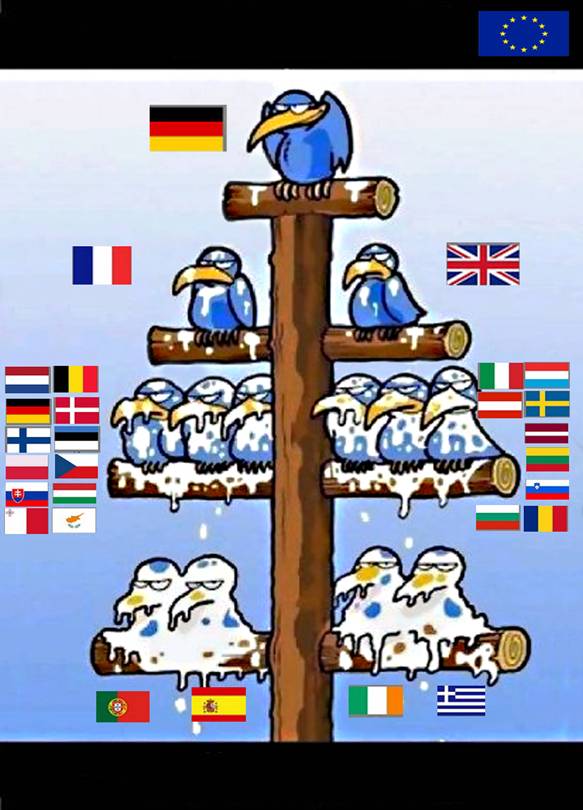
P.S. We leave you with the image of the European Union´s Christmas tree:
The laugh test

A prominent practitioner once explained to me the usefulness of the “laugh test” (a.k.a. “red face test”) in our profession. He said that lawyers often have to defend arguments about which they are not very confident, but that there should be a limit to the “originality” of these arguments. According to him, this limit could only be drawn with the aid of the laugh test.
The practical instructions are easy: whenever you come up with what you fear to be a far-fetched argument, ask yourself the following question: will the addressee of the argument in question have a laugh when she/he reads it? If the answer is no, you may as well give it a try. If the answer is yes, then you´re better off keeping it to yourself.
Sounds easy, right? If you´d read some decisions and submissions that I´ve been reading this week you´d realize that not everyone applies the laugh test properly!
Since I can´t talk about the examples that are currently on my desk, I will refer to a case that´s being heard today in the U.S. in which it appears legitimate to ask whether the laugh test has been applied or not.
Take a look at this piece (Price-fixing or good manners? Jury might decide) and reach your own conclusion 😉
Antitrust Compliance

The European Commission has just released a brochure entitled Compliance matters: What companies can do better to respect EU competition rules.
The foreword says that companies should “[l]ook at this brochure as a road safety brochure ahead of the holiday period“. Many of the companies reading this will be certainly comforted by the irony positive thinking underlying the reference to the holiday period ahead.
In essence, the Commission´s document contains the following messages: (i) breaching competition law isn´t cool and naughty companies can be punished; and (ii) companies should have tailor-made compliance programs.
When I received the brochure this morning I was curious to read the Commission´s advice on how firms could stay out of trouble. After a quick skim, I see that the closest to constructive advice on substantive matters is this profound passage:
“DON´T fix purchase or selling prices or other trading conditions; DON´T limit poduction, markets, technical development or investment; DON´T share markets or sources of supply; DON´T exchange individualised information on intended future prices or quantities or other strategic information.”
I have the feeling that most of the readers of the brochure already had some kind of intuition that they couldn´t do such things. Moreover, some of that advise is rather hard to put in practice (e.g. “limiting investment” : could bank’s refusal to grant credit be considered a breach of competition law?; “limiting production”: shall a company make some more of this product that isn’t selling too well?; “limiting a market”: how does one limit a market? ).
In any case, and leaving easy jokes aside, the Commission must be applauded for its attempt to foster a compliance culture. Other competition authorities such as the OFT and the Autorité de la Concurrence should also be commended for their efforts on this area. Moreover, the Commission has provided much general guidance elsewhere and it cannot be expected to do so on a brochure like this.
In fact, the message about the need for companies to have an effective and tailor made compliance program is welcome and important. The brochure basically sets out the fundamentals of compliance program design, and whereas it does not say anything groundbreaking it does a good job in explaining the basic stuff.
The Commission doesn´t seem to contemplate further incentives such as fine reductions for companies with established and appropriate compliance programs. The French competition authority has proposed fine reductions, but on an ex post basis and only in the framework of settlement proceedings. But why not take a bolder step? I tend to understand those who argue that it doesn´t make much sense to reward firms that have breached the law ignoring such programs, but what about those cases where the company has a clear policy and intention of complying with the law, but one or a few “rogue” executives act on their own? (we all know many instances where this has been the case). It all would come down to assessing what standard the firm had set and whether it complied, as a firm, with that standard. This point was also made by D. Geradin (with the support of J.Wileur and D. Malamataris ) on an interesting recent paper. Companies should not be rewarded for breaching the law, but it would be fair to limit the damage when it can be shown that a given company has done everything it could.
At the end of the day, the content of the Commission´s document is ok given what can be expected from a non-specialist brochure from the Commission. What is more worrysome is that I have seen (more than once) very similar “brochures” which had been sold to companies prêt à porter (not tailor made; i.e copy/paste jobs) and at ridiculous prices. I´m currently working on a couple of compliance programs, and, to be frank, general and vague programs aren´t useful for the companies nor for lawyers (unless billing is considered to be the sole parameter). On the contrary, ad hoc programs adapted to particular firms and markets are extremely useful for firms as well as extremely interesting for lawyers, since we get to be in touch with a wide array of strategies and practices in many different markets. A subversive thought springs to mind, shouldn´t clients also draft some compliance programs on professional service standards for some law firms?
The language of competition law

In a comment to a recent post we recently engaged in a discussion about the meaning of words and the importance of the proper use of terminology in light of the crucial meanings, nuances and attitudes that words often implicitly or explicitly convey. Words often “carry dynamite”, we said. A few days earlier, we had also written another post which -perhaps in a manifestation of wishful thinking- highlighted the fact that the Court had used the term “objective justification” in an area (Art. 101 TFEU) where it had never resorted to it before. In our view, words matter. A lot.
All this sprung a reflection about the importance of words and of languages when it comes to understanding, teaching or applying law in general, and competition law in particular:
The crucial influence of the use of certain words, metaphors or narratives has already been noted in the past by some of the most prominent antitrust scholars. Excellent examples of this can be found, amongst others, in the influential piece by late Prof. Areeda on “Essential Facilities: An Epithet in Need of Limiting Principles“; in “Antitrust Doctrine and the Sway of Metaphor” by Michael Boudin (who, btw, was my antitrust professor at HLS); or in Newberg´s “A Narrative Construction of Antitrust“.
One of our blogosphere colleages (Prof. Sokol) also wrote a post some time ago about The Language of Sex and Antitrust (if cheap advice on how to increase online readers is right, this is the link that most of you will be clicking…).
But beyond words, the language in which the law is conceived, drafted, learnt, taught, and interpreted or applied also makes a huge difference. I am not aware of the existence of any study on whether and how languages compete to shape the law, but it is undeniable that they do shape it, and that their influence can be much greater than that of words, because languages (i) are also vehicles for the diffusion of certain values; and (ii) because they are subject to very strong network externalities (if any enforcer is reading this, then languages -as beneficiaries of network externalities- may have just become a new antitrust suspect…).
Many of you may have first-hand experience of the fact that law is very often learnt, taught and understood differently depending on the language used. Nicolas and I, for instance, are currently working on competition law textbooks in our own languages, and it is not always easy to transform the input we normally receive (typycally in English) to our output. Mere translation is not always enough because the language strongly influences the way in which the information is rationalized. Examples abound:
Some posts ago we wrote about the future reform of the General Court and noted that more than 40% of référendaires (clerks) at the GC are of French nationality. This is obviously due to the fact that the official language at the Court is French, but, as we noted in that post, those numbers have implications far beyond the merely linguistic. In that case there are also cultural elements involved (in as much as the language may be associated to the values of a country), but the influence of the French values through the French language can be traced in many of the Courts attitudes and Judgments.
Now English has become the lingua franca (a fact of which this blog stands as evidence). This may have had some disadvantages for the English language (because being used by non-natives it risks deteriorating, as this blog also illustrates..), but overall it offers many advantages to anglosaxon values and ideas which enjoy an “unparalleled competitive advantage” (to use the words of the CFI´s Judgment in Microsoft). Ask the Financial Times or The Economist…
But competitive advantages arising from the use of language in competition law are not merely enjoyed by ideas and policies, but also by firms. One example of this could be the legal market, where anglosaxon firms enjoy a competitive advantage on the worldwide market just because they´re anglosaxon firms. I´m not necessarily criticizing this; my firm, for instance, also benefits from a competitive advantage derived from huge brand recognition in its main market. I do nevertheless have a problem with the legal market becoming a “luxury” market where brands matter more than quality and outcomes (and I know many examples where this is true in the EU competition law world), but this is another matter that perhaps we´ll deal with in another future post.
JD

Jones Day Paris announced recently that they had hired Eric Barbier de la Serre (formerly Latham & Watkins, Brussels).
He will join there Eric Morgan de Rivery, who is the resident partner in charge of competition cases.
I knew, as many, that Jones Day applied strict standards when it comes to appointing new partners. But that strict???
I mean, unless you are (i) a superstar antitrust lawyer; and (ii) you’re called “Eric ___ de____”, the odds that you’ll make partner in Paris seem pretty low.
The bottom line: when it comes to HR, Jones Day clearly is no joker.
New job openings

Last week Nico started using this blog as a way of advertising available jobs. In line with our often stated belief that there´s life out there beyond competition law, we´ve decided to provide you with info on other less obvious but certainly interesting work alternatives.
So here´s the first one: the legal tabloid abovethelaw.com has a great piece on how Drunk Driving Defense can be an alternative to “Big Law” jobs. This doesn´t appear to be a small market niche: I once (completely unitentionally) found a whole section of book stacks at Harvard Law School´s library solely devoted to the law of Drunk Driving.
So far vacancies are only available in the U.S. However, I´m pretty sure that Brussels would make a good geographic market for a similar venture. Actually, my co-blogger hosted a party at his place this Saturday and I can tell you: it was crowded with potential clients..
(Needless to say, drunk driving is a hugely serious issue, and the last part on Nico´s party was only a joke. Not only no one “drove under the influence”, but also most people were only driving strollers..) 😉


 Chillin'Competition