Archive for the ‘Our Organizations’ Category
Antitrust and Tech Seminar Materials

A few days ago I participated at a very interesting AIJA seminar in Bruges on Antitrust and Technology. All panel discussions were great, but I’m particularly grateful to Pablo Ibañez (LSE) and Kevin Coates (DG Comp) for their participation in the panel I moderated on interoperability issues, which was truly excellent (and not because of me).
The presentations projected at the conference have been made available at AIJA’s website (I include the hyperlinks below for your convenience):
- Technology Licensing and the New TTBER
Dominic Muyldermans – Exclusion of termination for challenge of IP
Olivier Sasserath – Exclusion of the exclusive grant-back obligations
Anna Vernet – update after public consultation
Stefan Vollering – Big Change on a Minor Issue
- Keynote speech – With great power comes great responsibility
Dr Philip Marsden – With great power comes great responsibility
- Caught in the antitrust web -Regulating internet services
Gerardo Faundez – Travel as evolving market
Thomas Graf – The EU Google Investigation
Silke Hossenfelder – German Antitrust Cases in the Internet Economy
Sebastian Jungermann – Regulating internet services
- Patent litigation and settlements -The limits of settlements and Pay-for-delay
Tamar Dolev-Green – Pay-for-delay
Kyriakos Fountoukakos – Patent litigation settlements
Simone Gambuto – latanoprost-pfizer saga in Italy
- Patent strategies and abuse of dominance What are the antitrust boundaries
Miguel Rato and Nicolas Petit – Abuse in Technology Enabled Markets
Maria Troberg – Patent Strategies and abuse of Dominance
Jan Peter Van der Veer – An economic perspective on patent strategies
- Competition law and interoperability
Pablo Ibanez Colomo – Interoperability issues under EU Competition Law
Alfonso Lamadrid – Interoperability
(Image quite possibly subject to copyright)
An announcement and a nomination

The announcement: On 15 February my co-blogger Monsieur le Professeur Nicolas Laurent Max Petit (no kiddin’) will be joining DG COMP for a 6-month stint. I’m curious as to how this experience will impact his views on the Europen Commission’s work.
Btw, Nico took care of the inaugural lecture at the IEB course in Madrid on Friday and did a great job. Tomorrow he’ll be delivering a must-attend presentation on Art. 102 at Les Mardis de la Concurrence in Brussels (the PPP will be made available here).
The nomination: Chillin’Competition has been nominated as one of the best foreign legal blogs in a competition ran by our favorite German site (Kartellblog) (as if we were able to read German…). Thanks to Johannes Zöttle and to whovever nominated us. Since it’s always nice to win something (or so I’m told 😉 ) you can vote for us here: http://kartellblog.de/2014/01/06/poll-beste-jurablogs-2014/
ADS

In the course of the past few days and weeks some friends have asked us to advertise a few upcoming Competition-related happenings. We’ve taken our time, but here’s a compilation of stuff worth knowing about:
The 3rd edition of Concurrence’s Antitrust Writing Awards is now ongoing. You can vote for your favorite piece before the 1st of March.
Harvard’s European Law Association (HELA) has scheduled its first Antitrust conference, to be held on 24 March. It will deal with the informal application of competition law in the U.S. and the EU. Click here to check out the call for papers and to find out more info: Hela_Call_Abstracts_updated (and apologies to Zena Prodromou for not having done this before!)
On 30 January the ABA’s Section of Antitrust Law will be holding a networking reception + a panel (Inquiries into Competition and Alleged Misconduct in UK Financial Services) in London. Click here for more info.
The annual junior competition lawyer’s conference will take place on 31 January. This is an initiative that we’ve always supported and that would be nice to see replicated in places other than the UK. Click here for more info.
And also on 31 January we will be hosting the first seminar within the competition law course that Luis Ortiz Blanco and I co-direct in Madrid. It will be devoted to Recent developments regarding the application of Article 101 TFEU (including damage claims, anti-competitive agreements in the pharma industry and the fight against cartels in a context of economic crisis), and will feature Fernando Castillo de la Torre (EC’s Legal Service), Eric Gippini Fournier (EC’s Legal Service), (Carlos III University, EAGCP and CEPR), Mario Mariniello (Bruegel), Helmut Brokelmann (MLAB), Maria Luisa Tierno (DG Comp), Natalia Fabra (Universidad Carlos III, EAGCP), Flor Castilla (EC’s Legal Service), Borja Martínez (Uría Menéndez), Antonio Martínez (Allen&Overy), Jesús Alfaro (Linklaters) and Gerald Miersch (DG Comp). I’ll post the final program here as soon as it’s ready.
Very importantly, a reminder is in order: on February 7-8 AIJA and the College of Europe will be holding the not-to-be-missed conference Antitrust 2.0 Competition Law and Technology.
P.S. We’ve also been asked to mention that the Swedish Competition Authority is taking steps to publish decisions in English. Our source suggests to present this as one of the major 10 developments on the year, which I’m a bit hesitant to do 😉 However, the Swede’s move is commendable, particularly when compared to what other national competition authorities do (the new Spanish authority doesn’t even have an English version for its webpage…)
News

Next week:
- On 17 December, we’ll have a GCLC lunch talk on the Aegean/Olympic merger decision. S. Simon (COMP), B. Durand (RBB) and A. Guttermuth (Arnold & Porter) will be our speakers. Registration here.
- On 18 December, we will have the graduation ceremony of the Brussels School of Competition. This is an open ceremony, and you can register here. There will be tons of good food and top notch tier antitrust lawyers. Not sure which of the two is the seller :). Above, some of last year freshly graduated studs.
Recently, our friend David Henry and his friend David Ashton have published a timely, thorough, thoughtful book on Competition Damages Actions in the EU. The book is impressive, it makes a thorough exploration of how the main EU MS have dealt with antitrust damages to date. Congratulations to them.
Yesterday: I was at a conference in Paris giving a presentation on IP and antitrust law. And I finally spoke of lions, black swans and butterflies. For more, see below (2 files, read 1 before 2).
Presentation ASPI – Rappel des grands principes applicables à la relation DEC-DPI (2) Presentation ASPI – Rappel des grands principes applicables à la relation DEC-DPI (1)
The ultimate conference on competition law and technology
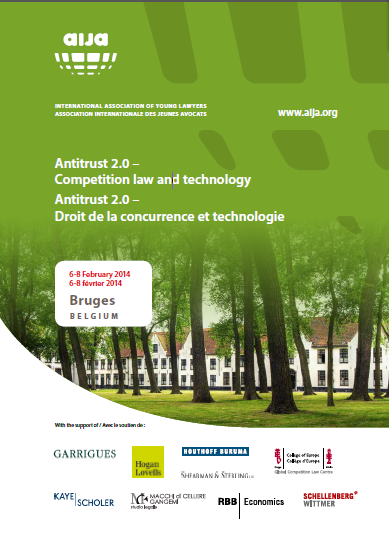
As anticipated a few days ago, on 7-8 February AIJA -with the collaboration of the College of Europe- will be holding a two-day conference on: Antitrust 2.0- Competition and Technology.
The conference will cover all hot issues in current antitrust enforcement in the IT sector, and will feature an impressive line-up of panelists (and then also Nicolas and myself).
It will be very much worth the visit to Bruges. The program is available here: Antitrust 2.0- Competition law and technology
P.S. Two other not-to-be-missed events (ones that I’ve been anxiously awaiting for quite some time) will be taking place in the next 24 hours: see here and here 😉
XVII edition of the EU and Spanish competition law course

For 16 years now Luis Ortiz Blanco has been directing a top-notch competition law course in Madrid, which is actually where Nico and I first met. I followed this program as a student quite a few years ago, have lectured on it since then, and last year I started co-directing it together with Luis (which comes handy as a justifications to travel to Spain a bit more).
The line-up of more than 50 high-profile guest speakers who come every year from all over Europe to enjoy Madrid lecture in Madrid is a true Who’s Who of EU competition law experts. Moreover, the 115 hours of scheduled classes allow for a more detailed coverage than that offered by many other competition law courses on the market. About half of the course is lectured in English. Price wise the course is unbeatable: full registration is available for only 3,000 euros.
The final program for each module and seminar has yet to be confirmed, but the overall structure and dates have been set, so I’ve included the info below. Anyone interested can register both for the full program or just for specific module/s or seminar/s. Anyone interested in more information can contact me at alfonso.lamadrid@garrigues.com
The 2014 program will be structured as follows:
– An inaugural/introductory session by the not-so-good Professor Nicolas Petit will take place on January 10.
– A module on cartels (coordinated by myself) will be held on 13-15 January.
– A module on other restrictive agreements and practices (coordinated by Juan Andrés García Alonso; Peugeot) will take place on 20-22 January
– On 31 January there will be a seminar on recent developments in relation to Art. 101 (coordinated by Fernando Castillo de la Torre and Eric Gippini Fournier, both from the Legal Service of the European Commission).
– A module on abuse of dominance (coordinated by Nicolas) will take place on 3-5 February.
– A module on merger control (coordinated by Jerónimo Maíllo; San Pablo CEU University) will be held on 10-12 February.
– A seminar on recent developments in abuse of dominance and merger control coordinated by Cecilio Madero (Deputy Director General, DG Comp), Nicholas Banasevic and Per Hellström (both Heads of Unit at DG COMP) and Milan Kristof (Référendaire at the ECJ) will be held on 21 February.
– A module on competition law and regulation in network industries (coordinated by myself) will be held on 3-5 March.
– A module on the application of competition and state aid rules to public entities (coordinated by José Luis Buendía and Jorge Piernas) will take place on 13-14 March.
– A seminar on the application of competition law by judges and arbitral tribunals (coordinated by Francisco Manuel Serrano, Garrigues) will take place on 21 March.
Nico wins best legal book of the year award

First it was the Jacques Lassier prize for his PhD thesis (see here).
Then the Antitrust Writing Award (thanks, btw, to the campaign I so well managed… ; see here).
And now (actually, last Saturday) Nico got the “Prix du livre juridique” to the best legal book published in France (see here), for his new textbook Droit européen de la concurrence.
The prize was awarded at the Constitutional Court in Paris; prestigious setting for a prestigious prize (see pic above; in case you were wondering, Nicolas is the one posing).
Judging by his mother’s comment on his Facebook wall, the prize has made the family happy. You know, there haven’t been so many ocassions to feel proud of the chap 🙂
Congrats to Nico for the prize and for his contribution to spreading the competition gospel in France. Hopefully new generations of French will gain a better understanding of competition law and, unlike the jury in this case, will be able to tell what’s sound legal competition reasoning and what’s not !
P.S. Contrary to what you might think, I’m not writing this simply to promote my co-blogger’s achievement. I’m doing it because the a****** said he won’t give me a free copy, so I’m hoping that some advertisement will earn me one from the publisher.
The Procedural Bible is out

The 3rd edition of EU Competition Procedure (Oxford University Press) is out.
I’m the least objective reviewer, because its editor is Luis Ortiz Blanco, who, among many other things, is the person because of whom I work in competition law (he essentialy planned my whole professional career the very first day he interviewed me for an internship, when I was only 20).
For this third edition Luis has brought together a truly exceptional team. In addition to my colleagues Konstantin Jorgens, Marcos Araujo and José Luis Buendía, who, together with Kieron Beal, Gordon Blanke and Jean Paul Keppenehad already contributed to the 2nd edition, there have been very notable additions from the Commission’s Legal Service and DG Comp, namely: Carlos Urraca, Ralf Sauer, Corneliu Hodlmeyr, Manuel Kellerbauer, Nicolas von Lingen and Maria Luisa Tierno Centella.
The book (a short read of over 1,200 pages) deals in more depth than any other source with procedural issues in antitrust, merger control, State aid, public undertakings and exclusive/special rights, competition enforcement in the EEA and arbitration. It’s a must-have.
I’ll do my best to get you an invite for the launching party, like last time.
Déjà vu? Microsoft announces Skype’s integration in Windows

On 15 August Microsoft announced on a blog post that Skype will come installed by default in Windows 8.1, and that it will be prominently displayed in its “Start” Menu (see Skype-right from (the) “Start”)
The news appears to have surprised many, who have publicly wondered whether Microsoft is actively looking for antitrust trouble (see notably here, here, or here).
And, of course, given my involvement in Skype-related competition matters, when I returned from my summer holidays I had a good number of emails from students, journalists, lawyers, friends and even family who were sending me the news and asking for an opinion. Since it would not be practical to reply to all those emails separately, I have decided to do it here.
[A disclaimer first: as frequent readers of this blog know I represent the two companies who chose to challenge the Commission’s decision authorizing the Microsoft/Skype deal. This means that I certainly am not an impartial observer, but it does not mean that the views set out here are to be attributed to my clients or my firm; they are exclusively mine. These views also refer to a conduct which is post-decision and therefore not the subject of the pending case].
My first comment is: Did anyone really not see this coming?
During the past few months Microsoft has pervasively integrated Skype with most of its products. Skype is now closely integrated with, for instance, Office, Office 365, Outlook, Outlook.com (formerly Hotmail), Windows Phone 8, Xbox, Lync (as announced only minutes after our Court hearing ended), and it was only a matter of time that it would come pre-installed in Windows. In the meanwhile, Skype’s only meaningful competitor in the consumer world (WindowsLiveMessenger) has disappeared and its users have been migrated to Skype. As a result, Skype’s user base has skyrocketed since the merger (going from approx. 150 to over 300 million unique monthly users), and rapidly growing.
[By the way, all this obviously voluntarily enhances the already powerful network effects at play in the only communication markets where interconnection is not mandatory, with obvious consequences]
Microsoft’s decision to bundle Skype pervasively with other Microsoft products, including – as just announced – Windows, may actually have come as a surprise to the European Commission. In its Microsoft/Skype decision, the Commission concluded that Microsoft would not have the incentive to tie Skype to other Microsoft “leading/dominant” products (e.g., para 155). No kidding.
Now let’s cut to the chase, can the integration of an application with a dominant operating system run afoul of the competition rules?
The European Commission itself has held various seemingly contradictory views over time. Microsoft, too, appears to have opposite views on this question. Let me explain this:
In the light of the spirit and the letter of the Microsoft’s 2004 infringement decision, the 2007 Microsoft Judgment, the 2009 Microsoft commitment decision, Skype’s integration with Windows would likely raise some antitrust flags (notably concerning the market for video calls, given that currently over 3 out of 4 video calls are made using PCs). As you know, in all of those precedents, the Commission and the General Court observed that pre-installation resulted in an unparalleled distributional advantage that could not be offset by the downloading of competing applications.
The Microsoft/Skype 2011 decision, however, arrived at exactly the opposite conclusion. The comments voiced out in the past few days in the media seem to have overlooked the fact that the Microsoft/Skype Decision – despite denying Microsoft’s incentives to tie Skype to its products – did actually address the possibility that Skype could be tied to Windows, and that it ruled out any competition concerns. The Decision acknowledged that pre-merger Skype was already present on approximately 60% of Windows PCs pursuant to agreements with OEMs, but alleged that there was data -not cited- showing that in practice pre-installation resulted only in a small share of Skype users (para 162). In other words, the Commission considered that pre-installation does not offer that much of a competitive advantage because users could easily and freely download Skype and other competing applications.
Query: does anyone see any inconsistencies between the Commission’s approaches to downloading? The Commission is certainly entitled to change approaches, but since the reasons for this change were not set out in the Decision, it’s difficult to identify with clarity what the Commission’s current approach to pre-installation vs. downloading is.
If you want to play more “find the differences”, try comparing the Commission’s prospective analyses and approaches to technical tying/bundling (and, for that matter, to interoperability degradations too) in Intel/McAfee (2011) and Microsoft/Skype (2011).
And whereas the Commission’s shifting viewpoints are remarkable, what is more striking is that Microsoft is, as of today, advocating two opposite legal standards, one for itself and another for Google:
As you may remember, back in April the FairSearch coalition (led in this case by Microsoft and Nokia) lodged a complaint against Google arguing that Google is abusing Android’s alleged dominance in the market for mobile operating systems by bundling certain “core Apps” with its operating system.
[The way I see it, in the case of Android the dominance and the bundlling are much more doubttful, but that is another story, and one interesting enough -I’ve just realized- to deserve some specific comments in the coming days].
So, in one case Microsoft is claiming that the pre-installation of Google apps on Android phones constitutes an abuse of a dominant position in the market for mobile OSs (no matter if users are free to download any competing application; btw, Skype for Android has no less than 100 million users!), but, at the same time, having Skype pre-installed in the dominant PC OS poses no problem (precisely because users are free to download other applications).
Anyone else sees any issue conflict?
A stupid post

You already know this trick: busy days= attempts at light funny or stupid posts. Today’s post isn’t particularly funny, but it sure is particularly stupid. Even though it’s not prima facie related to competition law, I’m sure that you’ll be able to find it of practical application to your law firm, competition authority, university or psychiatric institution (to name only the four organizations from which we get more readers):
A couple of Swedish professors (M. Alvesson and A. Spicer) have recently published an article titled A Stupidity-Based Theory of Organisations in which they develop the concept of “functional stupidity” and conclude that organizations with too many smart individuals risk being disfunctional. Their article has been discussed in other places like Fortune or New Scientist, where it was originally published.
The authors posit that stupidity boosts productivity, streamlines things in an effective manner, facilitates consensus, conveys respect for hierarchy, fosters a culture of commitment and effort, and that it can even help you (no offence; I didn’t mean you, I meant the stupid at issue..) get a promotion faster (the argument supporter the latter being that bosses would not promote their most useful assistants because they couldn’t do without them).
The theory also goes that people who try to make sure that everyone notices how smart they are are likely to do worse than those who hide their intelligence (a troubling thought for many of us show-off lawyers). Likewise, places where people tend to believe they are clever are, according to this theory, quite inefficient (I wonder whether profit per partner ratios confirm this intuition)
Interestingly, the Fortune piece discussing this article and the benefits of stupidity concludes with a reference to Google’s simple and functional user interface (as already anticipated a few times, whether Google’s UI will be smartened up or made more complex thanks to DG Comp will be discussed in our upcoming comments on Google’s commitments; but don’t take my word for it, a couple of years ago we also committed to hold a Chillin’Competition conference and, well…).
For more on stupidity, check out Cipolla’s masterpice on The Basic Laws of Human Stupidity.
P.S. If you ask me, whereas there may be some logical basis and abundant practical evidence for some of this “functional stupitidy” theory, holding it as true would be a bit stupid, and, as most things stupid, quite dangerous.


 Chillin'Competition