Archive for the ‘Our Organizations’ Category
Last Call – GCLC Lunch Talk on Menarini

On Thursday 8 December, the Global Competition Law Centre (GCLC) will hold its 55th Lunch Talk on the Judgment of the ECHR in Menarini Diagnostics SRL v. Italy.
Sir Christopher Bellamy QC (Linklaters) and Marco C.E.J. Bronckers (Leiden University and VVGBlaw) will share the stage.
Online registration at http://gclc.coleurope.eu/LunchTalk
Slides Evening Policy Talk – Bill Kovacic

Bill Kovacic was our guest yesterday at the GCLC.
He gave a superb presentation on the measurement of competition authorities’ performance. In so doing, he confirmed that he is the n°1 speaker on the conference circuit. A great speaker + a pure entertainer.
I attach his slides below.
A quote: in response to a question on why the CAs were so ineffective at communicating that they work in the public interest “we are in the business of instability”
Forthcoming Events
A quick post to update our readers on forthcoming events:
- GCLC Evening Policy Talk on 1 December with B. Kovacic (former US FTC Commissioner);
- A set of three BSC seminars on the Law & Econ of Horizontal Cooperation Agreements (incl. recent developments) with M. Bennett (OFT), A. Lofaro (RBB Econ) and S. Völcker (WilmerHale);
- A half day conference on the future of Belgian Competition Law on 12 December (in the framework of the BSC);
- GCLC Lunch Talk on 8 December on the ECtHR Judgment in Menarini Diagnostics v. Italy (with M. Bronckers and C. Bellamy).
The slow death of Article 101(3)

Yesterday we attended the first session of the annual conference of the Global Competition Law Center (of which, btw, Nicolas is the director). As expected, the conference was extremely interesting, and gave us plenty of ideas for future posts. Here´s one.
Our friend Damien Gerard made a very good presentation in which, following a historical approach, he presented several paradoxes of the modernisation of EU competition law. After he concluded, I posed a question to the panel, asking whether the interplay of the three dimensions of modernisation that Damien mentioned (substantive, procedural and institutional) may have had the effect -or perhaps the object..- of killing Art. 101(3). The comments that followed showed that this is a widespread concern.
Let me now explain to you how I view this, and why the usual question (who did it?) has no clear answer. My take is that all the usual suspects bear some responsibility:
In the early days of the classic case law, EU Courts paid great attention to Art. 101(3) because they were conscious of the crucial role that the drafters of the Treaty had attributed to this provision. But it wasn´t their task to apply it. They saw it as something too complex and abstract, so they washed their hands off: they left its application up to the Commission and decided to apply a light standard of review. That is, in fact, where the “manifest error of appraisal” test of judicial review was born for EU competition law.
For many years, the Commission exercised its monopoly over the application of 101(3). Those were, in a way, the “golden days” of this provision (even though there were some obvious disfunctionalities as a consequence of the centralized system). With the entry into force of Regulation 1/2003 this whole situation changed. The Commission shifted its priorities to focus on the “most serious infringements” which, as a matter of fact, are also the “most obvious” ones. It therefore also washed its hands and left the cases where Art. 101(3) would be relevant to national competition authorities (NCAs) and national courts.
But NCAs and national courts also regard the application of 101(3) as something which is too complex, and, let´s face it, the Commission´s Guidelines on Art. 101(3) are far from being decisively helpful. Couple that with the feeling that undertaking an effects analysis under 101(1) is also too burdensome, as well as with the fact that NCAs have, logically, their own priorities, and what you get is a situation where at the national level there are essentially only “object cases” where 101(3) assessments are reduced to an absolute minimum under the argument that “object restrictions” are hardly redeemable (which, btw, is at odds with all case law departing from European Night Services) There are no available stats on this, but I bet they would be mindblowing.
The Commission hasn´t done much to solve this situation. It has failed to provide case by case guidance, and has instead focused on sanctioning cartels, abuses of dominance (mostly in network industries) and in releasing general guidance; moreover, where an issue appears as uncertain, the usual solution is to adopt a commitment decision. Not really helpful. Furthermore, the Commission has contributed to fostering the confusion by enlarging (with the help of EU Courts) the “object” category (e.g. with regard to information exchanges).
EU Courts, on their part, could also be charged as accomplices. Three pieces of incriminating evidence are (i) the enlargement of the “object” category in T-Mobile; (ii) the ruling in Tele 2 Polska precluding NCAs from adopting negative decisions; (iii) the adoption of distinct standards for the review of 101(3) assessments: would the overly simplistic Premier League Judgement, where the Court says, without providing much support for its assertion, that the exclusivity arrangements at issue do not meet the conditions of Art 101(3) (see para 145 of the Judgment) comply with the Court´s tough stance against the Commission in Glaxo Spain?
What does this imply for competition law:
In my view, this situation is dramatic for EU competition law (well, as dramatic as a legal matter in the competition law field can get, which, to be frank…). The interplay of all the factors above has led to an overly simplistic view of competition law, to a shifting of the burden of prove, and to even more arbitrariness and uncertainty.
PS. The painting illustrating the post is “Prometheus bound” by Rubens. As Art. 101(3) in the world of competition law, Prometheus was “credited with -or blamed for- playing a pivotal role in the early history of mankind“. As you know, immortal Prometheus was punished by Zeus to a -quite nasty- eternal punishment: he was bound to a rock where his liver was eaten daily by an eagle, only to regenerate and be eaten again the following day. Mithology has it that Hercules finally slayed the eagle and freed Prometheus. Will anyone eventually free Art.101(3)?
XV edition of the EU & Spanish Competition Law Course

Some of you may recall from previous posts that both Nicolas and I are heavily involved (although in this case I clearly beat him..) in the organization of an excellent competition law course that Luis Ortiz Blanco has been directing for 15 years in Madrid. Actually, that´s where we met four or five years ago.
We are of course biased, but we must say that the line-up of more than 70 guest speakers who come every year from all over Europe to lecture in Madrid is a true Who´s Who of EU competition law experts. Moreover, the 115 hours of scheduled classes allow for a more detailed coverage than that offered by many other competition law courses on the market. About half of the course is lectured in English.
The final program for each module and seminar has not yet been decided, but the overall structure and dates have been set, so I´ve included the info below. Anyone interested can register both for the full program or just for specific module/s or seminar/s. If any of you would like more information you can contact me at alfonso.lamadrid@garrigues.com
The 2012 program will be structured as follows:
– An introductory session -in which Nicolas will play a very prominent role- will take place on January 13.
– A module on cartels (coordinated by Jerónimo Maíllo; San Pablo CEU University) will be held on January 16-18.
– A module on other restrictive agreements and practices (coordinated by Juan Andrés García Alonso; Peugeot) will take place on January 23-25.
– On February 3 there will be a seminar on recent developments in relation to Art. 101 (coordinated by Fernando Castillo de la Torre and Eric Gippini Fournier, both from Legal Service of the European Commission).
– A module on abuse of dominance coordinated by myself will be held on February 6-8.
– A seminar on recent developments in abuse of dominance and merger control (8 hours) jointly coordinated by Cecilio Madero (Deputy Director General at DG COMP) and by myself will be held on February 24.
– A module on merger control coordinated by Jerónimo Maíllo will be held on February 13-15.
– A module on the application of competition and state aid rules to public entities coordinated by José Luis Buendía (Garrigues) and Jorge Piernas (EUI) will take place on March 1-2.
– A seminar on competition law in regulated markets coordinated by myself will be held on March 12-14; and
– A seminar on competition law and IP coordinated by Álvaro Ramos (Legal Director at Cisco) will take place on March 23.
“Canada Dry” Decisions

The ECJ ruling in Tele2 Polska is a joke (actually a bad one).
I’ve already blogged on the nefarious effects of this ruling. Today, I’d like to make a few more points.
Remember: the judgment states that National Competition Authorities (“NCAs”) cannot, under Regulation 1/2003, adopt declaratory decisions stating that there has been no breach of Article 101 and/or 102 TFEU (on the merits).
This judgment is likely to have far reaching consequences. As written in a paper below, and confirmed by a number of colleagues at the GCLC lunch talk yesterday, it means that NCAs cannot adopt individual exemption decisions under Article 101(3) TFEU.
Since the inception of Regulation 1/2003, however, many – including me – have repeatedly stated that decentralisation was all about empowering NCAs to take Article 101(3) TFEU decisions. More importantly, several NCAs have taken exemption decisions over the past 7 years. Is this decisional practice now unlawful?
The Commission’s response to this is that the ruling does not change much. Rather than taking a negative decision under 101(3) TFEU, the NCAs can still adopt decisions that “there are no grounds for action on their part” pursuant to Article 5 of Regulation 1/2003.
Now, is this really true? As noted by F. Zivy yesterday, could a NCA conceivably write in a decision: « The impugned practice infringes Article 101(1) TFEU. There is strong evidence that it is nonetheless justified under Article 101(3). But we are sorry, the only thing we can do is to say there are no grounds of action against this infringement”?
Or to be even more extreme: “The impugned practice constitutes an infringement of Article 101(1) TFEU. Hence, there are no grounds of action on our part“? Come on..
To me, decisions that there are no grounds of action are like Canada Dry to “negative decisions”: they look like negative decisions, they taste like them, but they are not like them.
In practice, rather than making such paradoxical statements, NCAs willing to exonerate anticompetitive agreements are likely to reason within Article 101(1) TFEU, under a “rule of reason“-like approach (which BTW has been consistently held alien to EU law by the ECJ).
A last remark: the judgment is primarily based on a litteral reading of Article 5 of Regulation 1/2003 which sets the powers of NCAs, and is supposed to be exhaustive. Article 5 says nothing of inapplicability decisions. hence, NCAs cannot take them.
Now, has the ECJ really read Article 5 of Regulation 1/2003?
I mean had it done so, it would have realised that this provision is all about the decisions taken for the application of Article 101 and 102 TFEU (“The competition authorities of the Member States shall have the power to apply Articles 81 and 82 of the Treaty in individual cases“). Hence, it is somewhat unavoidable that this provision is silent on negative decisions, that DO NOT apply Articles 101 and 102 TFEU.
Hereafter a paper that I have written with my assistant (in French) + the slides presented at the GCLC lunch talk yesterday.
Commentaire Tele 2 Polska – Petit et Lousberg – Final
Chillin´Competition: The Conference

As our usual readers know by now, this blog was born out of the conviction that it was possible to do and say some things differently within our small competition law world. We have intended to do that on the blog, and now we want to extend this attitude to a conference -the 1st Chillin´Competition conference- which will be somehow different from what you may be used to. We can´t say much more for now (except that it will be held in Brussels), but details will follow soon.
We want you to be involved to the greatest extent possible, and therefore we would like you to please send us your ideas on possible topics and speakers: we´re looking for excellent and open minded practitioners, officials or academics who might give brilliant, fresh and even humorous views on competition law issues. We already have ideas on a number of people who fit that description, and some of them have already expressed their willingness to participate in this initiative. Please send us your suggestions either publicly by commenting on this post or in private at nicolas.petit@ulg.ac.be and alfonso.lamadrid@garrigues.com
Thanks!
GCLC Lunch Talk on VEBIC and Tele2 Polska
I am very pleased to announce a new GCLC lunch talk on “The Rights, Powers and Duties of NCAs following the ECJ Judgments in VEBIC and Tele2 Polska“.
It will take place on 24 October. Time and place as usual. Online registration available here.
We have invited E. Sakkers (DG COMP), F. Zivy (French Competition Authority) and S. Brammer (University College Leuven) to discuss those fascinating cases.
Some background documentation can be found here.
On SGEIs and Sausages
As Nico advertised announced yesterday, on September 30th the GCLC will be holding a major conference on the Reform of State Aid Rules on Services of General Economic Interest (SGEI) in Bruges.
The conference couldn´t be more timely, because last Friday the European Commission launched a public consultation on some proposed new texts regarding the application of State aid rules to SGEIs.
This reform is set to be one of the highlights of Commissioner Almunia´s tenure. The Commission has been working on this for some time, and we can provide you with some insights on how they have undertaken this work.
A famous quote by John Godfrey Saxe -often attributed to Otto von Bismarck- states that “law and sausage are two things you do not want to see being made.”
Sure you don´t? We´ll show you anyway 😉
In the case of sausages, they are basically made like this:
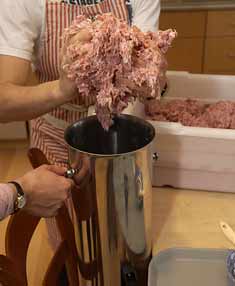
And if you want to see part of the process of how law is made, check out this first draft of the SGEIs package that was circulated amongst the European Commission´s services under the coordination of the Commission´s General Secretariat, and promoted by Commissioners Almunia, Andor and Barnier:
It includes some highlighted internal comments, my favourite being this one:
“[voir absolument son [Judge Lenaert´s] intervention postée sur youTube in http://www.youtube.com/watch?v=L52IhxqxUXo ]”
It´s good to know that European Commission officials share our (and CPI´s) taste for competition law videos.
Note: We received this some months ago because our addressess were included in a large mailing list (no kidding).
Back to School
The GCLC is back to school with a very busy agenda.
- On 30 September 2011 there will be a high level conference on the Reform of State Aid Rules on Services of General Economic Interest (SGEI) in Bruges;
- On 17 October, it will hold a lunch talk in Brussels on “The Rights, Powers and Duties of NCAs following the ECJ’s rulings in VEBIC and Tele2 Polska” (invitation to be posted soon on our website);
- On 27 and 28 October, we will have our Seventh Annual Conference. The 2011 edition will be devoted to the Effects-Based Approach in EU Competition Law;
- On 2 December, there will be an Evening Policy Talk with B. Kovacic (TBC) (invitation to be posted soon on our website).


 Chillin'Competition