Archive for the ‘Uncategorized’ Category
A CHALLENGE FOR THE COMPETITION COMMUNITY

We tried to put an end to the 2020 nightmare with a bit of humor, and with an award in memory of someone we lost. Chillin’Competition now wants to follow up with a bit of hope, and with a challenge.
We have often claimed that the competition community is special, and that the people in it are special too (mostly in a good way ;-)). We would now like to prove this. When we ran our meme contest, Isabelle de Silva (President of the French Competition Authority) suggested that we should again use the best memes to produce mugs. This gave us the idea to refocus a light hearted contest – and actually to leverage whatever reach this blog may have – towards supporting other much more serious, important and worthy initiatives, like KickCancer.
KickCancer is a public interest foundation devoted to combatting childhood cancer. KickCancer finances these innovative research projects aimed at understanding and curing paediatric cancer. Their cause could not be more important, or more fitting given the various extraordinary colleagues we sadly lost to cancer this past year. KickCancer is also an organization that is doing its best to turn an adverse event into a force for change (which in a way symbolizes what we want to get out of this pandemic too). It is an organization that finances projects with a European scope. It is an organization that approaches the most serious possible cause with humour. And since no organization is perfect, this one is largely run by lawyers 😉
Chillin’Competition has partnered with KickCancer to sell customized mugs featuring the winners of our meme contest, as selected by our devoted jurors (Foo Yun-Chee, Lewis Crofts, Javier Espinoza, Thibault Larger and Aoife White).
YOU CAN NOW BUY THE WINNING MEME MUGS HERE
All funds will go directly to KickCancer, and the (evident) overprice will be devoted to financing paediatric cancer research.
We would encourage you buy mugs for your colleagues, employees, clients, students, friends or for yourselves. It will cost you little, and it would help a lot. To facilitate logistics, we would also encourage you to collude, make a joint purchase and set a single delivery point for various mugs (shipping costs are free if you buy more than 10). You will be able to buy these mugs until 19 March.
The mugs are obviously nothing but an excuse. You can contribute to KickCancer in any way you can, also through direct donations (which will get you a tax deduction instead of a mug). You can do that in less time than it would take you to read one of our posts, for less than the cost of a takeaway meal (or for a very small fraction of a billable hour), and it will have a much more positive impact than either of those 😉
It would be nice to demonstrate that the competition community can beat all others not only in numbers of conferences, webinars and awards per capita, but also at joining forces in support of something that truly matters.
NEW PAPER | Territorial restrictions in EU competition law: from Consten-Grundig to Ping and Pay-TV

I have just uploaded on ssrn (see here) a paper on Territorial restrictions in EU competition law. I am particularly proud that the piece will be coming out in the proceedings of last year’s GCLC conference, devoted to vertical restraints, and edited by Adina Claici and Denis Waelbroeck.
I wrote on vertical restraints and market integration a few years ago. This paper was an excellent opportunity to revisit some themes in light of the growing case law and administrative practice. One of the themes was inspired by the Ping case (which explains a part of the pic above).
When market integration is at stake, the analysis of restrictions changes. It shifts from the ‘precise purpose‘ of the practice to focus on the means through which the aims are achieved. As a result, conduct that would otherwise be unproblematic is deemed prima facie unlawful insofar as it goes against the market integration objective.
The Ping case shows that courts and authorities may struggle with this methodological shift. In the case, the CMA, the CAT and the Court of Appeal all reached the right outcome: the online sales ban was restrictive by object. However, they all struggled to justify why, and they also struggled to reconcile the outcome with cases such as Cartes Bancaires or Budapest Bank. All those difficulties could have been easily avoided by simply pointing to market integration, and the fact that online sales bans hinder cross-border trade and are problematic for that very reason.
It is also clear since Murphy that the parties to an agreement that is in principle restrictive by object can provide evidence showing that it is incapable of having anticompetitive effects in a specific economic and legal context. However, there is precious little guidance about the application of this principle.
One can reasonably conclude, in light of Generics, that agreements limiting cross-border trade are incapable of restricting competition where there are ‘insurmountable barriers’ to such cross-border trade. This could be the case, in particular, where there are intellectual property rights involved. If a right holder or a licensee can validly invoke a right to prevent the flow of goods or services across borders, it is difficult to see how there could be a restriction.
The Commission seems to take a different view. I have read with particular interest the (relatively recent) Character Merchandise decision (which explains the other half of the pic above). Intriguingly, the Commission argues that agreements that limit cross-border trade are restrictive by object irrespective of whether the intellectual property rights are exhausted. It is not clear to me how this position can be squared with a long saga of cases, including Generics, Micro Leader and Coditel II. I would very much welcome your thoughts on it.
This Character Merchandise case is also interesting for another reason. The case involved non-exclusive distribution rights. The Commission argued that, in that context, active sales restrictions are restrictive by object (implying that they are only acceptable in the context of an exclusive distribution agreement). The decision does not refer to any judgment in support for this position. In fact, my understanding of both Societe Technique Miniere and Nungesser has always been that active sales restrictions are not restrictive by object. Again, it would be wonderful to hear your thoughts on this point, too.
I look forward to your comments!
Capability and likelihood of anticompetitive effects: why the difference exists, and why it matters

For a practice to amount to an infringement, should it be likely to restrict competition? Is capability enough? Do capability and likelihood have the same meaning? These are basic questions that, for some reason, keep coming back. I was reminded of them when going through Lithuanian Railways. In its judgment, the GC refers to the European Commission’s view, according to which there is a single threshold of effects in the case law, to which the capability/likelihood label applies. Pursuant to this interpretation, capability and likelihood would be synonymous (even though the plain meaning of the words is obviously different).
A close examination of the case law, however, shows that there are indeed two thresholds in the case law, one of capability and one of likelihood. This conclusion is apparent when one pays attention not only to what the Court says but to what it does. It is apparent, in other words, when one looks beyond the words and focuses on how the analysis is actually performed. This is something I explained in my paper on effects, but it is worth devoting a post to the matter and start, hopefully, an exchange.
A threshold of capability is relevant when the practice is prima facie prohibited irrespective of its impact (that is, it is a ‘by object’ infringement, whether under Article 101 or 102 TFEU). Capability means that anticompetitive effects are a plausible outcome of the implementation of the practice. Accordingly, it is a threshold that is easily satisfied. The Court was explicit on this point in T-Mobile, where it held that, for by object conduct to amount to an infringement, it ‘must simply be capable’ of restricting competition. In doing so, it rejected the view of the referring court, which suggested a higher threshold of effects to establish a breach of Article 101(1) TFEU.
AKZO provides a wonderful example of the practical operation of this (relatively low, easy to meet) threshold. Predatory pricing within the meaning of that judgment is prohibited as abusive without it being necessary to engage in a case-by-case analysis of its effects. As explained by the Court in para 72 of the ruling, below-cost prices are capable of excluding equally efficient rivals. They are not necessarily likely, let alone certain, to do so. However, capability is enough when predatory pricing à la AKZO is at stake. Why? Because either the below-cost prices have no plausible purpose other than the exclusion of rivals (pricing below AVC) or because the anticompetitive object is established by the claimant or authority.
A threshold of likelihood, on the other hand, is necessary when ‘by effect’ conduct is at stake. Accordingly, it is not sufficient to show that anticompetitive effects are a plausible outcome of the implementation of the practice. Something more, to be established in light of the features of the relevant market, is required. This conclusion is apparent when one examines Deutsche Telekom and Post Danmark II.
In Deutsche Telekom, the European Commission argued – not unreasonably – that a margin squeeze provides, in and of itself, sufficient evidence of an abuse. This argument would be correct if a threshold of capability were enough in relation to this conduct. It is no doubt plausible that a ‘margin squeeze’ leads to the exclusion of equally efficient rivals. However, the Court of Justice did not follow the Commission and held that the exclusionary impact of a ‘margin squeeze’ will have to be assessed by reference to, inter alia, the extent of the dominant position, the features of the market and the nature of the practice. Irrespective of the label, the threshold is appreciably higher than in AKZO (and appreciably higher than the threshold of plausibility suggested by the Commission in its Deutsche Telekom decision).
Consider now the facts at stake in Post Danmark II. The case concerned the behaviour of an incumbent in a partially liberalised industry. The practice, moreover, involved a scheme of retroactive rebates calculated over a one-year period. Such a scheme is, at the very least, capable of having anticompetitive effects. The exclusion of equally efficient rivals is more than plausible. However, plausibility was not deemed enough in the case. Thus, the Court held that the analysis must consider other factors, including the coverage of the practice. Call the threshold what you will, it is higher than the plausibility threshold embraced in AKZO.
The judgment that perhaps best shows that there are two thresholds in the case law, each with a distinct scope of application, is Post Danmark I. As in AKZO, the practice at stake involved below-cost pricing. And, as mentioned above, we know since AKZO that below-cost pricing is capable of excluding equally efficient rivals. The threshold that was considered sufficient in AKZO was not considered sufficient in Post Danmark I. Why? The object of the practice was not anticompetitive (there was no evidence of an exclusionary plan, and the prices were not below AVC, or an equivalent measure).
Accordingly, the evaluation of the effects in Post Danmark I had to dig deeper into the features of the relevant market and the impact of the conduct therein. It was not sufficient to show that exclusion was plausible; it was necessary to establish that it was likely. In this sense, the Court noted that its main rival had not been excluded. In fact, it had been able to gain two customers back from the dominant undertaking. Against this background, the Court strongly signalled to the referring court that the behaviour was not abusive.
I look forward to your comments. In line with what was suggested above, the key lesson is that, in the continental tradition, paying careful attention to what courts actually do (how the analysis is performed, what factors are considered) is as important, if not more, as meticulously scrutinising what they say.
Be careful what you wish for: why discretion to fine-tune digital markets may not be in the interest of authorities (or the public interest at large)

Thibault Schrepel has been kind enough to invite me to write a piece for his Concurrentialiste (see here). It was a good chance to explore some of the themes that are central to my ongoing research projects and to share my thoughts on some of the proposals to regulate digital markets that are doing the rounds. My message? Regulatory design is key, and there are instances in which giving discretion to an authority might not be in the latter’s interest (or the public interest at large). I reproduce my post below, and very much look forward to your comments. Thanks again for the invitation, Thibault!
Emerging regimes for the regulation of digital markets share a common philosophy. They are grounded on the belief that, if authorities enjoyed more discretion and, in the same vein, if the constraints to which they are subject were reduced, they would be in a position to intervene fast, and adopt the sort of far-reaching remedies which, the argument goes, digital markets demand. In this sense, the new instruments represent, first and foremost, a departure from the limits of competition law systems. Establishing the anticompetitive object or effect of a practice and ensuring that the theories underpinning intervention reflect mainstream views are seen, from this perspective, as a burden that may dangerously delay much-needed action.
There are reasons to question whether this philosophy will deliver on its promises. Granting discretion to an authority to fine-tune digital markets whenever it deems it necessary does not address the fundamental challenges raised by the measures proposed. The phenomenal difficulty that comes with the latter does not relate to the lack of discretion, but to the very nature of the intervention expected from authorities. Redesigning products (as in Google Shopping), altering business models (as in Android) and re-allocating rents across the supply chain (is a 30% commission too much or just about appropriate?) are complex tasks, prone to errors, which are not made any easier by doing away with the need to show the anticompetitive object and/or effect of a practice (or the need to weigh such effects against any pro-competitive gains). The lengthy aftermath of the Google saga, and the aura of limbo and uncertainty that surrounds the remedies implemented in those cases, provides eloquent evidence in this sense.
This piece, however, makes a different point. It is submitted that granting discretion to an authority to fine-tune digital markets does not necessarily do it any favours. On the contrary. Depending on the design of the regime, discretion may in fact weaken it vis-à-vis stakeholders. One of the most precious powers of an administrative authority (and all of us, really) is the ability to say no. The ability, in other words, to see off pressure from firms and governments and take a decisive stand on a particular issue (or not take a stand at all). Paradoxically, the problem with discretion is that it empowers the authority to reach virtually any decision it desires from a policy-making standpoint. Once this impression is created, it may be difficult for an authority to justify why it favours certain outcomes and why it does not opt for the maximalist (or minimalist) positions allowed under the regime.
It is not difficult, on the other hand, to anticipate the behaviour of stakeholders potentially benefitting from regulatory intervention. It is natural for them to try and secure the outcomes that, within the boundaries of what is possible, best serve their interest. Where, for instance, a break-up of Big Tech firms is allowed under the regime, there is no downside, from their perspective, in pushing for structural action. An authority that is serious about meeting the objectives set in legislation, stakeholders would claim, should seek the most effective remedy, and the one that genuinely preserves competition on adjacent markets. If the regime requires intervention, and allows for the break-up of firms, all the pressure lies with the authority.
The aftermath of Google Shopping and Android gives a flavour of how these stakeholders may react to authorities’ newly found discretion. In the first of these cases, the European Commission imposed a duty of neutrality regarding the way in which the relevant search results are displayed. Ostensibly, the firm’s chosen path complies with the obligation, even if it just one of many ways to align its behaviour with the decision’s requirements. Rivals and their advisers, however, have been repeatedly pushing – again, as one would logically expect – for interpretations of the non-discrimination duty that are more favourable to their own interests. These attempts have little chance of success (and so the European Commission has signalled) because of the very constraints that come from the competition law system. The point of remedies under Regulation 1/2003 is to bring the infringement to an end, not to reshape markets to optimise rivals’ chances of success. Now think of how different the picture would be – and how much more powerful rivals would – if this constraint disappeared and every approach – from the minimalist to the maximalist – were in theory possible and left in the hands of the authority.
If you want another example of an area of the law where the European Commission enjoys broad discretion and is, as a result, subject to pressure to reach certain outcomes, think of State aid. Under Article 107(3) TFEU, the authority is empowered to define, as it sees fit, the instances in which subsidies and similar measures are in the interest of the EU as a whole. And it is not necessary to explain at any length why lobbying by EU Member States awarding aid can be just as formidable as the calls for action coming from dozens of firms operating in the digital sphere.
Of particular interest are the insights to draw from the way in which the European Commission has chosen to exercise its discretion in the field. Years of enforcement have taught the authority that it is unlikely to withstand pressure from EU Member States with a stake in a particular measure. It just does not trust itself. In this sense, it knows that its discretion is most powerful and best used when it is constrained ex ante and thus leaves minimum (if any) scope for manoeuvre in individual cases. Just like Ulysses when he reached the Land of the Sirens, the European Commission has tied its hands tightly to ensure that its decisions are in the public interest (and it is able to say no).
If you have never done so, take a look at State aid instruments implementing Article 107(3) TFEU – say for instance the Guidelines on regional aid, or the General Block Exemption Regulation. The most apparent feature of most of this body of law is its infinite dullness: pages and pages of figures detailing to the millimetre the intensity of the aid that is allowed. Beneath the dullness, however, lies the fundamental lesson to draw for the future regulation of digital markets: once the European Commission is freed from the constraints coming from the EU competition law system, it will have to devise a set of sound, effective and meaningful constraints to make sure it acts in the public interest. If it does not do so, it risks losing control of policy-making altogether.
Recent developments in EU Competition Law (5 February 2021)
It has become a long-established tradition for our friends Fernando Castillo de la Torre and Eric Gippini-Fournier to coordinate a high-level, one-afternoon seminar in the context of the annual IEB competition law course.
This is the first year where participants will not be travelling to Madrid. While we very much hope that this will change next year, the online format (we will be using Microsoft Teams) will give you the opportunity to discover one of the best kept secrets in the world of competition law events. The program speaks for itself:
Friday, 5 February 2021
Moderators: Fernando Castillo de la Torre & Eric Gippini Fournier. European Commission, Legal Service.
16:00 –18:00: Competition investigations in the digital era: recent case law and practice about powers of investigation
‐Marc Van der Woude. President, General Court of the European Union.
‐Cani Fernández. President, Spanish Competition Authority (Comisión Nacional de los Mercados y la Competencia).
‐Nathalie Jalabert Doury. Partner, Mayer Brown.
‐Anthony Dawes. European Commission, Legal Service.
18:00 –20:00: Article 102 –Looking past (beyond) “GAFA”: recent cases and current issues outside digital markets
‐Pierre Régibeau. Chief Economist, European Commission.
‐Evelina Kurgonaite. Secretary General, Fair Standards Alliance.
‐Luc Gyselen. Partner, Arnold & Porter.
‐Ekaterina Rousseva. European Commission, DG COMP.
***
Registration information is available here:
Should you have any questions, you can also write to competencia@ieb.es
Subsidies in the EU-UK Trade Agreement: a codification of the EU acquis on State aid. How will the UK system work?

After a period of uncertainty (and some last-minute drama), the European Commission and the United Kingdom reached an agreement on the trade deal that will, if ratified, govern the economic relationship between the two parties from 1 January 2021. The time was unusually short for the task, but the negotiators managed to deliver. It is a remarkable feat for which they deserve praise.
As an academic teaching and doing research in the area, I followed with particular interest the developments relating to State aid. The issue was regularly mentioned by the press as one of the sticking points in the negotiations. It could not have been otherwise: any trade agreement worthy of the name should have a system to control the award of subsidies and similar measures. The need for it was even more pressing in this case given the geographic proximity and the volume of trade involved.
The negotiation around subsidies focused on the UK’s refusal to build it expressly around EU law concepts and its reluctance to accept a regime based on an independent authority controlling, ex ante, the compatibility of measures adopted by State authorities. It has been reported that the UK insisted on having light-touch and relatively unintrusive provisions, such as those found in the Canada-EU trade agreement (CETA).
A look at the agreed text (see here), pp. 184 shows that the chapter on subsidies is considerably longer and more prescriptive than that found in CETA (or indeed the EU-Japan agreement). In fact, the single most notable aspect of the chapter is how much of the EU acquis has been codified, even if in an unusual way.
Formally speaking, EU law concepts have been avoided. In substance, however, the chapter is obviously and extensively inspired from it. Codifications of the EU acquis that had only found their way, so far, in soft law instruments, are now part of the instrument around which the EU relationship with the UK will presumably revolve in the short to medium term.
A codification of the EU acquis
As one might have anticipated, the words ‘State aid’ (and the EU law baggage that comes with them) are avoided in the text. Crucially, however, the agreement does not simply define the notion of subsidy by reference to the WTO model (as CETA, for instance, does). The notion is defined relatively extensively around four conditions: (i) State resources, (ii) economic advantage, (iii) specificity, and (iv) effect on trade or investment between the parties.
Crucially, the notion of specificity (which might make one think of the WTO model) is fleshed out by reference to the three-step test that is well known to all EU State aid lawyers. You will find the essence of the European Commission Notice on the notion of aid (and its references to the normal taxation regime as well as to geographic selectivity and the principles inherent to the design of the system) in the agreement.
This is not the only aspect that EU State aid lawyers will find familiar. The whole agreement is peppered with concepts and approaches borrowed from the case law and the administrative practice of the European Commission. I will note in particular that the principles for the award of subsidies are directly inspired from the approach to the compatibility assessment (including the famous incentive effects) that has been part of the EU landscape since the launch of the State aid Action Plan back in 2005.
It is desirable that EU law concepts would find their way in the final version of the agreement. This chapter would not be effective if the parties were able to define the notion of subsidy in fundamentally divergent ways, or if the criteria to identify the instances in which such subsidies are acceptable varied too much. As the mature and developed system (with the UK’s decisive input over decades), it is only natural that EU law provides the starting point.
Effects on trade or investment: a dual threshold
A crucial discussion in the months preceding the agreement related to the threshold of effects. The threshold in the EU regime is notoriously low, which means that it rarely ever plays a role when deciding whether intervention by public authorities qualifies as State aid within the meaning of Article 107(1) TFEU.
Some commentators see a flaw in this feature of the EU system, and hoped that the EU-UK agreement would introduce a threshold requiring a meaningful assessment of effects to decide whether a measure amounts to a subsidy.
The agreement, however, does not require that the effect on trade or investment be ‘material’ or ‘significant’ for a measure to fall under the definition of subsidy. It is sufficient, in this regard, to show that intervention ‘could’ have such an effect. The threshold does not come across as fundamentally different from that found in the EU system (which, again, is natural and arguably desirable).
Crucially, the parties must fulfil some of their obligations without ascertaining whether the effects on trade or investment are material or significant. The principles for the award of subsidies (that is, the compatibility assessment) is not contingent on such an evaluation. The same is true of the transparency obligations that require the parties to keep a record of the subsidies they grant.
Evidence of the significant effects of the subsidy is relevant in another respect, however. If one of the parties wants to take remedial measures against the other, it will have to show, on the basis of facts, that there is at least a ‘serious risk’ that the subsidy will have a ‘significant negative effect’ on trade and investment. This threshold is clearly higher than that needed to show that a measure amounts to a subsidy within the meaning of the agreement.
As can be seen, there appear to be two thresholds of effects: a low one, which is relevant to decide whether or not a measure falls within the scope of the definition; and a high threshold (‘significant negative effects’), to decide whether or not the subsidy, once qualified as such, warrants remedial intervention.
This dual threshold looks like a function of the hybrid nature of the system and the divergent starting points in the negotiation: the EU expressed a preference for a regime based on its own model (in which the effect on trade plays no meaningful role), whereas the UK favoured one inspired from the WTO regime (in which evidence of significant effects is a precondition to take action).
In a way, this duality is the trace of the initial disagreement. As such, it might lead to confusion and perhaps even to disputes about the appropriate interpretation of the relevant provisions.
Will the UK adopt a regime for the ex ante control of subsidies?
The available information suggests that the UK insisted on not being required to set up a system for the ex ante control of subsidies. In the exercise of its sovereignty, it argued that it should be able to opt for an ex post one instead. Formally speaking, the agreement does not mandate the setting up of an ex ante model. It merely requires to create an independent authority, which can be expected to play a major role in the interpretation of the notion of subsidy and in relation to the transparency obligations.
If one reads the chapter as a whole, one gets the impression that the path of least resistance would be to award ex ante powers to the independent authority. It would be the most obvious way to fulfil the different obligations that stem from it (in addition to the transparency obligations mentioned above, one needs to consider the fact that courts may be involved in subsidies cases) and to provide legal certainty. It looks like we will have to wait and see which way the regime goes.
Announcing the Winner and Finalists of Chillin’Competition’s 1st Rubén Perea Award

On 1 April 2020 we lost Rubén Perea, a gentle and kind young man and a bright lawyer who had just graduated from the College of Europe and was about to start a career in competition law. The loss of Rubén after a brave fight against cancer and missed surgeries due to the Covid-19 outbreak in a way symbolizes for us what we lost in 2020.
We decided to set up an award to honor his memory, and to recognize the work of other promising competition lawyers/economists under 30.
We received a large number of submissions. These were reviewed by a devoted jury composed of reknown experts, some of whom were also friends, former teachers or colleagues of Rubén, namely Damien Gerard, Lena Hornkhol, David Pérez de Lamo, Michele Piergiovanni, Gianni de Stefano and myself (our gratitude goes to all of them for devoting part of their time to this project).
It was a tough job, but the Jury has now selected a winner who, when the circumstances allow it, will receive the Award from Executive Vice-President Vestager, who very kindly and immediately accepted our invitation.
And the winner of the 1st edition of the Rubén Perea award is…
VLADYA REVERDIN, for her paper: “Abuse of Dominance in Digital Markets: Can Amazon’s collection and use of third-party sellers’ data constitute an abuse of a dominant position under the legal standards developed by the European Courts for Article 102 TFEU?“
The Jury also selected other 4 papers of particularly high quality. JECLAP will publish these papers in a special issue that will also feature Ruben’s LLM paper and an introduction from his friends. The selected papers and authors are:
–The Selective Advantage Criterion in Tax Rulings: The Path Towards a More Coherent and Thorough Analysis of Selectivity (by Nieves Bayón Fernández)
-When does Algorithmic Pricing Result in an Intra-Platform Anticompetitive Agreement or Concerted Practice? The Case of Uber in the Framework of EU Competition Law (by Hubert Bekisz)
–At the Mercy of the Gatekeeper: the Theory and Practice of Undertakings’ Fundamental Rights in the EU Cartel Settlement Procedure (by Stefan Ciubotaru)
-Which Sustainability Agreements are not Caught by Article 101(1) TFEU? (by David Wouters)
Our warmest congratulations go to Vladya, as well as to Nieves, Hubert, Stefan and David!
And thanks a million also to all those who submitted their work for this award; you truly made the Jury have a hard time.
New publications: Self-Preferencing (World Competition) and Anticompetitive Effects in EU Competition Law (JCLE)
The year is coming to close and, true to form, there is still plenty of fear and uncertainty in the air (even more so if, like myself, you happen to be in the UK).
The above said, looking back to the things we have done over the past twelve months always manages to bring a kernel of satisfaction amid the exceptional circumstances. I was recently reminded of a few of these when I was notified that two of my papers have been released by the journals to which I submitted them.
My paper on Self-Preferencing (see here for the pre-edited version available on ssrn) has recently come out in this year’s last issue of World Competition (see here), which is a great one. Giorgio Monti‘s paper on CK Telecoms definitely deserves a read. The editorial team was lovely and efficient (I am, in fact, proud that a paper of mine finally comes out with them).
My paper on Anticompetitive Effects in EU Competition Law (see here for the pre-edited version) is already available as an advanced article on the website of the Journal of Competition Law & Economics (see here), alongside some inspiring pieces (this one by Stavros Makris was a discovery). The team was not any less amazing (and my paper, full of figures and tables, was admittedly not the easiest one to handle).
My thanks go again to all among you who provided comments on these two pieces (I certainly welcome more). I look forward to sharing more ideas in the coming year (if anything because it is one of the things that keeps us sane).
2020 Competition Memes Competition (V)
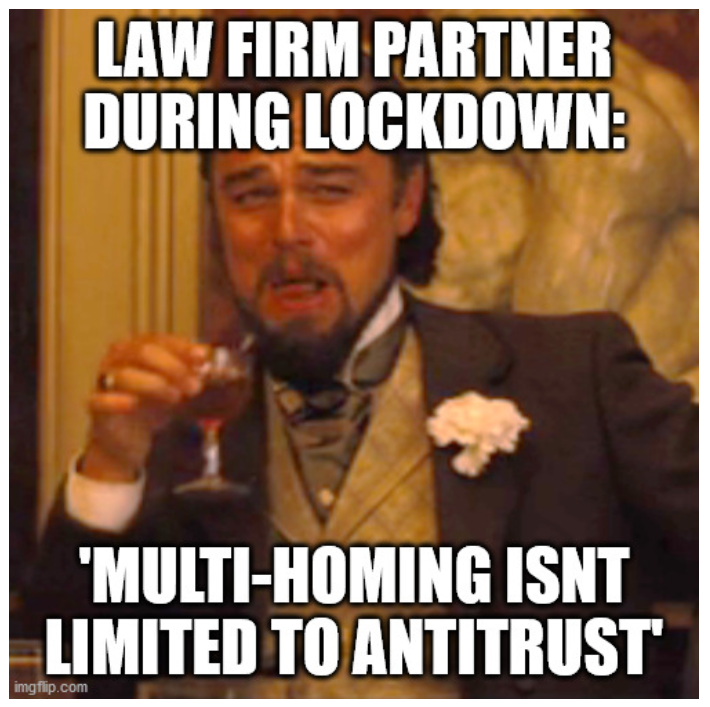
This is the final round of our 2020 Competition Memes Competition (click here for the first, second, third and fourth posts in these series). We hope that these may have brought some smiles to your faces. Our expert meme jurors (Aofe White, Foo-Yun Chee, Lewis Crofts, Javier Espinoza and Thibault Larger) will now devote all of their free time to selecting the winner(s). We have an idea to put these memes to use for a good cause. More details coming soon…


10 Comments on the Commission’s DMA Proposal

The DMA proposal is a bold and ambitious attempt to rewrite the rules applicable to (some) digital platforms. While competition law has proved dynamic and capable of constant evolution to address these and other challenges, this proposal would bring about a revolution. There are very different views on whether this may be a good or a bad thing (certainly no expert-consensus either way). All views are legitimate. Here are mine, surely influenced by my work.
1) EU legislators are not afraid of taking up an extraordinarily difficult task, and of breaking new ground, in addressing some of the anxiety about these markets; that is not necessarily a bad thing. EU legislators have the right to try, but also the responsibility to get it right. With great regulatory powers also comes great responsibility.
2) The DMA proposal will first need to overcome legal and political hurdles, but its practical implementation would pose even greater challenges. Managing such a far reaching tool, and managing expectations, could prove a daunting task.
3) The proposal makes a commendable effort to make rules more efficient. The combined promise of far-reaching remedies and relaxed intervention standards (i.e the perception that the sky is the limit) may, however, expose the Commission to continuous and unprecedented pressure and lobbying on the part of stakeholders. We are already witnessing this phenomenon regarding remedies in some specific cases. The proposal would turn this into the new normal. Imagine a world of evergreening investigations and remedy disputes. It is important to realize that the limitations imposed by the law are also meant to protect Institutions from possible pressures.
4) The criteria to identify what companies would qualify as “gatekeepers” will no doubt attract much of the attention given that the proposal would appear to cover companies other than just the five or six that you may have had in mind. The Commission explains that companies meeting the proposed objective thresholds may be able to rebut the “gatekeeper” presumption, even if it is unclear exactly how they might be able to do that. Conversely, the Commission proposed to have the power to identify as gatekeepers companies that do not meet all of these thresholds following a market investigation and “on the basis of a qualitative assessment”. Given their potentially very broad implications, the legislators might need to think very carefully about the relevant criteria to govern these exercises.
5) The DMA proposal incorporates some ideas worth considering that could make users better off while not compromising trade-offs (e.g. an example of low hanging fruit concerns the prohibition for users to complain to agencies). With some exceptions (e.g. MFNs), the list of absolute prohibitions in Art. 5 is an improvement by reference to the leaked previous drafts. The recognition that compliance with other prohibitions (those in Art. 6) would require regulatory dialogue would also seem positive, in that it reflects the complexity inherent to some of these practices (e.g. self preferencing) and could leave room for a more nuanced approach.
The problem, in my view, lies not so much on the very existence of absolute or relative blacklists (even if various competition authorities have cautioned against them), but on the various provisions overlapping with competition law. As observed by competition authorities like the CNMC, this overlap is premised on the assumption (fueled by the parallel publication of various reports) that competition law’s reach may be insufficient. This premise is questionable, but it perhaps reveals what may be the object, or at the very least the effect, of the proposal. The Impact Assessment transparently acknowledges the overlap, but notes that ”competition law is not always an ideal solution due to challenges in applying the market definition concept in multi-sided markets, lengthy timeframes, high legal thresholds to prove abuse, and the backward-looking nature of intervention” (emphasis added). The current proposal would certainly do away with those difficulties and thresholds. It would create a new competition regime under the guise of regulation and free from legal constraints (Ceci n’est pas competition law). At the time the expert reports came out my comment was that one could not aspire to change competition law (shifting the burden of proof or lowering standards to intervene) without the participation of the EU Courts. Admittedly, that was naive, because this proposal is a smart way of obtaining the very same result, only in relation to a limited category of companies.
6) Under the proposed DMA, the Commission would be able to challenge the very same practices that it is now challenging in ongoing cases, only faster, avoiding the limits set by the EU Courts, not having to define markets, show likely potential effects (competition law is not backward-looking!), deal with ambiguities, or indeed bear the burden of proof. Simple rules for a complex world, I guess. At the same time, the Commission would be able to impose the same sanctions and the same remedies as under competition law. In these circumstances, one may wonder whether the Commission or complainants will have any incentives to choose to challenge alleged anticompetitive behavior of “gatekeepers” via Articles 101 and 102 TFEU. National competition authorities, on the contrary, would not get to benefit from these shortcuts. The law and the Courts would also be largely displaced to the benefit of more discretion (giving rise, in passing, to a new mixed breed of lawyers/lobbyists and economists/lobbyists). Once again, there are different views or whether this may be a good thing or not.
7) It is fair and legitimate for the proposal to be informed by the experience acquired in recent cases. For the very same reasons, it would also be convenient not to dismiss the experience acquired in earlier cases (and in future Judgments). It is often wise to first try to understand what one intends to dismiss. And it is important to understand that the limits set by the EU Courts are not capricious, but the result of a steady and incremental evolution, of slowly distilled common sense over decades of experience, fact-finding, balancing of trade-offs and learning from mistakes. Those limits, moreover, do not appear to have been an obstacle given the Commission’s almost immaculate track-record of success in Court.
8) As anticipated, the proposal is based on Art. 114 TFEU (harmonization of national rules to avoid regulatory fragmentation). This legal basis has the advantage of avoiding the unanimity requirement in the Council, but it also implies certain limits to EU action, and it may make the DMA vulnerable to a possible legal challenge (for more on that, see here). As I told Politico, to be on the safe side, Member States and the Parliament would need to ensure that the final version of the DMA does not go beyond its declared goal of preventing regulatory fragmentation across the internal market.
9) The proposal refers to a new set of “harmonized rules”, but it would appear to leave Member States’ margin of legislative manoeuver intact. The Impact Assessment, in fact, observes that some Member States may adopt additional parallel rules (“[a]lthough some national administrations such as those in France and Germany, have taken steps to implement national measures, these may be seen as supportive of and potentially complementary to EU solutions”).
10) This is only the start of a long legislative process which should hopefully contribute to a sensible, balanced and effective solution. As arduous as the legislative process may be, an eventual DMA would face greater challenges. One may disagree with some of these proposals, as I do, but one should also applaud the Commission for launching a necessary debate on how to regulate the digital world.
[Disclaimer: my clients include various companies that could potentially be subject to these new rules. The comments above should coincide with the views I share with my clients, but certainly do not reflect their own views or those of my firm]


 Chillin'Competition