Archive for the ‘Uncategorized’ Category
NEW VERSION | Anticompetitive effects in EU competition law (now with more law, and yet more figures)

I have just uploaded on ssrn (see here) a new version of my paper on ‘Anticompetitive effects in EU competition law’. I am really grateful to Fernando Castillo de la Torre, Andriani Kalintiri, Gianni De Stefano and Alfonso Lamadrid de Pablo for their helpful comments on the previous versions. Their thoughts greatly improved the piece.
What is new about the piece? Some aspects had to do with recent developments. As you all know, CK Telecoms came out a couple of weeks after I finished the first version. The implications of the judgment are now considered (in particular in relation to appreciability and unilateral effects).
I have also worked hard on some bits, where I thought the ideas could transpire more clearly. In particular, I sought to emphasise a key aspect of the case law, which is that a limitation of a firm’s freedom of action and/or a competitive disadvantage do not in themselves amount to anticompetitive effects.
Experience leads us to these conclusion: cases like Microsoft/Skype or Post Danmark I show that a competitive advantage, even an unparalleled one (as in Microsoft/Skype), does not necessarily affect firms’ ability and/or incentive to compete. In fact, it may actually spur competition.
Remember Post Danmark I? The dominant firm’s rival lost market share, but was able to gain back two customers. On those grounds, the Court of Justice concluded that the practice did not amount to a breach of Article 102 TFEU.
I have also expanded the section devoted to frictions. Following conversations with the great people acknowledged above, I realised that there tends to be a confusion between the time dimension (actual or potential effects) and the threshold of effects (capability, likelihood and so on).
According to the case law, considering the ‘actual’ effects of a practice means taking into account the actual context in which it took place: what actually happened, and how the market operated, during the implementation of the practice. However, it is sometimes assumed (both by claimants and defendants) that it means ‘certainty of effects’.
Finally (and this will not come as a surprise to those following the blog, who know already I am a visual person), I have added a few figures to ensure that some ideas transpire as clearly as possible.
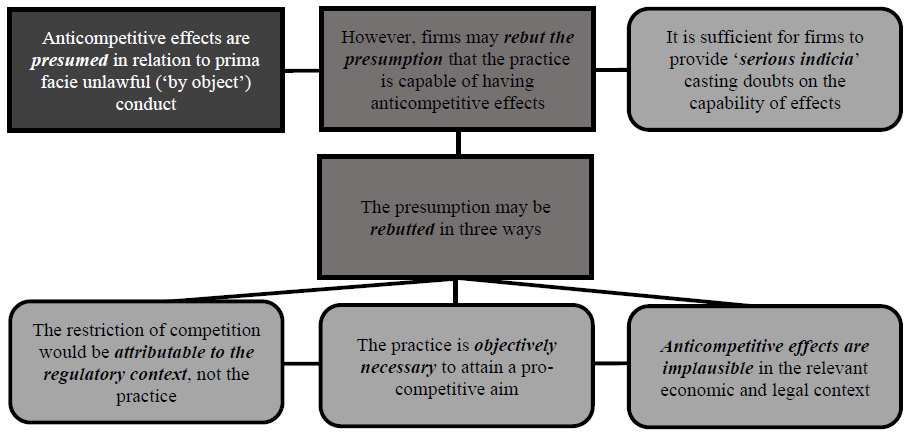
A figure concerns the role of anticompetitive effect in ‘by object’-style conduct (that is, conduct prohibited irrespective of its effects). As you see below, conduct of this nature is presumed to be capable of having anticompetitive effects (both under Articles 101 and 102 TFEU).
The presumption can be rebutted in three ways. A firm can show that the absence of competition would be attributable to the regulatory context, not the practice (the ‘Generics/Toshiba defence’); that the practice is objectively necessary to attain a pro-competitive aim (the ‘Société Technique Minière defence’); or that anticompetitive effects are implausible in the relevant economic context (the ‘Intel defence’).
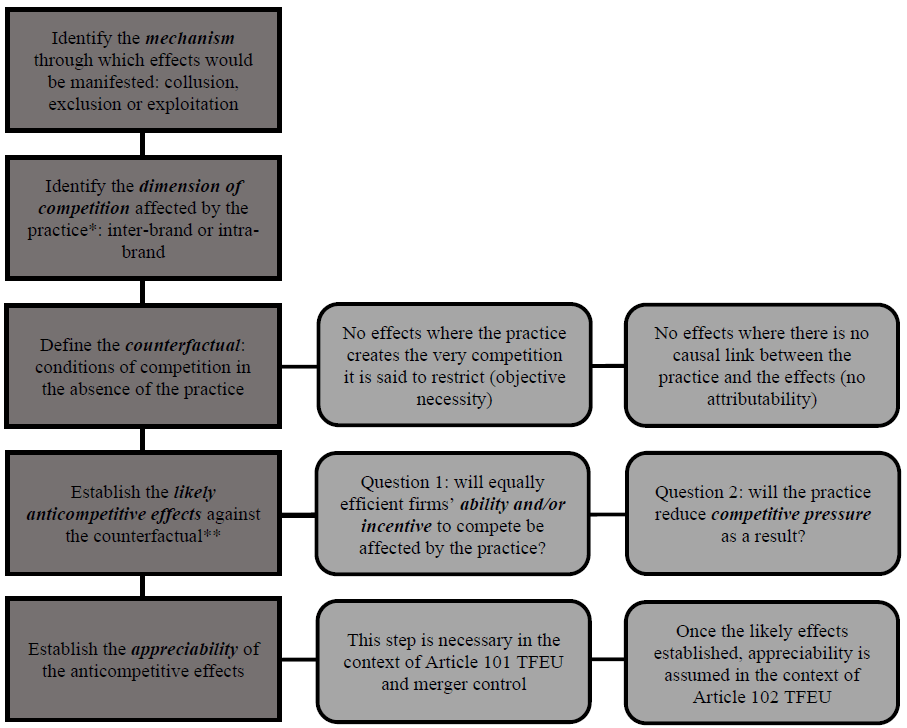
I also have another figure addressing the relevant steps to evaluate the effects of a practice or transaction.
I very much look forward to your comments on this new version. Something has not changed since May: I did not have anything to disclose then, and do not have anything to disclose now.
Protecting the ‘law’ in competition law

Competition law is undergoing an exciting – perhaps unprecedented – period of reform and change. Public bodies and academic institutions are evaluating, from Australia to Germany (and indeed the EU), whether it is necessary to introduce adjustments to the discipline to ensure that it is up to emerging challenges, namely digital and sustainable development. The perception that it may not be able to adapt to a changing landscape is driving the demand for broader, faster and more intrusive competition law.
The desire to move fast and decisively to tackle perceived threats to the competitive process is understandable. The wish to improve the system for the better, in turn, is commendable. The fact that competition law is deemed to be a major part of the response to some of the most pressing concerns in society, finally, says a lot about the continuing relevance of a field that was introduced in a different economic and technological landscape and that has proved capable of adapting to new demands.
The zeal for change, however, sometimes goes as far as to question some of the pillars of the field. The fact that competition policy is enforced through law is now openly criticised in some quarters. The argument is relatively straightforward: freed from the legal shackles, intervention would be faster, more effective and more responsive. Underpinning this position there is the idea that the law is inherently conservative and insufficiently reactive to emerging issues. It sees with suspicion the EU courts’ dislike of sweeping changes and preference for incremental adjustments to legal doctrines.
The solutions, according to these proposals? Increase the resources and the leeway given to competition authorities. Where the law requires a finding of infringement, the said infringement should, if at all, be presumed; thus, it would be for firms to show either that the practice or transaction does not adversely affect competition or that its positive aspects weigh more than any anticompetitive effects. Courts, on the other hand, would not interfere with the choices made by authorities absent manifest errors of assessment.
These proposals, in essence, amount to turning competition policy, a field traditionally driven by law, into one driven by discretion. Such an approach would afford authorities a virtually unconstrained margin of appreciation to decide when to intervene, and how. Insofar as they do, these ideas advocate a Copernican transformation of the field: the centre would move away from the courts towards administrative agencies.
It is difficult to avoid the conclusion that doing away with the law – and, in effect, changing an essential feature of the system – would be too high a price to attain the policy objectives sought by the most ardent reformers, no matter how noble their intentions. It would make the discipline more contentious, more prone to errors and less effective. Perhaps worse, the perceived legitimacy of intervention would inevitably suffer – for how can it be otherwise, if administrative action cannot be meaningfully challenged?
It is occasionally forgotten, but the purpose of the law is not to slow down policy making, or to check whether intervention fits within a set of pre-defined pigeonholes. Its point is instead to ensure that it is sound and in the general interest.
One cannot deny that the case law, as defined by the Court of Justice over the years, limits intervention by competition authorities. It is also true that the case law evolves at a relatively slow pace. These constraints, however inconvenient in individual cases, are far from capricious. They reflect the lessons of experience, which are incrementally incorporated into the acquis of the discipline. They also reflect an awareness of what competition law can realistically achieve in practice.
Removing these constraints would give a false sense of freedom to authorities. In some respects, doing away with legal boundaries to administrative action would make these same authorities realise that, even if not limited by law, they will always struggle when implementing complex and demanding remedies for which they are not adequately equipped. In other words, the law, rather than a barrier, often signals the barrier itself. There is wisdom underpinning the judgments in Magill and Bronner, whether or not this wisdom is enshrined in law. Regulating the terms and conditions of access to an input will always be a daunting task for a competition authority.
In other respects, the perceived sense of freedom would make authorities less able to resist pressure from stakeholders and, similarly, to manage their resources effectively. Experience and expertise, as reflected in the law, are precious assets to prevent regulatory capture – capture implies a loss of freedom, and a far more problematic one from the perspective of the general interest. Once an authority is nominally able to achieve virtually any outcome and to intervene in virtually any instance, the expectation that it can and will take action against every perceived or actual concern will be created sooner or later.
Finally, doing away with the law significantly increases the risk that intervention will not be based on the best available evidence. Over the years, the Court of Justice has crafted the law in a way that ensures that action by competition authorities reflects mainstream consensus positions. Mere concerns or conjectures that are insufficiently supported by theoretical and empirical evidence are not deemed robust enough to justify intervention. And for good reasons: if conjectures warranted action, there would be no effective limits to intervention by competition authorities.
One can try and make the argument that waiting for a consensus to emerge is a luxury that society cannot and should not afford. Ultimately, however, this argument is one based on faith, not on evidence. The concerns expressed may or may not materialise as described. The hard evidence may or may not be eventually available. It is certain, on the other hand, that transforming the institutional setup to turn competition policy into a discretionary tool to achieve the desired outcomes without effective judicial review is an even more extravagant luxury into which society should not even contemplate indulging.
NEW PAPER | The legal status of pay-for-delay agreements in EU competition law: Generics (Paroxetine)

I have just uploaded on ssrn (see here) a paper discussing the Court of Justice’s ruling in Generics (Paroxetine). It is a case note commissioned by the Common Market Law Review earlier this year. Hopefully it provides a clear and useful overview of the judgment and its implications. There is also a cameo appearance of Budapest Bank, which was issued shortly afterwards and could not be left out of the analysis.
Before I say anything about the piece: I am really grateful to Fernando Castillo de la Torre (Legal Service), who shared his comments on a previous version and definitely improved the end product. Thanks so much again!
I have written several (almost certainly too many) posts on a legal issue which I continue to find fascinating. But I tell myself that it is worth emphasising the points that follow.
Pay-for-delay and minimisation of Type I and Type II errors
The more I think about it, the more I tell myself that Generics (Paroxetine) achieved an optimal balance to minimise the risk of both Type I and Type II errors.
It is true that the Court defines the notion of potential competition in a relatively broad manner. It is sufficient to show that there are ‘real concrete possibilites’ of entry (as opposed to the likelihood of entry). What is more, potential competition can be established by proxy, on the basis of indirect indicia.
On the other hand, the Court is careful to point out that pay-for-delay agreements are not always restrictive by object, and that it is necessary to consider the specific circumstances of each case to come to conclusions about whether a given settlement is prima facie unlawful irrespective of its effects.
Intellectual property and insurmountable barriers to entry
Part of the interest of the preliminary reference in the case came from the fact that the UK Competition Appeal Tribunal openly invited the Court to think in probabilistic terms about intellectual property titles. Instead of seeing them as presumptively valid exclusive rights, the tribunal suggested that the probability of them being declared invalid could be incorporated in the assessment.
The Court did not follow the path suggested or implied in the reference. This is not surprising, considering that there is a consistent line of case law, dating back to the very early days of Consten-Grundig, according to which EU law does not question the existence of intellectual property rights, but only their exercise.
What I found interesting (but also not surprising) is that the Court declares that, in the specific circumstances of the case, intellectual property rights were not deemed an ‘insurmountable barrier to entry’.
The question for future rulings is that of when intellectual property will be deemed an ‘insurmountable’ barrier. The Court suggests it is an issue to be decided on a case-by-case basis in light of the relevant economic and legal context.
On restrictions by object
On the notion of restriction of competition by object, I have already explained that Generics (Paroxetine) will be remembered as a seminal ruling, together with Budapest Bank.
The two confirm that the identification of the object of an agreement is a context-specific inquiry. In addition, they (in particular Generics) made it explicit that the pro-competitive aspects of a practices are part of this assessment.
Another point that I have addressed at length is the counterfactual: in the two judgments, the conditions of competition that would have prevailed in the absence of the practice play a role in the evaluation of the object of the agreement. Insofar as this is the case, it seems difficult to argue that the counterfactual is merely confined to the assessment of effects.
The analysis of effects under Article 102 TFEU
Finally, Generics (Paroxetine) is particularly valuable in the contributions it makes to the clarification of the notion of anticompetitive effects under Article 102 TFEU.
In this regard, the Court confirms that the evaluation of this question under Article 102 TFEU is not different from that undertaken under Article 101 TFEU or indeed merger control (which is not only welcome but natural).
Accordingly, it is necessary to assess effects by reference to the market as a whole. By the same token, the impact of the practice would need to go beyond that consequences it has for the freedom of action of individual undertakings.
In reality, the Court’s approach is not any different from that laid down in Delimitis (an Article 101 TFEU case) and sketched in Post Danmark II and Intel (where the Court placed an emphasis on the coverage of the practice as a factor).
AG Saugmandsgaard Øe’s Opinion in Slovak Telekom: Bronner and TeliaSonera vindicated; open questions remain

AG Saugmandsgaard Øe’s Opinion in Slovak Telekom came out earlier this week (see here). Those interested in the outcome of cases will not see anything particularly remarkable. As expected, the Opinion concludes that indispensability should not be an element of the legal test in the circumstances of the case (I suggested this is the most probable outcome here). Those interested in drastic changes in the law will also fail to find anything remarkable. The Opinion sticks to the letter and spirit of both Bronner and TeliaSonera and shows that the two judgments can be easily reconciled.
The Opinion is important insofar as it addresses and explains some key issues and hints at a meaningful analytical framework. In particular, AG Saugmandsgaard Øe explains when and why indispensability is an element of the legal test. In addition, he introduces a useful distinction between (i) a refusal to make available and (ii) the terms of an agreement when it comes to the application of Article 102 TFEU.
There are other issues that are not explicitly addressed in the Opinion and that will have to wait for future developments as a result. In any event, AG Saugmandsgaard Øe’s provides a useful framework for the clarification of these points.
When is indispensability an element of the legal test? And why? The ‘make available’ doctrine
It has long been known that, in certain circumstances, indispensability is a precondition for the application of Article 102 TFEU. According to the case law, indispensability is an element of the legal test, inter alia, in cases like Magill, Bronner and IMS Health.
When is indispensability an element of the legal test?
The case law suggests, and the Advocate General confirms, that the abovementioned judgments concern a ‘refusal to make available, which amounts to requiring a firm to conclude an agreement’ (para 68). Thus, the key seems to be whether intervention would involve mandating a firm to deal with third parties with which it has not chosen to deal.
This position is not surprising in light of the judgments cited in the Opinion, including TeliaSonera and Van den Bergh Foods. It is an approach to the question that places substance above form (as the Court has always done). It matters little how the practice is labelled (AG Saugmandsgaard Øe is rightly wary of labels). What matters is what intervention involves. Finally, this conclusion shows how intimately linked remedies and legal tests are (which is a question to which I have devoted a few thoughts, as you can see here).
Why is indispensability an element of the legal test in ‘refusal to make available’ cases?
The second crucial question addressed in the Opinion is why indispensability is an element of the legal test in refusal to make available cases. In this regard, AG Saugmandsgaard Øe builds on AG Jacobs’ memorable Opinion in Bronner.
Experience and economic analysis suggest that forcing firms to deal with rivals can be expected to have a negative impact on firm’s incentives to invest and innovate and thus on long-run competition.
AG Saugmandsgaard Øe also mentions that the right to property is generally recognised as a fundamental right. As I see it, this is another way of expressing the same idea. If the right to property has a special status, this is precisely because it is widely understood to be an essential ingredient to achieve freedom and prosperity.
When is indispensability NOT an element of the legal test?
The Opinion distinguishes between ‘refusal to make available’ cases and ‘unfair contract terms’ ones. Indispensability would not be an element of the legal test in the case of the latter.
This position is in line with TeliaSonera and Van den Bergh Foods and as such not surprising. It also provides the key to the outcome in Slovak Telekom. The dominant firm in the case ‘imposed unfair conditions on undertakings wishing to access it’ (para 100). Therefore, one cannot argue that indispensability should have been established by the European Commission.
AG Saugmandsgaard Øe’s concludes that the concept of a ‘constructive’ or ‘implicit’ refusal to deal is not particularly useful. This position is in line with his general wariness of formal labels, in particular those that would lack clear boundaries or explanatory power.
Whether or not there is sector-specific regulation imposing a duty to deal is not a relevant consideration, according to the Advocate General (paras 110-111). This is a sensible position and one that is unsurprising. One should bear in mind that the Court attached no importance to this factor in TeliaSonera.
Sector-specific regulation may impose access obligations in circumstances where competition law would not. The objectives of the ex ante regime may be compatible with competition law, but not necessarily identical. Thus, the fact that the former imposes access obligations cannot be decisive.
Open questions after the Opinion
There are some issues that did not come up in Slovak Telekom. Accordingly, one can only speculate how the logic underpinning the Opinion may apply to them. For definitive answers, however, we will have to wait for future cases.
What if the behaviour is unilateral?
AG Saugmandsgaard Øe distinguishes between a refusal to make available and unfair contract terms cases. There is a scenario that is not contemplated in the Opinion: what if the behaviour is strictly unilateral? What, for instance, if the case is about the design of a complex product (think of the integration of two products, as in the example of the camera and the smartphone)?
Even though not expressly addressed, the Opinion provides, in my view, sufficient elements to give an answer to the question.
If intervention in the case would interfere with the firm’s right to deal with whom it pleases (and thus to conclude an agreement with third parties with whom it has not chosen to deal), then indispensability would be an element of the legal test.
What about a structural separation (or an obligation to close a division)? ‘Reverse refusals to make available’
It is not often mentioned, but cases like Bronner or Magill can be remedied in three different (and equally effective) ways. One approach is to force the firm to deal with third parties on the adjacent market. A second remedy is to impose a structural separation and split the upstream and downstream divisions of the firm. A third way is to require the firm to close its upstream or downstream division.
Since all three remedies are interchangeable, and since they would all interfere with the firm’s right to property, it seems inevitable to conclude that indispensability would also be a precondition where intervention would require a firm to sell some of its assets (or otherwise dispose of them by closing a division). Arguably, Van den Bergh Foods already provides the answer in this regard (it makes an explicit reference to the sale of assets).
What about principles-based remedies? What if the authority’s decision leaves the choice of the remedy to the firm?
A final question, not addressed in the Opinion, has to do with authorities’ decisions that take a ‘principles-based’ approach to remedies. This technique seems to be on the rise. Since the remedy (‘requiring an undertaking to conclude an agreement’) is typically the key to understand whether indispensability is an element of the legal test, a ‘principles-based approach’ can be used by an authority to circumvent the stricter legal test.
There are two possible responses to this conundrum: the ‘substance’ response and the ‘form’ response. I have already explained why we should place substance above form in this (and every other) regard.
What matters is what intervention involves in substance, not what the authority formally requires. Accordingly, if intervention amounts in effect to ‘requiring an undertaking to conclude an agreement’ (or, I would add, a structural separation, or an obligation to close a division) then indispensability would be an element of the legal test. It is irrelevant that this obligation is concealed behind a ‘principles-based’ approach.
If we were to rely on what the decision formally requires, it would be very easy for any authority to circumvent the indispensability condition. In a case like Magill, for instance, the Commission could avoid the indispensability threshold by asking the firms to bring the infringement to an end without specifying how. This does not come across as the most reasonable way to interpret the case law (if only because it would turn an issue of law into one of discretion).
Our Curious Amalgam: The ABA’s Antitrust Podcast (and my take on the Apple Judgment)

The American Bar Association’s Antitrust Law Section now has a weekly podcast program, called Our Curious Amalgam. I was the guest in an episode released yesterday where we discuss the General Court’s Apple Judgment. Coincidentally, the episode was released as I was participating in a hearing at the Grand Chamber of the CJEU where we also discussed fiscal State aid (fifth and hopefully final hearing in the Santander-World Duty free saga…). The podcast is available here.
We recorded this podcast over my summer holidays, and I made sure to listen to quite a few episodes before. It was a great use of time. Each podcast is about 20-25 minutes. They cover everything related to antitrust, consumer protection, data, and privacy and there are very insightful conversations freely available to anyone interested.
To catch new episodes that drop on each Monday, you can subscribe “Our Curious Amalgam” on Google Podcasts, Apple Podcasts, and Spotify.
Many thanks to Matthew Hall, Christina Ma and John Roberti for the invitation and the chat!



On the Qualcomm (exclusivity payments) decision (by Max Kadar)

[The second installment of this series of guest blog posts is devoted to the Qualcomm decision on exclusivity payments, which was (finally) made public in June. The post has been prepared by Max Kadar, Deputy Head of Unit at the European Commission and Visiting Professor at King’s College London. He is uniquely placed to provide an overview of this landmark development. Thanks so much for accepting the invitation, Max!]
I confess that when Pablo got in touch a few days ago to invite me to write a blog post on the Qualcomm (Exclusivity Payments) decision, my instinctive reaction has been something along the lines of “after having spent the past months locked up at home, there’s no way that I am going to spend my holidays writing another article”. After some time reflecting on the matter, I ended up doing the only logical thing that I could have done in these circumstances: politely but firmly refusing the kind invitation writing the piece before going for holidays.
Before starting, I should say that I have a conflict of interest to declare, as I was part of the case team working on the Qualcomm (Exclusivity Payments) decision. In addition, as usual, I should say that my views in the following are personal and may not necessarily reflect the position of the European Commission.
The Qualcomm (Exclusivity Payments) decision adopted on 24 January 2018 (and a public version of which was published on the Commission’s website a couple of weeks ago) constitutes the first example of a Commission decision dealing with exclusivity rebates under Article 102 adopted after the Court of Justice’s Intel judgment.
As a brief reminder, in Intel, the Court of Justice clarified the Hoffmann-La Roche case law with regard to exclusivity rebates and stated that while such rebates by a dominant undertaking are subject to a presumption of anti-competitive effects, this presumption is a rebuttable one. In particular, if the dominant undertaking submits, “during the administrative procedure, on the basis of supporting evidence”, that its exclusivity rebates do not have the capability to restrict competition, the Commission will be required to engage in an analysis of such capability.
In the aftermath of the Intel judgment, academics and practitioners have engaged in an extensive debate on what exactly the Commission needs to show and how (my take on this here). Against this background, the Qualcomm (Exclusivity Payments) decision is important as it sheds light on the way the Commission interprets the standard of proof it has to satisfy under the Intel case law and in particular under paragraph 139 thereof.
The case concerns agreements between Qualcomm and one of its main customers, Apple. In a nutshell, pursuant to these agreements, Qualcomm granted significant rebates (in the form of direct payments) to Apple, in exchange for Apple exclusively incorporating Qualcomm baseband chipsets compliant with the LTE cellular communication standards (so-called “LTE chipsets”) in its iPhones and iPads. Such conduct was at the centre of the European Commission’s investigation in this case but was also pursued by the US FTC as part of its wider case against Qualcomm.
Qualcomm has historically been a leader in the supply of baseband chipsets and, at the time of the challenged conduct, was by far the world’s largest supplier of LTE chipsets, with market shares in the range of 90% or more for most of the infringement period. Although certain of Qualcomm’s customers were large companies such as Apple and Samsung, the Commission found that even these customers were to a large extent dependent on Qualcomm during the infringement period.
At first sight, one can say that the agreements between Qualcomm and Apple were similar to those challenged by the Commission in previous decisions on exclusivity rebates. On closer inspection, though, the agreements contained loyalty-inducing mechanisms that went even further. In particular, if Apple had incorporated LTE chipsets from a competitor of Qualcomm in some of its iPhone or iPad devices, it would not only (1) have lost all future payments from Qualcomm; but also (2) in the central years covered by the agreements (2013-2015), have had to return to Qualcomm a large part of the payments it had already received in the past (so-called “clawback” provision). Thus, it is perhaps not surprising that throughout almost the entire duration of the agreements, Apple sourced LTE chipsets exclusively from Qualcomm. Only in September 2016, when the agreements were about to expire and the cost of switching was reduced due to the limited future payments left and the termination of the clawback provision, did Apple start to source part of its LTE chipset requirements from one of Qualcomm’s competitors – Intel.
Building on these basic facts, the Commission decision first establishes that Qualcomm’s payments amounted to exclusivity payments or rebates within the meaning of the case law (see Section 11.3 of the decision). As a second step, the Commission analysed the capability of such payments to restrict competition on the basis of several elements (see Section 11.4 of the decision), namely: (i) the extent of Qualcomm’s dominance; (ii) the long duration (from 2011 until 2016) of the payments and their significance, both in absolute terms and as a percentage of Apple’s LTE chipset expenditure; (iii) the fact that Apple’s demand affected by the exclusivity payments covered a significant share of the LTE chipset market (up to roughly half of the worldwide market); (iv) the fact that Apple was a key customer for baseband chipset suppliers; and (v) a broad range of contemporaneous evidence, including Apple’s internal documents, showing that Apple gave serious consideration to switching part of its LTE chipset requirements for iPads to Intel but refrained from doing so, the loss of Qualcomm’s payments being a material factor in Apple’s decision-making.
As one can clearly see, the elements above are in line with those referred to by the Court of Justice at paragraph 139 of the Intel judgment to establish whether exclusivity rebates are capable of restricting competition. Notably, when it comes to the last point, one may even say that the Commission engaged in a form of actual effects analysis, which goes beyond the requirements of the case law.
As regards the so-called “as-efficient competitor” (AEC) test, the Intel judgment does not require the Commission to run such a price-cost test to prove an infringement of Article 102 (as recently confirmed by the UK CAT in Royal Mail). Against this background, the Commission did not have to rely on an “own” AEC test to establish that Qualcomm’s payments were capable of restricting competition. Nevertheless, in the decision, the Commission did analyse and rebut an AEC test that had been prepared and submitted by Qualcomm (see Section 11.5 of the decision).
In addition to submitting an AEC test, Qualcomm had also argued that by failing to carrying out an AEC test, the Commission breached Qualcomm’s legitimate expectations concerning the application of the Guidance Paper on Enforcement Priorities (see Section 11.7 of the decision). In this regard, the decision notes that Qualcomm had failed to submit contemporaneous evidence that it had indeed relied on the Guidance Paper in any way. For example, the AEC test submitted by Qualcomm was prepared specifically for the purposes of the proceedings and not at the time of the negotiations with Apple. In any case, the decision dismisses Qualcomm’s arguments, pointing inter alia to the fact that the AEC test is merely a tool that the Commission can use to establish its enforcement priorities and that in this case, there were many other clear reasons why the case should be handled as a priority (on a strictly personal level, I find it very difficult to argue that an agreement of the type at hand between two leading technology companies in a multi-billion market should not be investigated by the Commission as a matter of priority).
A final but important part of the decision’s effects analysis relates to Qualcomm’s claimed efficiencies (Section 11.6 of the decision). In essence, Qualcomm argued that its conduct was justified because the exclusivity was necessary to allow Qualcomm to recoup the alleged investments required for the design and production of tailor-made LTE chipsets for Apple. As is usual in Article 102 cases (see here), the Commission examined these claims in detail: there is indeed no doubt that efficiencies may outweigh the effects of anti-competitive conduct and it is the Commission’s task to look into this after having received a properly substantiated efficiency submission. In this case, however, the decision concludes that Qualcomm failed to prove the link between the exclusivity and the alleged need to recoup investments for tailor-made products. Once again, the decision also refers to the fact that Qualcomm failed to submit any contemporaneous evidence supporting its claims.
As a concluding remark, I note that, while the Commission adopted a Statement of Objections (SO) in this case well before the Court of Justice’s Intel judgment, the SO already contained an analysis on the capability of Qualcomm’s payments to restrict competition. This allowed the Commission to proceed to a final decision without the need to issue a supplementary SO after publication of the Intel judgment, which would have likely dragged on the proceedings for at least several more months. While the end-result was certainly good from an administrative perspective (as I hope we all share the importance of avoiding unnecessarily protracted legal procedures), it was certainly not a departure from the Commission’s recent decisional practice. Those who have been following the Commission’s approach closely know well that, regardless of whether the Commission is legally required to assess the potential effects of a given practice on competition, such an assessment is always included in the Commission’s decisions. While I would not go as far as saying that the debate between “by object” and “by effect” in Article 102 is purely of academic interest, I do think that the practical importance of such a debate should not be overstated.
What is in my mind, however, highly relevant, is the type of evidence that a competition agency can use to prove a case and the robustness of such evidence. The Qualcomm (Exclusivity Payments) decision confirms that the elements of evidence that can be taken into account to prove effects are many and varied. Furthermore, it confirms that there is no pre-determined hierarchy of importance between those elements. Depending on the specific circumstances in each case, its factual background and investigative history, a given element of the analysis may play a more important role than another. In this respect, one can say that the different types of evidence are like bricks used to build a wall: what matters is not whether they are of a given colour or shape, but rather that the wall in the end is solid and robust. Whether this was the case in this decision is a matter for the General Court to decide, in the context of the ongoing appeal of the decision by Qualcomm. In the meantime, one can only expect that exclusivity arrangements entered into by dominant firms, which have the potential of harming competition, will remain high on the Commission’s agenda, as shown for example by the ongoing Broadcom case.
The pitfalls of preventing discrimination through ex ante regulation (by Daniel Beard and Jack Willams)
[In the course of the coming weeks we will be publishing a number of guests posts on different topics (feel free to send ideas our way!). We start this series of guest posts with a contribution from Daniel Beard QC and Jack Williams on discrimination concerns underlying new regulatory initiatives]

Language is both beguiling and dangerous. Being an author would be no fun if it were otherwise. But being an author and being a regulator are very different jobs. Sometimes compelling words and rhetoric can distract from the regulatory job at hand. The political force of a cri de coeur risks losing sight of the raison d’être.
The mood of regulators and governments across the EU is that, in relation to digital technology and the operation of competition law, something must be done. All sorts of interesting suggestions are being made, from new governmental inquiry units and changes in merger scrutiny to whole new competition tools.
Amongst the myriad reports and studies one thing comes out loud and clear: discrimination is bad. It is particularly bad where the discrimination is by a dominant undertaking in a digital industry characterised by high entry costs, low marginal costs, and network effects. Indeed, it is so obviously bad that a new ex ante regulatory regime is needed so we can make sure it never happens in the first place.
The level of support for this idea is striking. Perhaps it comes from the language itself: who is going to say that preventing “discrimination” is wrong? After all, when we first think about the notion of discrimination, we do not think about digital service self-preferencing; we think, for example, about powerful struggles for freedom from race or gender inequality. Legal battles to protect people from discrimination on the basis of the colour of their skin or their sex, religion, physical ability or sexual orientation have been long and hard fought. It is easy, and obviously right, instinctively to think discrimination wrong when that is our starting point.
Yet, transferring the concept of discrimination away from recognised status cases involving individuals, the analysis becomes problematic and the effective use of ex ante tools even harder to gauge. There are three types of issue: substantive difficulty; procedural complexity; and fairness.
Substantively, discrimination analysis can confuse as much as enlighten. If you want to change the way that electricity transmission pricing works, can you treat low carbon, renewables and traditional generators in the same way? The electricity they produce is the same. The way they do it is not. Does that mean that you say all the generators are similar? If they are comparably similar, is there a justification for different treatment? The test in such economic cases is whether you are treating like cases differently (or different cases the same way) without justification.
The problem is that the same essential considerations are used for assessing whether the cases are alike and whether there is a justification for differential treatment. What is really being asked is whether the particular benefits of renewable generators mean that arrangements for charging them differently from, for example, gas fired plant is reasonable overall. It is an assessment of priorities and objectives within the sector. Labelling the issue as discrimination does not itself assist the substantive analysis of whether the changes properly pursue the legitimate aims of the sectoral regulation. Indeed, using the language of discrimination in economic contexts may ultimately distract from the key policy issues which a measure is trying to address.
It might well be because discrimination assessments outside recognised status cases are hard that until recently we had not seen as many cases as we might otherwise expect applying Articles 101(c) or 102(c) TFEU. Broadly, those provisions prevent agreements or provisions by dominant entities applying different conditions to equivalent transactions – stopping discrimination. Aside from various music collecting societies cases these apparently very powerful tools have not historically been wielded frequently. Plainly things have changed more recently with cases such as MEO, Google Shoppingor Royal Mail v Ofcom. Yet none of those cases is an advert for the clarity and simplicity of using discrimination as a key tool.
Ex ante non-discrimination provisions are applied to regulate utility industries. Where a legacy incumbent inherits a system monopoly such that they have significant market power, non-discrimination requirements are a standard feature of the regulatory regimes. Those requirements often focus on criteria and terms for access to established networks: what information has to be provided for a connection? How are connections to be made and paid for?
However, there is a real difference in assessing discrimination – and justification – where networks have built through investment and competition (rather than bequeathed), where the nature of the services being provided by the dominant entity are changing, and where the criteria for assessment have to consider different business models and types of demand. The substantive difficulties involved in applying discrimination outside status cases are all the greater in dynamic rather than mature industries. And that is in addition to setting the thresholds for what sorts of entity are going to be subject to the ex ante tools in the first place.
In addition to these substantive concerns about using discrimination as a key tool, there is the second problem of a new regulatory process introducing complexity and inertia. Experience shows that building a novel regulatory infrastructure can itself create another layer of definitional disputes and uncertainties.
Sponsoring lawyers and compliance departments to be involved in extensive exchanges with regulators is an excellent means of shifting resources from technology developers to professional services providers. But it is far from clear that social utility and consumer welfare is enhanced by such a process. It can increase the risk of undue intervention by regulators. It can encourage undue conservatism on the part of operators. In a fast-moving industry a complex regulatory process can be a real impediment to innovation.
Such a regime may offer particular protection to a cautious undertaking. After all, if it can reach agreement with a regulator on an ex ante approach, the prospects of ex post fines under existing rules must diminish. Affecting the dynamism and risk taking of large companies can damage innovation. It cannot be assumed that the best and fastest development always comes from start-ups or scrappy mavericks. Does having a prior regulatory clearance mechanism mean better outcomes for consumers or simply a slower digital industry in Europe?
Then there is a third issue: fairness. It is perhaps not going to cause people to rally to the barricades (or blogs) where the new process is directed primarily at large multinational firms, but the rule of law should not pick and choose.
If companies are required to pre-justify conduct, that is effectively a shift in the burden of proof: they are being required to prove what they are doing is acceptable rather than a regulator having to show the contrary later. There is a reason the burden is placed on regulators. It is not just to make their life hard. It is because it is generally accepted to be unfair to assume that someone is doing wrong unless they can show otherwise. The use of presumptions against people is something to be cautious about. The fact that they would be used in the complex and confusing territory of discrimination assessments might make that all the more concerning.
Whatever course is to be taken on ex ante regulation it needs to recognise that big themes and buzz words do not equal good law. We must not get carried away with an easy reliance on prejudicial language. Perhaps we need to be more discriminating on discrimination in order to decide what new tools we really need.
NEW PAPER | Vertical restraints after Generics and Budapest Bank

I have just uploaded on ssrn a new paper (see here) on the legal status of vertical restraints following Generics and Budapest Bank. It is part of a series of short contributions on the topic that is forthcoming in Concurrences and that has been coordinated by Mario Marques Mendes (thanks very much for the invitation to contribute!).
I have already discussed the implications of these two landmark rulings on the blog (for instance here). The key conclusion I draw from them is that, as a rule, an agreement that is capable of having pro-competitive effects is not restrictive of competition by object.
This conclusion is consistent with the legal treatment of vertical restraints in the Court’s case law over the years. My paper focuses on two traditional pro-competitive justifications for vertical restraints: brand protection and the fight against free riding.
Free riding considerations are particularly relevant in the context of MFN clauses. As evidenced in the Support studies for the evaluation of the VBER prepared for the Commission (see here), this pro-competitive justification is valid both in relation to the ‘wide’ and ‘narrow’ varieties of the restraint.
Accordingly, there seems to be little support for treating MFN clauses as ‘by object’ infringements and/or hardcore restrictions within the meaning of the Block Exemption Regulation. One can imagine, however, ways in which the future Regulation could provide for some bright lines in relation to ‘wide’ MFNs (for instance, by treating them as excluded Article 5 restrictions above the 30% threshold).
As far as brand protection is concerned, the paper focuses on online selective distribution. Some clauses, such as a ban on the use of online marketplaces and/or of price comparison sites serve a brand protection purpose. In this sense, they are not different from other restraints typically found in selective distribution systems.
Accordingly, there seems to be no reason to give such clauses (specifically tailored to the needs of online distribution) a different (stricter) legal treatment. The conclusion would be the same irrespective of whether the good is a luxury or a non-luxury one (experience and economic analysis show that brand protection can be relevant also in relation to the latter).
I very much look forward to your thoughts. I am happy to clarify, as ever, that I have nothing to disclose.
State aid as the single most important obstacle to an EU-UK agreement: making sense of the EU’s position

Teaching State aid at LSE is a particularly enjoyable experience. I will have to wait an academic year, alas, to do so again. I tell myself it is a sensible arrangement (even if not one I chose): 12 months from now the module will have become either a niche irrelevance for most students or an exciting window to explore an emerging legal regime (in the UK, that is).
The background story is well known. The EU has consistently insisted on the importance of a system for the control of subsidies and similar measures in any EU-UK trade agreement. State aid is the most salient feature of the so-called ‘level playing field’ provisions deemed necessary as part of the future relationship between the two sides.
The UK government is not inclined to remain bound by the substantive or institutional aspects of the EU system (and is very public about it). The idea of setting up a technocratic body that would constrain public authorities’ discretion to award subsidies and similar measures is resisted (see here). From a substantive standpoint, the UK government does not seem keen to make its domestic regime revolve around Article 107(1) TFEU (as interpreted by the Court of Justice over the years).
I was inspired to prepare this post after realising that the logic of the EU’s position does not come across very clearly on this side of the Channel. It is true that there are frequent references to the protection of the ‘integrity of the internal (single) market’. However, something tells me that these references sound so abstract that they are probably seen as suspicious pretexts to constrain the UK’s regulatory freedom post-Brexit.
The truth is that it is difficult to see how the EU State aid system would survive if the UK were allowed to depart from it in any significant way. For the same reason, one can understand why Member States may believe that giving up their own internal State aid regime is too high a price for a trade agreement with the UK.
State aid: a remarkable (and fragile) achievement of integration-by-law
My guess is that anybody who is reasonably familiar with the EU State aid regime marvels when thinking about the remarkable achievement it is (even if one disagrees about its pertinence).
A group of States decided to give up their discretion to award subsidies and similar measures and entrust a supranational authority with the task of deciding when they are in the interest of the community as a whole (as opposed to the interest of its individual members).
What is more, the boundaries of the system – the definition of what State aid is – are defined by law, not discretion. It is ultimately for the Court of Justice to decide whether a measure falls within the scope of Article 107(1) TFEU – a central question, for instance, in the recent Apple case, discussed by Alfonso here.
It is so unusual to see States agree such a regime that no similar system exists even within the US (see here). And precisely because it is so unusual it is also uniquely fragile. The temptation to abandon it and/or relax the rules is always present – every now and then, Member States float the idea of ‘decentralising’ State aid control (which is code for loosening it).
Can the EU State aid regime survive if the UK departs from it?
Hopefully the above gives an idea of why the Commission, and EU Member States, insist so much on State aid in the context of the EU-UK trade agreement. If the UK obtains a deal without an ex ante regime that is in essence similar to that applying within the EU, it will achieve what some EU Member States have always secretly – and not so secretly – wanted.
In other words: the one State leaving the bloc would enjoy greater leeway to engage in regulatory competition than EU Member States themselves. I find it difficult to imagine how the EU State aid system, as we know it, would survive in such circumstances. The pressure to abandon it, or to change it beyond recognition would be too strong. (And no, the issues raised by the trade agreements concluded with Canada and Japan are not comparable in this regard.)
Some may argue that the EU regime may need to change – there are commentators that claim that the notion of State aid is too broad and encompasses too many measures that fail to affect trade. Even if one assumes that this view is correct, it is probably not wise to amend the system to make sure that a trade agreement is reached with the UK. The impetus would have to come from within, not from an external stressor.
No easy way out
The above was an attempt to give an idea of what I believe are the reasons why State aid is seen as so fundamental from an EU perspective. It is not so much about emotions or curtailing the UK’s freedom as it is about making sure the EU’s own State aid regime survives the trade negotiations with the UK.
One may take the view that the EU is asking too high a price for a trade agreement and that the UK may be better off with no agreement and the regulatory freedom that comes with it. It is certainly a defensible one. On the other hand, I do not believe the EU’s demand is unreasonable, as sometimes suggested. It is reasonable to protect one’s fragile supranational arrangements.
If one takes account of the above, it becomes clear there is no obvious solution to the current situation. It makes no sense to try and anticipate the future, given the many issues at stake and given that both sides know that it is in their interest to reach an agreement (which is why they may both be prone to making compromises that would have seemed implausible ex ante).
In any event, I very much struggle to imagine a trade deal in which the UK does not agree to set up a regime that essentially mirrors the acquis on Article 107(1) TFEU and is enforced by an independent agency with powers comparable to those of the European Commission in the field. We will soon find out whether a compromise can be achieved.
Apple’s App Store: a microcosm capturing what digital cases are all about

Developers using Apple’s App Store have been voicing their grievances for a while. These complaints reached a whole new level last week, when a high-profile developer (or so the younger generations say) very publicly defied Apple’s rules. As expected, the firm – Epic – was expelled from the app store and the confrontation made the headlines (see here).
Reading about this sensational story made me realise it captures effectively what is new and distinctive about disputes in digital markets. There are some patterns that cut across pretty much every case against Big Tech. The point underpinning the complaints – what these seek to achieve – is identical.
The rise of the powerful complainant
Epic is a large and successful firm that offers the most popular videogame these days. It shows. The video accompanying its confrontation with Apple deserves to be watched (here, via, ahem, another platform). It is a play on Apple’s iconic 1984 ad and an astute way of pitching Epic as the outsider siding with ordinary folks against the (fruit-shaped) establishment.
Epic exemplifies the rise of the powerful complainant. This development is perhaps the single most relevant change in the competition law ecosystem over the past decade. Until relatively recently, firms – in particular large and successful ones – were wary of proactive, far-reaching competition law intervention. They all sang to the same cautious tune.
Not anymore. In fact, a few large multinationals keep urging authorities to take risks and, if necessary, depart from the case law and/or introduce new ad hoc rules. ‘Act fast, deal with the unintended consequences later’ is the mantra on the rise. Just like Epic, these players seek to persuade the wider public that these changes do not just suit their agenda but are good for society at large.
The above can hardly be criticised. It would be surprising if firms did not attempt to advance their interests on all fronts, including the legal one. The point is that the changing ecosystem introduces new, fascinating and to some extent unprecedented dynamics [note: if you happen to be a political scientist reading this post, drop me a line!).
It is all about access and rents: the fight for a larger slice of the pie
If one looks at the past and ongoing investigations involving large online platforms, it becomes apparent that there is an overarching theme cutting across all cases. In essence, complainants seek to secure access on improved terms and conditions. More precisely, they intend to capture a larger share of the rents generated by the platform.
This conclusion is obvious to draw from disputes around the App Store. Complainants in these investigations have been candid about the thrust of their claim: they consider that the 30% commission charged is excessive and thus should be entitled to a larger slice of the (apple) pie.
The rest of cases are no different, whether they are said to concern exploitative or exclusionary behaviour.
The interim measures adopted by the French competition authority – and concerning press publishers – are an obvious example (see here). The struggle for ‘equal treatment’ in Google Shopping was in essence a struggle for the traffic (and thus the rents) generated via the search engine.
Even investigations on Amazon’s marketplace are, at their heart, about rents: the data shared by retailers using the marketplace is just part of the price they pay to access the platform. It is, in other words, a fraction of the commission charged by Amazon (and should be analysed as such).
How these cases may change competition law
EU competition law occasionally ventures into the allocation of rents within a value chain. It has never been disputed that Article 102 TFEU applies to exploitative conduct by dominant firms. It is not a secret, on the other hand, that the Commission has always been careful about opening exploitation cases, for very good reasons.
It will never be never easy to determine the appropriate remuneration for a firm developing an input or infrastructure, let alone the optimal allocation of rents across the value chain. The unintended consequences of intervention along these lines are also well known.
These questions – this is not a secret either – are considerably harder when it comes to online platforms. This is so for two reasons. One relates to the dynamic and fast-moving nature of digital markets, which makes the task more prone to errors than, say, getting the access price to the telecoms network right.
The second reason is not always acknowledged. Re-allocating rents across digital markets typically goes much further than tweaking the the price of a medicine or the tariffs of a copyright collecting society. It often involves changing a firm’s product, business models and/or degree of integration.
Just think of the aftermath of Google Shopping (the design of the search engine was modified) and Android (the business model was altered) or of the implications of ruling that Apple may not impose an in-app purchase system (intervention would add an additional layer of modularity).
As already explained (see here), EU competition law is even more careful about imposing remedies leading to such outcomes (which, in turn, is the reason the indispensability condition has traditionally acted as a legal filter to limit the instances in which the system is exposed to them).
As the ‘act fast, deal with the unintended consequences later’ mantra gains traction, the exception comes closer to becoming the rule, and the system closer to dealing, on a routine basis, with the very issues it has avoided for decades. Fascinating times indeed.


 Chillin'Competition