Archive for the ‘Uncategorized’ Category
State Aid Asymmetries and the Covid-19 Outbreak- An Update and an Offer

At the end of March, my colleague José Luis Buendía and I wrote a post on this blog (also here and here) pointing to the risk of massive distortions to the internal market caused by the asymmetric national responses to the Covid-19 outbreak. We put out there a proposal to mitigate these distortions that we think would be legally feasible.
This was not a prominent debate at the time. After all, there appeared to be more pressing issues, and pointing to this one was uncomfortable, and even politically incorrect. Things, however, have changed, and this debate is gaining prominence (see below for a list of recent pieces touching on it). President Von der Leyen and Commissioner Vestager have now also warned about the dangers of what’s happening. The consequences of what we decide to do on this subject might be felt for generations.
What was politically incorrect only two months ago has now become almost the consensus. To put it mildly, almost everybody recognizes now that may be witnessing the greatest competitive distortion of our lifetime. Having a correct diagnosis does not cure the illness but is at least a first step in the right direction. It is certainly much better than denying the existence of the problem.
We put a possible solution on the table that we think is legally feasible, but you might have other ideas about variants or alternative models that could also do the trick. We are confident that if the community of competition lawyers and economists puts its creative juices to work we might be able to contribute to the solution. After all, we can get really creative when it comes to market definitions and theories of harm…
If any of the readers of this blog has other ideas or suggestions on how to prevent, mitigate or correct these competitive distortions, we are happy to offer you a space in this platform.
For more on this see, for example:
-. Von der Leyen warns state aid ‘unlevelling the playing field’ in Europe (The Guardian, 13 May)
-. Vestager: Discrepancy in state aid distorts single market, hampers recovery (Euractiv.com and Reuters, 18 May)
-. EU Members clash over State aid as richer countries inject more cash (Financial Times, 1 May)
-L. Hornkohl and J. van‘t Klooster, With Exclusive Competence Comes Great Responsibility: How the Commission’s Covid-19 State Aid rules Increase Regional Inequalities within the EU, VerfBlog (29 April)
-M. Motta and M. Petz, EU state aid policies in the time of COVID-19 (18 April);
–Macron: “We are at a moment of truth” (Financial Times, 17 April)
– JL. Buendía, Editor’s Note: Editor’s Note – State Aid in Time of Cholera (European State aid Law Quarterly, Vol 19, Issue 1 (1 April)
The debate on big tech- We can do better

The debate about the role of technology and technology companies in the economy and in society is inevitable, and largely positive. It is necessary and healthy for experts to discuss the virtues and perils of different ideas and approaches, no matter how creative, conservative, revolutionary. I am not sure, however, that many of the ongoing debates will assist society in reaching sensible solutions. I don’t know where the right balance lies, but I do have a clear idea of how we are not going to attain it. So this is not a post on substance; it is (mostly) a post on process.
An important disclaimer: I do have professional interests in this debate and work for companies at the center of these debates (on the last point I discuss how that affects my personal views and attitude).
1-.The tone. It is perplexing to see how much animosity these debates create, how many personal attacks and high-pitched criticism they trigger, how they make awkward friends and new enemies. But we should all be above that. We probably all think we are on the right side of the debate (which is not necessarily a bad thing). But that doesn’t entitle anyone to be offensive or dismissive of those with different ideas. If anything, we have the responsibility to demonstrate the merits of our ideas, and not let them lose weight because of our tone. Being a lawyer is mostly about empathy, and too often we show too little. Can’t we try to be less controversial and more civilized? [A tip: the ones who insult the least are the ones who tend to be right]. All these are but minor issues in the grand scheme of things. Even within competition law, there are arguably more important ongoing debates eliciting less passions and commentary
2-. The temptation of partisanship and simplicity. Unfortunately, moderate views are often a faithless creed. Pablo wrote some time ago about the “footballization” of competition debates. As he explained, “it would seem it is all about joining a team – becoming a loud, proud member of a camp that supports everything that comes from within and opposes whatever comes from the other side”. That’s sadly true. Life is much more comfortable when you align yourself with one view and know always what line to take. If only things were that easy… Most debates are about trade-offs, and that is certainly the case of debates on big tech. If you refuse to understand the real points others are making, your arguments will be weaker, it not flawed. That’s an easy mistake to make (perhaps I make it all the time), but that’s precisely why we should resist the instinct. More nuance would do much good. More active listening and constructive engagement with/by the affected stakeholders (companies, consumers, industry associations) would also be desirable.
3-. The lack of neutrality. Last weekend we received a critical comment pointing to alleged conflicts of interests in lawyers/economists participating in these discussions. So take this also as a comment on that comment. There is nothing wrong with people advocating for private interests; that’s the way the system works. Lawyers and consultants do that for a living, and I don’t see how one can criticize us for doing our job. That also includes academics who may choose to do consulting, which I believe it’s absolutely fine. To be sure, we are all for clear disclosures to permit closer scrutiny on the merits by the audience. That said, I can see the point that there is too little neutrality in professional circles and in academia. People like Pablo are all too rare. It’s legitimate and most helpful for academic to voice out their views, no matter whom they benefit. But I do admit there’s a problem when advocacy work is concealed as an academic piece. [A tip: If someone’s research is only dictated by their client base, then you know they are not academics]. We should also hear more from more people, including experts in related areas.
4-. The theory vs the evidence. Our job, as lawyers or economists, consists in applying established rules and principles to a given set of facts. We are not entitled to our own facts, nor to ad hoc principles that would ensure we always win. The role of evidence is not to support preconceived views, but to challenge and test them in order to verify them. And this is particularly true for public authorities, who have the higher (and more difficult) responsibility to get it right. So we should not exclude the evidence that contradicts our instincts; we should look forward to it, because it may allow us to understand whether our views may be wrong, and how they can be polished. And if it is the case that this evidence is wrong, irrelevant or confirms our views, then we can reason through it and explain why. The EU Courts were right to point out that the only way of avoiding manifest errors is to have all the necessary evidence to avoid a complex situation. By the way, we can all probably agree that this should also apply to legislation and regulation.
5-. The frustration of uncertainty. Even (or particularly) when we look hard into evidence, the right answer is often “we don’t know” or “it depends”. That is frustrating, but it is what it is. This is true in most areas entailing some degree of complexity, also when it comes to digital markets. The Special Advisers’ Report, for example, was open about it: there are many issues we simply don’t know. Can network effects tip markets? It depends. Can data be the source of competition concerns? It depends. Can self preferencing be anticompetitive? It depends. If there’s anything we know, is that we know very little. Does this suggest that we should never take action? Not at all! It means there should be even closer scrutiny, just not broad brushing. [For a similar message, see para. 80 of the recent Budapest Bank Judgment]. At the end of the day, we might still have doubts. Without recognizing that there might be doubts and shades of gray, instead of just black or white, we are unlikely to make progress.
6-. The alleged blind gap (?). What sets competition law apart from other areas of the law is its wideness and its reliance on vaporous legal concepts. That’s its blessing (it can immediately adapt to new realities and new economic theory), but that’s also its curse (hammer-nail, etc). So I think that it’s unfair on the discipline to dismiss it due to alleged blind gaps. Now, where is that gap? Is there any practice harmful to competition that EU competition authorities are not/ have not been able to effectively pursue? In my mind, the German Facebook case (discussed here) is a perfect example of how we are failing to address, or properly frame, the real challenges for enforcers. Nothing in the Düsseldorf Court’s Order suggests that there is anything wrong with a new theory of harm based on exploitative privacy policies; the reason for the annulment was lack of evidence. In reality, the problem is not that competition law and competition authorities cannot adapt to new theories and realities. If there is evidence of anticompetitive conduct in digital markets (which may very well exist), then competition authorities have the tools to address that. The problem is that we (as plaintiffs, authorities, etc) need to do our homework if we want to establish an infringement on the basis of evidence.
7-.The approaches to uncertainty (on the rule of law). What frustrates some people about competition law might actually not be the fault of competition law, but of Law alone. Legal principles and rules (allocation of burdens, presumptions, etc) articulate ways of dealing with uncertainty. These rules incorporate the lessons of experience and factor the relevant trade-offs. In any sanctioning regime, arguably the most important presumption is the presumption of innocence. When we speak about “Type-2 errors”, etc. we also need to understand that we have to operate within the confines of the rule of law and of that presumption. That might be uncomfortable, but that is what makes us civilized and what protects us from arbitrariness. Let me invoke, again, the words of General Court President Marc van der Woude: “where the contested conduct of the public authorities is repressive in nature, it is hard to conceive, at least in free democratic societies, that citizens and firms can be condemned on the basis of estimates, approximations or guesses, even if they are informed ones. Uncertainty must then be balanced against the requirements of the presumption of innocence […]. [T]his balance is struck by relying on legal concepts, such as the burden of proof”. To the extent that any proposals deviate from these principles, we will not be making progress.
8-.The role of the Courts. The trend that worries me the most in these debates is that of “taking antitrust away from Courts”, proclaiming that precedents are but relics that hold progress down. In my view, this is intimately connected with all of the above. We might disagree with Courts (coincidentally, that tends to happen more when we lose), but they are what makes the system work. We should cherish the legitimacy that Courts give to any decision and policy. That is why I resist the proposals to turn to regulation (where there is no judicial review or evidence standards). I never really understood the Furman Report’s point that “appeals systems can contribute to the competition authority’s risk aversion” (to be sure, I get the point; just not why that’s a problem). In addition, the EU case law is remarkably sensible and balanced in its approach to competition law (for more, see here), and we should be proud about that. I’ve said this for many years when people systematically accused EU Courts of being biased in favor of the Commission, and I say the same now that some people criticize the case law as putting limits on enforcement. It’s remarkable that the Courts can be accused of the two things at the same time, which brings me to my next point (almost done!).
9-.What the near future holds. The Courts will soon have the chance to rule on some of the test cases at the heart of these debates. Regardless of what they do, remember: the system does work. I am personally invested in some of these cases, but I will oppose any suggestion, on any side, invoking an outcome to point to alleged flaws in EU competition law or in our enforcement system. And those will come. Whatever side loses will need to accept it and adjust. In a properly functioning system, cases are won and lost (see here for Pablo’s recent take on that). That is how the law progresses, even if at a cost, and even of not always in a straight line. If test cases work, then that shows the tested hypotheses are correct. If they don’t, then that would show the test-case was flawed or that the evidence was insufficient, but it will say nothing about our discipline (other than that the system works).
10-.My own bias. Are my views affected my work and background? Of course they are. The fact that I spend a lot of my time on these issues does make me more sensitive to them, and also contributes to shaping my views. Does that mean I might be wrong? Perhaps, yes. I’ve never worked on a case where I didn’t believe on the points we were making, so it’s a matter of probability and common sense that I might have been wrong on a good number of occasions. It is healthy to keep that in mind, and it is a reason to more carefully scrutinize the merits of what we say. Actually, for quite some time I’ve been holding thoughts on many of these issues, avoiding to engage and comment on important issues, simply because I realize my comments may be suspect of bias (and also because of my first observation about the tone of the debates). That might have been a mistake.
My commitment: Together with Pablo, we commit to making this platform a place where people can discuss different ideas openly and respectfully. We will comment on the issues that we believe are important, because there are important things going on in competition law at the moment (even if more important things are happening outside competition law). We will always play the ball, and not the man. We won’t be offensive or dismissive to people with contrary views. And we will continue to like and invite (here and to our conferences) people who think differently from us.
New Paper | Anticompetitive Effects in EU Competition Law

I have uploaded a new paper on ssrn (see here) on Anticompetitive Effects in EU Competition Law.
What was the impetus behind the paper? The ‘effects-based approach’ have long been part of discussions, yet there are only a handful of judgments addressing the analysis of effects in a meaningful way.
There is still some uncertainty about what anticompetitive effects are and how they are measured in concrete cases. On the other hand, the Court has already clarified the key issues. Against this background, I felt I could contribute to the debate by bringing together the various strands of the case law and present them in a single framework.
The paper tries to organise what we know about effects around the main variables that shape its meaning and scope, and in particular:
- The time dimension: actual and potential effects (and retrospective and prospective analysis).
- The dimensions of competition (inter-brand and intra-brand) and the counterfactual (ex ante and ex post).
- The meaning of effects: effects can mean many things, from a competitive disadvantage, to harm to the market structure to harm to consumers. The analysis is particularly sensitive to the way this variable is defined.
- The threshold of effects: again, the analysis would vary substantially depending on whether it is enough to show that effects are plausible or whether instead it is necessary to establish that effects are likely to happen.
It would not be obvious to summarise the paper in a single post (I will probably add some dedicated entries). It may make sense to mention, however, that the notion seems to have acquired a clear meaning over the years.
In particular, it seems like effects are more than a competitive disadvantage and/or a limitation of a firm’s freedom of action (think of Deutsche Telekom, Post Danmark I, MEO, Maxima Latvija, Generics and, in the context of merger control, Tetra Laval and GE/Honeywell).
We know from experience that having an edge over rivals is not necessarily fatal for competition; it may even spur rivalry (think of Post Danmark I, where rivals were able to withstand a below-cost price campaign). A limitation of a firm’s freedom of action is not enough either (think of Generics, where the Court held that the effects should be more than the impact of each individual agreement).
What matters, the case law suggests, is whether firms’ ability and/or incentive to compete is affected by a practice or transaction, and this to such an extent that competitive pressure is reduced. Thus, no effects would exist where firms on the market are still willing and able to compete.
The threshold of effects is another contentious issue. We all know that effects can be actual or potential. The real question, when the analysis of potential effects is at stake, is whether it is sufficient to show that harm is plausible or it is ‘more likely than not’ (to use AG Kokott’s expression in Post Danmark II).
If we pay attention to what the Court does, it appears that, regarding ‘by effect’ conduct under both Articles 101 and 102 TFEU (as well as mergers), the negative impact of a practice should be probable (‘more likely than not’) and not simply plausible. Just think of how the analysis was actually conducted in, inter alia, Delimitis, TeliaSonera, Post Danmark II, Kali & Salz and Microsoft/Skype.
As far as ‘by object’ conduct is concerned, it is sufficient to show that harm to competition is ‘plausible’ (the threshold, in other words, is much lower). Bananas or Toshiba are clear examples in this regard, and reveal how much the analysis differs between the ‘by object’ and ‘by effect’ stages.
As I say, I will probably follow up with more posts on the paper. In the meantime, I very much look forward to your comments.
The ‘robust and reliable experience’ requirement in Budapest Bank: why it is a consequence of the case law (and why it is not relevant in pay-for-delay cases)

The ‘robust and reliable experience’ requirement: a natural consequence of the case law
An interesting aspect of Budapest Bank is the reference to ‘robust and reliable experience’. According to the Court, it is not appropriate to categorise conduct as a ‘by object’ infringement absent sufficient accumulated knowledge about the nature, purpose and potential (pro- and anticompetitive) effects of a practice (para 76).
This requirement cannot come as a surprise. Cartes Bancaires and Generics already made a reference to experience. If one considers the logic of the case law as a whole, moreover, it looks like this requirement was already implicit in the Court’s approach.
One can think of at least two reasons in this regard, one relating to the allocation of the burden of proof in the system and the other one to the value placed to expert knowledge by the EU courts.
Experience, ‘reasonable doubts’ and the allocation of the burden of proof
The Court held in Generics that the categorisation of a practice as a ‘by object’ infringement would not be appropriate where ‘reasonable doubts’ remain about whether the agreement is capable of generating pro-competitive effects. In such circumstances, it would not be possible to rule out that the agreement would improve the conditions of competition that would have existed in its absence.
Where there is insufficient experience about the rationale behind a practice in a particular economic and legal context (given, for instance, the features of the relevant market, as in cases like Budapest Bank or Cartes Bancaires), it would not be possible for an authority or claimant to dissipate any such ‘reasonable doubts’. For the same reason, they would not be able to discharge their legal burden of proof.
On experience and expertise as a constraint on administrative action
There is another reason why the ‘experience test’ was an implicit element of the case law. The EU courts have always seen expertise and expert knowledge as a safeguard against arbitrary decision-making. Cases like Airtours, Tetra Laval and, indeed, Cartes Bancaires, show that the Commission (or any other administrative authority subject to EU law) cannot ignore the body of knowledge accumulated over the years.
Against this background, it is only logical that the Court requires that the categorisation of a practice as a ‘by object’ infringement is grounded on consensus positions refined over time. By the same token, absent sufficient evidence about the rationale behind a practice, authorities should refrain from coming to conclusions that cannot be adequately substantiated by expert knowledge.
The issue can be aptly illustrated by reference to a concrete example: if, at the time of the adoption of a decision the pro-competitive effects resulting from a practice are not yet well understood, an authority would not be in a position to conclude that the practice in question has, as its object, the restriction of competition (in such circumstances, ‘reasonable doubts’ in this sense would not be dissipated).
The ‘robust and reliable experience’ requirement and pay-for-delay cases
It is natural to ask oneself whether the ‘robust and reliable experience’ test has a role to play in pay-for-delay cases. After all, it is not unreasonable to argue that these cases are new and that there may not be sufficient accumulated knowledge to conclude that they are restrictive of competition by object.
Contrary to this view, I fail to see how the ‘robust and reliable experience’ test could be of assistance to defendants in pay-for-delay settings. The test laid down in Generics seeks to ascertain, in essence, whether the settlement conceals a cartel-like market-sharing or market-exclusion arrangement (paras 76-77).
One cannot seriously dispute that there is an abundance of experience about the nature, purpose and net anticompetitive effects of cartels (since they have no plausible purpose other than the restriction of competition, they can only do harm). There is probably more experience about these agreements than about any other. This point is central to Cartes Bancaires (para 51) and Budapest Bank (para 36).
It has long been known, in addition, that cartel arrangements can be concealed as a pro-competitive venture. There is so much experience on this question that the Guidelines on horizontal co-operation agreements repeatedly allude to this point. For instance, a standard-setting arrangement can hide a cartel, as in the venerable ANSEAU-NAVEWA case.
Can an intellectual property settlement conceal a cartel arrangement? Do we have experience in this sense? It is sufficient to take a look at Ideal Standard to see that the two questions are to be answered in the affirmative.
In Ideal Standard, the Court held that the assignment of a trade mark can amount to a cartel-like arrangement (more precisely, it can amount to market-sharing). In such circumstances, it would be restrictive by object. As in Generics, however, the Court was careful to point out that the issue cannot be ascertained in the abstract and requires a case-by-case, context-specific assessment.
What is ‘robust and reliable experience’? The example of the Special Advisers’ Report
While the Court made an express reference to ‘robust and reliable experience’, it never fleshed out the concept. Inevitably, it can be interpreted in a variety of ways. The most reasonable way to make sense of it is to read para 76 of Budapest Bank together with AG Bobek’s Opinion, which is explicitly cited in the judgment.
It would seem that the key question is whether a consensus has emerged about the nature, purpose and potential (pro- and anticompetitive effects) of a practice, and whether this consensus has found its way in the practice of courts and authorities. In this regard, the lessons from mainstream economics are of particular relevance.
The Special Advisers’ Report provide an example a contrario. The authors acknowledge that the efficiencies of certain practices in the digital economy are ‘not yet well understood our knowledge and understanding still needs to evolve step by step’. In such circumstances, it would be reasonable to conclude that the ‘by object’ label (or, more generally, their prima facie prohibition irrespective of their effects) would not be appropriate.
Court of Appeal in Ping: how market integration complicates the analysis of object restrictions
Market integration: why it matters in cases like Ping
Market integration considerations are essential to understand EU competition law. Articles 101 and 102 TFEU exist, after all, as part of a wider project that seeks to remove barriers to trade and create an internal market.
Thus, one cannot be surprised that, from the outset, market integration was treated differently under Article 101(1) TFEU. In Consten-Grundig, the Court expressed concern about the risk that firms recreate the very barriers that the Treaty sought to bring down.
How is the special status of market integration manifested in practice? In a stricter, treatment of practices aimed at restricting cross-border trade within the EU. The topic is dear to my heart and I discussed it in a number of papers and at this year’s GCLC conference (see here for the slides).
Earlier this month I commented on Budapest Bank (here) and, more generally, the principles of the case law (here). There is a long line of case law suggesting that, as soon as the Court finds a plausible pro-competitive rationale for an agreement, the ‘by object’ categorisation can be ruled out. Budapest Bank is valuable in that it states, in para 83, that ‘serious indicia’ about the pro-competitive effects of the agreement are conclusive in this regard.
The Court departs from these principles, alas, when market integration is at stake. It is, as I have explained elsewhere (for instance here), one of the outliers in the case law (and one for which I think there are good reasons: my own view is that the symbolic dimension of market integration would alone justify this stricter legal treatment).
Accordingly, conduct aimed at restricting cross-border trade (for instance, an export ban or absolute territorial protection) is in principle restrictive by object even if it is known to be a plausible source of efficiency gains (by the way: if you were wondering how paras 52 and 83 in Budapest Bank can be reconciled, this is, I believe, part of the answer).
If the parties to an agreement aimed at restricting cross-border trade want to avoid the ‘by object’ qualification they can, as the Court held in Murphy (para 140). However, they would have to overcome higher hurdles than usual. They would need to show either that the restraints are objectively necessary to achieve a pro-competitive aim or that they are not capable of restricting competition (which would for instance be the case if there were ‘insurmountable barriers’ to cross-border trade).
The legal analysis in Ping and the conspicuous absence of market integration
You may be wondering what the above may have to do with the Ping ruling of the Court of Appeal of England and Wales, decided earlier this year.
The case involved a ban on online sales à la Pierre Fabre. Against the background of the above, the case seems straightforward. Online sales bans are problematic in EU competition law insofar as they limit passive sales. And limiting passive sales is, as recent action by the Commission since the e-commerce inquiry shows, inimical to market integration. The Internet is a most powerful tool to promote cross-border trade.
Accordingly, a ban on online sales is restrictive by object unless the parties can show that it is objectively necessary and/or it is incapable of restricting competition in its economic and legal context.
If you read the Court of Appeal ruling in Ping (as well as the CAT ruling and the CMA decision), you will realise two things: (i) the outcome is the same as above (the online sales ban is restrictive by object) and (ii) the reasoning is infinitely more convoluted.
The CMA, the CAT and the Court of Appeal all reached the same conclusion about the legal status of the ban. As the law stands, this conclusion seems uncontroversial. However, all three bodies struggled with a key aspect of the case: the online sales ban is at least plausibly pro-competitive.
If one reads the facts in both Ping and Pierre Fabre, it is difficult to avoid the impression that the ban was probably all about brand image and the creation of an aura of exclusivity and prestige around the products. Why, otherwise, would a firm want to limit the exposure, and thus the sales, of its products?
How to reconcile the fact that the ban is a plausible source of pro-competitive gains and its status as a restriction by object? Market integration, as seen above, provides the easy, straightforward answer.
Since market integration was never seriously considered in the analysis, the CMA, CAT and Court of Appeal could not avoid some legal contortions to reach the desired (and correct) outcome. The CMA went as far as to suggest that a restraint amounts to an object infringement unless it is objectively necessary (this position, at odds with the case law, was discussed on the blog here). The CAT, in turn, suggested that a plain vanilla cartel like the one in BIDS was plausibly pro-competitive (see here).
Finally, the Court of Appeal had to engage with AG Bobek’s Opinion in Budapest Bank, which summarised the relevant case law. Now that we have the judgment, it seems to me that the Court of Appeal departed from the Court’s interpretation of Article 101(1) TFEU in some important respects.
In particular, the Court of Appeal seems to require more than ‘serious indicia’ about the pro-competitive gains resulting from the agreement; in addition, it limited the scope of Cartes Bancaires as relating to two-sided markets alone (as opposed to pro-competitive gains more generally, which is the interpretation Generics and Budapest Bank would confirm).
Market integration and restrictions by object: more clarity needed
Market integration has enjoyed a special status in the EU system from the very early days. It is difficult to see that reality changing. More importantly, there is no reason why it should. Accordingly, clauses that would be typically unproblematic in other legal systems (including a post-Brexit UK?), such as online sales bans, are in principle restrictive by object.
The Ping judgment, on the other hand, suggests that it may perhaps be a good idea if some aspects about the special status of market integration were made explicit in the case law. This move would avoid the confusion of methodologies that we observe in the Court of Appeal ruling (and, as the example of Glaxo Spain case shows, this is not the first time we witness this situation).
Chillin’Competition’s Rubén Perea Award

Rubén Perea passed away on 1 April 2020 at 25 years old.
He was a smart, kind, formidable guy who had just completed his LL.M at the College of Europe and accepted an offer to work as a competition lawyer at Garrigues in Brussels. He bravely fought for months against cancer, a fight he ultimately could not win because the Covid-19 delayed the surgery on which we all had our hopes. The grace and courage he showed in these past few months revealed the kind of person that he was, that he would have been, and that we have tragically lost.
In his memory, we have decided to create the annual “Rubén Perea Award” for the best paper (master thesis, research paper or article) in competition/state aid law written by lawyers, economists or students under 30 years old.
The paper will be published in the Journal of European Competition Law and Practice. The winners will be announced on the blog, where they will have the opportunity to present their work in a guest post. If the circumstances allow it, an award will be presented at our next Chillin’Competition conference.
We call on university professors and senior lawyers or economists to encourage their students and younger colleagues to apply. The deadline for submission will be 15 September, so you can save the date. More details will follow soon.
We are also exploring the possibility of funding a scholarship to pursue EU studies in Ruben’s memory, and we hope to publish more info on this soon. Should anyone like to contribute to this initiative, please drop us a line.
On the possible ex ante regulation of online platforms (I): lessons from the EU telecoms regime

Before our world was turned upside down, a major theme in our community concerned the possibility of regulating ex ante online platforms. No matter how challenging the times, it is safe to predict that this question will not completely go away in the foreseeable future.
For the same reason, it makes sense to start a conversation about the possible ex ante regulation of online platforms, and more precisely about (i) why we would want it and (ii) what it would look like if it is ever going to see the light of day. Further posts will follow, as well as, hopefully, some sort of online discussion.
I would not break new ground by saying that it is an exercise that requires careful reflection. Any regulatory regime needs to be scrupulously crafted to ensure that the public interest is preserved. When there is so much at stake this is often a challenge. And claiming that something ‘needs to be done’ is not sufficiently compelling.
Fortunately, we have a template that gives us an idea of why and when to regulate online platforms. I see it as an insurance against sub-optimal outcomes. The EU telecoms regime (that is, the EU Regulatory Framework for electronic communications) asks the right questions and provides the right answers. Every time I look into it I realise that it is, in fact, an impressive achievement.
The EU telecoms regime has always been part of my research and teaching and thought it would be a good idea to start by discussing on the blog how a regulatory framework inspired in its approach would work, and whether there are good reasons to depart from the principles and approach enshrined in it.
Principles of regulation (and how they could apply to digital markets)
When the European Commission proposed the adoption of a new regulatory framework for electronic communications, it was aware of the challenge posed by innovation and technological evolution. Telecommunications activities were undergoing major changes; it was necessary to adapt regulation so that it would not become obsolete (that intervention would continue where it would no longer be necessary and/or it would be unable to address new issues).
The main principles of the framework can be summarised as follows:
- Flexibility and adaptability: legislation sets the objectives and the procedure to be followed by regulatory authorities; it does not directly prescribe the remedies.
- No regulation for the sake of regulation: the framework is premised on regulatory humility. Competition is seen as the best form of regulation, and as the default. Regulatory intervention only takes place where it can be shown that competition law would be unable to address the problem (mainly due to the problems that come with proactive remedies) and where there are major and lasting structural problems in a market.
- Technology neutrality: the framework was crafted to ensure that it would not favour a particular technology over others, and that the market, not regulation, would pick winners and losers.
- Bias against intervention in newly emerging markets: the framework is particularly careful not to intervene in nascent markets, where it is difficult, by definition to anticipate their evolution.
If ex ante regulation is ever adopted for online platforms, I hope the principles outlined above will also guide the regime. Two particular aspects deserve attention.
First, I cannot think of a good reason why an ex ante regime for platforms should not revolve around principles, as opposed to outcomes. In other words: it seems to me that ex ante regulation should provide for the objectives and the process through which the need for intervention is considered. By the same token, the details of intervention should be left to a regulatory authority. The temptation to enshrine particular remedies in legislation may be strong. Wisely, the EU legislature resisted it.
Second, it seems to me that neutrality should be a key guiding principle, in particular when (as acknowledged in the Special Advisers’ Report), there is much that we do not know about the gains resulting from practices in the digital sphere. There appears to be every reason to ensure that any ex ante regime does not have a built-in bias in favour of, or against, certain practices or business models.
The operation of the regime
As a principles-based regime, the EU telecoms regime leaves it to the regulatory authority to decide, on a regular basis, whether intervention is warranted and, if so, the remedies that may be needed to promote competition and innovation on a particular market segment.
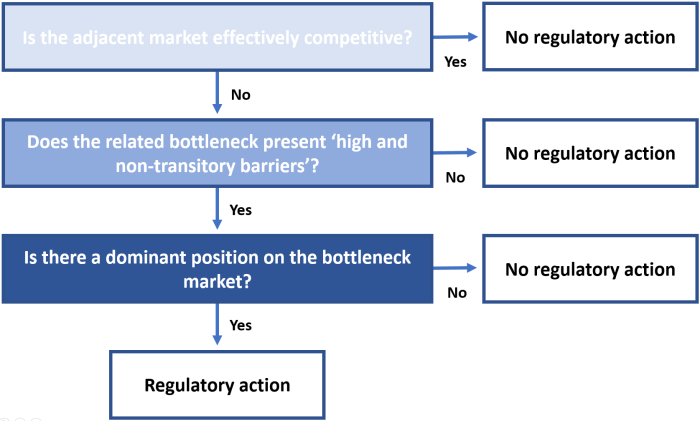
How does the system work? If you are not familiar with the framework, you may not know that market definition (understood in the competition law sense) is central to the identification of regulatory concerns. The best explanation of when and why remedial action may be warranted is to be found, I think, in the Commission’s Explanatory Note on market definition.
The starting point of the analysis is to define, in accordance with competition law principles, a market on a segment that is potentially competitive and that is adjacent to a potential bottleneck. In telecoms, this adjacent segment could be, for instance, the one for retail broadband services (and the potential bottleneck the local loop).
In the digital sphere, this adjacent segment could be (I mention some examples that can be easily visualised) the online distribution of a particular good (say, books), a particular category of app (say, music), or a particular online service (say, travel). Each of these segments would relate to a particular bottleneck segment. Some good candidate markets that are less easy to visualise are extensively discussed in the CMA’s Interim Report.
The key question is whether these adjacent segments are effectively competitive. If they turn out to be effectively competitive – in the sense that no dominant position can be identified – then regulation would not be warranted. No matter how strong the position of a market player on the potential bottleneck segment, no remedial action will take place (again, no regulation for the sake of regulation).
If they are not effectively competitive, then the two main questions that follow are, first, whether the potential bottleneck segment to which these activities relate has ‘high and non-transitory barriers to entry’ and, second, whether a dominant position can be established on this market. As part of this assessment, it would be necessary to consider whether this position is likely to last in the foreseeable future or whether, instead, technology and innovation would undermine this position (for instance, by allowing the firms on the adjacent segment to circumvent the bottleneck).
Only where these two questions are answered in the affirmative will the regulatory authority be in a position to impose remedies, which have to be adapted to the specific demands of every case (they range from transparency and/or non-discrimination obligations to the functional separation of some activities).
The operation of the EU telecoms regime provides two valuable lessons. Again, I cannot think of a good reason to deviate from them.
First, regulatory action should be based on a market-by-market assessment of the conditions of competition, not on a broad-brush identification of companies as having a ‘special status’ on the basis of vaguer, more general criteria. Second, where a market is effectively competitive absent intervention, regulatory obligations would not be warranted. In such circumstances, they can well do more harm than good.
As usual, your thoughts and comments would be most welcome.
Below you find, reduced to the essential, the logic of the framework.
Interim measures by the Autorité de la Concurrence: history repeats itself after IMS Health
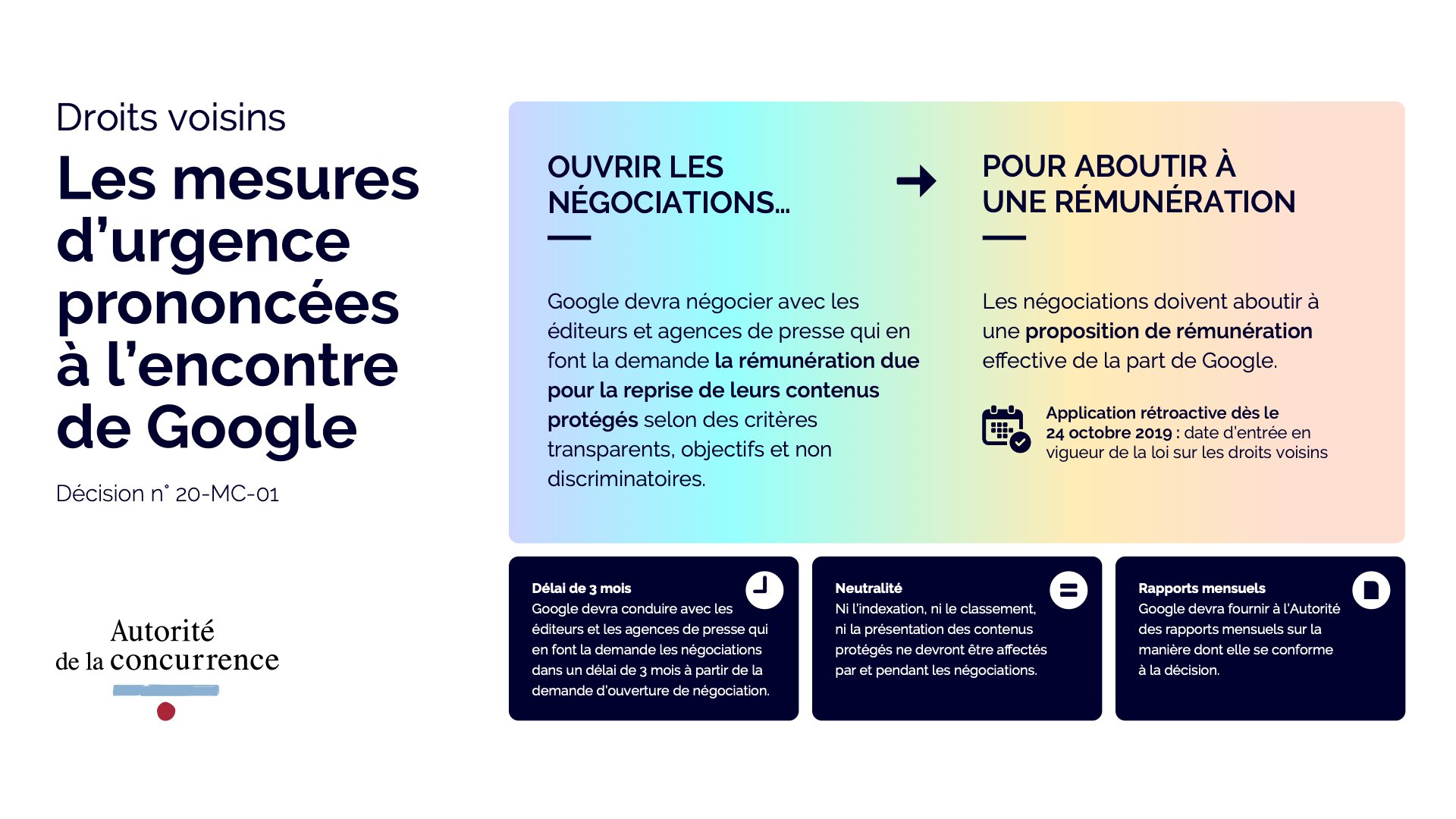
Last week’s decision by the Autorité de la Concurrence is remarkable for several reasons, in particular because it provides for interim measures and it is about exploitative conduct. In that sense, it is an excellent example of what the new competition law will bring.
Traditional competition law was reluctant to engage with practices involving the administration of complex, prescriptive remedies (such as the redesign of a product or the determination of the terms and conditions under which firms are to deal with rivals and/or customers).
The decision reveals how much things are changing. As summarised in the picture above, the Autorité does not hesitate to mandate that Google set up a framework for its negotiations with press publishers and their remuneration.
At the same time, the decision feels like a déjà vu. When reading it, I could not avoid being reminded of the interim measures adopted by the Commission in IMS Health back in 2001 (and the subsequent developments before the then Court of First Instance).
As an instrument that invites us to ponder both the past and the future, it is a good starting point for a serene debate about the European competition law system and its evolution. Your thoughts and comments would, as usual, be most welcome.
Interim measures: IMS Health, Broadcom and Google
It is worth reading (or re-reading) the Order in IMS Health. As I understand it, there were two main reasons why the President of the CFI suspended the implementation of the interim measures decision in that case.
First, the Order explains that the Commission’s interpretation of the existing case law (in particular Magill) was, at best, controversial. Second, the President concluded that, rather than preserving the status quo (interim measures are known as mesures conservatoires for a reason), it sought to alter the market structure by means of proactive remedies changing the firm’s business model.
Following this experience, it would have been reasonable to anticipate that any new interim measures decision would be more risk averse than IMS Health. The European Commission’s decision in Broadcom (which concerned a well-established category of conduct, and involved a plain vanilla cease-and-desist obligation) comes across as the model of what one could have expected.
The Autorité’s decision shows that, contrary to this view, the days of ambitious action by means of interim measures, IMS Health-style, may not only not be over, but about to start.
Reasonable people can disagree about the legal analysis underpinning the decision. Whether or not the said analysis is correct is not the point. Instead, the fascinating issue – at least from the perspective of an independent academic – is that it breaks new ground, and does so by means of an unusual instrument.
At least in part, the assessment revolves around the idea that Google, when dealing with press publishers, has used its dominant position to frustrate the objective of the legislature, which was to allow press publishers to receive adequate remuneration for the exploitation of their sui generis rights. In this regard, Article 102 TFEU seems to be applied as a ‘safety net’ that assists and completes another area of economic regulation (a growing trend in contemporary enforcement).
A second, equally fascinating, point is that the interim measures decision only seems to make sense insofar as, and for as long as, Google displays protected content (one of the interim measures in fact requires the firm to keep displaying protected content).
Alas, copyright legislation merely provides for a right to authorise or prohibit the use of content. It is not a right to receive adequate remuneration (some rights are configured as such) and it does not provide for a right to have the said content displayed. In this sense, there seems to be a limit as to what the Autorité can achieve (at least under the theory of liability on which the decision is based).
As a result, the endgame is uncertain. Much depends, it seems, on how the various stakeholders react to intervention. I cannot avoid wondering whether the Autorité would go as far as to introduce a duty to display protected content. That would involve, again, breaking new ground, in more ways than one – but would also be consistent with the new competition law. An external observer could hardly ask for more.
Judicial review and the public interest
The Autorité’s decision exemplifies a key feature of the European competition law system. As I have been able to gather through my research, competition authorities in the EU are not paralysed by fear of judicial review. Unlike their US counterparts, they take risks when pursuing their policy objectives (which sometimes involves departing from the case law).
Inevitably, the higher the risk taken, the more likely it is to see a decision annulled by a review court. And such an outcome is a good thing and a positive indicator: I read somewhere, not long ago, that, if the rate of annulments is too low, it probably means that an authority is not doing its job properly. In this sense, I hope that the attitudes to judicial review will not change in the new environment (in spite of growing anxiety among some stakeholders, which I fully understand).
The public interest is advanced through the correction of errors of law and of fact and through the definition of the boundaries of the system. By the same token, the annulment of a decision is not a ‘blow’ or a ‘defeat’ (words I always disliked). It is not a sign of judges ‘not getting it’ or of existing doctrines being flawed and in need of change, either. It is, instead, the sound of the system working.
Generics vs Actavis: why the ‘by object’ and per se categories are different

As I was drafting, and thinking about, the past few posts, an idea kept coming back: the ‘by object’ category does not work like (and is very different from) per se restraints in US antitrust. Comparing the two (or presenting ‘by object’ infringements as the European version of per se prohibitions) is not accurate and can be misleading.
Some commentators like to turn to the US system and its categories (per se, ‘quick look’ and so on). to make sense of the EU law on restrictions by object. This is probably one of the reasons why there has been confusion about what the evaluation of the object of a practice entails under Article 101(1) TFEU.
If, instead of borrowing concepts from other legal systems, one reads the case law of the Court of Justice, it is easy to understand how different the two categories are.
Suffice it to compare Generics and Stephen Breyer’s Opinion in Actavis.
In Actavis, the majority agreed to examine reverse payment settlements under the rule of reason. In this sense, it went against the FTC’s position, which argued that such payments should be presumptively unlawful and subject to a ‘quick look’.
Justice Breyer explained in his opinion that the rule of reason is more appropriate as the likelihood of anticompetitive effects of this practice is very much context-dependent: the size of the reverse payment and, by the same token, the availability of justifications vary from one case to another. The majority concluded that the ‘quick look’ does not always fit all such practices.
In Generics, the Court ruled that it is necessary to evaluate, on a case-by-case basis, whether a reverse payment has an anticompetitive object in the economic and legal context of which it is a part.
The factors considered in the analysis are the same as those pondered by the US Supreme Court under the rule of reason: the size of the reverse payment and whether there is a plausible procompetitive rationale for it.
In this sense, there is an overlap between the two inquiries: the analysis at the ‘by object’ stage under Article 101(1) TFEU stretches to the point that it engages in a context-specific assessment of the nature of the practice. For the same reasons, it does not seem appropriate to draw analogies between ‘by object’ and per se.
To be sure, the purpose of the inquiry at the ‘by object’ stage and under the rule of reason is different. In Actavis, the point of the analysis is to evaluate the effects of the payment; in Generics, to make sense of the objective purpose of the practice.
In any event, I hope the bottomline is clear: the temptation to treat the ‘by object’ and per se categories may be strong, but it does not reflect the reality of what courts do and how they interpret the key provisions.
The case-by-case, context-specific approach to the identification of the most egregious infringements is a European specificity (and one that gets, in my view, the balance right).
Restrictions by object after Generics and Budapest Bank: a road map

It was relatively frequent to hear, until not so long ago, that it was not possible to discern, from the case law, a clear set of principles spelling out what a restriction of competition is. I have never been of this view (as explained here) but I understand where it was coming from.
The case law that followed the adoption of Regulation 1/2003 significantly clarified matters. Generics and Budapest Bank, the two most recent landmarks, provide the answers and the vocabulary we needed to present the Court’s interpretation of the notion of restriction by object in a systematic way.
Following the analysis of the said two judgments (I look forward to sharing some more thoughts on them in due course), I told myself it could be a good idea to draw a road map of the principles underpinning the case law and the way they have been applied by the Court over the years (there appears to be a clear and consistent trend dating back to the early days).
The road map is presented below and can also be downloaded here.
When evaluating whether an agreement amounts to a ‘by object’ infringement, two separate questions arise:
- First, what would an authority (or claimant) need to show to discharge its legal burden?
- Second, what sort of contrary evidence would the parties to the agreement need to adduce, and to what standard?
In relation to the first question, I understand the case law, as synthesised in Generics and Budapest Bank, as revolving around the following principles:

It was clear since Murphy that the parties may show that an agreement is not capable of restricting competition (and thus not restrictive, whether by object or effect). Generics and Budapest Bank confirm (and make it explicit) that the parties may also provide evidence, for the same purposes, showing that the agreement in question is capable of having a pro-competitive or ambivalent impact. More precisely:

Your comments and questions would be most welcome.


 Chillin'Competition