Archive for the ‘Uncategorized’ Category
Forget about consumer welfare: it’s the law vs discretion divide that will mark the future of competition law (my presentation at the IEE in Brussels)
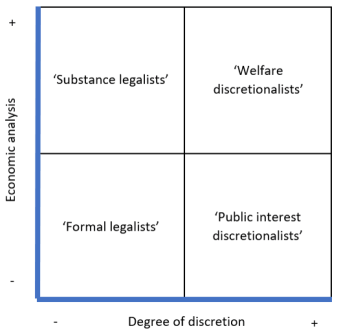
Considerable energy has been devoted to attack (and defend) the consumer welfare standard on both sides of the Atlantic.
There is a real (perhaps growing) divide in the competition law community. Now that we are at a crossroads, this divide matters. It will mark the field for the years to come.
The above said, I think defending the consumer welfare standard is a waste of energy. For those who challenge it, consumer welfare is just a proxy war. Their end destination is not to embrace an alternative standard, but to change the shape and understanding of competition law.
(EU) competition law has progressively become a legalist discipline. Competition authorities are subject to constraints coming from the law and coming from mainstream economics. In the same vein, effective judicial review is known to be an indispensable ingredient in the system.
Under a legalist approach, consistency and predictability are paramount (for could we say that competition policy is implemented through law if enforcement were not consistent and predictable?). It is accepted that these values may occasionally lead to under-enforcement.
Those who attack consumer welfare, as much as those who say to endorse fairness or a wider range of values are, in essence, pleading to move away from legalism to embrace a discretionalist approach to competition law.
A discretionalist approach does not feel bound by consensus positions in economics, and is characteristically sceptical of them. Disregarding mainstream economics is not seen as a big deal. In fact, it may even be desirable – the consensus may be flawed for a variety of reasons.
What matters, under a discretionalist approach, is to reach the outcome that is deemed optimal in any given case. This is something that I explained already in the blog a while ago. Avoiding under-enforcement, accordingly, matters more than the consistency and/or predictability of the system. And avoiding under-enforcement may occasionally involve introducing a plurality of values or considerations.
These are the ideas I presented on Friday of last week in Brussels. My slides can be found here. I try to explain why people tend to develop a fascination with the goals of competition law, and why this debate is, by and large, irrelevant (or overly superficial).
I then move on to explain why law vs discretion is the real divide in the competition law community. As I already explained here, economic analysis can be legalism’s best friend, in the same way that formalism is often its worst foe.
I look forward to your comments!
On Ping: the CAT reinvents economics in a paragraph – will cartels now be allowed?

The provisional judgment of the Competition Appeal Tribunal in Ping is now out. Most of you will remember that the case is about the status of (outright) online sales bans under Article 101(1) TFEU.
The CAT has upheld the CMA’s decision: such bans are restrictive by object. However, it departs in some crucial respects from the authority’s analysis.
In the post I wrote back in May, I explained that the CMA had conflated the question of whether an agreement is restrictive by object with that of whether it is objectively necessary.
The CMA’s decision indeed suggested that companies can only escape the by-object qualification if they can show that there are no less restrictive means to attain the legitimate aim they seek.
The CAT concluded, in line with what I suggested, that the CMA erred in law in that respect. If the CMA’s analysis was incorrect, you may be asking why (and, more importantly, how) the decision was nevertheless upheld.
The CAT did so through a somewhat heterodox interpretation of the case law and, more controversially, by coming up with a surprising statement that questions everything we thought we knew about cartels.
Restrictions by object, pro-competitive rationales and cartels
Ping argued (para 101) in the proceedings that an agreement is restrictive by object only if it lacks a plausible pro-competitive rationale. As Alfonso and I have explained many times here, this is the most sensible way to make sense of the case law (with the exception of cases that relate to market integration, where the bar is higher, and vertical price-fixing).
Ping’s arguments are in line with AG Saugmandsgaard Øe’s opinion in F Hoffmann La Roche v AGCM (which is not cited by the CAT).
Cartes Bancaires is an example that illustrates the Court of Justice’s approach well. In the relevant economic and legal context, the agreement was understood to be a plausible means to address genuine free-riding concerns. As a result, it was found not to have an anticompetitive object.
The CAT does not read Cartes Bancaires in this way. However, it fails to explain what methodology, if any, the Court followed to ascertain the object of the agreement in that case. Interestingly, the CAT also refers to Delimitis, in which the Court’s approach to by-object infringements (paras 10-12) could not be more transparent (and more in line with Ping’s arguments).
The most interesting bit of the Ping judgment comes immediately afterwards (same paragraph). The CAT argues that Ping’s approach to identify by-object infringements (is the agreement a plausible means to attain a pro-competitive objective?) cannot be right because it contradicts the Court’s judgment in BIDS.
BIDS, the CAT acknowledges, was a cartel case (a cartel of well-meaning people, as I like to say, but a cartel nonetheless). And because it was a cartel, the Court could only conclude, as it did, that the agreement was restrictive by object (I never understood why such a straightforward case generated so much interest).
Cartels can take many different forms and can be concealed in all sorts of ways. The defining feature of cartels, their essence, is the fact that they lack a plausible pro-competitive rationale. This is what makes them stand apart from other horizontal agreements – and the reason they are the enforcement priority of competition authorities around the world.
And because cartels lack a plausible pro-competitive rationale, firms rarely ever try to come up with a justification under Article 101(3) TFEU. And when these justifications are advanced, they are irrelevant because they lack credibility. This is the – very sensible – point the Court made in BIDS: once it is established that the agreement is restrictive by object, it does not matter whether it is alleged to pursue other objectives.
For instance, pharmaceutical companies may attempt to claim that the point of their cartel is to devote the additional profits to enhance their research and development capabilities. Or book publishers may try to claim that their cartel seeks to expand the range and diversity of their titles. These arguments can be disregarded precisely because they are implausible.
Or so we thought.
The CAT points out in its judgment that it was ‘obviously plausible’ that the cartel at stake in BIDS ‘might be pro-competitive’. You read it right.
The consensus about cartels (what authorities, courts and international organisation have been saying for decades), the foundations of contemporary competition law and policy, casually questioned in a paragraph. Not only is the consensus wrong; it is ‘obviously’ wrong.
There is much debate about unilateral conduct, mergers, and vertical agreements. We thought cartels was the one area where there was no disagreement. Until Friday of last week.
What explains the CAT’s argument? Was there another way?
I can think of a (plausible) reason behind the CAT’s reasoning in Ping. On the one hand, it may have felt that Ping’s aims were legitimate. On the other, it may have felt that the outcome of the CMA’s decision was correct. Accordingly, it concluded that, even though the object of the agreement could be pro-competitive, the agreement had an anticompetitive object (I am paraphrasing).
One can come to the conclusion reached by the CAT without so many contortions, and without casually reinventing economics along the way.
The reason online sales bans are, in principle, restrictive by object has to do, I believe, with market integration in the EU. This is clear from the Guidelines on vertical restraints and the Digital Single Market Strategy. E-commerce is a powerful tool to enhance cross-border trade and integrate Member States’ economies.
One cannot be surprised, accordingly, that outright bans on online sales are treated more strictly than most other vertical restraints. It is one of these areas where it makes sense to apply the logic of Consten-Grundig. Because market integration is at stake, even a clause that is plausibly pro-competitive is deemed restrictive by object.
I have already explained that I do not have any problem with the introduction of market integration considerations in EU competition law. So long as courts and authorities are explicit about the fact that such considerations guide the outcome in the case, I fail to see why it would be controversial to rely upon consistent case law dating back to 1966.
Why the CAT’s judgment may be a problem
One could argue that the CAT’s judgment is just an anecdote to be mentioned in passing at conferences and in the classroom.
I am not so sure.
We live in times of change. It is not a secret that some sectors of the economy are trying to justify the creation of cartels in the current (disruptive) environment. And, as the Ping case shows, there may always be an astute lawyer able to persuade courts and authorities that cartels are good after all.
Creating the perception that cartels may be a plausible means to attain the objectives advanced by their members may eventually pave the way for sector-specific exemptions aimed at extracting rents from powerful suppliers and/or customers.
And (sorry to end on a gloomy note) the moment cartels start to get exemptions, (EU) competition law and policy would be over. This, I guess, is one of the battles for the years to come.
Grillin’&Chillin’: Two new entrants in the competition press segment

Competition is thriving in the chilling competition market. This blog always stood for the proposition that it’s possible to cover competition law in an informative, serious manner, yet with a relaxed or even purportedly fun tone. We are glad to see that apparantly there is increasing demand, and supply, for this. A number of new outlets have emerged and are doing a great job at chillin’ while grillin’ the real issues [I know it’s a bad one but, hey, I needed something to fit the image…] Instead of seeing them as rivals in attracting the short time span attention precious time of slacking busy ompetition professionals, we see them as complementary goods. They also complement the excellent media services that for very good reasons have long dominated this field.
Two examples (that also share the odd commonality of featuring fishes in their logos) are these:
[Intermission: if any if you can identify a law firm and a department of an institution that also featured marine creatures in their logos, you get one of the last remaining Chillin’Competition meme-coffee mugs]
-Competition Lore, a podcast series run by Prof. Caron Beaton-Wells (University of Melbourne) where she seeks to engage guest in a debate about the role of competition in a digital economy and society. To get more info, suscribe or listen to the 7 episodes available thus far, click here. Btw, Nicolas Petit (founder emeritus), who’s a big podcast fan, also recently appeared on a different series where he also touched on these issues (see here).
-POLITICO is taking a new approach to covering competition with two weekly publications: Fair Play, a briefing on what’s driving the competition world, and Competitive Edge, a column that analyzes and challenges ideas about mergers control, antitrust, state aid policy and more. Politico has been a very successful entrant in the EU media market, and has made an ambitious bet to cover competition policy too, with a team of expert senior journalists (Simon van Dorpe and Christian Oliver) and, unusually (for the good), a competition economist (Thibault Larger).
Their mandate is to explain how competition is increasingly the weapon used to shunt the policy through, whether it be in the digital single market, the energy union or any other enforcement area. Their primary focus centers on the politics, economics and personalities behind the cases, but they are also keen on op-eds and will soon also be giving subscribers data tracking and case monitoring. The tone is meant to be fun and thought-provoking, but they certainly are not afraid to touch on challenging or uncomfortable issues. More info on their services is available here [pro@politico.eu]
Below we give you an example of their work, and we also use the occasion to recycle some of the quotes that weren’t finally used throw some ideas out there that we did not discuss here. Since they are good media professionals, their articles give you quotes from all sides. Since we are (I am) a biased, conflicted, non-neutral lawyer, below I only reproduce only mines 😉
These hyperlinks enable you to read the full pieces which would otherwise only be available to subscribers:
MULTI-SIDED MARKES AND AMEX. Politico ran a very good piece explaining the arguments on the multi-sided discussion on the SCOTUS decision in Amex. For that piece, we contributed with views that I had already advanced on the blog. This is what I sent Thibault for that one (including a couple of quotes that did not make it to the article, but that I still think may be of interest): (i) “The Opinion effectively holds that complex, multi-faceted market realities cannot be examined in silos. Requiring that the full picture be considered is sensible and in line with established EU case law“; (ii) “The only practices that this Opinion exempts from antitrust liability are those that are necessary for the operation of business models that overall do not restrict but foster competition“; (iii) “The case in no way immunizes multi-sided platforms, nor should it. The case is however a blow to the Nirvana fallacy that one can challenge piecemeal a complex business model under the assumption that only positive things will follow“; (iv) “In reality, this all boils down to the burden of proof. It may be hard to show with empirical evidence that a given practice is, or is not, necessary for a platform to deliver established procompetitive benefits. Very often one simply does not know. But holding that uncertainty plays against the accused would be problematic on many levels“.
POLITICS IN COMPETITION. Politico recently inquired into the real role of politics in competition policy and cases.. My quoted view was that “Political principles guide competition policy. There’s nothing inherently wrong about that.” The problem comes when politics impacts not on policy the outcome of specific individual cases. My additional views on these question avoided recent big cases and mostly focused on State aid cases, where “politics plays a particularly evident and crucial role“. This is because “the institutional set up for State aid cases puts the center of gravity on Member States, so politics inevitably plays a much more important role”. In my view, “a way to make State aid control less political and more objective would be to grant more rights and a greater role to companies (beneficiaries and complainants)”. In any event, “Courts are however well placed to identify and correct any undue influence of short-term politics”.
HR RULES AT DG COMP. A recent piece crunched through which big players at DG COMP would soon have to move according to HR rules. My take was the value of these rules to the EC is arguable and, in addition, DG Comp is a different animal (there are others, like the Legal Service). Officials deal with cases that require time, familiarity with the law, with the files and industry knowledge. In my personal view, doing away with experience and with some of the DG’s top assets could be counterproductive.
Discretionalists vs legalists (ULB Summer School, 7 September): want to attend Pablo’s keynote?

The Institute for European Studies, based at the Université libre de Bruxelles, will run a new edition of its Competition Law Summer School in a couple of weeks. In addition to the intense training on fundamental and current issues, they have foreseen a series of lectures and keynote speeches.
The organisers have invited me to give a lecture based on the post on discretionalists vs legalists that I wrote earlier this year on the blog. A 1,000-word piece can only get you so far when developing ideas, so I am delighted that I will have around an hour to put some flesh on them.
The lecture will take place on Friday 7 September at 7pm. The venue is ULB’s Institute for European Studies (39 Franklin Roosevelt Avenue, 1050 Brussels).
Are you interested in attending? The organisers are kind enough to allow 10 readers of the blog to attend. Note that places will be allocated on a first come, first served basis. If you want to be one of the chosen few, send an email to Nicholas Joncheray (nicolas.joncheray@ulb.ac.be). I look forward to seeing you there!
The ASCOLA conference that was (at NYU School of Law) and that will be (Aix-en-Provence, 27-29 June 2019 – with a CALL FOR PAPERS)

The conference that was
The Academic Society for Competition Law (ASCOLA), of which I am a proud member, is doing really well, and its profile keeps raising. No surprise, given that the awesome Michal Gal is the current Chair.
Many will know that this year’s conference took place at NYU School of Law, a strong contender for the Coolest Location Award (and this without getting started about the quality of its antitrust faculty members, who were our hosts).
The event was intense and full of interesting stuff. I am certainly being unfair but cannot resist highlighting two presentations that got me thinking:
Ioannis Lianos gave a fascinating talk about food sovereignty and competition law. His presentation (see here) was primarily devoted to merger control issues. Ioannis discussed the transformation of the food industry, in particular the increased concentration that it is taking place.
I was left with the impression (and I told him so) that it would not be unreasonable to launch a sector inquiry identifying conduct potentially falling within the scope of Article 101 TFEU (and/or their equivalents around the world). Cross-licensing, joint ventures and patent settlements are all practices that deserve close scrutiny in a concentrated industry.
I also enjoyed a paper (available here) by Marco Botta and Klaus Wiedemann on exploitative practices in the data economy. The paper is solid, rigorous and firmly grounded on positive analysis (quite important at a time when many scholars like to indulge in speculation, in particular when addressing all things digital).
Incidentally, these were some of the very qualities I identified as desirable in a pre-conference discussion on what makes a good competition law paper.
As far as I am concerned, I gave a presentation on Regulatory Capture and the New EU Competition Law (available here). It is a topic about which I have been thinking for a while (remember this post?). I have the impression that competition lawyers tend to be somewhat complacent about the risk of capture. I discussed some of the reasons why competition law may be vulnerable to this phenomenon, as well as the safeguards available in the system.
The conference that will be
David Bosco, in his capacity as host-to-be, said a word about the location of next year’s ASCOLA conference. It will take place at the Faculty of Law of Aix-Marseille University (in lovely Aix-en-Provence, in case you were wondering whether it was one or the other city). The call for papers can be found here. Make sure you save the dates: 27-29 June 2019.
The conference will be devoted to ‘Challenges to the Assumptions at the Basis of competition Law’ and will cover issues such as the following:
- The goals of competition law and how they can be achieved;
- How markets operate (including the effects of certain types of conduct and/or technologies on market performance);
- The correct balance between risks and benefits of certain market actions or technological changes;
- The institutional structure that best serves competition law enforcement;
- Burdens of proof, and economic and legal presumptions that best serve its goals;
- The interaction of competition law with other legal or regulatory spheres, and how they affect overall social welfare.
Please note that the pre-conference discussion will be this time devoted to ‘Innovative Ways to Teach Competition Law’.
And before I forget: if you would like to join ASCOLA, please follow this link.
Memories of my workation in Buenos Aires

Alfonso’s last post was devoted to work-life balance among lawyers. Things are quite different for academics. I rarely ever think of the things I do as work. For better (I would say) or worse, it is all a blurred line.
My recent trip to my beloved Buenos Aires was not an exception. On top of the planned (non-competition related) activities which justified my purchasing the flights, I gave three talks last week.
The occasion could not have been better. Competition law is picking up again in Argentina, and I was delighted to see so much intelligence and enthusiasm put into it. The role of competition policy in the improvement of ordinary citizens’ lives seems to be well understood by the government and key stakeholders.
My talks were given at the initiative of two Commissioners of the Argentine Competition Authority (Comisión Nacional de Defensa de la Competencia, or CNDC): Pablo Trevisán (who was lucky enough to study at LSE before I arrived) and Eduardo Stordeur (who is also the Director of the LLM in Law & Economics at Torcuato di Tella University).
On 30 August, I gave a talk at di Tella about my book (info on it and a youtube video – In Spanish – can be found here). Di Tella, a real success story, is modelled upon top US research-intensive universities. This is something I could certainly notice in the lively exchanges that followed my presentation.
A couple of days later (1 August), I spoke at the Bar Association of the City of Buenos Aires and the CNDC.
At the former, I spoke about the preconditions for competition law to emerge and flourish, and about how fragile consensus in its favour can be. I also emphasised that law and mainstream economics cannot be avoided – if they are, they eventually come back to highlight the inconsistency and unpredictability of the system.
My presentation (also in Spanish) at the Bar Association can be downloaded here.
At the competition authority, I gave an overview of recent developments in EU competition law. Officials quickly jumped in to share their views and the discussion, as expected, was of the highest level.
Whether the reasons are competition law-related or not, you should definitely visit Argentina if you ever have the chance to do so (just so you know, I already look forward to coming back). And, no matter the reasons that take you there, let me know if you want any tips!
Side effects of DG Comp’s work (and research all lawyers should read)

(Official pictured just hours after having clicked “Send”)
Competition law enforcement is also a multi-sided industry. Optimal enforcement depends on a complex balancing of incentives between enforcers, Courts, companies, lawyers, economists, politicians, journalists and other stakeholders.
This means that we often forget about the implications of certain initiatives on other sides of the market. And there is one of these cross-side effects on which (for several reasons) I have particularly strong feelings this year.
You know the joke about how the Commission plays with lawyers holidays adopting Decisions, Statements of Objections and Information Requests just before August? Well, some lawyers are lucky enough to have just received all three.
So at a time when many are asking for summer read suggestions, this is my suggestion to DG Comp: “LEISURE AS A COPING RESOURCE“, a study of how lack of holidays impacts lawyers’ life based on a sample of 900 law firm lawyers. 😉
This is the abstract:
“This article explores whether leisure is an effective coping resource in response to the demands of one’s job and in reducing depression. Karasek’s job demand-control-support (JDCS) model of psychological strain serves as a framework for empirically examining the importance of leisure in reducing depression and buffering the detrimental effects of excessive job demands. This article relies on data from a sample of 887 law firm lawyers who are renowned for working in highly stressful work settings. We find that participating in active and social leisure activities or taking a vacation are important in reducing lawyers’ depression, whereas participating in passive leisure is not. None of the leisure variables buffer the harmful effects of job demands on depression. We discuss the implications of these findings“.
Enjoy your time off!
Ithaca Competition Summit: update (and last two weeks to register!)

The Ithaca Competition Summit is just a month away! There are still a few places available, and you can register until 8 August here. All extra info you need (or so I think) can be found in this file.
The programme is as stellar as last time you looked at it. You should note, in addition, that there will be a discussion on AT&T/Time Warner following recent developments. And that CPD/CLE points will be available.
If you still have any questions, you can always send an email to Ithaca.Summit@gmail.com.
The Android decision is out: the exciting legal stuff beneath the noise (by Pablo)

To nobody’s surprise, the Commission has announced, today, the adoption of a decision concerning Android. The stakes in the case are so high that the outcome was known well in advance. The only open question related to the amount of the fine. But even then, it looked like a given that it would be the highest ever. Which turned out to be correct.
When the stakes are so high, corporate strategies tend to dominate the landscape and the discussions.
Some aspects of these strategies are beyond reproach. It makes sense for companies to hire the very best lawyers – a category that definitely includes Alfonso, who has always been open about his involvement in this case.
Alfonso, by the way, will not be blogging again on Android, no less because he is likely to have very little time in the coming months (bye bye summer holidays and bye bye paternity leave, I guess).
I regret other aspects of these corporate methods. Companies tend to make loads of noise when their interests are at stake. Big Food, for instance, has perfected a strategy of confusion that gives many people the impression that beef and cheese are perhaps healthy after all (they are not).
There has certainly been a lot of noise recently in the competition law community – coming from all over the place.
The ongoing cacophony is a real pity, since there is a lot of exciting legal stuff beneath the noise. And it is worth discussing it.
For those interested in the law bit of competition law and policy, here are some thoughts.
According to the press release, the Android decision finds that three main practices amount to an abuse of a dominant position:
- The tying of Google Play to other applications: Google does not license its applications a la carte. In particular, the Commission takes issue with the fact that Google Play Store is not available as a stand-alone product. For a comparable practice, think of pay TV providers preventing users from cherry-picking the channels to which they subscribe.
- Compensation for exclusive pre-installation: According to the press release, mobile phone manufacturers are given financial incentives for exclusively pre-installing Google Search. This arrangement makes me think of a supermarket chain receiving compensation as consideration for prime shelf space – or perhaps an online store receiving compensation for placing some products as default choices.
- Android Forks: If mobile phone manufacturers choose to offer the Google version of Android, they may not offer rival versions of Android. It is like McDonald’s requiring its franchisees not to run their own burger joints (or a Burger King restaurant) in parallel.
The second of these practices is perhaps the least exciting one. The only intriguing question is perhaps whether the exclusive pre-installation amounts to an exclusivity obligation a la Hoffmann-La Roche (which is what the press release seems to imply) or to a practice falling elsewhere along the spectrum of schemes that can have a fidelity-building effect. Either way, the legal framework is firmly in place after Post Danmark II and Intel.
The two other practices, on the other hand, raise more fundamental issues. So much so, in fact, that this case may mark the evolution of EU competition law. Allow me to explain.
Tying: how products are sold vs how products are made
Some people will argue that the application of Article 102 TFEU in relation to the tying aspect of the decision cannot surprise anyone. And it is a reasonable point to make. After Microsoft I, any tie-in that gives a distribution advantage to the dominant firm’s tied product amounts to an abuse – which is another way of saying that tying is presumptively abusive under Article 102 TFEU.
What can be exciting around this case, then? Well, the fact that, in some respects, the setting is different from that found in traditional tying scenarios. Inevitably, the remedy is also different.
Traditional competition law in general, and tying in particular, typically interferes with how products are sold. By the same token, competition law is generally wary not to second-guess how products are made.
What do I mean by this distinction? I mean that, absent exceptional circumstances, competition law is not there to tell companies how to run their business. The point of competition law is to ensure that companies have the ability and the incentive to thrive in the marketplace using the strategies of their choosing.
Competition law is agnostic about whether companies vertically integrate or sell their products through third parties, whether they choose selective distribution over franchising or (more to the point) make money through advertising (like a free-to-air TV channel) or through subscriptions (like HBO). For the same reasons, authorities dislike telling firms what prices they should charge.
How is Android different from traditional tying cases?
It is obvious to everyone why Play is tied to Search (and why Search is given a distribution advantage). It is through this mechanism that a company like Google makes money. Thus, if the tying of content and advertising is made unlawful, Google will have to find new ways to make money – or perhaps reinvent Android as a non-profit entity.
The remedy in the case is likely to lead to a fundamental rethink of Android. This issue does not arise in traditional tying cases. If a firm like Coca-Cola is not allowed to engage in tying, it can carry on making money the same way it used to. Not even Microsoft had to change its business strategy – this said, the Media Player remedy failed, which is not an unimportant factor in this context.
To sum up: Android will inevitably lead to more intrusive intervention than usual. And the potential unintended consequences of second-guessing firms’ strategies are universally acknowledged in the competition law community (and have often informed legal analysis).
Against this background, the open question, I guess, is whether, and to what extent, this difference should be reflected in the law.
Is this factor irrelevant from a legal standpoint? If it is not irrelevant, how does (or should) the law adapt to the increased intrusiveness? What are the closest precedents at which the remedy hints?
The reach and scope of competition law intervention may vary significantly depending on how these questions are answered.
Android forks and the legal status of non-compete obligations
What I say above can also be extended to the issue of Android forks. As explained above, obligations relating to this matter are like the sort of non-compete obligations found in franchising agreements or in those seeking to protect the goodwill around a business (think of Remia). From this perspective, one could argue that they are reasonable.
Is it not sensible for a company to prevent free-riding and to make sure that it does not create competition to itself when licensing its products and services? One could point to the Guidelines on technology transfer agreements to suggest that, indeed, it is. In relation to these agreements, Valentine Korah consistently emphasised that competition cannot be examined from an ex post perspective alone.
One could also argue, equally reasonably, that dominant firms have a special responsibility. I agree that they do. This point, however, does not say anything about the relevant legal test. Under what conditions are dominant firms precluded from taking measures against free-riding? Can they avoid creating competition to themselves when licensing their products? How are these considerations integrated in the legal framework?
These are questions, again, for which there is no clear-cut answer in the case law – Article 102 TFEU case law, that is. In that sense, Android looks like a good opportunity to evaluate and clarify the status of these business strategies – and similar ones raising the same issues.
Conclusions
These are not the only questions in which I am interested. But it gives you an idea of the sort of major points to which I will jump when the decision is made available. The telecoms lawyer in me is also intrigued by some aspects of market definition mentioned in the press release (in particular the reference to indirect constraints). And I am curious to know how the notion of effects is defined.
If you are interested in making sense of the law (as opposed to making noise) too, I would very much welcome your thoughts.
Save the date- The Ultimate Chillin’Competition Conference- 20 November 2018
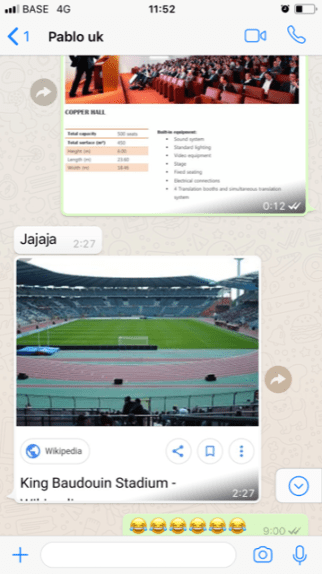
The 4th Chillin’Competition Conference will take place in Brussels on 20 November 2018.
Here is what we can tell you for now:
-It took us a while to settle on a venue (because Pablo mocks my ambitions; the picture above corresponds to a real recent Whatsapp conversation regarding possible venues. His counterproposal reveals how seriously he takes me…).
-We have so far invited only one speaker, who has very kindly accepted: Commissioner Vestager will once again be our star speaker;
-The theme of the conference will be: “Concepts“. We will pick a few common but often misunderstood, or yet unclear, concepts and we will invite a group of experts to discuss their meaning and implications. It’s a bit what we did with the notion of “neutrality” in our 2nd conference, but with a broader scope. We will discuss horizontal concepts, not cases or industries.
-We are selecting the specific concepts that will be disected and your feedback would be most useful; what are the concepts that you think are in need of clarifications?
–We are open to fresh ideas and new speakers, so if you think you can astonish the competition community with a brilliant speech on any particular concept, please send us a one pager with your ideas. Depending on what we get, we might invite those with the best ideas to deliver a brief Ted-like talk (note that candidates will be selected “on the merits”; i.e. on the basis of wholly subjective and undisclosed criteria);
-Our non-business model consists in making the conference accesible to everyone by offering the service for free. If you want to be one of the sponsors that makes this possible, please shoot us a line;
-It will be, by far, the best Chilling Competition conference to date;
-Yes, yes, there will be drinks afterwards
More info on the programme, registration, etc. will follow in September…


 Chillin'Competition