More 20K results
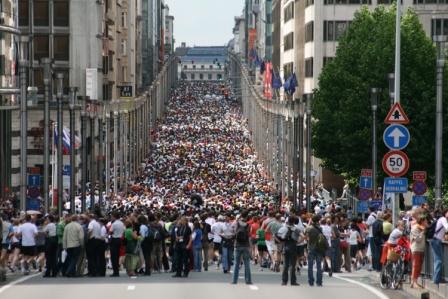
More results, including several IP lawyers.
- Matthew Levitt (HoganLovells): 1:46:25
- Jean-Jo Evrard (former University of Liege and Darts IP): 1:47:31
- Enrique Gonzalez Diaz (Cleary): 1:48:44
- Norman Neyrinck (University of Liege): 1:48:52
- Alain Strowel (University of Liege): 1:49:01
- Thomas Wiese (Ashurst): 1:50:52
- Valentijn de Boe (Allen&Overy): 1:51:56
- Tom McQuail (Morrison Foerster): 1:54:59
- Damien Gerard (Cleary): 1:57:30
- Philip Bentley (Mc Dermott): 1:56:49
- Dirk Auer (Herbert Smith, former ULg student): 1:58:29
- Cedric Burton (Hunton & Williams): 2:01:45
- Maarten Meulenbelt (Sidley): 2:02:10
- Geert Zonekeyn (Ronse): 2:07:10
- Kristina Nordlander (Sidley): 2:10:05
- Philip Werner (Mc Dermott): 2:13:36
- Sarah Ashall (Shearman): 2:57:53
PS: I just selected the people I know. Apologies to those that I missed.
The Fastest Antitrust Expert Award

[If you’re reading this, it means that the above pic of Robocop Nicolas hasn’t scared you off, in which case you’ve earned my respect]
A few posts ago we referred to the proliferation of awards in the competition law world and we created what we referred to as the “first objective legal competition”: the Fastest Antitrust Expert Award. The idea was to give the award to the competition law expert who could run the Brussels 20k faster. We said that we would both participate. Nicolas did and I didn’t (a few days before I was told not to because I seem to have a herniated disc, a.k.a. a very convenient excuse, so I followed the maxim “when in doubt, chicken out“).
A bunch of you ran too. Some of you (mainly our friends who wanted to show off) have been kind enough to send their times. The contest is still open: you have until Friday to submit your results. The provisional semi-finalist readers/runners are the following:
1) Mark English (Shearman & Sterling): 1h 39′ 21” (it was about time that Mark earned a reputation for something other than endive bashing).
2) Nicolas Petit (Chillin’ Competition): 1h 42′ 02” (actually, there’s another (?) Nicolas Petit who apparently did not finish the race -see here ChronoRace20k-; who’s who?).
3) José Enrique Elías (Chief Economist Team): 1h 44′ 12′. We are told that José Enrique ran fast because he was being chased by some violent ordoliberals who were throwing stones at him.
4) Napoleón Ruiz (Garrigues): 1h 48′ 39”. Napoleón was, in fact, one of the ordoliberals throwing stones at José Enrique.
We are also told that Philip Lowe (former Director General at DG Comp, now Director General for Energy) did 1h 42′ 30” and that G.J. Koopman (Deputy Director General for State Aid) did 1h 49′ 27”. Very impressive.
Congrats to all others who took part in the race, and especially to those who signed up by commenting on the previous post, namely Philip Werner, Sandy Tsakiridi, Montse Adam and M. Fevzi Toksoy.
Once again: this post serves not only as a provisional set of results but also as a final call for any other readers to submit their times. We will publish a definitive list – and announce the winner of the coveted Friday slot and Li-ning shoes – in the coming days. So, who beats Mark English?
Job advertisement

Job Vacancy – Professor (100%) in the Department of European Legal Studies at the College of Europe (Bruges campus)
The College of Europe (Bruges campus) is seeking applications for the position of a full-time professor in the Department of European Legal Studies (www.coleurope.eu/law), starting on 1st September 2012.
Essential requirements are:
- a Ph.D. European Law with an excellent result
(applications of candidates who have already formally submitted but not yet defended their Ph.D-thesis at the date of application are also admissible ; however, the doctorate needs to be obtained before taking up duties on 1 September 2012) - a proven interest in European Law, demonstrated by a list of publications,
- university-level teaching experience,
- a very good command of English and French,
- the ability to work as part of a team,
- good organisational skills and a high measure of flexibility (working time can include evenings and week-ends).
Tasks include:
- teaching an LLM course in the field of European Law, including the supervision of Master’s theses,
- research and publication in the field of European Law, and
- assisting the Director of the Department in leading and supervising a team of assistants, the organisation of conferences, the management of the study programme (including the ELEA-specialization), and the selection of prospective LLM students.
The College offers:
- an excellent academic setting,
- the possibility of teaching and interacting with high-level graduate students,
- a stimulating and international working environment,
- a four-year contract under Belgian law, renewable, and
- remuneration in relation to qualification and experience of the successful candidate.
Mail or e-mail applications, either in English or French, comprising a detailed curriculum vitae, transcripts, a list of publications and courses taught as well as a letter of motivation and contact details of two references should be submitted at the latest by 1st June 2012 to
Professor Paul Demaret
Rector
College of Europe
Dijver 11, BE-8000 Bruges
Belgium
e-mail ann.verlinde@coleurope.eu
Successful applicants will be invited for an interview. Should you require any further information, please contact the Director of the Department, Professor Govaere (inge.govaere@coleurope.eu).
Nico’s fools day

I was the first victim of the scam. Here’s my version of the story:
I was having a particularly busy and tough week: swamped at work and unsuccesfully trying to give a hand to some close people who are having trouble coping with the crisis in Spain. So I didn’t have the time to write anything on this blog and, in full frankness, to a certain extent I didn’t feel like it (at times it feels weird to focus on this very narrow field of competition law when there are so many more important things going on out there). Last week was somehow similar, and we covered it with some “easy” brief posts. But since we are becoming increasingly more concerned about not sacrifying quality in exchange for output, I told Nicolas yesterday that I wouldn’t have time to write anything this week. He said he would take care of posting something. So far so good.
At around 18 pm I was at a meeting with Luis Ortiz, Marcos Araujo and Susana Cabrera when suddenly I started receiving a first set of weird emails entitled: “I’m so sorry“, “What happened?”, etc. So I first thought: has Spain collapsed or what on earth is going on??
Then I see another set of emails coming in asking “Is it a joke?“. I still had no idea of what they were talking about, but judging by the number of emails it looked like something big.
But then a minute later I get one from Nicolas entitled “Check out my post…” followed by some others asking what had I done to him (?!). It took a few hours until I was able to read the post, but then I read it and understood all the fuzz. Of course it was a joke (although the fact that it wasn’t funny might have misled you to believe it wasn’t!).
Since then I’ve received tenths of very kind emails from all kinds of people (most of whom I’ve actually never met, which is nice). I’ve tried to respond saying that everything was ok, but, once again, there was no time to respond to everyone.
Not only we’re not parting ways [although after this I’m starting to have second thoughts 😉 ] but we’re thinking about ways to make this blog better. Our problem is that there are now too many things on which we would like to write something sensible, and since you are a particularly informed and smart bunch of readers, we’re afraid not to have the time to stand up to the challenge (and perhaps the brains neither; don’t let the size of Nico’s head fool you) (sorry but it’s easy-joke-day around here!).
In sum, the show will go on, for whatever it’s worth.
A few additional comments:
– Whoever wrote the comment saying that after our divorce I should keep the blog has definetely earned a free dinner!
– Could the creator of chilledcompetition please identify himself? (No sooner has one gone that another comes along…). I’m impressed by the fast move. You deserve a guest post here!
– If what Nicolas wanted was traffic then the scam was a successful one; more than 3,000 visits in less than 24 hours is insane for a blog like this.
– Next time my dear co-blogger does something like this without consulting me first we’ll split up for good!
– We owe you one. Those interested in having one or a few beers on Sunday evening (post Brussels 20km + Street jazz festival) are welcome to join us. Everything is on Nicolas, of course. No kiddin’ here.
– This very timely scam has made me lose most of today’s morning. And now I’m leaving for the airport. My firm will take care of billing Nico for this (hourly rates apply).
Show must go on

The very existence of this post is proof that yesterday’s announcement was a scam.
The idea of this post germinated a year ago. Alfonso and I were pondering about the actual impact on the blog, and how would people react if we ever shut it. We thought we should one day announce that we had a fight (we mean a real one, after a heavy night out), and that the blog would close. For a whole bunch of reasons, we eventually never published this post.
Yesterday, it crossed my mind that the time was ripe for a post like this.
First, we had been silent for 5 days.
Second, we posted nothing on 1 April.
Third, and more importantly, my professional life lies at a juncture. I have taken way too many commitments in recent years, and I need to address a huge input>output situation. I have discussed the issue at length with friends, and I came to the conclusion that I have to scrap various things in my activities. The blog belongs to the list of activities, but for some reason, I keep on thinking that we should continue. This natural experiment just confirmed it, thereby leaving open the issue of how to calibrate an effective structural remedy (GCLC, my courses in Lille, BSC, etc.?).
Fourth, on Tuesday this blog was eventually accepted on Adwords publishing platform. With this, our incentives have changed :). We must now make sure that our posts generate a sizeable amount of traffic (how could we otherwise finance the chillincompetition conference?). And with more than 1000 visits and 17 comments, this post shows that we are up to the challenge. BTW: our decision to run ads has nothing to do with the somewhat weird, and coincidental Almunia ukaz on the very same day (or with other coincidental reasons).
Finally, whilst the mud throwers have been quite vocal on this blog in past months, the silent army of readers friends only occasionally gives feedback. With this post, we received many nice messages and comments from sad readers (in particular within the Spanish readership). In fact, I’d never have thought that there would be so many reactions. And the post has revealed a number of interesting things:
- Alfonso has a big fan, who will soon be invited for a free lunch;
- A complaint before DG COMP is apparently under way, with allegations that we abusively refuse to supply;
- Competition is one click away, and we now have a new competitor (http://chilledcompetition.wordpress.com);
- We are discussed daily at the university of Chicago, wow!;
- Bengoshi was the first to suspect a joke (he also gets a free lunch);
- M-Lex and Competition 360 have made no annoucement about our fake separation. We still need to get bigger !
Please note that the decision to publish this post was mine, and mine only. In no way, this reflects the opinions of my learned co-blogger and Friend Alfonso (who nonetheless suggested the title of this post).
To conclude, thanks to the very many of you who read us, and who will keep doing so.
Why we kept silent in the past days

Alfonso and I decided to part ways.
There will be no more posts on this blog.
He may explain why if he so wishes, but I just don’t feel like it.
Thanks for your support in the past years.
Refining “The Friday Slot”

“Friday Slot” interviews have proved to be quite successful. The interviews keep on receiving an insane number of visits, and for the most part we keep on receiving very positive feedback. However, we’re a bit concerned about the “straightjacket effect” that our questionnaire may give rise to. That’s why we need your help: Could you please let us know your suggestions on how we could make Friday Slot interviews better?
Also, following the suggestions of a couple of our previous guests who have “complained” about our comfortable position in asking but not answering questions, I’ve decided to invite the founding mother of this blog (I guess I’m the stepdad), Monsieur Nicolas Petit, for a “Friday Slot” interview (he will find our about this invitation when he reads it here). The idea is not to let him have a nice time replying to easy questions, so I need your help here too. Could you please send me any questions that you may have for Nicolas?
(Those who wish anonymous treatment when the questions are published can send me an email at alfonso.lamadrid@garrigues.com including the question/s and an alias).
And speaking of Nicolas, the competition law social event of the day will be held tonight in the form of a BBQ party at what will very soon be his former house. Since he’s leaving the place, the pic illustrating this post is from the office from which he’s been doing his writings -including this blog- during the past few years. No promising future awaits this desk (see here).
Short Notice – Evening Policy Talk with J. Fingleton on 22 May

The Global Competition Law Centre will host J. Fingleton (OFT) on 22 May in the context of its Evening Policy Talk series.
More information can be found here.
This will likely be a stimulating talk. I hope to see many of you there.
Legal films and series

Many of you are aware about our taste for antitrust videos. In previous posts we commented on “The Informant” and on the OFT’s own production, we awarded Chilling Competition’s Antitrust Oscars, and we brought to you the wonderful classic”The Raid“. Many of those posts rank high in our list of most visited posts, so there are reasons to believe that you share our “geek” taste for these movies.
Our “Friday Slot” guests also seem to be fans of legal movies. In the interviews published so far some of them have confessed that legal movies rank among their favorites [e.g. “12 Angry Men” (Eric Gippini Fournier); “12 Angry Men”, “Philadelphia” and “The Verdict” (Johan Ysewyn), or “To Kill a Mockingbird” (Maurits Dolmans)].
The American Bar Association has a list of the 25 Greatest Legal Movies of all times [headed by “To Kill a Mockingbird” and “12 Angry Men”, which reveals that Maurits’, Eric’s and Johan’s taste for movies is not as original as their legal constructions 😉 ] Other websites have posted lists of the top-15 film/TV lawyers in history. The image that oursiders sometimes have from our job is often dictated by these movies and these characters. Whether or not they portray reality is generally a contentious issue. I went to Harvard Law School thinking that it would be like in “Legally Blonde” (I even died my hair and let it grow…here is the evidence), but it actually was closer to the scary “The Paper Chase“. Actually, it didn’t ressemble any of them. But it didn’t ressemble “The Social Network”s constant drunk partying neither..
Nowadays the good stuff has moved from the big screens to the TV. There’s a surprising number of “legal” TV series (see here for a list). Not having ever watched most of them, I have to confess that I’ve a clear favorite: The Good Wife. For the past couple of months watching an episode (sometimes a couple, sometimes even one or two more…) has been a late-night vice routine. I know for a fact that other competiton lawyers are going through the same problem right now with this series. I even know someone in the US who called in sick the day the last season was released in DVD and watched the whole thing in one day. Maybe that was a bit too much, but you really should watch it. I’m now done with all available episosed and opened to suggestions for a new series. Anyone?
Antitrust Hotch Potch

The title of this post is not to pay tribute to my former blog.
And it safely assumes that my former co-blogger will not sue us for unfair free-riding, or for some weird trademark infringement.
A hotch potch of antitrust-related ruminations:
- It struck me today as a little counter-intuitive that the upper Court of Justice (“CJ”) benefits from the advice of an Advocate General (“AG”) in all competition cases, whilst the General Court (“GC”) which hears more cases – and which reviews the whole of the case (facts + law) – does not enjoy the same luxury of perspectives. I know all too well that the GC may appoint an AG occasionally. But I have never heard that the GC availed itself of this opportunity in a competition case. I also know that AGs’ opinions focus primarily on points of law. But the GC also deals with issues of law. This situation is even more more surprising considering that before 1989, competition cases were handled by the Court of Justice in first instance, with the systematic assistance of an AG. A possible explanation for the degrading quality of first instance judgments in competition cases?
- Talking of AGs’ opinions, AG Mazak’s opinion on AstraZeneca’s appeal to the CJ is out. In short, AG Mazak advises the Court to dismiss all appeals.
- Talking of pharmaceuticals, I feel I have to
self-promotewrite a line on a short, and modest text I wrote for the 1st edition of the Life Sciences College in March (see link below). This text deals with recent antitrust developments in the pharmaceutical industry. It has been published nowhere, and I just do not know what to do with it (expand, publish, update, trash?). If anyone has a clue, please drop a line.
Speech – A quick look into the past, present and future of AT enforcement in Pharma – (22 03 12) NP


