Google Books Settlement Rejected

Some of you will recall that roughly a year ago I wrote a post on the Google Books settlement (“Google Books Settlement: It´s the search market stupid!”) in which I argued that the only competitive problem, if any, posed by the amended settlement related to the search market. [In that post we also directed you to the transcript and a very good summary of the fairness hearing (Part I ; Part II) which may allow you to better understand all subsequent developments].
Yesterday, Judge Chin, of the Southern District of New York, issued an opinion concluding that the Amended Google Books Settlement (“ASA”) is not fair, adequate or reasonable, precisely because it would further entrench Google´s maket power in the online search market. The Opinion is available here.
Judge Chin acknowledges that Google´s plan of creating a universal digital library would bring about great benefits for many, but concludes that the ASA “would simply go to far”. In his view, “it would permit the class action to implement a forward-looking business arrangement that would grant Google significant rights to exploit entire books, without permission of the copyright owners. Indeed, the ASA would give Google a significant advantage over competitors, rewarding it for engaging in wholesale copying of copyrighted works without permission, while releasing claims well beyond those presented in the case“.
From a reading of the opinion it is obvious that (i) Judge Chin has conferred significant relevance to the number and vociferousness of the objections presented to him, and has mainly based his Opinion upon them; and (ii) the decision is to a great extent motivated by concerns which are not directly antitrust-related, such as those over the adequacy of class representation (e.g. foreign authors), involuntary expropriation of copyrights by virtue of the “opt-out” mechanism, or the alleged improper use of the settlement of a class action to regulate a aspects of a “forward looking” business arrangement which had not been raised before the Court.
With regards to the antitrust concerns posed by the ASA, and after referring to the submissions made by several parties, Chin concludes that “Google´s ability to deny competitors the ability to search orphan books would further entrench Google´s market power in the online search market”.
Most, if not all, of the concerns outlined in the opinion would be addressed “simply” by switching from an opt-out to an opt-in model, although that would surely be detrimental to the scale and quality of the service provided and could perhaps even affect the viability of the project. Balancing all the interests at stake is certainly a daunting challenge.
There are no easy answers to the many fascinating issues that arise in connection with this case. In fact, its interest lies precisely on the fact that those issues can only be addresses by adopting a defined stance with regards to the core, almost ideological, debates underlying our discipline (amongst others, and to put a couple of them in their most basic terms: would we rather have a natural or de facto monopolist providing a service that no one else can provide, or would we rather prefer a counterfactual where we renounce to have that service for the sake of not having a monopolist controlling it? What room is there for fairness concerns in antitrust analysis?).
These are particularly complicated days at work, but you can expect a more detailed commentary of Judge Chin’s Opinion from us once things clear up a bit.
————————–
PS. And speaking of Google, as announced here some days ago, on Friday I will be presenting a discussion on antitrust issues in cloud computing featuring Tero Louko (Google) and Carel Maske (Microsoft).
Other panels will feature Jennifer Vasta (Qualcomm), Thomas Kramler (European Commission), Luis Ortiz Blanco (Garrigues), Álvaro Ramos (Cisco), Miguel Rato (Shearman&Sterling), Pablo Hernández (SGAE) and Daniel Escoda (Telefónica).
JV

I attach hereafter the slide deck presented jointly by J. Rattliff (WilmerHale) and C. Gauer (COMP) at our GCLC lunch talk last week.
A somewhat unusual, but welcome joint venture between DG COMP and a law firm
On a related issue: I was puzzled to learn that all the Article 102 TFEU cases dealt with by the Commission in 2010 concerned the energy sector… but less surprised of their outcome: all of them gave rise to Article 9 decisions.
Terrorist Competition Law

… is the reaction that I triggered from a participant at the APRAM’s conference yesterday. See my presentation below. A paper on trademarks and competition law is in the making.
The APRAM is a famous French association that gathers practitioners active in trademarks and designs law.
And now a question: will the French APRAM urge international colleagues to start bombing raids over the Institute for European Legal Studies?
GCLC Lunch Talk on Competition Enforcement in Energy Sector

Will keep it brief for today. I am VERY busy (and so is Alfonso).
We have a GCLC lunch talk tomorrow, with C. Gauer (COMP) and J. Rattliff (WilmerHale).
There’s still a few seats available. Please drop a line to Tarik Hennen, should you wish to participate.
AT Quote of the Day

Wanna look eloquent at your next antitrust conference? Here’s a good, catchy antitrust quote:
“While the law [of competition] may be sometimes hard for the individual, it is best for the race, because it insures the survival of the fittest in every department”.
A. Carnegie, Wealth, from the North American Review (June 1889 vol. 148, issue 391).
A New Theory of Harm

I attach below a presentation I delivered yesterday at the Amsterdam Center for Law & Economics (UvA). This presentation summarizes and updates my PhD work.
In substance, It shows that Article 102 TFEU may provide a workable ex post remedy against certain types of oligopolistic conducts. The concept of abuse of joint dominance may be applied to the artificial tactics which oligopolists adopt to protect an observed collusive equilibrium from the natural, disruptive effect caused by an external shock (entry, natural disaster, change in tax rate, etc.). In this sense, it is different from the proposals of Prof Whish re. excessive prices and Korah, Monti & Stroux re. facilitating practices.
A related aspect of my work challenges the over-optimistic, and naive view that the merger regulation is the ultimate preventive instrument against tacit collusion.
The good news is: my hosts in Amsterdam – very bright economists and lawyers – were quite attracted by the idea. They advised me to send it to officials within competition authorities.
A paper will shortly follow.
Presentation ACLE – 14 March 2011 – N Petit
A big thank you to Maarten Pieter Schinkel, Carmine Guerriero and all the other ACLE nice guys I met yesterday.
PS: With yesterday’s post on the Dutch competition authority, Alfonso’s taste for dirty stories is now public. Unlike him, I have decided to spare our readers from stories on coffee shops and other infamous districts of Amsterdam.
A sexy case
A good friend who has asked us to keep his identity confidential informs us of a possible new case in the Netherlands.
An online retailer (willie.nl) has asked the Dutch Competition Authority (NMa) to investigate the conduct of two wholesalers which would have ceased supplying it with erotic toys and costumes. willie.nl attributes this decision to the fact that it deviated from recommended sales prices. Apparently, the NMa has replied that more hard evidence is needed
The news has also appeared in the Dutch business press.
Nicolas is in Amsterdam today carrying out a field investigation.
(After an intense fight with my inner self I´ve decided to omit links and pictures this time).
The US Senate´s Antitrust Agenda (and a false debate)

Herb Kohl, the Democratic Senator chairing the US Senate Subcommittee on Antitrust, Competition Policy, and Consumer Rights announced yesterday the Subcommittee´s agenda for the next session of Congress.
The leitmotiv of the agenda is the idea that vigorous antitrust enforcement plays a vital role in ensuring consumer welfare. In particular, it appears that the Senate has its eyes set on the freight railroad industry; prescription drugs; gasoline, natural gas and oil markets; agriculture; media/Cable/satellite; airline competition; the broadband industry; and health care organizations.
In addition to those, some of the items in this agenda might affect EU competition law:
First, Kohl insists on the necessity of a statutory prohibition of resale price maintenance, arguing that the Supreme Court´s decision in Leegin “has the potential to seriously harm discount pricing and retail competition“.
Second, there is a specific mention to online markets and internet search issues. The Senate appears to be ready to conduct hearings on Google´s allegedly discriminatory practices in parallel to the investigation conducted by the European Commission (which we´ve covered here, here, or here), and, in clear reference to the Google/ITA Software controversy, also asserts its willingness to “closely examine the impact of further acquisitions in this sector“. It could be interesting to see how these two investigations overlap and affect each other.
Thirdly, and somehow related to the last point, is the Senate´s committment to “continue to examine closely how U.S. multinational companies have been affected by different antitrust regimes in various countries“. This is also a debate with which we´ve dealt before and that, to be frank, still perplexes me. I will explain why in a second.
But first, let´s make clear that, to be sure, Kohl´s agenda appears to be fair in referring to the varios viewpoints that have been expressed on this issue. The document reads as follows:
“Complying with the antitrust laws of different countries, which often have differing substantive and procedural rules, is increasingly becoming a burden on U.S. businesses. Over the past several years, foreign and in particular European regulators have been aggressive in their review of American companies’ business practices. Some have argued that these same foreign regulators have unfairly used their power to discriminate and hinder American corporations. On the other hand, many times those bringing complaints regarding the business practices of American companies to foreign antitrust enforcement agencies have been other American companies. Further, advocates of aggressive international enforcement argue that this enforcement is warranted. Exploring the validity of these claims will be an important priority for the Subcommittee”.
It´s shocking to see how widespread this idea that the Commission only targets US firms is, and how little factual support it has. Here are some reasons why I think that this whole debate should be a non-issue:
– It is a fact that in recent years the European Commission´s stance in some areas, particularly on abuse of dominance cases, has been tougher than that of US agencies (especially under the Bush administration). You may or may not agree with the Commission´s viewpoints ( I, for one, certainly don´t share a lot of the reasoning behind the Microsoft cases and the Google investigation), but it´s clear to me that if US firms are the main targets of such investigations it´s mainly because in most cases US firms are the dominant players worldwide. In fact, I wish more European firms were in a position to be subject to similar investigations in the US…
– European companies have to live with the precedents set by the Commission and the EU Courts and shape their strategy according to it. Consequently, if the law were really irrational or established excessively low thresholds for competition law intervention, as some claim, that would mainly be to the detriment of the competitiveness of EU companies.
– In spite of what the record fines on abuse of dominance cases may suggest, the reality is that fines on foreign companies, and US companies for that matter, represent a very small percentage of the total fines imposed by the Commission.
– In contrast to the above, fines on non-US firms represent nowadays the lion´s share of the the total fines imposed by US agencies. An illustration: it has been reported that in the past few years 80% of the fines above $ 10 million have been imposed on foreign firms.
– On the merger side, everyone recalls all the fuzz related to the prohibition decision in GE/Honeywell. But has anyone checked how many other acquisitions by US companies have been prohibited by the European Commission?
– Lastly, if many US antitrust lawyers believe that the Commission only goes after US companies that may be due to the fact that they only mostly pay attention to cases concerning US companies. One should remember, for instance, that the Commission has not only sanctioned Microsoft and Intel for abusive conduct, but also Tomra, Astra Zeneca, Deutsche Telekom, Telefónica, British Airways, to name only a handful of the most recent ones.
I made it
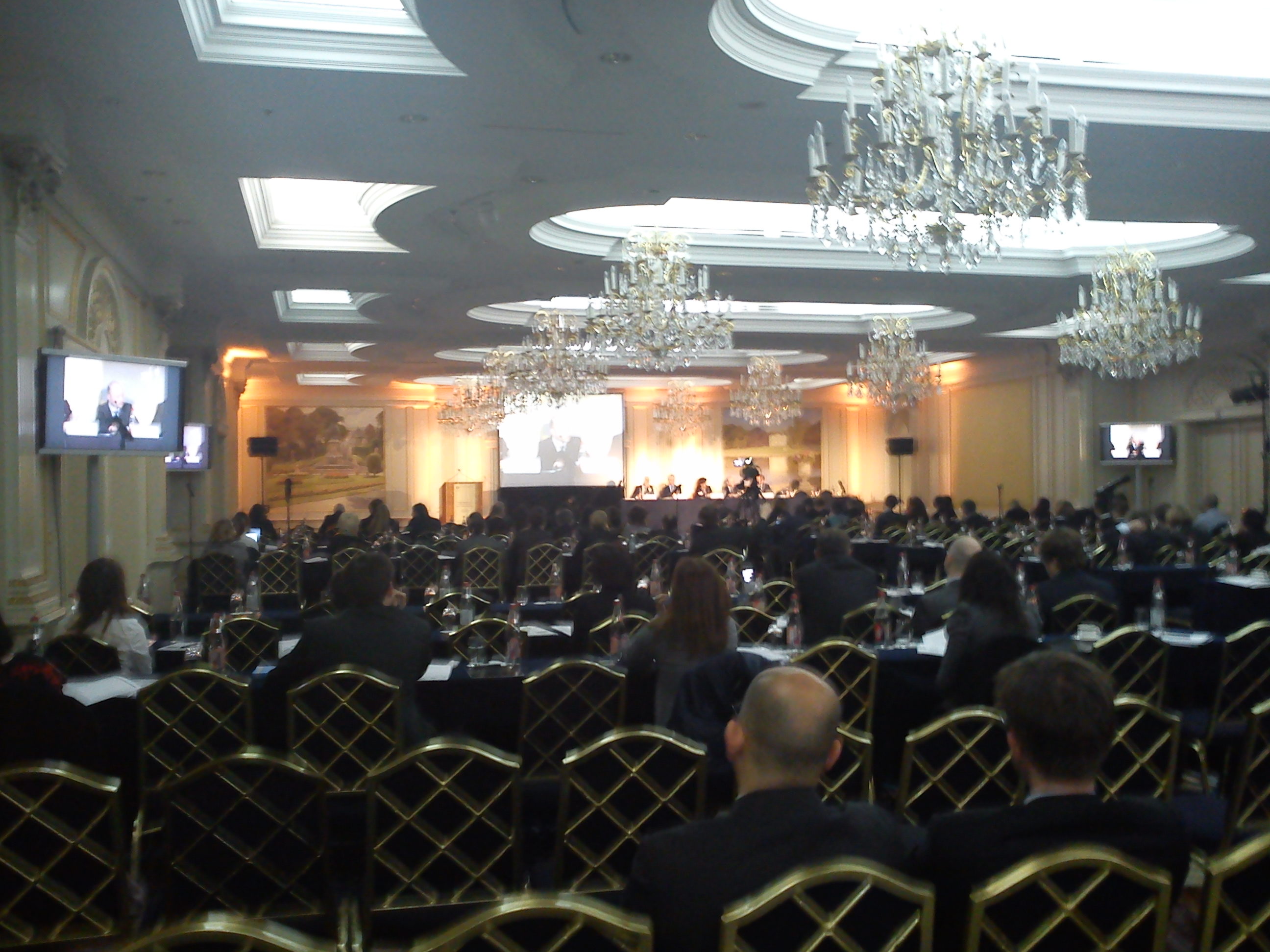
The above picture is proof that I eventually attended the expensive conference which triggered a post on price discrimination two days ago
And guess what: I made it for free :)… I belong to the happy few who got a free pass from a very important institutional player in the field (not a law firm).
More seriously, I understand my benefactor shares my concerns on (i) the pricing of such conferences; and (ii) on the necessity to entitle the little number of academics active in the field to participate to such events.
Now a teaser: the next big issue in the merger area relates to minority shareholdings. Is there a gap in the EUMR, and should it be closed? Commissioner Almunia referred to this issue in his speech, and I trust the Commission will start to do some thinking on this in coming months.
Many thanks again to my colleagues who helped me get a free ticket.
Information exchange=cartel?

Many have praised the inclusion of some guidance on exchanges of information within the new EU Guidelines on horizontal agreements. Personally, I agree with those arguing that guidance from the Commission was necessary, and I acknowledge that there are some useful (although arguably insufficient) orientations in the new guidelines. There is nonetheless an issue which may have not been adequately dealt with, and that I believe has very far-reaching implications. I´m referring to the idea of equating information exchanges with cartels (the title of the post probably gave you a hint):
Section 59 of the Guidelines states that “communication of information among competitors may constitute an agreement, a concerted practice, or a decision by an association of undertakings with the object of fixing, in particular, prices or quantities. Those types of information exchanges will normally be considered and fined as cartels“. No qualifications.
Sections 72-74 develop the idea: “Information exchanges betweeen competitors of individualised data regarding intended future prices or quantities should therefore be considered a restriction of competition by object. In addition, private exchanges between competitors of their individualised intentions regarding future prices or quantities would normally be considered and fined as cartels because they generally have the object of fixing prices or quantities”
– Where did this come from??
To my best knowledge (and please correct me if I´m wrong), information exchanges have only been treated by the EU Courts as cartels, or even as restrictions by their object, in two scenarios: (i) either they were an instrument intended to monitor or enforce a “proper” cartel; or (ii) they were conflated into a single and continuous infringement composed of various agreements and/or concerted practices pursuing a common goal (and, in practice, this situation generally arises where evidence is scarce and not enough to prove that the practice at stake was in its own right a cartel, or at least part of one).
That is, either they were purely ancillary to a cartel (first scenario), or they interacted with a wider agreement in the framework of a global plan having a single objective (second scenario). In other words, the European Courts have not validated the idea that stand-alone information exchanges shall be “considered and fined” as cartels.
In fact, it is significant to note that, unlike what happens in the rest of the document, no case-law is quoted in the Guidelines in support of these propositions (there is one cosmetic reference to the ECJ´s ruling in Glaxo, but it has nothing to do with the substance of what´s being discussed -it is cited as the source of the expression on the “legal and economic context”).
– Implications
Against this background, it is pretty clear that the legal approach towards exchanges of information has changed, and become wider and tougher. We´ve always lived with the idea that a thorough assessment of any information exchange was necessary prior to reaching any conclusion about its potential impact on competition, but apparently this isn´t so anymore.
The joint application of the ECJ´s Judgment in T-Mobile (which also enlarged the notion of concerted practices in an unprecedented and yet unclear way) with a wide interpretation of the statements contained in the Guidelines will certainly make it easier to label many things as a “cartel”. An example: if a company receives individual information on the future prices of its competitors it could be held liable for its participation in a cartel, even if it never used that information or even if the prices circulated amongst the competitors had priorly been given to their respective customers.
In practice, this opens the door for leniency applicants to come forward with evidence of information exchanges, and for the Commission to settle those cases under the procedure envisaged for cartels. With regards to sanctions, it means that companies that until now were participating in information exchange schemes have suddenly become members of a cartel, and are therefore subject to the huge fines, personal sanctions, and, in some jurisdictions, even criminal prosecution that is reserved for cartel cases.
– He who sows the wind will reap the whirlwind
The perils arising from such statement are not confined to the future decisional practice of the European Commission. After all, the European Commission is generally a very reasonable enforcer subject to the review of very reasonable Courts.
My main concern lies on the spill-over effects of the content of the Guidelines. The European Commission has a role as primus inter pares that carries with it a special responsibility. In this sense, it may not have been prudent to include this rather novel and ample statements because they run the risk of being overstretched by other enforcers. I fear that the Commission may be providing an “alibi” to enforcers willing to avoid the burden of undertaking sophisticated analyses. Hasn´t the Commission noticed that enforcement at the national level tends nowadays to automatically resort to the object category?
Justice Cardozo once warned about the dangers linked to legal principles expanding beyond the limits of their logic. This tendency not only applies to principles, but also to rules and, as acknowledged by Hovenkamp in his great book The Antitrust Enterprise , “in the short run rules weigh much more heavily than principles“. Considering that in the context of European competition enforcement system the statements included in the Commission´s guidelines automatically become quasi-rules for national competition authorities and courts, the risk of those statements expanding beyond the limits of their logic is blatant.
But the risk is not hypothetical. The Spanish Competition Authority adopted a decision last week in which it imposed a fine of 51 million euros on 8 companies active in the sale of hairdressing products for their participation on a stand-alone information exchange labeled as a “cartel” (even if the Spanish Competition Act contains a definition of the concept of cartel that is narrow enough to exclude many conducts that pursuant to an original interpretation of the Guidelines would consitute one).
Although I am unaware of the specificities of the case (my firm is not involved in it and the text of the decision has not yet been published) and it may well be that the exchange was a restriction of competition which deserved such a sanction, the press release already reveals that the risks to which I referred above are a reality.
Hold tight:
“It is established doctrine of the national and Community competition authorities that the exchange of information between competitors in relation to future information on prices and quantities amounts to a cartel and must be sanctioned as such”.
Let´s at least hope that the Commission becomes aware of these risks and decides to closely monitor the way in which other enforcers will interpret its guidelines.


 Chillin'Competition