Misc.

The winners of yesterday’s quizz are Anna and Alfonso. Here’s the source: B. Hawk, “Un tour d’horizon de la politique de la concurrence”, Cahiers de droit européen , 1992, n°5, p.1. I found the quote in one of my students (Mathieu Coquelet) dissertation.
I am currently reading students dissertations. I find this very stimulating intellectually. Two ideas came to mind in going through their papers:
- From an economic standpoint, the prohibition of RPM even at low market share levels makes some sense, because it allows price differenciation at the distribution level (e.g., distributors can efficiently price discriminate to serve more customers/recoup fixed costs more rapidly);
- What economic errors could give rise to compensation under Articles 268-340 TFUE ?: Saying that establishing tacit collusion does not require the proof of retaliation mechanism; using list prices rather than transaction prices to establish a finding of SIEC, whilst rebates are pervasive on the relevant market.
Testing your competition knowledge

Who said that the dual, bifurcated structure of Article 101 was the “original sin” of EU competition law?
Heard on the Grapevine
Our friend Pablo Ibanez Colomo was apparently appointed as a lecturer at the London School od Economics (“LSE”). TBC, but congrats already.
For those of you who do not know him, Pablo is a promising competition lawyer, who recently defended a Phd at the EUI in Florence. The subject of his Phd was: “European Communications Law and Technological Convergence. Deregulation, Re-regulation and Regulatory Convergence in Television and Telecommunications“.
Joke

Apologies to all my friends at the Commission who read this blog, but I thought this was just a good one:
“What is the difference with Terrorists and European Fonctionnaires?, Well with Terrorists at least you can negotiate”
A noteworthy precision: it is taken from a blog written by a Commission official.
(Image subject to copyrights: source here)
Teaser

Want to know why the EU’s commitment to fostering parallel trade is plain ideology?
Want to know why the Commission’s decisions in MSFT make no sense from an IO perspective, but are sound from a behavioralist standpoint.
Then read my new working papers here and here.
(Image possibly subject to copyrights: source here)
Upcoming events
- On 18 an 19 November, the city of New Dheli will welcome a “Global Competition Law Conference” entitled Implementing Competition Law and Policy, Global PerspectivesI. The conference organizers are I. Liannos and D. Sokol. For more on this, see programme here
- On 7 October, the GCLC will have its annual conference. This year’s edition is devoted to the role of the EU courts in competition cases. See programme hereafter.GCLC_-_Sixth_Annual_Conference_-_7_&_8_October_2010_-_Programme_and_Registration_Form
- On 23 September, the GCLC will have a lunch talk on the quantification of damages for antitrust infringements. Speakers are Judge Peter Roth (High Court – Chancery Division) and Andrea Lofaro (RBB econ). See registration form hereafter: Registration Form – 48th GCLC Lunch Talk – 23 septembre 2010
Back in Black
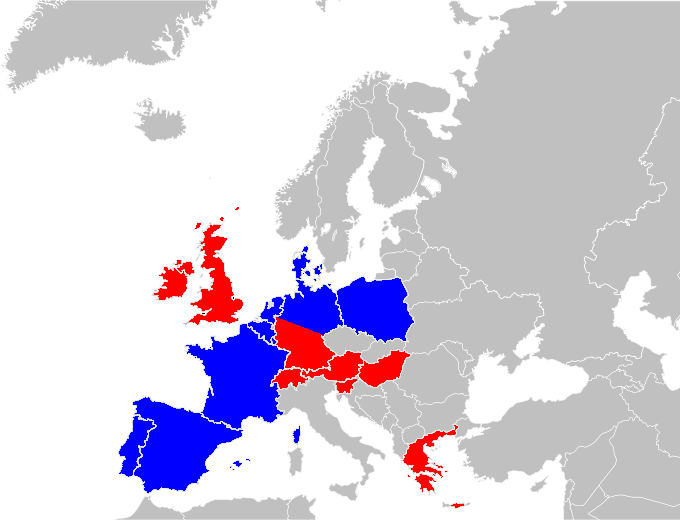
Back from hols with a sad story. During the summer, Theo Albrecht, one of the founders of the Aldi group – a sort of German Wal Mart – passed away.
Wikipedia has a full entry on Aldi. In addition to espousing the low-cost business model, Aldi has built part of its success on what seems to be a blatant market partitioning strategy. The Aldi group is indeed composed of two financially independent firms, Aldi Markt and Aldi Süd, which respectively serve northern and southern territories (see map above: Aldi Markt in Blue and Aldi Sûd in red). As explained in Wikipedia, the companies describe their relationships as a “friendly relation“…
Thanks to L. de Muyter for the pointer.
Break

I am leaving tomorrow on hols. Regular blogging will resume in early August. Thanks to all of you for the support, and for your interest in our postings.
And please mark your agendas for:
1. the GCLC annual conference, due on 7-8 October 2010 (see programme below).
2. the beginning of the BSC’s LLM in competition law and economics (on 1 October).
GCLC – Sixth Annual Annual Conference – 7 & 8 October 2010 – Programme and Registration Form
BTW: I have just posted a new working paper on ssrn.
(Image possibly subject to copyrights: source here)
Will Never Get Funds from the EU :(
The Commission has published today a call for projects in the context of its FP7 programme (i.e., the EU’s main instrument for funding research in Europe).
This thing is a bitter news for us legal academics looking for research funds. Under theme 8 (socio-economic sciences and humanities), only one topic is related specifically to law.
This bitter feeling only gets worse when looking at the selected topic: “Rule of Law and Justice in a Multilevel Governance System“. Although I do love legal theory, I hate jargon-driven, remote from practice research topics, and don’t believe this is the direction where the EU should direct its funds.
Take a bite at it and read the following summary of the research topic. Really disconcerting.
“Interdisciplinary research -drawing from law as well as sociology, political science, history or others- should address the implications of the Lisbon Treaty on the very identity and’actorness’ of the EU with regard to its legal personality and the impact of this on the work ofthe EU and its Member States. The integration of the Charter of Fundamental Rights into theTreaty and the new provisions of the Stockholm Programme must be taken into account.More broadly research could examine how the interaction between the Community method,intergovernmental decision making, and matters decided by national and EU parliaments,executives, courts as well as international bodies influence the legitimacy and theeffectiveness of EU policies. The impacts of the diversity of legal cultural traditions and bodyof law (e.g. common, civil or Islamic law tradition) on mutual recognition of judicialdecisions, the internal market, family law and many regulatory fields should also be assessed.The citizen’s point of view when faced with a multilevel governance system in the field ofjustice needs to be examined, as well as the implications of the Citizen’s Initiatives foreseen inthe Treaty. Different degrees and forms of ‘litigiosity’ –in terms of intensity of resort to legal suit- across countries, sectors and political and legal cultures in contexts ranging from economic regulation to consumer’s safety and the development of alternative disputes resolution could be assessed“.
New Notice on Verticals – Switzerland

Our good friend David Mamane has informed us that just a few weeks following the reform of the EU rules on verticals, the Swiss Competition Commission had published its own new notice on vertical agreements. The Notice outlines the basic antitrust rules applicable to the drafting and assessment of distribution agreements that relate to Switzerland. A number of rules have been brought in line with the new EU regime (e.g. the double market share treshold).
David’s law firm has published a short memo which nicely summarizes the content of the new notice (see attached document below).
Verticals Notice Newsflash Schellenberg Wittmer
(Image possibly subject to copyrights: source here)


 Chillin'Competition