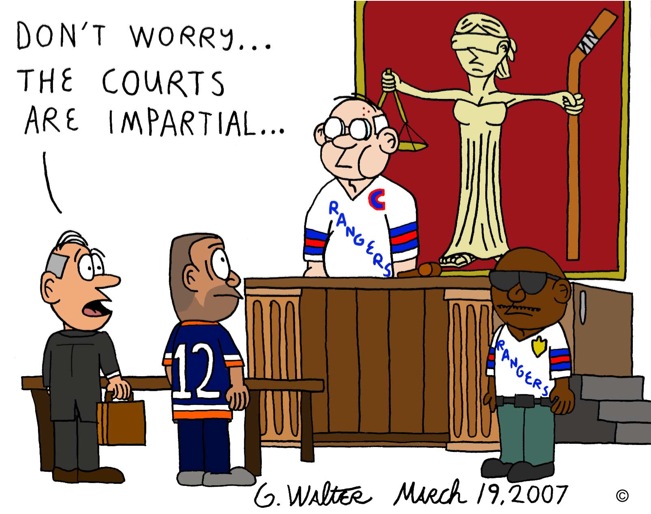
Anticompetitive partiality?

We have all heard people complaining about how a case turned out in a particular way due to the special relationship that the contrary party had with the decision maker (be it a judge or an administrative agency), but I suspect that categorizing that as an anticompetitive practice hadn’t crossed the minds of many of us.
Apparently it did occur to someone that fostering a good relationship with judges could amount to an anticompetitive practice. The Spanish Audiencia Nacional has issued a Judgment upholding a decision issued by the CNC in 2006 which shelved a complaint alleging that a Bar Association infringed the competition rules by paying judges to intervene at conferences and seminars organized by the Bar. The complainant argued that those judges could eventually be called upon to decide on cases on which the Bar itself or the members of its Board might be interested parties.
The legal basis for the complaint was a provision in the former Spanish Competition Act which targeted acts of unfair competition that significantly distort competition and therefore affect the public interest (the current Act retains a similar but amended provision). The alleged act of unfair competition is envisaged in Article 15 of the Unfair Competition Act, which provides that it is deemed unfair to obtain benefits from a significant competitive advantage obtained by illegal means.
The complainants firstly alleged that the retribution perceived by judges in exchange for their attendance to a given conference could compromise their impartiality. With respect to this claim, the Court responds that judicial activity is not an economic activity carried out in the market, and therefore cannot be reviewed in the light of the Competition Act.
Secondly, it was argued that the practice could have an affect on the market for legal services in as much as the attendance of judges to such conferences could create an impression upon clients that a particular lawyer is more trustworthy because of his ability to have built a relationship with judges over the course of those events.
The Judgment also rejects this second contention stating that in order for such practice to affect competition it would be necessary that (i) potential clients had a very extensive knowledge of the particular relationships between specific lawyers and judges; and (ii) the cases affecting those clients would fall under the jurisdiction of the said judges. The Court underlined that the parties had not put forward any evidence showing that such information existed on the market, nor had they provided examples of particular cases.
I certainly would never support applying competition law to this sort of conduct, and therefore believe that the Judgment is a sensible exercise of common sense. In fact, I would encourage fostering as much interaction as possible between enforcers and lawyers. It is a healthy way of exchanging viewpoints which can be enrichening for all: lawyers can convey their concerns to enforcers, and the latter are able to receive feedback and have the opportunity to publicly explain and debate their views without the constraints posed by formal acts. In this sense, enhancing communication results in benefits to the functioning of the system. In addition, I very much doubt that in most instances an enforcer’s independency could be undermined because of their attendance to a conference or seminar.
Nonetheless, reading the Judgment I couldn’t help wondering whether some aspects of the reasoning put forward by the Audiencia Nacional are truly applicable to the little and idiosyncratic world of competition law to the same extent as they are to other areas. Don’t get me wrong; it’s not that I believe there’s anything wrong with how things are done in our field; my point is that the Judgment’s reasoning departs from an assumption regarding legal markets that highlights the difference of niche areas of practice, and particularly of ours:
Competition is surely one of the areas of law practice where there is a greater interaction between enforcers, lawyers, economists, academics, and even clients. It is a somehow narrow and certainly specialized area, and its enforcement has traditionally been entrusted to specific authorities located in a handful of cities (most relevant EU Competition law cases are still dealt with in Brussels).
All those factors mean that not only are we relatively few people working on these issues (which explains the astonishing cult of personality that exists here in comparison to other areas of law), but also that enforcers and lawyers or economists on the other side of the table are in constant interaction: many are friends or have very similar backgrounds: some have probably studied together, some others have worked together, and in many instances people’s lives take place in the same communities.
In this context, it is not rare for lawyers and officials to write books or articles jointly, and it is all the more common to attend conferences or seminars together. Accordingly, contrary to what the Audiencia Nacional assumes to be standard market circumstances, in our field many potential clients do have a “very extensive knowledge of the particular relationships between specific lawyers and judges”, and “the cases affecting those clients would fall under the jurisdiction of the said authorities”.
Does this affect the perception clients have of their lawyers? Sure it might, and in fact it’s one of the main marketing tools for some law firms. Does this mean that fostering interaction with judges or competition authorities is an anticompetitive practice? Surely not, but because of different reasons to those stated in the Judgment above. Is it unethical or morally/professionally reprehensible? Not at all provided that deontological boundaries are effectively respected and appear to be respected (Caesar’s wife must be above suspicion). Should lawyers ‘sell’ clients their good relationships with enforcers? I don’t see the problem provided that it is done prudently: a lawyer may sell the fact that he’s respected in the legal community since clients will surely appreciate having a lawyer perceived as trustworthy by people on the other side of the table, but it could be imprudent on the part of the lawyer to imply more than that, and naive on the part of the client to think that an enforcer might adopt a different stance towards matters defended by lawyers with whom they have a closer relationship. One can understand suspicions on the part of contrary parties, but at the end of the day, it all comes down to having a little more faith on the enforcers.
(Image possibly subject to copyrights: source here)
2.0
 Derecho de la competencia has upgraded. see http://lalibrecompetencia.com/
New design, new name and more contributors from different jurisdictions of Latin America:
In addition to Juan David, Ignacio de León (Venezuela, Queen Mary U. of London),Pablo Márquez (Colombia, Harvard U.and U. of Oxford), Victor Pavón Villamayor (México, U. of Oxford), Javier Tapia (Chile, U. College of London), Leopoldo Ubiratan (Brazil, LSE and U. of Sao Paulo) and Natalia Barrera (Colombia, U. Javeriana), have joined the venture.
Just Published: OGEL Antitrust Special

OGEL 1 (2010) – Antitrust in the Energy Sector (February 2010)
OGEL, the global Oil-Gas-Energy Law Intelligence service. OGEL focuses on recent developments in the area of oil-gas-energy law, regulation, treaties, judicial and arbitral cases, voluntary guidelines, tax and contracting, including the oil-gas-energy geopolitics. — www.ogel.org
A new issue has been published and can be found at www.ogel.org
This Antitrust in the Energy Sector special was prepared for OGEL by Prof. Nicolas Petit of the University of Liège (Belgium). This issue addresses the challenges arising from the implementation of the antitrust laws across various energy sectors.
EDITORIAL
- OGEL Special Issue – Antitrust in the Energy Sector
by N. Petit, University of Liège
A publication, an information and an explanation

My paper on competition authorities’ enforcement discretion has just been published in Concurrences. Amongst the various papers I published to date, I am really proud of this one. The reason? It embodies all the things which make research, and academic life, a thrilling job:
- It forced me to conduct research on a largely unchartered topic, and to propose an original – at least I believe – conceptual framework;
- I benefited from strong empirical input received from more than a dozen national reporters;
- The LIDC annual congress – for which I prepared the paper – was a great moment in a wonderful town. I met loads of fascinating people during the congress;
- We eventually managed, on the basis of this paper, to draft public policy proposals, which were eventually sent to competition authorities.
As to the information: the next LIDC congress will take place in Bordeaux (France), from 30 September to 3 October. To all those interested in learning how competition law and a Lafite Rotschild combine, I recommend the conference. A specific website has been created to advertise the conference.
Finally as the explanation: the past days have been increasingly busy. This explains the belated posting activity on the blog.
Conference – Google Book Settlement – 12 February 2010
We still have several seats for the conference on the Google Book Settlement next week! A new version of the programme is attached below.
IEJE-St Louis – Conference – Google Book Settlement – 12 February 2010
P. Pescatore

With great sadness, we learned yesterday that Pierre Pescatore passed away. P. Pescatore was a former Judge at the European Court of Justice, Professor at the University of Liege (ULg) and co-founder of the Institute for European Legal Studies (IEJE). With his death, the legal community loses one of the building blocks ofEuropean law. P. Pescatore, who helped drafting the 1957 EC Treaty personified what we generally label the “founding fathers“. Our thoughts and condolences go to Prof. Pescatore’s family.
Competition Law and Sport (I) – American Needle v. NFL

A few days ago, shortly before its infamous and dangerous ruling in Citizens United, the US Supreme Court heard the oral arguments in American Needle v. NFL. American Needle is the latest antitrust case to have made it to the Court’s docket, and it has the potential to be the single most important decision in the history of sports law in the US.
The application of competition law to the sports sector is a fascinating theme yet to be fully explored in Europe and which, moreover, has been haunting me for a while now. I will therefore develop some reflections on this topic in soon to come posts, but for the time being American Needle seems a very good starting point.
The facts in a nutshell: American Needle, a manufacturer of sportswear had traditionally enjoyed a non-exclusive license to manufacture and distribute products including NFL’s teams names and logos. In 2000 the NFL changed its policy and decided to grant a exclusive license to Reebok. American Needle responded by challenging the agreement between the NFL and Reebok on the grounds that it violated Section 1 of the Sherman Act.
The applicability of antitrust law to exclusivity arrangements in the sports sector is not a novel issue, and similar claims have arisen regarding sports equipment standards. However, the debate at stake in American Needle goes well beyond a mere contractual dispute and has more profound implications.
Part of NFL’s defense consists in arguing that sport leagues constitute single entities, which pursuant to the Copperweld doctrine, would imply that no agreement (“contract, combination or conspiracy’ in the sense of the Sherman Act) can be found within the said leagues. The NFL’s argument brings to the fore an interesting debate: given that Copperweld’s single entity doctrine relates to the relationship between a parent company and a wholly owned subsidiary, could such doctrine be applied to sports leagues? How divergent are the interests of the members of such peculiar organizations? Can a league be deemed to be a single entity only with respect to certain aspects of its functioning?
In the past, the applicability of the single entity argument with regards to sporting leagues had been rejected practically every time it was brought up before a Court. However, in American Needle the 7th Circuit adopted a new stance by accepting the NFL’s arguments and declaring that this is a matter that “should be addressed not only one league at a time, but also one facet of a league at a time”. This statement was used for the purpose of affirming the District Court’s decision, which had held that the fact that teams had traditionally licensed their trademarks jointly through a company called NFL Properties meant that on this particular aspect they acted as a single entity. Such reasoning raises an interesting question: is a traditional business practice enough to determine that franchises within a league do form a permanent single-entity? How integrated must the conduct of the members of a joint venture be in order to exempt them from potential antitrust liability by virtue of the single entity doctrine?
Moreover, as a way to support the proposition that the NFL acts as a single entity regarding licensing of trademarks, both the District Judge and the 7th Circuit emphasized the efficiencies arising from joint licensing. Once again, this argument seems flawed: there are other markets where joint licensing/selling is common and generates efficiencies, but it doesn’t follow that those efficiencies justify granting single-entity status to the ‘intermediary’. On the contrary, the fact that efficiencies may arise is precisely what determines that such practices are to be subject to a rule of reason analysis instead of to a per se rule, and is a key factor to be considered when engaging in that analysis (see BMI v. CBS).
The approach of focusing closely on the competitive impact on the restraint rather than on the single-entity issue seems more appealing to me. Such approach was used by the 1st Circuit in Fraser v. Major League Soccer, an opinion written by Judge Boudin (which, by the way, served as inspiration for his exam at Harvard last semester). An opinion authored by Justice Sotomayor before being appointed Supreme Court Justice (Major League Baseball Properties v. Salvino) also implicitly undertook a similar approach.
A reading of the transcripts of the recent hearing suggests that the Court may be inclined to accept the Solicitor General’s view, grounded on the precedent in NCAA v. Board of Regents, that leagues may be entitled to single-entity treatment with respect to the issues where cooperation is required to organize the essential aspects of the league’s operations, but not in relation to additional business activities such as licensing of trademarks.
As illustrated by the number of amicus curiae briefs submitted to the Supreme Court, the stakes are very high. If the NFL’s argument were upheld, that would bring about radical changes in the way professional sport in the US now operates (for instance, collective bargaining agreements to deal with issues such as salary caps for players wouldn’t be needed in order to immunize the agreement from antitrust scrutiny), and even possibly in the manner in which the Sherman Act is applied to certain joint ventures.
The Court’s ruling is expected by late June. In the meanwhile, for a couple of very good articles analyzing the case and its possible implications, see here and here
(Image possibly subject to copyrights: source here)
First Issue of the ECN Brief

This brief brings an appropriate response to some of the flaws which were identified during the review of Regulation 1/2003. At first glance, the first brief contains plenty of useful information on the activities of National Competition Authorities. It will be published five times a year. A subscription service is available here.
Thanks to Sonia Jozwiak for the pointer (and congrats to her as well as her colleagues who have brought this useful project to life).
BEREC

A new creature is born : since 28 January 2010, the Body of European Regulators for Electronic Communications (“BEREC”) is formally and operationally part of the EU institutions’ food chain.
See here for the Press Release and here for more information.
Thanks to E. Provost for the pointer.
(Image possibly subject to copyrights: source here)
Revelation

The brilliant, prolific, US judge and scholar Richard Posner recently had a revelation. See here. Not a philosophical U-turn, but close.
Found on D. Gutierez’s blog.
(Image possibly subject to copyrights: source here)


 Chillin'Competition