Predictably Irrational – Behavioral Economics and Competition Law

I’m currently reading Predictably Irrational, an extremely interesting and thought provoking book on behavioral economics. It challenges traditional assumptions regarding, amongst others, price theory and rational profit maximizing behavior, precisely the tenets of economic thinking that underpin competition law’s design and application.
The subject of the possible uses of behavioral economics for competition law purposes remains largely unexplored, even if now seems to be on the rise. Nevertheless, the controversy over the validity of rational choice theories is by no means new. Challenges to such theories have been rebutted in the past, sometimes brilliantly and even humoristically, by some of the most prominent antitrust scholars:
Skimming through ‘The Antitrust Paradox‘ I came across Bork’s dismissal of the objection that business are not purely, or even primarly, rational profit seekers. Bork argues -quoting Friedman- that price theory does not require the assumption of effective profit maximizing behavior, but rather that firms ‘generally behave as if they were engaged in maximization. But, in addition, he has a somehow more interesting argument when he states that:
‘[i]f required I should not hesitate to impute conscious profit maximizing to businessmen -experience with businessmen, and even more, with antitrust lawyers and consulting economists should convince anyone that profit is a goal not only consciously but constantly borne in mind‘.
(There we are, us, poor innocent antitrust professionals, turned into the quintaessential rent seekers….)
This notwithstanding, this book on behavioral econ. certainly has a valid point. Whilst behavioral econ. is ill-suited to replace rational choice theory as the theoretical framework for competition law, this rising discipline can surely contribute to raise our awareness about the existence of unavoidable flaws in traditional analysis.
Moreover, there are surely some direct applications of behavioral economics which could be useful for competition law purposes. Let’s illustrate this through a few examples.
First, behavioral econ. may help identify systematic biases or deviations from rational prescriptions which would aid in determining whether in some instances firms are more or less likely to engage in non-profit maximizing strategies than we generally tend to believe (e.g. predatory pricing when recoupment is unlikely).
Also, some studies aim at explaining why ‘overconfident entrants’ may decide to enter into a given market ignoring unfavorable conditions and high barriers and therefore tipically fail in their attempt (if that were so, then reliance on entry rates to qualify market power should be replaced by the sole study of successful penetration).
Another possible use of behavioral econ. relates to ex post assessment of predictions on the effect of mergers. Competition authorities could increase their efforts to empirically evaluate ex post how accurately economic models used in merger control predict the effects of mergers in order to explore whether systematic deviations might also take place. I understand that US authorities are starting to follow this path (after all, the laxity of the Bush administration in the area of merger control provides for a favorable environment for such exercise), but I am not aware of such developments in other jurisdictions.
Finally, the possible uses of this disciple in the area of competition law must not necessarily be confined to analyzing why businessmen and firms engage in irrational behavior; it would surely be interesting to study when and why competition authorities behave irrationally.
(Image possibly subject to copyrights: see here)
Slides of Today’s GCLC Lunch Talk, and Some Remarks

I attach below the slides presented at today’s lunch talk on State Aid and the Financial Crisis.
Thanks to C. Caffarra, C. Ahlborn, D. Piccinin for their stimulating presentations.
According to a speaker at this event, one of the remedies imposed in the Fortis decision implies something close to a Commission-sponsored retail cartel. On the facts, the point may be valid, but is not that straightforward. The remedy is as follows: “Predatory pricing on the retail deposit market is… prohibited“. This, in essence, seeks to preclude the risk that the otherwise failing bank initiates a price war thanks to tax-payers money, and ends up forcing out healthier firms from the market. On face value, this makes a lot of sense, even though this leads to prohibit under Article 87 EC something that would not be as such prohibited under Article 82 EC, absent dominance.
Now, if I understand correctly, the cartel problem likely originates from the fact that the Commission has also imposed this remedy on other Belgian banks that have benefited from public subsidies (e.g., KBC), as a result of what the remedies might, altogether, have the cumulative effect of chilling competition.
Workshop on Competition Policy and Sector Specific Regulation in the Electricity Sector

The GREDEG-CNRS, OFCE and Gis LARSEN organize this Friday in Nice (France) a high level workshop on competition policy and regulation in the electricity sector. See programme below. Frederic Marty (GREDEG and CNRS) has invited me to talk about collective dominance.
I seize this opportunity to indicate that one my three research projects this year will consist in trying to apply the findings of my Phd on Oligopolies, Joint Dominance and Tacit Collusion in a sector-specific, empirical, fashion. My first target is the energy sector (electricity and gas). My assistant, Norman Neyrinck, and I, are currently drafting a paper on this. I have one or two ideas re. next targets, but it is too early to tell. Stay tuned.
Journée OFCE LARSEN elec market definition
(Image possibly subject to copyrights. Source here)
Lapsus

The Commission’s prosecutorial bias in official writing… I did not immediately notice, but this is undeniably a big, important, mistake.
At § 12 of its Guidance Communication on its enforcement priorities in applying Article 82 to abusive exclusionary conduct by dominant undertakings, the Commission explains the objective methodology that it will follow to assess dominance.
Read carefully:
The assessment of dominance will take into account the competitive structure of the market, and in particular the following factors: • constraints imposed by the existing supplies from, and the position on the market of, actual competitors (the market position of the dominant undertaking and its competitors);
Read again:
The assessment of dominance will take into account the competitive structure of themarket, and in particular the following factors:• constraints imposed by the existing supplies from, and the position on the market of, actual competitors (the market position of the dominant undertaking and its competitors);
In other words, the Commission pretends it will systematically review whether there is dominance, but meanwhile implies that this three stages approach is entirely redundant, because it has already reached this finding. A strong candidate for the 2009 worst antitrust law prize?
Resolution
![MCj03230910000[1]](https://chillingcompetition.com/wp-content/uploads/2009/10/mcj032309100001.gif "MCj03230910000[1]") Another post related to what happened last week in Vienna. Had no time to report on this before.
Another post related to what happened last week in Vienna. Had no time to report on this before.
As some of you may know, each year, the LIDC adopts resolutions on a competition-related issue. In so doing, the LIDC seeks to call the attention of the decision makers to certain issues of importance for the competition law community.
This year, the LIDC had chosen to deal with the issue of the competition authorities’ discretion in the context of the investigation of competition law proceedings.
Importantly, the LIDC’s resolutions are adopted pursuant to a lenghty, representative, process, which starts very early in the year at the national level: in each member state, groups of competition experts representing not only private practice, but also academics, in-house counsels and national competition officials, appoint a national reporter who is entrusted with the duty to draft a comprehensive national report. Once the national report is approved by the national group, it is sent to an international reporter who attempts to synthetise the data and to identify points of convergence/divergence amongst national jurisdictions. Where there is too much divergence or no common position, the international reporter can make spontaneous proposals on selected issues. The international report is presented at the LIDC annual conference. A large debate takes place between national groups, the international reporter and the General LIDC reporter (the person in charge of all scientific activities in the organization: this year Jean Louis Fourgoux). Eventually, this leads to the adoption of resolutions that are subsequently sent to competition enforcers.
A primer: this year’s resolutions can be found below.
Please note that next year, the conference will take place in September in Bordeaux (France). The topic is resale price maintenance and the exchange of price information through vertical relationships. The International reporter is Elisabeth Legnerfält, from the law firm DELPHI (Sweden). Nice region, nice topic and bright international reporter. A promising event.
Anti-Monopoly
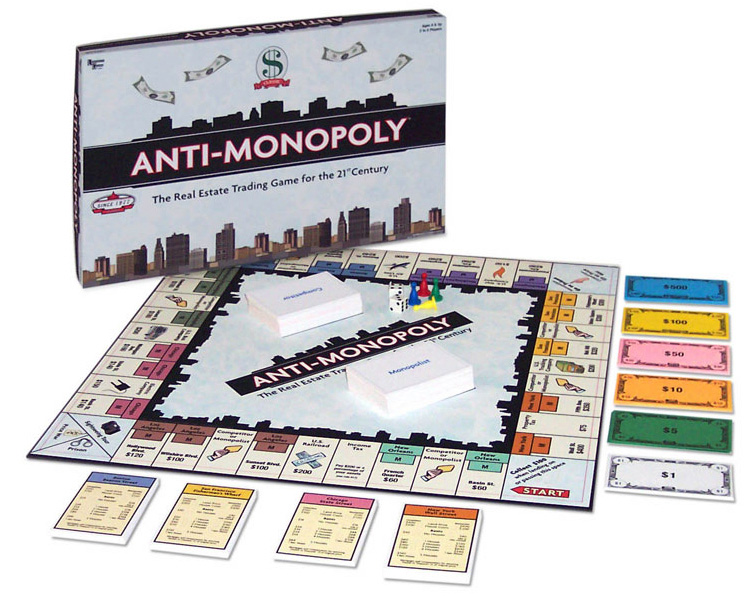
As anticipated in previous posts, we continue feeding up a ‘leisure time for competition geeks’ section.
This post is about a board game, ‘Anti-Monopoly’, a different version of ‘Monopoly’ with an ‘anti-monopolistic’ theme.
In Anti-Monopoly®, players play either by or competition rules fixed at the beginning of the game:
COMPETITORS … charge fair rents, build as soon as they own a property, put five houses on their properties and occasionally go to Price War.
MONOPOLISTS… extort monopoly-high rents from their poor tenants, build only after they have monopolized a color grouping, restrict supply by putting only four houses on their properties and occasionally go to Prison.
The good guys are the small business entrepreneurs and the bad guys are the monopolists. Since players do not play by the same rules, fairness is achieved by a patented probability technique, has given each side equal chances to win.
OBJECT OF THE GAME: To be the richest competitor after all monopolists have been bankrupted or to be the richest monopolist after all competitors have been eliminated.
There is actually a great deal of controversy surrounding the creation of the game, which includes a 10 year long legal battle between the creator of Anti-Monopoly (Ralph Anspach) and the owners of the ‘Monopoly’ trademark. After more than 37.000 copies of ‘Anti-Monopoly’ were destroyed pursuant to a District Court’s order which found a trademark infringement in the use of the word ‘Monopoly’, the 9th Circuit Court of Appeals ruled in 1979 that the trademark ‘Monopoly’ was generic and thus unenforceable. Nonetheless, this wasn’t the end of the story. Soon after the 9th Circuit’s decision, the US Congress amended the Trademark Act to protect longstanding marks against generic claims, thereby allowing Hasbro to assert again its rights to the mark ‘Monopoly’ and its variants.
A settlement was eventually reached and the game is now marketed under a license from Hasbro.
For more info on the game as well as on the underlying legal story, click here
Thanks to Anne Dostert for the pointer (and indirectly to Scott Hemphill, from Columbia, who apparently has a copy of the game in his office) .
Did we chill competition?

See here. We were a few days ahead on this story.
It is quite well known that competition in the news market is not primarily about price, but almost equally about being the first to report a news. And even on price, our stories are freely accessible…
Bloggerhood
 A fellow blogger, Juan David Gutierrez from Derecho de la competencia has asked me to post on this blog the following research proposal:
I am conducting a research on the Latin American antitrust community as part of the investigation projects of the Competition Law Study Center (CEDEC) at U. Javeriana in Bogota. In particular we are interested in studying how competition law is taught in our region and the impact of Universities in the development of competition law.
To this end, we are collecting information regarding courses on competition law and policies (and related areas, such as industrial organization and regulation) in Latin America. I published a first draft in the “Boletín Latinoamericano de Competencia” N°26, (titled “La comunidad académica y la defensa de la libre competencia: Bases para una propuesta en América Latina”) which explains the rationale for the research topic and academic proposal.
We hope to collect more data with the help of Latin American Universities, professors and practitioners. The information per course that we require is the following:
- University’s name.
- Geographical location of the University.
- School or department that offers the course (law school, economics, management).
- Title of the course.
- Type of course. Undergraduate (mandatory or optional), Graduate (specialization, masters or Phd) or a short course (seminar, certificate, etc:).
- Course length and class hours per week
- Teacher’s name and e-mail.
- Teacher’s academic experience and studies.
- Syllabus (subjects studied during the course) for each course.
- Number of students (average or per course)
- Since when it has been taught.
- Periodicity of the course. (once every two years, once a year, twice a year, monthly, etc).
- Additional information. Website, events, publication, concluded researches or on going, etc.
I cordially invite to send us the information, to the following e-mail addresses: jdg@cable.net.co and cedec@cable.net.co
All the data collected will be made available at http://derechodelacompetencia.blogspot.com/. Once the information has been processed, we will get in touch with all those who participated in the research in order to share the results and strengthen the bonds between them.
Recent Output

- A French Competition Commissionner? The results of our poll are as follows. Out of 45 votes, 21 readers voted for C. Lagarde, 12 for N. Kroes (in spite of clear signals that she will not stay in charge) and 7 for V. Reding. (Image source here)
- My assistant and I have co-authored in La Libre an Op-Ed on the Lisbon Treaty and the failing communication strategies of our political leaders when it comes to European affairs (in French).
- Dr. Theodor Thanner (Director of the Austrian NCA) and I, last week in Vienna:

- To date, we have received a few, robust, submissions for the latest antitrust law development prize. Please do not hesitate to send yours.
- I just received the latest edition of competition law international (the journal of the antitrust committee of the IBA). It comprises a collection interesting papers by antitrust enforcers (Varney, Leibowitz, Lasserre, Badin and Krasnodebska-Tomkiel)
Spanish Court of Appeal strikes down CNC’s Inspection Practices

The Audiencia Nacional (‘AN’) – i.e. the Spanish Court in charge of the review of acts and decisions adopted by the Spanish National Competition Commission (‘CNC’) – recently delivered an important judgment quashing some of the CNC’s investigatory practices, which had elicited a great deal of controversy over the past few months.
Background: In a raft of recent cases, the CNC investigatory branch made use of the new investigatory powers provided for under Competition Act 15/2007. Those cases triggered a stern opposition from the legal community, which voiced that the CNC’s inspections might have deviated (i) from the standards set out by the ECJ in relation to inspections under EC competition rules, as well as (ii) from the limitations imposed by Spanish Courts with regards to police/and or administrative inspections, thereby breaching the rights of defense of the inspected undertakings. Disregarding the criticism, the CNC’s Council nonetheless adopted a number of decisions supporting the interpretation of the CNC’s Investigation Directorate.
The judgment: the AN’s Judgment originates in an appeal against one of those decisions. In essence, it can be summarised as follows:
1) The Court observes that many of the documents obtained -collected pursuant to the copying of computer hard drives- are unrelated to the sector under investigation as identified in the mandate as well as in the judicial authorization granted to the CNC, and therefore cannot be deemed to be covered by them. Consequently, the Judgment declares that there was a breach of the right to inviolability of the domicile of the undertaking inspected.
2) As to the consequences of the said breach, the Court rejects the claim that the whole inspection should be declared void. Instead, it holds that the documents related to the subject matter of the investigation did fall within the scope of the mandate and of the judicial authorization and were thus lawfully collected, and orders the CNC to return all other documents.
3) The Judgment affirms the rights of firms subject to an inspection to have access to the search criteria used to retrieve information stored in hard drives (allegedly no search criteria had been used in the inspection at stake).
4) The AN dismisses the claims related to the alleged violation of legal privilege arguing that the CNC has merely collected possibly privileged documents but has not made use of them.
5) The arguments related to a possible breach of the rights to privacy of correspondence of the undertaking’s employees are also dismissed on the basis that the inspection was not aimed at collecting such documents. Accordingly, the Court holds that any extra-limitation with regards to employee’s private documents stored in computers located at the undertaking’s premises must be subsumed within the breach of the rights of the undertaking inspected.
In my view, this is a most welcome judgment if only because it narrows the gap between the standards applied by the CNC and those of the European Commission.
However, the non-conformist lawyer that sleeps inside me has a couple of comments:
– First: the AN’s argument that there cannot be a breach of the rights of defense unless privileged documents are effectively used as evidence seems to be at odds with the ECJ’s ruling in Akzo with regards to the ‘cursory glance’ practice.
– Second: in this case, unlike in a number of other recent ‘dawn raids’ in Spain, the subject matter of the investigation had been clearly defined in the mandate as well as in the judicial authorization. Both identified the specific conduct under investigation, the product and geographic market affected, as well as the years during which the agreement was thought to have been implemented. Nevertheless, for the purpose of determining which documents can be deemed to be comprised within the scope of the mandate, the Judgment prescinds of those and merely takes into consideration whether it is related or not to the sector under investigation without any further qualifications, which is arguably still a wide criterion.
See below for link to the judgment.
(Image possibly subject to copyright. Source)


 Chillin'Competition