The Old New Competition Tool ?

For around 10 years (between 2004 and roughly 2014) the competition community spent countless hours discussing how commitment decisions could pursue stretched theories of harm and obtain remedies that went well beyond what would have been possible in standard infringement decisions. By the way, I gave an overview of all this in this 2014 presentation (Lamadrid- Overview of competition decisions).
Commitment decisions (after Alrosa) probably made us all think that intervention under competition law could reach where it had not reached before. The Commission was able to intervene very effectively in many markets with forward-looking, far-reaching remedies agreed by the parties. This improved the functioning of many markets and arguably reduced clarity in the law. We became accustomed to remedies that were not necessarily proportionate to the concerns triggering investigations.
In the past few years, however, recourse to commitment decisions has become relatively rare. A positive aspect of the new enforcement trend was that infringement decisions and subsequent Court judgments would provide greater clarity on the law. Perhaps we did not anticipate that greater clarity as to where real boundaries lie might also lead to frustration which, in turn, would propel calls to replace the law and bypass Courts, but that is another story (or is it?)
Coincidentally, as the use of commitment decisions started to decline, the debate completely shifted. We suddenly discussed less about the far-reaching scope of competition law, and more about the alleged insufficiency of competition law. There may not be causality, but there is certainly some correlation. [Btw, it’s amazing how the world, incluiding competition law, has changed in these past 6 years].
One of the main reasons that made Art. 9 commitments less popular is that they could not lead to the imposition of fines, let alone huge fines. But, contrary to what used to be the case, proponents of more aggressive antitrust enforcement now argue that large fines are meaningless and don’t do the job, and that it’s only remedies that matter. From this perspective, at least, perhaps commitment decisions did the trick after all?
Others, including myself, were not necessarily in favor of commitment decisions becoming the standard enforcement tool because that would lead to all actors operating in the shadow of the law, not really knowing what the real law was. Commitment decisions, however, were case-specific, evidence-based, preliminary assessments, followed existing procedures and entailed a somewhat “participative” process, including negotiations with the affected companies and market tests). The Commission was also very smart in using commitment decisions while ensuring legal certainty in parallel infringement decisions (see e.g. the Samsung and Motorola decisions on SEPs, or the Visa and Mastercard decisions on MIFs). One could argue that commitment decisions already addressed some of the concerns voiced out against the new tool under consideration (a single instrument combining the NCT and the ex ante regulatory instrument).
Some might also argue that commitment decisions were also too slow. But were they? It would be interesting to explore the reasons why some cases dragged on for longer, and whether that may have been related to external factors and third-party strategies.
It might also make sense to spend some time negotiating remedies in advance, rather than impose impractical remedies that might then need to be continuously reviewed and updated. As the Commission itself explained, “due to the more consensual mode of concluding the case, the commitment path may result in more efficient proceedings and more effective remedies; it allows for a more fine-tuned tailoring of the commitments and swifter implementation”. In a way, this was participatory antitrust avant la lettre.
Be that as it may, the welcome revival of interim measures should dispel or alleviate timing concerns. The recent Broadcom case is the perfect example.
The history of EU enforcement under Article 9 is, from the authority’s standpoint, an unquestionable story of success. It allowed for rapid, strong and far-reaching intervention subject to fewer constraints than in standard cases. By the Commission’s own admission, having companies give their views in the process also ensured that remedies were workable and reduced the risk of disproportionate / undesired outcomes. Perhaps commitments were not entirely satisfactory for anyone (authorities and rivals could want more, affected companies would want less) but that is probably why the tool resulted in an equilibrium that worked well. Commitment decisions did require the Commission to show that it could build a prima facie credible case (credible enough, at least, to force a company to make concessions to avoid the risks and harms that come with prolonged investigations), but that was not a problem, rather a safeguard to mitigate discretion.
Take a look again at the theories of harm pursued in Art. 9 cases and at the remedies that the Commission was able to obtain (summarized in slides 6-7 of the 2014 presentation). Does it feel like there was an enforcement gap? There also does not seem to be any dissatisfaction as to the outcomes that were secured by virtue of commitment decisions.
The Commission’s successful intervention in the Broadcom case shows that commitment decisions (combined with interim measures in the face of genuine risks of irreparable harm) could actually be the old new competition tool that many were looking for. I guess sometimes we want new things, perhaps forgetting that what we already have might be even better.
[Disclosure: I have no professional interests in, and no detailed knowledge of, the Broadcom case. I do have clients that could be affected by the new digital enforcement tool under consideration (full disclosures are available in my posts on those, see notably here). Like practically all competition practitioners, I also have a very large number of clients that could be potential addresses of commitment and/or interim measures decisions].
Remedies in Google Shopping: a JECLAP symposium with Marsden and Graf & Mostyn

It is remarkable that the remedies in Google Shopping, a case that was decided more than three years ago, are still being discussed. As you certainly remember, the Commission chose a ‘principles-based’ approach that did not specify a particular way to comply with the decision.
Complainants argue, to this day, that Google’s implementation of the neutrality obligation mandated by the Commission does not respect the principles outlined in the decision.
It is against this background that the Journal of Competition Law & Economics is proud to feature a mini-symposium on the matter.
One of the papers – ‘Google Shopping for the Empress’s New Clothes –When a Remedy Isn’t a Remedy (and How to Fix it)’ – was prepared by Philip Marsden. As disclosed by Philip, the piece is a spin-off of some research he undertook for one of the complainants in Google Shopping.
The second paper – ‘Do We Need to Regulate Equal Treatment? The Google Shopping Case and the Implications of its Equal Treatment Principle for New Legislative Initiatives’ – was prepared by Thomas Graf and Henry Mostyn, who represent Google in the case (as is well known and disclosed).
The two papers are currently behind a paywall but we are looking, at JECLAP, to making them available free of charge soon.
If you ask me, the key takeaway about this debate is the very fact that it is taking place and that the remedy is still in a limbo over three years since the adoption of the decision.
Contrary to what has sometimes been suggested, this state of limbo is not a bug. It is an integral feature of proactive intervention in digital markets. Redesigning products and altering business models is complex, prone to errors, and does not have an obvious end in sight (once down this road: where to stop?).
I certainly do not see this case as a one-off or an aberration, but a sign of the challenges to come under the new competition law. As I mentioned at a conference a few weeks ago: in digital markets finding an infringement is not the end, it is just the end of the beginning.
Enjoy the papers!
Democracy and Equality: on the US Supreme Court and the role of judges
The US Supreme Court has been all over the news recently. Unfortunately, this was so because of the passing of Ruth Bader Ginsburg, a most remarkable figure whose reputation and achievements were admired outside the legal world and whose legacy will inspire many.
If it precisely because of legal minds like Ruth Bader Ginsburg that the US Supreme Court is, and has always been, a fascinating institution. As I was reflecting on her passing and the implications, I was immediately drawn to a book published earlier this year and which I read during the worst of the lockdown.
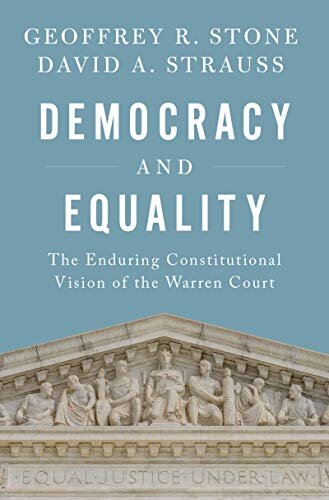
The book is called Democracy and Equality and is published by two renowned US constitutional law scholars. I very much recommend it if you feel like venturing outside competition law: it is particularly well written and accessible; more importantly, it is a thoughtful reflection of the role of courts in a democracy.
Democracy and Equality provides an overview of the landmark opinions of the so-called Warren Court (1953-1969), which advanced civil rights and liberties, as well as equality, probably like no other in the history of the US Supreme Court.
This is the Court that delivered Brown v Board of Education (on the segregation of public schools), Miranda v Arizona (on the right of suspects to remain silent and to be advised by an attorney), Reynolds v Sims (where it upheld the ‘one person, one vote’ principle) and NYT v Sullivan (on freedom of speech and my personal favourite in what it achieved in holding power to account and effectively ending segregation).
The book is particularly valuable, in any event, in that it uncovers the single, unifying vision of the Warren Court and its role in the institutional structure of which it is a part.
The authors convincingly explain, and the cases discussed show, that the members of the Warren Court understood that their role was to correct the inevitable flaws and inequities that come from majoritarian institutions. In the same vein, they interpreted the US Constitution as a device that provided protection for minorities against the proverbial tyranny of the majority.
Thus, if the Warren Court was ‘activist’ (a favourite word of its critics), it was so in a very precise way and for a purpose that was more noble than simply contributing to the growing polarisation surrounding us.
I know we are all busy, but enjoy the book if you can (it reads in an afternoon). And if it leaves you hungry for more, The Nine is another exceptional book that covers another crucial period of the Court.
IEB Competition Law Course (24th edition)- Now online!
The 24th (!) edition of the competition law course that I co-direct at the IEB in Madrid will take place online. The course (taught partly in Spanish and partly in English) will run from January to March 2021. All lectures take place in the afternoon (16h to 20h) in order to help make it compatible with other professional or academic activities.
As always, it will feature a great line-up of international lecturers that include Judges, officials from the European Commission and other national competition authorities as well as top-notch academics, in-house lawyers and practitioners. This includes Pablo, who will coordinate two modules and take care of the introductory session. Students are tipically officials from competition authorities, in-house counsel wishing to get a deeper understanding of competition law as well as young lawyers/economists. The course is designed to cater to all levels.
While the pandemic will not allow us to travel to Madrid, the online format will enable us to access a wider pool of interested professionals. The full course has a cost of 2,000 euros, and it is also possible to register for individual modules or seminars.
This is the general* program
(*There will be detailed individual programs for every module and seminar, each of which will feature a variety of experts)
Introductory session (15 January- afternoon). Cani Fernández (President, CNMC) and Pablo Ibañez Colomo (LSE, CoE)
Module I – Cartels and procedure (18-20 January-afternoon). Coordinator: Isabel López Gálvez (CNMC)
Module II – Other agreements and restrictive practices: vertical and horizontal agreements (25-27 January- afternoon). Coordinator: Carmen Cerdá Martínez-Pujalte (CNMC)
Seminar 1- Recent Developments in EU Competition Law (5 February 2021). Coordinators: Fernando Castillo de la Torre and Eric Gippini-Fournier (Legal Service, European Commission)
Module III- Abuse of dominant positions (8-10 February- afternoon). Coordinator: Pablo Ibáñez Colomo (LSE, CoE)
Module IV – Merger Control (15-17 February- afternoon). Coordinator: Jerónimo Maillo (USP-CEU)
Seminar 2 – Competition Law in Hi-Tech Markets (26 February). Coordinator: Nicholas Banasevic (DG Comp, European Commission)
Module V- Sector Regulation and Competition (1-3 March-afternoon). Coordinator: Pablo Ibáñez Colomo (LSE, CoE)
Module VI – Public competition law: State aid and Public undertakings (8-10 March 2021- afternoon). Coordinators José Luis Buendía (Garrigues) and Jorger Piernas (University of Murcia)
Seminar 3 – Private enforcement of the competition rules (19 March 2021). Coordinator: Mercedes Pedraz (Magistrada, Audiencia Nacional)
We will also be holding three practical workshops dealing with inspections, distribution agreements and mergers.
If you want to know more, please drop us a line at competencia@ieb.es
To Comment or not to Comment on the Ex Ante Rules for Gatekeepers (+ 9 Other Questions on the Draft Proposals)

Until today, I had avoided commenting publicly on the ex ante regulatory instrument that the Commission is considering for “platforms acting as gatekeepers”. There were three reasons for this. First, unlike the New Competition Tool, I did not see this initiative as a threat to competition law as we know it. Second, I do understand that there is a certain public anxiety about digital markets (to some degree justified, to some degree exaggerated by interested stakeholders), and a margin for regulation to legitimately address that anxiety and improve things. Third, my opinions could be legitimately criticized as biased because an important part of my work is to advise and represent companies targeted by this initiative. My thinking was that there were already enough people with professional interests making noise in all directions for me to contribute to the cacophony.
Alas, my reasoning on those three fronts has changed after reading the bold leaked drafts that circulate widely since last week. First, I now see a risk that the ex ante rules might have a much greater impact on competition law than I had anticipated. Second, it seems that the current plans might not always be addressed at the issues causing public anxiety, but to a large extent target issues at the core of pending competition cases. Third, I will not falsely pretend my opinions are neutral, but I hope they might add some value to the debate. Experts working against my clients have also authored some of the influential reports that the leaked documents cite as evidence supporting the need for intervention and, to be sure, I don’t think their views should be disqualified. In addition, given that the rules appear to be crafted to affect only a remarkably limited number of services, it is likely that a majority of stakeholders will feel relieved and/or might not have incentives to voice out concerns, so you might not be exposed to many contrarian views. And even if you are, a lot of the commentary out there seems somewhat radical.
As in other matters, there is excessive polarization here, and even a tendency to look at things through myopic and binary (progressive vs conservative) lenses. Some partisans of regulation invoke “progressive” attitudes as a reason to favor these initiatives. Others claim that they oppose them in line with “conservative” principles. In reality, though, this debate has very little to do with politics. There are media companies who support Trump, Brexit and deny climate change that also support these initiatives (provided they only target their rivals, of course). There are also conservatives who want more regulation and antitrust intervention (even if arguably not always for the right reasons; e.g. at a recent antitrust hearing a Republican Congressman claim Google should be regulated because it favours WHO health advice over Trump’s…). And then there is a vast majority of other perfectly reasonable companies or stakeholders who have legitimate commercial/professional interests in these initiatives passing, or not passing, regardless of politics.
Instead of simply shouting “this is great” or “this is rubbish”, I’ll try to reason my concerns through. Confronting (hopefully) reasonable views should (hopefully) contribute to progress. The public debate should not belong only to those shouting the most (and you should see my Twitter feed…). I said before that we can do better, and I will try to play my part by being assertive, but as constructive as possible. It is not easy to decide where to start, but here are some questions:
1-.Why The Focus on 4 Key Services? The current drafts indicate that the broader options have already been discarded, and that the plan is to focus only on 4 companies “key services”, namely “online intermediation services (market places, app stores and social networks), (ii) online search engines, (iii) operating systems and (iv) cloud services”. Queries: What were the criteria to concentrate on these? Can other “information society services” be excluded from the potential scope of application of the rules, even in the presence of “gatekeeping” features? Are these the services of the economy where consumers are getting the worst deal in terms of price/innovation/quality/R&D investment? Are these the services with the greatest risk of consumer lock-in or with the highest switching costs? Are these services that have escaped competition law scrutiny? Or are these the intermediary services that have succeeded in creating greater opportunities for third party business users?
2-. Unavoidable = Indispensable = Market Power? Perhaps the questions above are irrelevant, because the drafts show that the concern is that some services may be “de facto unavoidable for business users”. That does not necessarily mean the initiative is less legitimate, but it raises questions worth asking. Queries:
· The assessment of market power depends on the competitive constraints faced by the company under examination. Under this alternative standard, however, “gatekeepers” subject to these rules would be identified judging solely from the perspective of whether (all? some? how many?) business partners have (other? equally convenient?) alternatives, regardless of the possible exercise of market power. Should that be the right approach? Should we adapt our thinking about identifying market power, or should we only make a carve-out for these 4 services? And if the concern is not market power but the “economic dependency” of certain users, can the proposed remedies go beyond that and constrain, for instance, product design decisions?
· Does “de facto unavoidable” mean the same as indispensable within the meaning of EU Law, also beyond competition? Consider, for example, paragraph 55 of the recent CJEU Airbnb ruling. Would accomodation intermediaries, for example, be covered by these ex ante rules in spite of the Court’s observations?
. Rather than simply identifying “key services” and designating them as “gatekeepers” (which could arguably risk looking like reverse-engineering), would it make sense to craft some sort of normative or objective criteria to decide whether a given service might have “gatekeeper status” (e.g. on the basis of market shares, shares of traffic or other objective parameters)? What would be the process to identify the services with gatekeeper status? Would companies have opportunities to make their views known? Should there be consultations like in telecom? How often would this status be reviewed?
3-.A Gap in Competition Law or An Overlap With Competition Law? I had the impression that the ex ante rules would cover matters falling outside the scope of competition law, and that this is what could lend legitimacy to the initiative (competition law is not everything after all). I was wrong. The list of “black” and “grey” practices in the leaked documents cover three categories: (i) data practices; (ii) self-preferencing; and (iii) tying and bundling. The practices in the list pretty much coincide with the same very practices that the Commission and NCAs have recently investigated, or are currently investigating, in cases concerning mainly Amazon, Apple, Booking, Facebook, Google and Microsoft.
This means that (unless the EU Courts rule otherwise), this is all conduct that currently falls within the scope of the competition rules. Some of the practices in the draft lists in fact contain the actual wording of some of the examples included in Art. 102; others reproduce the wording and terminology used in recent decisions. Queries: To the extent that the rules would apply to practices falling within the scope of the competition rules, and only to companies that the Commission believes are dominant, then would this initiative fill a gap? Or would it rather replace case-by-case evidence-based assessments by outright bans when it comes to a handful of companies? Given the clear overlaps, wouldn’t it make sense for the enforcement of these rules to sit with DG Comp in order to ensure consistency with existing enforcement tools and with a possible NCT?
4-. Why Now? The Commission has spent years building cases, presumably challenging what it considers to be the most egregious instances of “black-listed” conduct. It is perfectly reasonable for the Commission to build its legislative proposal on “evidence derived from competition enforcement practice” as the drafts seek to do. But shouldn’t we then wait until those cases are over? The Commission has often said that what lends legitimacy to the fact-finding and enforcement process is judicial review. And EU Courts have now been called to render Judgments assessing the effects of some of these practices on the basis of actual evidence. Queries: Would upcoming Judgments concerning practices in the black list be rendered irrelevant before they are decided? Would that be that an unintended consequence? Would that be good thing? Would we accept this process in all areas of the law, or should we have an exception for matters that affect only a few companies? Would regulation be better or worse if it were also informed by the findings of the Courts in relation to the cases brought by the Commission?
5-. Harmonization as the Goal? According to the leaked documents, “the objective of the intervention is to harmonise rules in Member States relating to unfair behaviour in gatekeeper platforms”. Query: To the extent that competition laws, unfair competition laws, the P2B Regulation, and other initiatives at the national or EU level would remain in place, would the ex ante rules harmonize national legislation or would they rather be adding one more tool to the toolkit?
6-.What About the NCT? If these rules were to enter into force, an NCT would arguably not add much value with respect to these 4 “key services”. Most people thought, however, that these were precisely the services that an NCT would target. Query: Does this mean that the NCT will be deployed mostly in relation to other services?
7- The “black list”. The list is “based on CNET/GROW” evidence gathering. The legitimacy of the initiative would arguably be enhanced if that evidence were identified and made public. As explained above, it would appear that most of the practices in the black list target conduct at the core of recent or pending cases. It is commonly accepted that many of those practices (e.g. MFNs) are competitively ambiguous; they might have pro- or anti-competitive implications depending on the circumstances. Not even complainants in “self-preferencing” cases argued that self-preferencing should be prohibited in all circumstances. The drafts recognize that this practice is widespread and states that “in offline situations, such behaviour is not generally considered anticompetitive”. Queries: Should practices like self-preferencing be treated differently in offline vs online situations? Are practices included in the black list because (a) there is evidence that procompetitive aspects disappear, or are always outweighed, (only) in relation to these 4 key services/companies?; or (b) we can’t be bothered to assess this question in relation to the 4 key services/ companies?
8-. The added value of the “grey list”? The grey list contains a list of practices “where intervention by the competent regulator is required”. Query: Would intervention in these cases take place through standard procedures (e.g. a competition investigation?) subject to established standards? The merit of a grey list may arguably streamline and accelerate the process and could provide some sort of ex ante guidance, but then again, which would be the competent regulator? Given the clear overlaps with possible competition cases (and the need for coordination with national authorities), wouldn’t it be preferable for DG Comp to be in charge of enforcing the rules? That would also enable the Commission to coordinate with national authorities through tested channels like the ECN.
9-. Are you trying to say that there is nothing to do and that we should never regulate? Not at all. There is probably merit in the idea of having some sort of ex ante rules. The digital economy, like any sector of the economy, needs rules. Like in any sector of the economy, rules should be objective, not subjective, and a result of careful evidence-based reflection. Rules do not need to be only (or mostly) about efficiency, there are certainly other higher values. Rules can and should change, they can be creative; they can go against precedents and even be harsh when needed. But they should ideally be sensible, they should benefit the most (not the few), and they should be crafted to pursue their goals while minimizing the risk of undesirable outcomes. Leaving room for nuance and flexibility is often wise, particularly in the case of forward-looking rules. It would be a mistake to craft these rule to target only specific practices seen so far, because these will also be the applicable rules for future platforms. As Pablo explained in a previous post, building on the experience acquired in telecoms, a business-neutral, principles-based regime and the possibility of case-by-case assessments would seem much more flexible, adaptable and sensible than the alternative “black list” approach.
NEW VERSION | Anticompetitive effects in EU competition law (now with more law, and yet more figures)

I have just uploaded on ssrn (see here) a new version of my paper on ‘Anticompetitive effects in EU competition law’. I am really grateful to Fernando Castillo de la Torre, Andriani Kalintiri, Gianni De Stefano and Alfonso Lamadrid de Pablo for their helpful comments on the previous versions. Their thoughts greatly improved the piece.
What is new about the piece? Some aspects had to do with recent developments. As you all know, CK Telecoms came out a couple of weeks after I finished the first version. The implications of the judgment are now considered (in particular in relation to appreciability and unilateral effects).
I have also worked hard on some bits, where I thought the ideas could transpire more clearly. In particular, I sought to emphasise a key aspect of the case law, which is that a limitation of a firm’s freedom of action and/or a competitive disadvantage do not in themselves amount to anticompetitive effects.
Experience leads us to these conclusion: cases like Microsoft/Skype or Post Danmark I show that a competitive advantage, even an unparalleled one (as in Microsoft/Skype), does not necessarily affect firms’ ability and/or incentive to compete. In fact, it may actually spur competition.
Remember Post Danmark I? The dominant firm’s rival lost market share, but was able to gain back two customers. On those grounds, the Court of Justice concluded that the practice did not amount to a breach of Article 102 TFEU.
I have also expanded the section devoted to frictions. Following conversations with the great people acknowledged above, I realised that there tends to be a confusion between the time dimension (actual or potential effects) and the threshold of effects (capability, likelihood and so on).
According to the case law, considering the ‘actual’ effects of a practice means taking into account the actual context in which it took place: what actually happened, and how the market operated, during the implementation of the practice. However, it is sometimes assumed (both by claimants and defendants) that it means ‘certainty of effects’.
Finally (and this will not come as a surprise to those following the blog, who know already I am a visual person), I have added a few figures to ensure that some ideas transpire as clearly as possible.
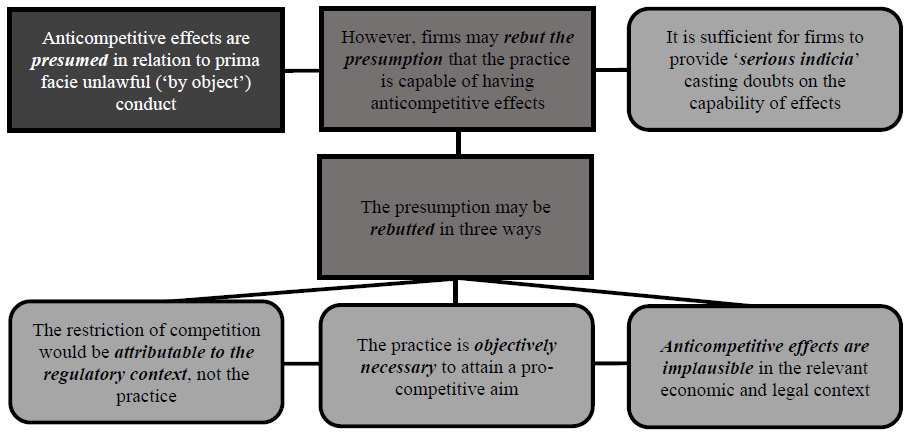
A figure concerns the role of anticompetitive effect in ‘by object’-style conduct (that is, conduct prohibited irrespective of its effects). As you see below, conduct of this nature is presumed to be capable of having anticompetitive effects (both under Articles 101 and 102 TFEU).
The presumption can be rebutted in three ways. A firm can show that the absence of competition would be attributable to the regulatory context, not the practice (the ‘Generics/Toshiba defence’); that the practice is objectively necessary to attain a pro-competitive aim (the ‘Société Technique Minière defence’); or that anticompetitive effects are implausible in the relevant economic context (the ‘Intel defence’).
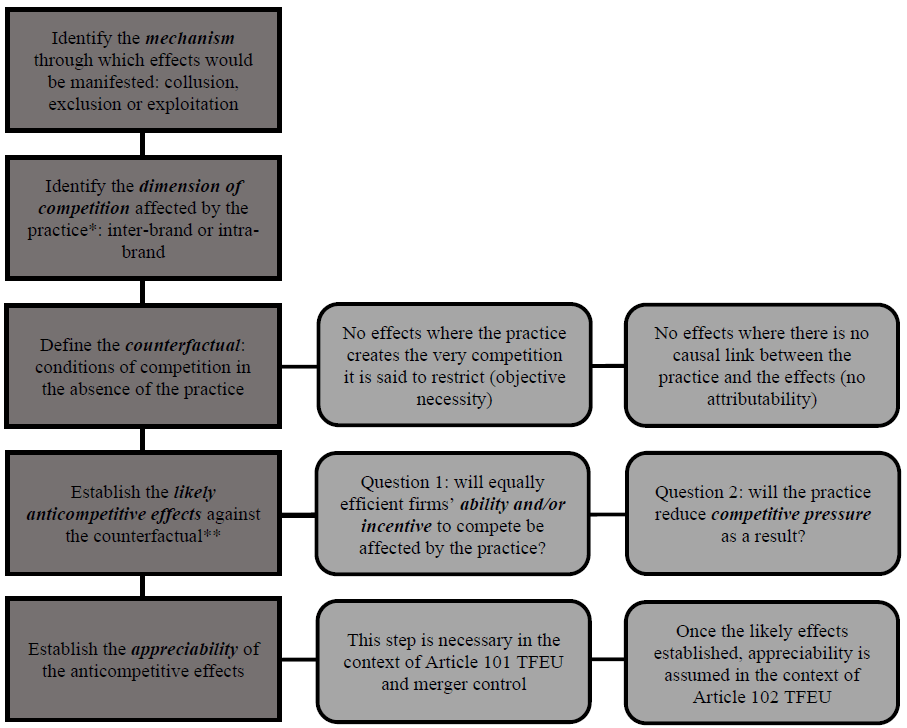
I also have another figure addressing the relevant steps to evaluate the effects of a practice or transaction.
I very much look forward to your comments on this new version. Something has not changed since May: I did not have anything to disclose then, and do not have anything to disclose now.
Protecting the ‘law’ in competition law

Competition law is undergoing an exciting – perhaps unprecedented – period of reform and change. Public bodies and academic institutions are evaluating, from Australia to Germany (and indeed the EU), whether it is necessary to introduce adjustments to the discipline to ensure that it is up to emerging challenges, namely digital and sustainable development. The perception that it may not be able to adapt to a changing landscape is driving the demand for broader, faster and more intrusive competition law.
The desire to move fast and decisively to tackle perceived threats to the competitive process is understandable. The wish to improve the system for the better, in turn, is commendable. The fact that competition law is deemed to be a major part of the response to some of the most pressing concerns in society, finally, says a lot about the continuing relevance of a field that was introduced in a different economic and technological landscape and that has proved capable of adapting to new demands.
The zeal for change, however, sometimes goes as far as to question some of the pillars of the field. The fact that competition policy is enforced through law is now openly criticised in some quarters. The argument is relatively straightforward: freed from the legal shackles, intervention would be faster, more effective and more responsive. Underpinning this position there is the idea that the law is inherently conservative and insufficiently reactive to emerging issues. It sees with suspicion the EU courts’ dislike of sweeping changes and preference for incremental adjustments to legal doctrines.
The solutions, according to these proposals? Increase the resources and the leeway given to competition authorities. Where the law requires a finding of infringement, the said infringement should, if at all, be presumed; thus, it would be for firms to show either that the practice or transaction does not adversely affect competition or that its positive aspects weigh more than any anticompetitive effects. Courts, on the other hand, would not interfere with the choices made by authorities absent manifest errors of assessment.
These proposals, in essence, amount to turning competition policy, a field traditionally driven by law, into one driven by discretion. Such an approach would afford authorities a virtually unconstrained margin of appreciation to decide when to intervene, and how. Insofar as they do, these ideas advocate a Copernican transformation of the field: the centre would move away from the courts towards administrative agencies.
It is difficult to avoid the conclusion that doing away with the law – and, in effect, changing an essential feature of the system – would be too high a price to attain the policy objectives sought by the most ardent reformers, no matter how noble their intentions. It would make the discipline more contentious, more prone to errors and less effective. Perhaps worse, the perceived legitimacy of intervention would inevitably suffer – for how can it be otherwise, if administrative action cannot be meaningfully challenged?
It is occasionally forgotten, but the purpose of the law is not to slow down policy making, or to check whether intervention fits within a set of pre-defined pigeonholes. Its point is instead to ensure that it is sound and in the general interest.
One cannot deny that the case law, as defined by the Court of Justice over the years, limits intervention by competition authorities. It is also true that the case law evolves at a relatively slow pace. These constraints, however inconvenient in individual cases, are far from capricious. They reflect the lessons of experience, which are incrementally incorporated into the acquis of the discipline. They also reflect an awareness of what competition law can realistically achieve in practice.
Removing these constraints would give a false sense of freedom to authorities. In some respects, doing away with legal boundaries to administrative action would make these same authorities realise that, even if not limited by law, they will always struggle when implementing complex and demanding remedies for which they are not adequately equipped. In other words, the law, rather than a barrier, often signals the barrier itself. There is wisdom underpinning the judgments in Magill and Bronner, whether or not this wisdom is enshrined in law. Regulating the terms and conditions of access to an input will always be a daunting task for a competition authority.
In other respects, the perceived sense of freedom would make authorities less able to resist pressure from stakeholders and, similarly, to manage their resources effectively. Experience and expertise, as reflected in the law, are precious assets to prevent regulatory capture – capture implies a loss of freedom, and a far more problematic one from the perspective of the general interest. Once an authority is nominally able to achieve virtually any outcome and to intervene in virtually any instance, the expectation that it can and will take action against every perceived or actual concern will be created sooner or later.
Finally, doing away with the law significantly increases the risk that intervention will not be based on the best available evidence. Over the years, the Court of Justice has crafted the law in a way that ensures that action by competition authorities reflects mainstream consensus positions. Mere concerns or conjectures that are insufficiently supported by theoretical and empirical evidence are not deemed robust enough to justify intervention. And for good reasons: if conjectures warranted action, there would be no effective limits to intervention by competition authorities.
One can try and make the argument that waiting for a consensus to emerge is a luxury that society cannot and should not afford. Ultimately, however, this argument is one based on faith, not on evidence. The concerns expressed may or may not materialise as described. The hard evidence may or may not be eventually available. It is certain, on the other hand, that transforming the institutional setup to turn competition policy into a discretionary tool to achieve the desired outcomes without effective judicial review is an even more extravagant luxury into which society should not even contemplate indulging.
NEW PAPER | The legal status of pay-for-delay agreements in EU competition law: Generics (Paroxetine)

I have just uploaded on ssrn (see here) a paper discussing the Court of Justice’s ruling in Generics (Paroxetine). It is a case note commissioned by the Common Market Law Review earlier this year. Hopefully it provides a clear and useful overview of the judgment and its implications. There is also a cameo appearance of Budapest Bank, which was issued shortly afterwards and could not be left out of the analysis.
Before I say anything about the piece: I am really grateful to Fernando Castillo de la Torre (Legal Service), who shared his comments on a previous version and definitely improved the end product. Thanks so much again!
I have written several (almost certainly too many) posts on a legal issue which I continue to find fascinating. But I tell myself that it is worth emphasising the points that follow.
Pay-for-delay and minimisation of Type I and Type II errors
The more I think about it, the more I tell myself that Generics (Paroxetine) achieved an optimal balance to minimise the risk of both Type I and Type II errors.
It is true that the Court defines the notion of potential competition in a relatively broad manner. It is sufficient to show that there are ‘real concrete possibilites’ of entry (as opposed to the likelihood of entry). What is more, potential competition can be established by proxy, on the basis of indirect indicia.
On the other hand, the Court is careful to point out that pay-for-delay agreements are not always restrictive by object, and that it is necessary to consider the specific circumstances of each case to come to conclusions about whether a given settlement is prima facie unlawful irrespective of its effects.
Intellectual property and insurmountable barriers to entry
Part of the interest of the preliminary reference in the case came from the fact that the UK Competition Appeal Tribunal openly invited the Court to think in probabilistic terms about intellectual property titles. Instead of seeing them as presumptively valid exclusive rights, the tribunal suggested that the probability of them being declared invalid could be incorporated in the assessment.
The Court did not follow the path suggested or implied in the reference. This is not surprising, considering that there is a consistent line of case law, dating back to the very early days of Consten-Grundig, according to which EU law does not question the existence of intellectual property rights, but only their exercise.
What I found interesting (but also not surprising) is that the Court declares that, in the specific circumstances of the case, intellectual property rights were not deemed an ‘insurmountable barrier to entry’.
The question for future rulings is that of when intellectual property will be deemed an ‘insurmountable’ barrier. The Court suggests it is an issue to be decided on a case-by-case basis in light of the relevant economic and legal context.
On restrictions by object
On the notion of restriction of competition by object, I have already explained that Generics (Paroxetine) will be remembered as a seminal ruling, together with Budapest Bank.
The two confirm that the identification of the object of an agreement is a context-specific inquiry. In addition, they (in particular Generics) made it explicit that the pro-competitive aspects of a practices are part of this assessment.
Another point that I have addressed at length is the counterfactual: in the two judgments, the conditions of competition that would have prevailed in the absence of the practice play a role in the evaluation of the object of the agreement. Insofar as this is the case, it seems difficult to argue that the counterfactual is merely confined to the assessment of effects.
The analysis of effects under Article 102 TFEU
Finally, Generics (Paroxetine) is particularly valuable in the contributions it makes to the clarification of the notion of anticompetitive effects under Article 102 TFEU.
In this regard, the Court confirms that the evaluation of this question under Article 102 TFEU is not different from that undertaken under Article 101 TFEU or indeed merger control (which is not only welcome but natural).
Accordingly, it is necessary to assess effects by reference to the market as a whole. By the same token, the impact of the practice would need to go beyond that consequences it has for the freedom of action of individual undertakings.
In reality, the Court’s approach is not any different from that laid down in Delimitis (an Article 101 TFEU case) and sketched in Post Danmark II and Intel (where the Court placed an emphasis on the coverage of the practice as a factor).
AG Saugmandsgaard Øe’s Opinion in Slovak Telekom: Bronner and TeliaSonera vindicated; open questions remain

AG Saugmandsgaard Øe’s Opinion in Slovak Telekom came out earlier this week (see here). Those interested in the outcome of cases will not see anything particularly remarkable. As expected, the Opinion concludes that indispensability should not be an element of the legal test in the circumstances of the case (I suggested this is the most probable outcome here). Those interested in drastic changes in the law will also fail to find anything remarkable. The Opinion sticks to the letter and spirit of both Bronner and TeliaSonera and shows that the two judgments can be easily reconciled.
The Opinion is important insofar as it addresses and explains some key issues and hints at a meaningful analytical framework. In particular, AG Saugmandsgaard Øe explains when and why indispensability is an element of the legal test. In addition, he introduces a useful distinction between (i) a refusal to make available and (ii) the terms of an agreement when it comes to the application of Article 102 TFEU.
There are other issues that are not explicitly addressed in the Opinion and that will have to wait for future developments as a result. In any event, AG Saugmandsgaard Øe’s provides a useful framework for the clarification of these points.
When is indispensability an element of the legal test? And why? The ‘make available’ doctrine
It has long been known that, in certain circumstances, indispensability is a precondition for the application of Article 102 TFEU. According to the case law, indispensability is an element of the legal test, inter alia, in cases like Magill, Bronner and IMS Health.
When is indispensability an element of the legal test?
The case law suggests, and the Advocate General confirms, that the abovementioned judgments concern a ‘refusal to make available, which amounts to requiring a firm to conclude an agreement’ (para 68). Thus, the key seems to be whether intervention would involve mandating a firm to deal with third parties with which it has not chosen to deal.
This position is not surprising in light of the judgments cited in the Opinion, including TeliaSonera and Van den Bergh Foods. It is an approach to the question that places substance above form (as the Court has always done). It matters little how the practice is labelled (AG Saugmandsgaard Øe is rightly wary of labels). What matters is what intervention involves. Finally, this conclusion shows how intimately linked remedies and legal tests are (which is a question to which I have devoted a few thoughts, as you can see here).
Why is indispensability an element of the legal test in ‘refusal to make available’ cases?
The second crucial question addressed in the Opinion is why indispensability is an element of the legal test in refusal to make available cases. In this regard, AG Saugmandsgaard Øe builds on AG Jacobs’ memorable Opinion in Bronner.
Experience and economic analysis suggest that forcing firms to deal with rivals can be expected to have a negative impact on firm’s incentives to invest and innovate and thus on long-run competition.
AG Saugmandsgaard Øe also mentions that the right to property is generally recognised as a fundamental right. As I see it, this is another way of expressing the same idea. If the right to property has a special status, this is precisely because it is widely understood to be an essential ingredient to achieve freedom and prosperity.
When is indispensability NOT an element of the legal test?
The Opinion distinguishes between ‘refusal to make available’ cases and ‘unfair contract terms’ ones. Indispensability would not be an element of the legal test in the case of the latter.
This position is in line with TeliaSonera and Van den Bergh Foods and as such not surprising. It also provides the key to the outcome in Slovak Telekom. The dominant firm in the case ‘imposed unfair conditions on undertakings wishing to access it’ (para 100). Therefore, one cannot argue that indispensability should have been established by the European Commission.
AG Saugmandsgaard Øe’s concludes that the concept of a ‘constructive’ or ‘implicit’ refusal to deal is not particularly useful. This position is in line with his general wariness of formal labels, in particular those that would lack clear boundaries or explanatory power.
Whether or not there is sector-specific regulation imposing a duty to deal is not a relevant consideration, according to the Advocate General (paras 110-111). This is a sensible position and one that is unsurprising. One should bear in mind that the Court attached no importance to this factor in TeliaSonera.
Sector-specific regulation may impose access obligations in circumstances where competition law would not. The objectives of the ex ante regime may be compatible with competition law, but not necessarily identical. Thus, the fact that the former imposes access obligations cannot be decisive.
Open questions after the Opinion
There are some issues that did not come up in Slovak Telekom. Accordingly, one can only speculate how the logic underpinning the Opinion may apply to them. For definitive answers, however, we will have to wait for future cases.
What if the behaviour is unilateral?
AG Saugmandsgaard Øe distinguishes between a refusal to make available and unfair contract terms cases. There is a scenario that is not contemplated in the Opinion: what if the behaviour is strictly unilateral? What, for instance, if the case is about the design of a complex product (think of the integration of two products, as in the example of the camera and the smartphone)?
Even though not expressly addressed, the Opinion provides, in my view, sufficient elements to give an answer to the question.
If intervention in the case would interfere with the firm’s right to deal with whom it pleases (and thus to conclude an agreement with third parties with whom it has not chosen to deal), then indispensability would be an element of the legal test.
What about a structural separation (or an obligation to close a division)? ‘Reverse refusals to make available’
It is not often mentioned, but cases like Bronner or Magill can be remedied in three different (and equally effective) ways. One approach is to force the firm to deal with third parties on the adjacent market. A second remedy is to impose a structural separation and split the upstream and downstream divisions of the firm. A third way is to require the firm to close its upstream or downstream division.
Since all three remedies are interchangeable, and since they would all interfere with the firm’s right to property, it seems inevitable to conclude that indispensability would also be a precondition where intervention would require a firm to sell some of its assets (or otherwise dispose of them by closing a division). Arguably, Van den Bergh Foods already provides the answer in this regard (it makes an explicit reference to the sale of assets).
What about principles-based remedies? What if the authority’s decision leaves the choice of the remedy to the firm?
A final question, not addressed in the Opinion, has to do with authorities’ decisions that take a ‘principles-based’ approach to remedies. This technique seems to be on the rise. Since the remedy (‘requiring an undertaking to conclude an agreement’) is typically the key to understand whether indispensability is an element of the legal test, a ‘principles-based approach’ can be used by an authority to circumvent the stricter legal test.
There are two possible responses to this conundrum: the ‘substance’ response and the ‘form’ response. I have already explained why we should place substance above form in this (and every other) regard.
What matters is what intervention involves in substance, not what the authority formally requires. Accordingly, if intervention amounts in effect to ‘requiring an undertaking to conclude an agreement’ (or, I would add, a structural separation, or an obligation to close a division) then indispensability would be an element of the legal test. It is irrelevant that this obligation is concealed behind a ‘principles-based’ approach.
If we were to rely on what the decision formally requires, it would be very easy for any authority to circumvent the indispensability condition. In a case like Magill, for instance, the Commission could avoid the indispensability threshold by asking the firms to bring the infringement to an end without specifying how. This does not come across as the most reasonable way to interpret the case law (if only because it would turn an issue of law into one of discretion).
Our Curious Amalgam: The ABA’s Antitrust Podcast (and my take on the Apple Judgment)

The American Bar Association’s Antitrust Law Section now has a weekly podcast program, called Our Curious Amalgam. I was the guest in an episode released yesterday where we discuss the General Court’s Apple Judgment. Coincidentally, the episode was released as I was participating in a hearing at the Grand Chamber of the CJEU where we also discussed fiscal State aid (fifth and hopefully final hearing in the Santander-World Duty free saga…). The podcast is available here.
We recorded this podcast over my summer holidays, and I made sure to listen to quite a few episodes before. It was a great use of time. Each podcast is about 20-25 minutes. They cover everything related to antitrust, consumer protection, data, and privacy and there are very insightful conversations freely available to anyone interested.
To catch new episodes that drop on each Monday, you can subscribe “Our Curious Amalgam” on Google Podcasts, Apple Podcasts, and Spotify.
Many thanks to Matthew Hall, Christina Ma and John Roberti for the invitation and the chat!