In no man’s land- Case T-355/13, easyJet
Last Wednesday, 21st January, the General Court rendered an interesting Judgment in Case T-355/13, easyJet v Commission.
It is well-known that the European Commission has always enjoyed great discretion to reject, shelve or prioritize cases, traditionally under the widely used justification (sometimes pretext) of lack of Community/EU interest (as the case-law has, ever since Automec, acknowledged it may do). With the entry into force of Regulation 1/2003 the Commission was granted another two reasons to dismiss cases (not that it needed them); pursuant to Article 13 it could now dispose of complaints where “one authority is dealing with the case” already (13(1)) or where a complaint “has already been dealt with by another competition authority” (13(2)).
easyJet v Commission concerns the latter scenario.
The facts in a nutshell
In 2008 easyJet lodged three complaints against Schiphol airport with the Netherlands Competition Authority, based on national legislation governing aviation law and on competition law. The authority rejected the complaints by relying on the laws governing aviation (said to be inspired on the competition rules) and by resorting to its priority policy, which enables it to pick the cases with which it deals.
In 2011 easyJet lodged an abuse of dominance complaint with the European Commission. It acknowledged it had lodged similar complaints in the Netherlands and explained that these had never been assessed on the merits.
After two years (so much for the best practices), in 2013, the Commission rejected the complaint arguing, inter alia, that a national competition authority had already dealt with it.
The Judgment
In Wednesday’s Judgment, the Court rules:
1) That the Commission is entitled to reject a complaint which has previously been rejected by a competition authority of a Member State on priority grounds even if the latter has not examined the merits of the case. The Court explicitly endorses an interpretation whereby what’s important is that the national authority has “formally”, however superficially, “reviewed” the complaint (see, e.g. recital 27 of the Judgment).
2) That the above is valid also where, as in the case at hand, the national competition authority rejected the complaint in the course of an investigation conducted under separate provisions of national law (aviation law in casu) “on condition that the review was conducted in the light of the rules of EU Competition law” (see in this regard para. 46 of the Judgment).
In sum, the General Court rules that when a national competition authority rejects a case without having examined its merits, and without having undertaken an analysis on the basis of the competition law rules this is enough to consider that the said authority has “dealt with” the case within the sense of Article 13(2) of the Regulation.
A few comments
It is also widely acknowledged that judicial review in these cases –also starting with Automec– has been rather lenient. At one point some –like me– saw a possible change of trend in CEAHR, but hopes were later dispelled by Protegé (see here for our comments). This Judgment fits within the classic very deferential stream of case law in this domain.
Whereas it’s true that the facts of the case are very specific, my first inclination is not to share the Court’s reasoning; if you see it differently I’d be happy to discuss.
– First of all, I wonder how this all fits with a stream of case-law (actually cited in this very same Judgment), according to which “where the institutions have a broad discretion, respect for the rights guaranteed by the legal order of the European Union in administrative procedures is of even more fundamental importance; those guarantees include, in particular, the duty of the competent institution to examine carefully and impartially all the relevant aspects of the individual case”. (In the same sense see also the often forgotten recitals 79 to 83 of Automec itself). Given that the EU Courts require –at least in theory- that the Commission examine carefully all the relevant aspects of a case prior to rejecting it out of lack of priority, why doesn’t the GC require the same from national competition authorities prior to concluding that they have “dealt” with a case within the sense of 13(2)? Moreover, doesn’t the case law require that the guarantees provided by EU Law be also applied by national bodies when applying EU provisions?
– Secondly, I’m not sure the Commission needed this favor in a domain in which it effectively already enjoyed almost unfettered discretion. Indeed, it didn’t need to invoke Art. 13(2); had it simply said the case lacked EU interest it would have got away with it
– The risk, in my view, is that after this Judgments authorities will be able to dispose of cases out of prioritization reasons without having examined first the relevant aspects of the case, at was required –at least formally- by EU case law, just because another authority chose to do just that before.
In a way, the Judgment might accordingly make it much easier for authorities to play hot potato. Wanna-be complainants would be in between, in no man’s land, with the frustrating feeling that no one wants to even cursorily look at their case.
– The Commission would probably reply to the above that national Courts are still well placed to deal with complaints, that they’re moreover under the obligation to examine the merits of cases and that they have wider powers (such as that of awarding damages). Query: I wonder how the experience of losing a case that the Commission thought was obvious before a Belgian Court (see here) may have altered the Institution’s perception as to how well placed judges are to deal with competition cases. I also think that the Commission often trusts judges to deal with cases that would need an EU-wide consistent solution, ideally from an experienced specialized agency. For instance, the Commission very recently rejected a complaint against the UEFA Fair Play Rules alleging that Belgian Courts were well placed to deal with it (see here; query: is that really a case that should be dealt with by a national Court instead of by the European Commission?)
A view from the hill: European Competition Law Annual (and my personal favourites)

Hart has been kind enough to send us (technically, to me) a review copy of the latest volume of the European Competition Law Annual series, and I thought I would devote this Friday slot to say a word about it. You do not need an introduction to the famous Florence workshops, which have proved to be enormously influential and which have anticipated some substantive and procedural developments in EU competition law. The vast majority of you do not need an introduction either to the beauty of the Tuscan landscapes surrounding the European University Institute. Even though I did my PhD there, I am amazed every time I have the chance to go back, which is less often than I would like to.
Because it would not make any sense to discuss the obvious, I thought it would say instead a few words about some of my favourite pieces published as part of the proceedings. These are articles which I use very often for research purposes or about which I find myself thinking quite often. My personal top 3 – in strict alphabetical order – is as follows:
- Ian Forrester, Sector-specific price regulation or antitrust regulation – A plague on both your houses?: If you have followed my work a bit you will know that I am interested in telecommunications regulation (as it is now called again, it would seem). Unfortunately, there is relatively little academic research in the area. This piece discusses the interaction between competition law and sector-specific regulation and the implications of some legislative developments. In particular, it provides an excellent critical analysis of the regulation of roaming. This was the first significant departure from the logic underpinning the EU Regulatory Framework for Electronic Communications. If Ian Forrester only knew back then what would happen in subsequent years.
- Luc Gyselen, Rebates – Competition on the Merits or Exclusionary Practice?: The first virtue of this piece is its clarity. If you want to understand DG Comp’s pre-Discussion Paper approach to exclusive dealing and rebates, this article is the best starting point. Many things make more sense after reading the piece (in particular some ECJ rulings such as British Airways). Its second virtue is its intellectual honesty. At the time of the workshop, in 2003, Luc Gyselen was Head of Unit at DG Comp. This fact did not prevent him from expressing in public his misgivings about Michelin II, which was controversial for several reasons even under the old approach.
- Heike Schweitzer, The History, Interpretation and Underlying Principles of Section 2 Sherman Act and Article 82 EC: Article 102 TFEU case law is frequently labelled as being ‘ordoliberal’. It is not always clear what people mean when they use this expression, no less because it is often relied upon to refer to any feature of the case law that is perceived to be problematic or controversial. This article explores some common misconceptions in this sense. Heike Schweitzer discusses the drafting history of Article 102 TFEU and explains post-war ordoliberal views and debates on the appropriate legal treatment of unilateral practices. The analysis of existing case law is valuable in its own right. I often refer in my work to her understanding of the principle whereby dominant firms have a ‘special responsibility’ under Article 102 TFEU. I agree with her views and I also believe that people tend to read too much into it. I only regret that the piece does not cover more practices!
On the (mis)application of Article 101(3): of judicial capture and cross-market assessments

We competition lawyers are probably more stupid than other lawyers (and that’s saying something!). Think about it, on the behavioral side many lawyers essentially work with only two provisions (Arts 101 and 102 TFEU) and they don’t really know what to do with them. Granted, I’m oversimplifying, but perhaps not so much: how many people have a clear idea of what a restriction of competition is? [my previous experiment on this point was used by some to criticize our discipline; see here] How many know how to extract the consequences of Article 101(2) [see here for my take]? And how many know how to apply Article 101(3)?
Today I’ll focus only on the last of these questions, to which the answer is: very few, and I’ll give you an example.
(Note: the first half of the post is mere background; the more interesting stuff is emphasized in bold at the end. The following may be a bit dense, but I bet that if you manage to read it you’ll find it quite interesting)
In the early days the Commission essentially did what it pleased with 101(3), using it often with common sense but with very little, and often divergent, reasoning, thus bordering on the arbitrary. The Court didn’t put much order in that mess: starting with Consten & Grunding it devised the manifest error of assessment test to review the legality of “complex economic assessments”, a label which was said to apply to the application of Art. 101(3). The result of this approach is that prior to the adoption of Regulation 1/2003 the Court only rendered a handful of Judgments (30 approximately) dealing with this sub-provision, which nevertheless is at the core of our enforcement system.
Following the adoption of Regulation 1 the Commission ceased applying Article 101(3) as well, seemingly acting under the assumption that its Guidelines on the application of what then was Article 81(3) would fill the void. But the Guidelines didn’t fix much and, in fact, as will be seen in a second they also created new trouble. Also, Article 5 of Regulation 1/2003 (later interpreted by the ECJ in Tele2Polska effectively precluded national competition authorities from adopting individual exemption decisions under Article 101(3) TFEU (they can only conclude that there are no longer grounds for action)
The result is that the Commission seldom undertakes a serious evaluation of 101(3) in its individual cases, that EU Courts very rarely have the chance to review its application and that national competition authorities can’t do it to a full extent either (in spite of the fact that decentralization was intended precisely to empower them to do it…). Passivity in this regard is so extreme that even when the ECJ has instructed the Commission to perform a 101(3) assessment, the Commission has felt free enough to take a pass (we’re currently working on a case wich is a perfect example of this).
Far from being unimportant, I often contend that many of the problems encountered in modern competition law (like the object/effect debate and the discussions on how far into the “legal and economic context” one must look within 101(1)) (see here, for instance) derive from the fact that 101(3) isn’t taken seriously in individual cases.
But what is even worse is that the very exceptional cases in which Article 101(3) is indeed applied, it doesn’t seem to be properly applied.
I’ll give you an example, resorting to an issue I dealt with in my presentation on two sided markets at the Swedish Competition Authority’s Pros and Cons conference a few weeks ago and which, I realized, not many seem to be aware of.
Let’s take a simple question which should have a straightforward answer:
Can you balance the efficiencies obtained in one market against the restrictions of competition caused in a different market?
–When this question first arose before EU Courts it was made it pretty clear that any positive effect should naturally have to be considered, regardless of the relevant market in which it occurs:
“For the purposes of examining the merits of the Commission’s findings as to the various requirements of Article [101(3)] of the Treaty (…) regard should naturally be had to the advantages arising from the agreement in question, not only for the relevant market (…) but also, in appropriate cases, for every other market on which the agreement in question might have beneficial effects, and even, in a more general sense, for any service the quality or efficiency of which might be improved by the existence of that agreement” (Case T-86/95, Compagnie Générale Maritime and others, [2002] ECR II-1011, paragraphs 343 to 345).
Sounds pretty unequivocal, right? Well, again, keep on reading….
– Then came the Guidelines on 81(3) and ruined it. Para. 43 of the Guidelines states that “[n]egative effects on consumers in one geographic market or product market cannot normally be balanced against and compensated by positive effects for consumers in another unrelated geographic market or product market. However, where two markets are related, efficiencies achieved on separate markets can be taken into account provided that the group of consumers affected by the restriction and benefiting from the efficiency gains are substantially the same”. In other words, they said precisely the contrary to what the case law said. And, cunningly enough, the Commission did so citing in its support the very same case law that it was departing from (not that EU Courts haven’t occasionally done the same regarding their own case-law…) Indeed, the footnote (57) accompanying this paragraph refers to Compagnie Générale Maritime (quoted above) but adds a long explanation aimed at confining the Court’s ruling to the very specific situation at issue in that Judgment, in which the group of consumers affected by the restriction and the efficiencies is said to have been the same. Read it for a good example of manipulation a lawyer-like interpretation of the case law.
– This very same issue returned to the EU Courts in the post-guidelines era with the Mastercard case. And instead of correcting the Guidelines’ intendedly wrong interpretation of the earlier case law, the Courts endorsed it, and I’m not sure that they did so consciously.
Click here to continue reading about how the Commission lawyered everyone:
Antitrust Writing Awards 2015

Concurrences has launched the 2015 edition of the Antitrust Writing Awards.
Among the roughly 50 articles selected for each of the “academic” and “business” categories there are many written by friends of this blog, and also some authored by Pablo (namely this one), Nicolas Petit (see here) and myself (here and here) (btw, if you click on any of those you might as well give us a 5 star vote 😉 )
Regardless of the degree of importance that you may give to these things, scrolling through the list of selected articles is a great way of catching up with some of the best scholarship of the past few months (and also with our writings). Being the sort of person that reads a competition law blog, you’ll surely find some stuff of interest in those lists.
P.S. An additional thought: I just saw once again the pic of Pablo that appears in the Concurrences website (at one point in time he was the most read author in that site) and couldn’t help thinking that it’s well suited for a before-and-after Men’s Health cover…
The Autorité de la concurrence and the Competition & Markets Authority on open and closed systems


I have finally read the report jointly issued by the Autorité de la Concurrence and the Competition & Markets Authority on the economics of open and closed systems and published about a month ago. The topic is exciting, the timing ideal and the initiative itself most interesting for several (both substantive and institutional) reasons. It remains to be seen whether joint action of this kind will become more frequent in the years to come.
The report seems to be broadly in line with consensus positions. Both relatively open (say, Android) and relatively closed (say, iOS) systems can have pro- or anticompetitive effects depending on the circumstances. As a result, there is no reason, from a competition law standpoint, to favour one over the other, or to seek an allegedly optimal level of openness. The fact that the report restates these commonly known principles does not make it any less interesting or relevant. Well-established positions tend to be forgotten all too often, and it is reassuring that two leading authorities embrace them publicly.
My only criticism (admittedly an incredibly unfair one!) of the report is that it is too abstract and avoids the use of concrete examples. When it is said that prohibiting closed systems could lead to substantial efficiency losses, advocates of open systems tend not to take the warning very seriously. Efficiency, when dealt with as an abstract concept, seems to be inherently suspicious and as such can be disposed of very easily. ‘Who wants efficiency when you can have freedom?’ has become a fairly frequent argument, even in published work.
It is only by referring to concrete examples that a discussion about these matters becomes meaningful. Apple launched its iPhone as a relatively closed system. It was even more closed in the early days than it is now – remember that Apple preferred to offer the phone through a single mobile provider in each country. It would be difficult to deny that the iPhone and the revolution in mobile telephony to which it gave rise have been immensely beneficial for consumers and society as whole (and please note that this statement comes from a never-ever-Apple person!).
Cable television was created as a closed system (something that was deemed problematic during the 1970s in the US). We may never have witnessed the dawn of a new ‘golden age’ in television if network providers had been prevented from keeping tight control of content. HBO was not created as a stand-alone venture, but at the initiative of a cable operator that wanted to attract subscribers to its system. The phenomenal growth of satellite pay television in countries like the UK during the mid-1990s owes much to the integration between the two activities.
Now that the battle seems to have been lost forever in the context of telecommunications regulation – net neutrality without a compelling theory, I am afraid, is here to stay – we can only hope that competition authorities do not fall into the trap of making sweeping assumptions or favouring across-the-board remedies. This is a risk that I have already identified in some of my pieces. I see a worrying tendency to assume – both in abuse of dominance and in merger cases – that the creation of a ‘level playing field’ in vertical settings is by definition conducive to more competition and innovation. This is not necessarily the case, and, as I say above, the report is a fine reminder that things are far more complex in practice.
Coming soon…

– On Friday 30 January we, at the IEB course, will be holding a seminar in Madrid, coordinated by Fernando Castillo and Eric Gippini, which will feature three panels: one on judicial review in competition cases (with Manuel Campos -Spanish Supreme Court-, Santiago Soldevila -former GC judge, now at the Spanish Audiencia Nacional- and Helmut Brokelmann -MLAB-; another on the application of competition law to public conduct (with Francisco Marcos -IE Law School-, Fernando Castillo – EC’s legal service- and José Luis Buendía -Garrigues-); and a third one on “Life after Cartes Bancaires“ (with Nicholas Khan -EC’s Legal Service-, Xavier Ruiz Calzado -Latham & Watkins- and a handsome lawyer going by the name of Alfonso Lamadrid -Garrigues-). For more info please click here or send an email to competencia@ieb.es.
– On Friday 6 February the editors of the Competition Law Journal will hold the 9th Junior Competition Conference, which will have two themes, namely “Control of unilateral conduct and ‘the Goldilocks dilemma’: too much, too little or just right?” and “The new frontier: competition law in the financial services sector”. The conference programme can be found here. Those interesting in attending may contact the organizers at operations@catribunal.org.uk
– On Thursday 19 February ERA will host a workshop in Brussels on “Dawn Raids in Practice: Developments in Case Law and Enforcement”. The workshop will examine the latest enforcement trends and the impact of recent case law from the CJEU and the ECtHR on the conduct of dawn raids by the European Commission and national competition authorities. More info is available here.
– On Friday 20 February we, again at the IEB in Madrid, will host a seminar on recent developments in abuse of dominance and merger control coordinated by Cecilio Madero -Deputy Director General, DG Comp-, Nicholas Banasevic -Head of Unit at DG COMP- and Milan Kristof -Référendaire at the ECJ-.
– A bit later, on 15 May, the University of Leeds will hold a (free) conference on Contemporary Challenges in Competition Law featuring, among top-notch speakers, Pablo and Nicolas. More info is available here.
– And, in a few days, Chillin’Competition will be resuming its Friday Slot section with a quite special interview. More info coming soon…
And the 2014 winner is…
(by Sam Villiers, Garrigues, Brussels, not pictured below)

With the Golden Globes this weekend and the Oscars fast approaching, the 2014 awards season is officially upon us. In this light, the FT ran an interesting piece yesterday (see here) on the highlights of 2014….in the world of cartel fines. I don’t know whether one can accurately describe there being ‘winners’ and ‘losers’ in cartels, but the article – based on a report by A&O (see here) – certainly highlights some interesting general trends in global cartel fining.
The report explains that total cartel fines dished out by the world’s competition authorities in 2014 reached a new level of $5.3bn, up 31% on the previous year’s (record breaking) total. And the nominees are…..sorry, I mean…the markets handing out the most fines in 2014 are:
- Europe leads the way, having handed out €1.7 bn ($2.3 bn), although didn’t quite make it to the giddy heights of its 2013 level of €2.5bn. The report picks out the German and French competition authorities as having enjoyed particularly vintage years.
- Brazil’s CADE (Administrative Council for Economic Defense) had a record-breaking year, with cartel fines totaling $1.6 bn. This figure includes the imposition of the second largest fine ever given by a competition watchdog, that of $1.39 bn for a decades-long cement cartel.
- South Korea’s KFTC also broke its fining record, doling out an impressive $1.01 bn worth of fines.
- In the 2014 fiscal year, the US DOJ Antitrust Division imposed a modest $861m of fines, 15% down from the previous year. Plus, the lion’s share of this total came from fines handed out to the auto parts cartelists.
It is quite hard to discern too many long-term trends from these isolated 2014 numbers as cartel investigations are characterised by such long gestation periods; the time between the opening of a case file and the final decision by an authority or court can take years. It would perhaps be more indicative of general trends if one could look at the total fines given over 5 or 10 year cycles. In any case, the numbers are interesting in themselves.
One general trend that did particularly catch my eye – in the context of the debates around reform of competition enforcement in Europe – is the seemingly large number of jurisdictions allowing individual offenders to face prison sentences. It is interesting to note that in 2014 a Brazilian court imposed a 10 year prison sentence (and a $156m fine) on an executive for bid rigging. At the level of DG Comp, I would imagine that we are some time away from this.
Oh, and one final point: according to the FT, bistros (the noisy, French variety one would presume – easier not to be overheard ;-)) and hotels were shown to be the preferred cartelist meeting spots. Not surprising I guess, but zero points for imagination… That said, if anyone reading this is in search of a cartel venue, I hear Alfonso’s parents have a special offer for cartellists at their hotel 😉
EU competition law and choice: falling back into old habits

Ideas originating in North America cross the Atlantic sooner or later. The view that competition law should be concerned with choice, rather than with a particular measure of welfare, or another objective, seems to be gaining popularity in the EU. In addition to the references to choice found in Commission decisions and other statements of policy, there is a growing strand of literature emphasising the importance of choice in the competitive process.
You have certainly guessed from the title that I am quite sceptical about this move, and that I find express reliance on choice by competition authorities to be problematic in certain instances. More than anything, I see this trend as the repetition of past mistakes. As such, it also provides a suitable topic for the first post of the year, when we all think about resolutions. Indeed, ‘don’t repeat past mistakes’ is probably the best resolution of which one can think. Before I forget, by the way: happy 2015 to all!
There is already quite a lot written on competition law (or antitrust) and choice, which means that the main arguments are already well-known. Saying that competition law should be about choice amounts in a way to stating the obvious. Preserving the sources of competitive pressure to which firms are subject can be expected to lead to increase choice for consumers, in the same way it can be expected to lead to lower prices.
It is also abundantly clear that the competitive process often leads to what look like choice restrictions. By definition, selective distribution limits choice for consumers, insofar as they may only be able buy the product in question from certain retailers. Yet such systems are known to be pro-competitive (they tend to promote competition and thus choice). They fall outside the scope of Article 101(1) TFEU altogether in certain instances. The same can be said of franchising. It would certainly enhance choice to have McDonald’s hamburgers sold alongside Pizza Hut products. However, the ECJ held very clearly in Pronuptia that franchisors may take steps to protect their know-how and their reputation without infringing Article 101(1) TFEU.
In light of the above, it is not clear why choice as such would be advocated after the experience acquired over many decades. I do not believe choice advocates claim that we should prohibit altogether selective distribution, franchising or other vertical restraints. I am certain that they accept free-riding as a concern that can justify choice restrictions in such and other instances, and I am also sure that they accept the idea that the protection of the competitive process tends to lead to increased choice. In this same vein, I do not think they have in mind an alternative, internally coherent and fully-fledged standard revolving around choice.
What are we left with, then? It is difficult to tell. My impression is that choice could be useful in practice as something akin to a ‘back-up’ quasi-standard; that is, as a contemporary abracadabra that would allow for intervention when conventional analysis would not. Remedial action is not warranted under the established framework? Well, one can always resort to the vague idea of choice to make a case for intervention. It may not be as robust as a properly articulated theory of harm, but it may sound plausible and, hey, sure nobody is heartless enough to be against consumer choice.
If this is really what is going on, there is every reason to be concerned. It shows, first and foremost, that the lessons of history are easy to forget. We have come a long way to make enforcement sensible and predictable. It would seem, however, that the temptation to rely on nebulous concepts will never fade. Expanding the boundaries of intervention will always be appealing. The good news is that EU competition law is now much better equipped to deal with insufficiently robust and/or poorly articulated claims.
A review of recent EU competition case-law
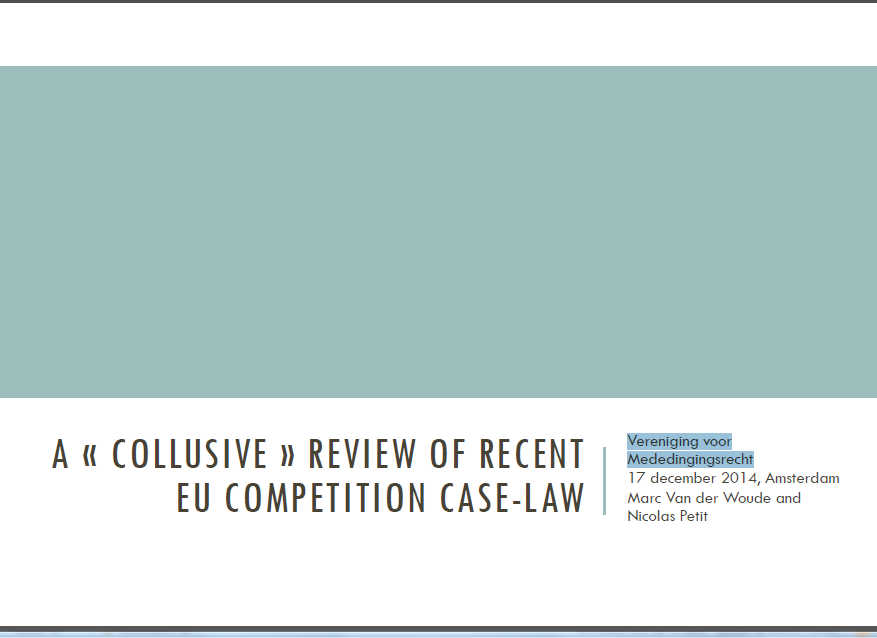
Last week General Court Judge Marc van der Woude (click here to read his Friday Slot interview with us) and Nicolas Petit did a joint presentation on recent EU competition case-law at the Vereniging voor Mededingingsrecht (Dutch Competition Law Association).
The must-read slides are available here: Slides -17 December – Van der Woude and Petit
(A teaser: the slided identify an apparent misquote in the Cartes Bancaires Judgment…).
International Conference on Cartels- Materials

The Universidad San Pablo CEU (which thanks to the work of Prof. Jerónimo Maillo has always paid an unusual attention to competition law) and the Spanish Competition Authority recently held an international workshop on Cartels in Madrid which I hear was a great success.
I couldn’t make it, but I’m told that my colleague Konstantin Jörgens did a great job discussing a piece I’ve co-written on the assessment of evidence in cartel cases.
All materials are now available at the website of USP-CEU’s Institute for European Studies , but since we know you’re a bit lazy (no offence) we’ll save you the effort of an additional click:
- Opening Speech
Eduardo Prieto
Download pdf - Integrating Regulatory and Antitrust Powers
Juan Delgado
Download pdf - Calculating fines: Practical problems
Alberto Escudero
Download pdf - Lessons from the Damages’claims in the Spanish sugar cartel
Francisco Marcos
Download pdf - EU Antitrust Damages
Evelyne Ameye
Download pdf - European Commission’s settlement procedure – a success story
Eric Van Ginderachter
Download pdf - Leniency programmes and the problematic use of confidential information
Javier Guillen
Download pdf - An economic assessment of the judicial review of the CNMC’s fines
Javier García-Verdugo
Download pdf - Cartel Settlements
Jean-François Bellis
Download pdf - Leniency and Cartel Detection
Juliane Schulze
Download pdf - Sanctioning hard core cartel infringements in EU Competition Law: towards a more compliance-driven approach
Aaron Khan
Download pdf - Fines and Evidence in Cartels
Konstantin Jörgens
Download pdf - Prosecutorial & Non-Prosecutorial Systems and the Fight against Cartels
Marianela Lopez-Galdos
Download pdf - Leniency – Dutch experience
Pablo Amador Sánchez
Download pdf - ‘How (Not) to Design a Criminal Cartel Offence: Learning from the UK Experience’
Peter Whelan
Download pdf - Swedish Competition Authority
Karin Montelius
Download pdf - EU Judicial Architecture Facing Anti-Cartel Enforcement
Georges Vallindas
Download pdf - Leniency Plus: a Building Block or a Trojan Horse?
Marek Martyniszyn
Download pdf - Class Actions to Claim Antitrust Damages
Pablo Gutiérrez de Cabiedes
Download pdf


 Chillin'Competition