The dangers of the notion of competition on the merits (and how to address them)

The notion of competition on the merits (which I recently discussed in a paper here) would have been aptly described, until recently, as a relic of the early days of Article 102 TFEU. Just take a look at the case law of the past decade.
Landmarks from Deutsche Telekom and TeliaSonera to Intel and Slovak Telekom (not to mention the Post Danmark saga) ignored competition on the merits altogether. At best, the notion featured in the old formulas taken from early judgments. In practice, however, it played no role in the assesment.
There was a good reason why competition on the merits was disregarded in the long decade preceding Servizio Elettrico Nazionale. It had been accepted that most potentially abusive conduct is normal (by which I mean that it has a pro-competitive potential and that it is also routinely implemented by non-dominant firms).
For instance, the fact that a practice is, objectively speaking, a product improvement does not insulate it from scrutiny under Article 102 TFEU.
The main conclusion to draw from this consistent case law is that authorities cannot be required to show that a practice is an abnormal method of competition. Typically, an abuse can be established by showing that the contentious conduct is a source of actual or potential effects in the relevant economic and legal context.
Things have changed. All of a sudden, it looks as if the notion of competition on the merits is central to the interpretation of Article 102 TFEU. Deciding whether or not a practice is a legitimate method of competition now seems to be a key step in an abuse of dominance investigation (at least in some quarters).
As I argue in my paper, this perception is not only difficult to square with the case law, but it is also dangerous. It is dangerous in the sense that it risks taking law and policy back to the stone age. If not handled with care, competition on the merits may pave the way for the comeback of intuitive and informal analysis (which we thought had left us for good).
Consider the example of tying. Is this practice a ‘normal’ method of competition? It certainly is. Decades of experience and formal analysis show that it is potentially pro-competitive (we know that the combination of products and of features can improve the competitive process in several ways).
We also know that tying is pervasive in the economy. Both dominant and non-dominant firms routinely engage in tying, typically for non-sinister reasons. In other words (and to come back to the vocabulary used in Servizio Elettrico Nazionale), non-dominant firms can (and do) ‘replicate’ the conduct.
In fact, tying illustrates (perhaps better than any other practice) the limits of the ‘replicability test’ at which the Court hinted in Servizio and reveals, moreover, that the said test is underinclusive (it would lead to Type II errors).
In spite of the above, tying can be caught by Article 102 TFEU if, absent an objective justification, it is a source of actual or potential anticompetitive effects in the relevant economic and legal context.
The key consideration is not whether this practice can be categorised as falling outside the scope of competition on the merits, but whether, in a particular factual scenario, it causes net harm on the competitive process. An authority (or claimant) cannot and should not be expected to establish, in addition to the effects, that tying is at odds with competition on the merits.
This (well-established and uncontroversial) analytical framework risks being replaced by intuitive, informal analysis that revolves around deciding whether tying is a legitimate method of competition (or an abnormal one instead).
We already have examples of this intuitive interpretation of Article 102 TFEU. Coming back to the example of tying, some commentators have argued that this practice is not competition on the merits insofar as it deprives customers of choice (presumably the possibility of acquiring the tying product without the tied product).
Crucially, these intuitive claims are made without the support of any theoretical and/or empirical evidence. They are an expression of what we might call a ‘vibes-based approach’ to the interpretation of Article 102 TFEU.
My point in this post is that this ‘vibes-based approach’ is not only at odds with the case law (the Court has consistently emphasised the importance of experience and economic analysis when construing competition law provisions), but also risky.
First, intuition and informal analysis would make enforcement less rigorous. Second, they would make it less predictable, since the established body of knowledge may be disregarded altogether in favour of ad hoc, impressionistic evaluations. Third, they would pave the way for the arbitrary and capricious interpretation of the law. ‘Vibes’, by definition, cannot be meaningfully challenged before a court, because they are just that – vibes.
Finally (and more importantly), intuition and informal analysis distract us from the fundamental substantive issues. Rather than focusing on the net impact of a practice on the competitive process, the assessment would turn into pigeon-holing and semantic discussions.
What is the solution? How can the risks associated with the notion of competition on the merits be addressed?
The solution, I argue in my paper, is simple: it is a matter of following the case law. As far as the vast majority of practices are concerned, the question of whether a practice is, in principle, an expression of competition on the merits and that of whether it can cause anticompetitive effects are one and the same. Showing the latter implicitly proves the former.
This is not only the approach that the Court has consistently followed since the early 2010s, but the one that ensures that law and policy remains rigorous and grounded on the best available expertise. Authorities (which would not be wasting precious resources arbitrarily categorising practices) would also gain from this approach (as would the system as a whole).
Announcing the Winner and Finalists of Chillin’Competition’s 4th Rubén Perea Award
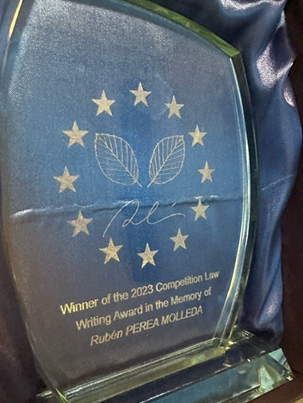
On 1 April 2020 we lost Rubén Perea, a truly extraordinary young man who was about to start a career in competition law. We decided to set up an award to honour his memory, and to recognize the work of other promising competition lawyers/economists under 30. EVP Vestager kindly agreed to deliver this Award.
Today we are announcing the winner and runners-ups of the 4th edition of this award. The winner of the 4th (2023) Rubén Perea Award is…
MUHAMMED MUSTAFA POLAT for his paper “Unraveling Labor Market Collusion: A Comprehensive Analysis Under EU Competition Law “.
The Jury also selected 5 other papers of particularly high quality. JECLAP will publish these papers in a special issue. These finalists and selected papers are:
- “Corporate Sustainability Due Diligence and EU Competition Law: Mandatory Due Diligence Collaborations Under the EU Corporate Sustainability Due Diligence Directive Exempted from the Application of Article 101 (1) TFEU?” (by Lois Elshof)
- “Efficiency and Capabilities in Article 102 TFEU“ (by Selçukhan Ünekbaş)
- “Reconsidering the Limits of EU Competition Law on the IP-Competition Interface” (by Quentin Schäfer)
- ”Access to Environmental Justice under the Aarhus Convention: Evaluating the Contemporary Hurdles for ENGOs in Challenging State Aid Decisions under EU Law “ (by Anna-Lici Scherer)
- “Competition and the Green Deal: a Study of Consumers WTP for CO2 Emissions Reduction in the Italian Car Market” (by Alessandra Catenazzo)
Our warmest congratulations go to Muhammed and the finalists. And thanks a million also to all those who submitted their work for this award. We received a large number of anonymous submissions; you truly made the Jury have a hard time.
This year’s jury composed of renown experts, some of whom were also friends, former teachers or colleagues of Rubén, namely Damien Gerard, Michele Piergiovanni, Gianni de Stefano, Lena Hornkohl, David Pérez de Lamo, Nicolas Fafchamps, Eugenia Brandimarte and myself (our gratitude goes to all of them for devoting part of their time to this project).
We will soon be announcing the 5th edition of the Rubén Perea Award. Stay tuned!
LSE Short Courses on Advanced EU Competition Law (May 2024) | Registration open

Slowly but surely, the Short Course on Advanced EU Competition Law is becoming an annual tradition at LSE Law School. The details on the fourth (!) edition, to take place in May of this year, can be found here.
I have been encouraged by the interest it has sparked in the community (we have had a full house every time) and by the fact that exchanging views with the world of practice (there is always a great and balanced mix of civil servants and practitioners, both from law firms and in-house) is invariably enriching for an academic.
Just like the preceding ones, the fourth edition is designed with full-time professionals in mind. The course (16 hours in total) takes place online on Friday afternoon over four weeks (2pm-6pm London time; 3pm-7pm continental time).
The course is limited to around 25 participants to maximise interaction (and I can tell from experience that interaction was definitely maximised in the preceding years).
We will be addressing in a systematic way the many exciting developments that are transforming competition law across the board (agreements, abusive practices and merger control). The idea is to give you an updated account of the most recent developments and help you navigate them by providing an analytical framework.
As you will see in the course page, the precise dates are: 3rd, 10th, 17th and 24th May.
An LSE Certificate will be available upon completion, along with CPD points for practitioners.
If you have any questions about the organisational aspects of the two courses, do not hesitate to contact my colleague Amanda Tinnams: A.Tinnams@lse.ac.uk.
Recent developments in EU Competition Law (9 February 2024- Hybrid event)
Like every year, Fernando Castillo de la Torre (Director of the Competition team at the European Commission’s Legal Service) and Eric Gippini-Fournier (Competition Hearing Officer) have put together a one-afternoon seminar on recent developments in EU Competition Law as part of the annual IEB competition law course. The seminar will take place (under Chatham House rules) next Friday 9 February 2024 between 16 and 20.30 CET. If you’re in Madrid, you can attend in person but, if not, you can also join the discussion online.
For registrations, please write to competencia@ieb.es
More information on logistics is available here:
This is the program:
16:00 – 17:45: Cartel Policy today and tomorrow
Soledad Blanco Thomas, DG COMP
Marisa Tierno Centella, Director for Competition, CNMC
Johan Ysewyn, Partner, Covington & Burling
Peter Whelan, Professor, University of Leeds
18.00 – 19.30: Towards Article 102 Guidelines
Mark English, Partner, Garrigues
Cristina Sjödin, Member of the Legal Service, European Commission
Elena Zoido, Executive Vice President, Compass Lexecon
19.45 – 20.30: EU Competition Law and Sports; the December 2023 judgments in Superleague, ISU and Royal Antwerp
Alfonso Rincón, Partner, MLAB
Launch of The New EU Competition Law (POSTPONED)

We regret to inform you that we have been forced to postpone, due to illness, the even that we had scheduled for tomorrow to celebrate the launch of Pablo’s new book.
We will reschedule once Pablo is back on his feet, which we all trust will happen very soon!
The New Competition Law (II): whatever happened to the ‘more economics-based approach’?

I look forward to seeing many of you next Thursday in Brussels for the launch of The New EU Competition Law. The other half of Chillin’Competition, as well as other good friends of the blog, will be there. It promises to be fun.
The first post on the book addressed the institutional transformation that the EU competition law underwent with the adoption of Regulation 1/2003. Today’s entry focuses instead on the intellectual shifts that the discipline has experienced over the past 20 years, which I address in Chapter 2 of the book (‘The rise and decline of the “more economics-based approach”‘).
The ‘more economics-based approach’ was all the rage in the early 2000s. The modernisation of Articles 101 and 102 TFEU, which was the big buzzword at the time, referred both to the substantive and the institutional changes to the application of the two provisions.
In those days, it felt as if economic analysis was taking EU competition law to its own ‘end of history’. Articles 101 and 102 TFEU (in addition to merger control), it seemed, were changing for good. This is the context in which Christian Ahlborn and Jorge Padilla coined the term ‘Brussels consensus’ (see here for their original contribution) and captured the zeitgeist.
It does not feel this way anymore. If anything, the impression is that there a new consensus is forming around different ideas. Economic analysis is not absent from this emerging consensus: its role, however, is different.
What happened over the past decade? Why are the ideas driving the rise of the ‘more economics-based approach’ seemingly falling out of favour?
Chapter 2 explains that the key might lie with perceptions about what makes competition law enforcement legitimate.
The ‘more economics-based approach’ was, I argue, a rational response by the European Commission to a legitimacy crisis in the system. The authority understood that enforcement would not be accepted as legitimate if not informed by economic analysis.
Under the ‘Brussels consensus’ what matters, above all, is input and process. What matters, in other words, is that competition authorities rely on the best available expertise and that the assessment asks the right substantive questions. The outcome (that is, whether an infringement is established or not) is something about which the system is agnostic.
Things have changed over the past decade (I draw evidence in this sense, inter alia, from some of the leading conferences organised in Brussels).
With the rise of Big Tech, and under the influence of old and new ideas, what is expected from the competition law system is that it delivers. Enforcement is deemed legitimate, in other words, if it is able to enact change.
Many stakeholders are no longer satisfied with asking the right questions and pondering whether intervention is warranted in the specific circumstances of the case. The expectation is that authorities deliver the palpable, timely restructuring of digital and other markets.
Outcomes (as opposed to input and process) are now the driving force under the emerging consensus. A number of important consequences follow. One of them is that the relationship with economic analysis changes. Formal economics does not act as a constraint on enforcement (or not in the same way it did under the ‘Brussels consensus’).
A second one is that, if the existing tools do not deliver the desired outcomes (or do not do so in a timely and/or effective manner), then new tools are introduced. This is the background against which we must make sense of the adoption of the Digital Markets Act.
A third one is that the priorities change. A key tenet of the ‘Brussels consensus’ was scepticism vis-a-vis distributional issues, in particular in the context of Article 102 TFEU. The discipline would focus on exclusion, leaving the allocation of rents to other fields of law.
Not anymore: redistribution is front and centre of the new EU competition law, with all the fascinating substantive and institutional consequences that follow.
We will be discussing all the above, and much more, next week in Brussels. À bientôt, and all the best for 2024!
NEW PAPER | Competition on the merits

What is competition on the merits? This is the question I seek to answer in my most recent paper, available here.
The notion of competition on the merits seemed irrelevant not so long ago (that is, before Servizio Elettrico Nazionale exposed a friction in the case law). Landmarks of the 2010s such as Post Danmark I, TeliaSonera or Intel went about applying Article 102 TFEU without paying much attention (if any) to this notion.
Competition on the merits is now back in all discussions (and, for some, central to determine whether or not a given practice amounts to an abuse). Against this background, the paper seeks to answer two interrelated questions. What is competition on the merits? Does Article 102 TFEU apply to normal conduct or is an abuse an inherently ‘abnormal’ or ‘wrongful’ act?
It makes sense to start with the second. An overview of the case law suggests that normal conduct can be subject to Article 102 TFEU. ‘Normal’, in this context, means that the strategy is potentially pro-competitive (that is, firms can have recourse to it for non-exclusionary reasons) and that can be implemented by both dominant and non-dominant firms (that is, it is not the exclusive province of the former).
Exclusive dealing, tying and rebates (not to mention a refusal to deal with a third party) are all normal in this sense. However, we know well that they may amount to an abuse of a dominant position where certain conditions are met.
How about competition on the merits? The paper explains that this notion has become an irritant in the case law, in the sense that it is a source of confusion and frictions.
Tensions can be explained in part by the fact that the notion of competition on the merits was introduced at a time when the prevailing ideas about abusive conduct were very different from today’s.
In the 1960s and 1970s, it was assumed that abusive practices could be identified ex ante and in the abstract. The underlying premise was that it was possible to draw a clear dividing line between unlawful conduct and legitimate expressions of competition on the merits.
The case law that followed (as well as the evolution of legal and economic thinking) moved away from these ideas. Whether or not most practices amount to an abuse is a context-specific exercise, not an abstract one detached from ‘all the circumstances’ surrounding their implementation.
If most practices are neither inherently good nor bad and the application of Article 102 TFEU is very much context-dependent, what is the contemporary role of competition on the merits?
My argument is that the notion of competition on the merits has role to play in the contemporary case law if it is interpreted in light of the ‘as efficient competitor’ principle (which has been a consistent feature in the judgments delivered over the past decade, including in yesterday’s ruling in Superleague).
Against this background, the argument provides a positive and a negative definition of the notion.
From a positive perspective, a dominant firm can be said to compete on the merits where it gets ahead in the marketplace with, inter alia, better, cheaper and/or more innovative goods or services.
The corollary to this positive definition is that, where the exclusion of a rival is attributable to the fact that the latter is less attractive along one or more parameters of competition, the practice is not abusive. Any exclusion would be the manifestation of competition on the merits.
From a negative perspective, a dominant firm does not compete on the merits in three instances.
First, where the practice has an anticompetitive object (that is, it makes no economic sense other than as a means to restrict competition). Pricing below average variable costs is the classic example in this regard.
Second, where the strategy involves the use of assets not developed on the merits (that is, assets that have been developed with State support, either in the form of State aid or the award of exclusive rights). In this instance, which was at stake in Post Danmark II, the ‘as efficient competitor’ principle would not be the benchmark against which the lawfulness of the practice is assessed.
Third, where the practice, while potentially pro-competitive, causes the exclusion of equally efficient rivals. In the latter, instance, the question of whether the behaviour is an expression of competition on the merits and that of whether it is exclusionary collapse into one and the same issue.
Based on the above, one can classify the case law in the manner you see on the Table below:

I would very much welcome your comments on the paper. As usual, I have nothing to disclose.
On Superleague and ISU: the expectation was justified (and EU competition law may be changing before our eyes)
Last year, in an editorial published in JECLAP, I asked whether Article 106 TFEU would change EU competition law. I pointed out that some rulings, including the General Court’s in ISU, gave the impression that Article 106 TFEU doctrines were slowly creeping into the case law dealing with Articles 101 and 102 TFEU.
The two (eagerly awaited) Court of Justice judgments in ISU itself and Superleague suggest that this transformation of EU competition law may well be under way, at least in relation to firms that have, de iure or de facto, the power to decide who gets to compete with them.
The key takeaway, in my view, is that organisations with such a regulatory or quasi-regulatory function are subject to the sort of obligations that apply to Member States pursuant to Article 106 TFEU. A distinct, stricter tier of competition law appears to govern the activities of such organisations.
Article 106-like obligations include, in particular, the respect of the principle of equality of opportunity and the duty to adopt rules that are transparent, objective, non-discriminatory and reviewable.
Any deviation from these obligations, when implemented by such organisations, presumptively amounts, it would seem, to a restriction of competition (and, more precisely, a by object infringement within the meaning of Article 101(1) TFEU and an abuse of a dominant position).
Article 102 TFEU in Superleague
The Superleague judgment starts with the application of Article 102 TFEU to FIFA’s and UEFA’s rules on the organisation of football competitions (and which may constrain third parties’ ability to run rival tournaments).
Some aspects of the ruling are strictly canonical, and capture the case law of the past decade (concerning, in particular, the ‘as efficient competitor’ principle). There are also interesting references to the notion of competition on the merits (on which I will follow up soon).
I find it particularly intriguing that the Court expressly refers to the object or effect of restricting competition in the context of Article 102 TFEU (see para 131 of Superleague: ‘conduct may be categorised as “abuse of a dominant position” […] where it has been proven to have the actual or potential effect – or even the object – of impeding potentially competing undertakings at an earlier stage‘; emphasis added).
In other respects, however, the judgment is genuinely innovative. As much as some recent General Court judgments, the Court relies upon the Article 106 TFEU case law applying to State measures, such as GB-Inno-BM, Merci convenzionali porto di Genova or MOTOE).
The overarching point seems clear: where an organisation is, de iure or de facto, in a position that is comparable to that of an undertaking enjoying exclusive rights, it is subject to strict non-discrimination obligations, aimed at preemptively addressing the risk of an abuse (para 138 of Superleague).
In the specific circumstances of the case, the Court strongly signals that rules on the prior approval of football competitions are not necessarily abusive. However, they must be subject to appropriate constraints if they are to be compatible with Article 102 TFEU.
Where an organisation has the regulatory means to decide go gets to compete with it, the judgment explains, there must be a substantive and procedural framework detailing how its regulatory powers are to be exercised (para 147 of Superleague). In the same vein, the organisation must avoid imposing sanctions in a discretionary manner (para 148 of Superleague).
Restrictions by object by sports organisations
The appeal in ISU focused on Article 101(1) TFEU, and more precisely on whether rules limiting (or prohibiting altogether) athletes’ ability to take part in some championships restrict competition by object. The Commission had taken issue with the so-called ‘eligibility rules’ laid down by the International Skating Union (and which went through various iterations over the years).
As I wrote a while ago, the General Court’s ruling introduced a novelty in its analysis of restrictions by object, in that it appeared to inject Article 106 TFEU case law (such as MOTOE) into the assessment. It also relied upon judgments like OTOC to substantiate its findings (even though the relevant passages from OTOC concerned the effects of the rules, as opposed their object).
The innovations introduced by the General Court have now been validated by the Court of Justice. Thus, the rules set by an organisation with a regulatory function must respect the principles of transparency, objectivity, non-discrimination and reviewability if they are to comply with Article 101(1) TFEU. Where they do not, they will amount to a restriction of competition by object.
Paras 131 to 149 of ISU depart in some respects from the canonical approach to the identification of restrictions by object (interestingly, and somewhat paradoxically, paras 101 to 108 of ISU are arguably the best and most elegant summary of the said canonical approach).
The analysis in ISU focuses more on the effects of the eligibility rules (and, more precisely, on the fact that they give the International Skating Union discretionary power and thus the ability to restrict competition and impose disproportionate sanctions) than on their object.
The ISU judgment appears to conflate, in other words, one and the other (and, similarly, borrow from the former to establish the latter). This cross-fertilisation had been carefully avoided in the past (establishing the object of an agreement in the relevant economic and legal context is indeed different analytically and conceptually from showing its effects).
However, it is not entirely impossible to rationalise the Court’s approach. When it comes to bodies with a regulatory function, the absence of checks is treated as a presumptive restriction of competition, without it being necessary to assess its impact. As already mentioned, a stricter tier of EU competition law appears to have been introduced.
The relationship between ancillary restraints and restrictions by object
There is another aspect of ISU that is worth emphasising. In para 113 of that ruling, the Court clarifies that the ancillary restraints doctrine applies only to agreement that do not have, as their object, the restriction of competition.
This point is, arguably, self-evident. The ancillary restraints doctrine presupposes that the overall agreement to which the clause relates is not restrictive by its very nature (if the agreement does not have an anticompetitive object, and the clause is objectively necessary to its operation, the latter escapes Article 101(1) TFEU altogether).
It is valuable and important, however, that the Court is explicit about this point. The issue may come back in future sports cases, and in particular the one dealing with agents’ regulation (which I discussed here). If the rules at stake in the case are found to be ancillary within the meaning of Meca Medina, it would mean, by implication, that their object is not anticompetitive.
REGISTRATION OPEN | The New EU Competition Law launches in Brussels (Fondation Universitaire) – 11th January, 5pm

The New EU Competition Law will launch in Brussels on 11th January (Fondation Universitaire, 5pm), with the support of LSE Law School and in cooperation with the College of Europe and its Global Competition Law Centre.
Click here to register for the event.
As you see in the programme below, I will be joined by a group of outstanding experts to discuss various aspects of the book. I very much look forward to seeing many of you there! Please get in touch in case you have any questions.
Programme:
17.00 | Welcome: Inge Govaere (Ghent and College of Europe)
17.15 | The New EU Competition Law : Mapping the Transformation
- Pablo in conversation with Pascale Déchamps (Autorité de la concurrence), Luc Gyselen (Arnold & Porter) and Marieke Scholz (European Commission)
18.15 | Break
18.30 | The New EU Competition Law : Looking into the Future
- Pablo in conversation with Filomena Chirico (European Commission and College of Europe), Alexandre de Streel (Namur and College of Europe) and Alfonso Lamadrid de Pablo (Garrigues and College of Europe)
19.30 | Closing remarks: Bernd Meyring (Linklaters and College of Europe)
19.45 | Drinks reception
The New Competition Law (I): the transformations of enforcement under Regulation 1/2003
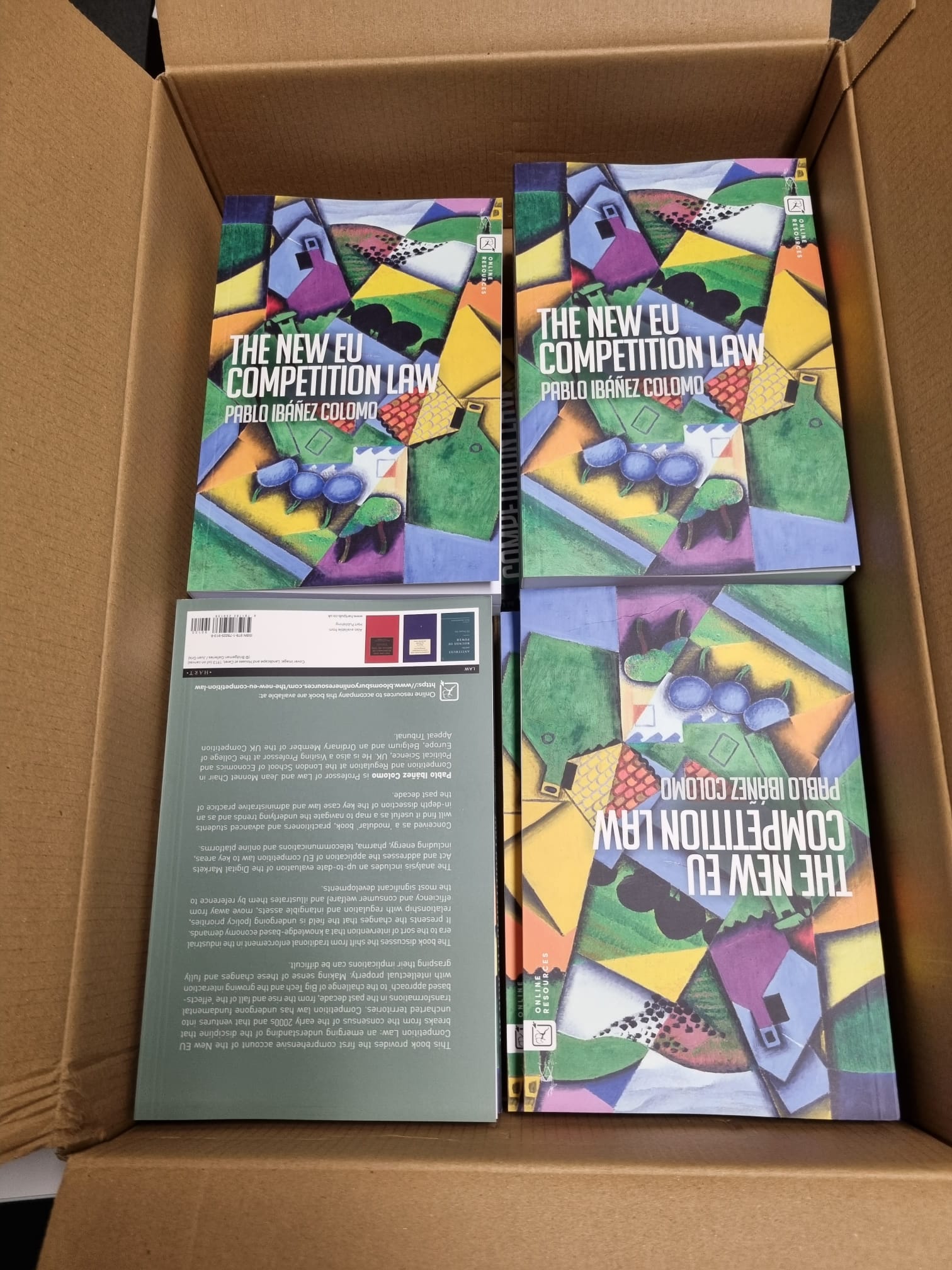
The New EU Competition Law comes out this Thursday (check here for a 20% discount). As you see in the picture, I got to see the hard copies (finally!) last week, with that beautiful painting by Juan Gris adding life and colour to the cover (it is the second time his work features in a book of mine, and something tells me it will not be the last). And I started to get the urge to share with the world what the monograph is all about. Which takes me to the topic of this post.
The starting point of the book is the realisation that EU competition law has changed in fundamental ways since the entry into force of Regulation 1/2003. I felt that these mutations had not been examined systematically in a single monograph, but in disparate articles that addressed one aspect or the other. As is often the case, I found myself trying to put together something I could not find elsewhere.
What are the mutations that Regulation 1/2003 favoured? In essence, this regime gave more freedom to the European Commission: more freedom to decide which cases to investigate and more freedom to make the most of its limited resources.
The new institutional landscape led to two shifts (which I discuss in Chapter 1). First, the Commission has explored, significantly more frequently than in the past, into the substantive and institutional limits of Articles 101 and 102 TFEU. ‘Market-shaping’ enforcement, in other words, has become a central feature of the contemporary landscape.
This transformation, alone, speaks to the success of Regulation 1/2003 and, more generally, of the EU model. It means that the Commission is not paralysed by fear (whether the fear relates to the exploration of new doctrines, the reinterpretation of existing ones or the implementation of the remedies) when applying Articles 101 and 102 TFEU.
Second, enforcement has become ‘policy-driven’, as opposed to ‘law-driven’. This phenomenon is not surprising. The Commission emphasised, in the lead up to Regulation 1/2003, that, after four decades, there was a ‘competition culture’ firmly in place in the EU and announced that, in the new landscape, it would make a more assertive use of its powers to advance its policy objectives.
The symbol of ‘policy-driven’ enforcement is the commitments decision, which has featured prominently in non-cartel investigations (in particular in ‘market-shaping’ cases, which demand, by their very nature, complex and resource-consuming remedies).
These two transformations have been compounded by a shift in the intellectual climate (addressed in Chapter 2) since the early to late 2010s. The modest, technocratic view of competition policy that dominated enforcement since the late 1990s progressively gave way to an approach that is less concerned with Type I errors and more with the effective application of Articles 101 and 102 TFEU.
There appears to be a progressive move away from the ‘more economics-based approach’: a new consensus may well be developing around a different set of values.
These transformation of the institutional and intellectual landscapes have had several consequences for EU competition law (and, as I argue, have led to the emergence of a ‘new’ iteration of the discipline). My book focuses on two of these consequences.
One of these consequences, which cuts across the whole of the book, is the permanent interaction with economic regulation (Chapter 3). ‘Market-shaping’ enforcement, by definition, is regulatory-like (it may lead, inter alia, to a duty to deal, to price regulation or to the redesign of products and business modelas).
Inevitably, it will enter into contact and interact with other regimes (such as telecommunications and energy regulation, which I cover extensively in Chapter 6). In some cases, Articles 101 and 102 TFEU have acted as a safety net or filled gaps in regulation; in others, they have gone as far as to rectify it or amend it de facto.
Occasionally, competition law has addressed a brewing ‘expectation of regulation’ that legislation may not be in a position to address fully and/or immediately (the legislative process is known to be often protracted and unpredictable).
Over time, it has become increasingly difficult (and increasingly pointless) to draw the line between competition law and regulation: it is no longer easy to figure out where one starts and where the other finishes. And it does not really matter. In a sense, the relationship between the DMA and Article 102 TFEU (and, indeed, the very existence of the DMA), encapsulates this idea well (as I argue in Chapter 5).
A second consequence is the change in the relationship with intangible property in general and intellectual property in particular (Chapters 4 and 7). During the formative years, EU competition law was largely deferential to intellectual property systems.
This attitude has changed over the past few years across a number of fronts that involve copyright and patents. I have discussed extensively many of these developments on the blog: taken together these developments signal a more assertive attitude vis-a-vis the malaise in intellectual property.
I very much look forward to discussing my ideas, on this platform and elsewhere. On this same note: remember that we will have a get-together on 11th January (Brussels) and 25th January (London). More details will follow soon!


 Chillin'Competition