Competition v IP

I attach a presentation I gave yesterday at the University CEU San Pablo in Madrid.
The presentation adresses wether competition policy contributes to investment in innovation.
I slightly reframed it though, to envision it under the competition v IP angle.
The picture above says it all of my views on this issue.
Comments welcome.
Interesting statements
The past few days have left us some interesting statements on the competition front. Here’s a personal selection. Happy to add any others any of you might have.
A) The French Industry Minister said last week that EU’s competition rules are “stupid and counter-productive“. I can understand part of the point, but the view that ”Europe organized the balkanization of its companies by chasing down state aid” is peculiar, given that the State aid control regime seeks precisely to eliminate barriers to inter-State trade. As put by José Luis Buendía in another often quoted statement, “State aid ‘DNA’ shares more chromosomes with internal market rules than with antitrust rules“.

This disrespect towards misunderstanding of competition law seems to be a non-partisan feature of French politics. Many of you might remember Sarkozy’s comments about endive producers not being Apple or Microsoft (see here) (the statement was not without consequences: it led our friend Mark English to stop wrapping his iPhone in ham).
B) Slow, ignorant’ lawyers charge by the hour to inflate bills, says President of British Supreme Court. A statement that adds up to a controversy we’ve often echoed regarding billable hours (see our previous post “Is associate lawyer the unhappiest job?“)

C) Have law blogs surpassed law reviews? That’s not really a statement, but rather an interesting (and interested) read.

D) The tone of the comments regarding Google’s proposed commitments has increased and reached new heights. A few days ago, an “anonymous” (no wonder!) lawyer representing one of the complainants said: “All we have to go on at the moment is what Almunia has said and it is absolutely not encouraging. Putting lipstick on a pig does not mean it is not a pig (…). “It’s starting to look like he just wants to get a deal before his term as Commissioner is up next year.”

Game Changer: Wathelet’s Opinion in Telefonica

And today, the best of the CJEU’s recent output: AG Wathelet’s Opinion in Telefonica v. Commission, C‑295/12 P (in French):
24. Un argument est souvent soulevé à l’encontre de l’approche préconisée dans les présentes conclusions, à savoir que Tribunal ne doit ou ne peut pas «s’immiscer» dans la fixation de l’amende, et de ce fait dans la politique de la concurrence, qui relève de la seule responsabilité de la Commission. Je ne partage pas ce raisonnement dès lors que le Tribunal ne se prononce que sur une affaire particulière. La Commission garde donc toutes ses compétences pour définir et appliquer sa politique générale dans d’autres dossiers.
125. Je déduis de ce qui précède et plus particulièrement sur la base des points 62 de l’arrêt Chalkor/Commission, précité, et 129 de l’arrêt KME Germany e.a./Commission, précité, que, à mon sens, lors de son contrôle, le Tribunal ne saurait s’appuyer sur la marge d’appréciation dont dispose la Commission ou la seule erreur manifeste d’appréciation qu’elle aurait commise en ce qui concerne le choix des éléments pris en considération lors de l’application des critères mentionnés dans les lignes directrices de 1998 ou l’évaluation de ces éléments, pour renoncer à exercer un contrôle approfondi tant de droit que de fait ou ne pas exiger que la Commission explique le changement de sa politique d’amende dans une affaire spécifique.
126. En tout état de cause, selon la jurisprudence de la Cour – même si le Tribunal peut à la limite, le cas échéant, se référer «au ‘pouvoir d’appréciation’, à la ‘marge d’appréciation substantielle’ ou à la ‘large marge d’appréciation’ de la Commission [ce que selon moi il ne devrait plus faire], de telles mentions [ne peuvent] pas empêch[er] le Tribunal d’exercer le contrôle plein et entier, en droit et en fait, auquel il est tenu» (63) (c’est moi qui souligne).
127. Au point 78 de son arrêt Chalkor/Commission, précité, la Cour juge que «le Tribunal ne s’est pas limité à ce contrôle de conformité aux lignes directrices, mais a contrôlé lui-même, au point 145 de l’arrêt attaqué, l’adéquation de la sanction».
128. La Cour a aussi rappelé dans l’arrêt SCA Holding/Commission (64) que «le Tribunal est compétent pour apprécier, dans le cadre du pouvoir de pleine juridiction qui lui est reconnu par les articles 172 du traité CE [désormais article 261 TFUE] et 17 du règlement n° 17 [article 31 du règlement n° 1/2003], le caractère approprié du montant des amendes. Cette dernière appréciation peut justifier la production et la prise en considération d’éléments complémentaires d’information dont la mention dans la décision n’est pas comme telle requise en vertu de l’obligation de motivation prévue à l’article 190 du traité [désormais article 296 TFUE]» (c’est moi qui souligne).
129. Le Tribunal doit donc estimer par lui-même si l’amende est adéquate et proportionnée et est obligé de constater par lui-même que tous les éléments pertinents aux fins du calcul de l’amende ont été effectivement pris en considération par la Commission, étant entendu que le Tribunal doit également être à ce titre en mesure de revenir aux faits et aux circonstances avancés par les requérants devant lui (65).
Flatline

I recently had the opportunity to sift through the recent case-law of the Court.
The CJEU ruling in Allianz Hungary, C-32/11 stands out.
Our Lords again blurred the object/effect distinction.
The Court held that “object” restrictions can be established by proof of anticompetitive effects:
“§34. Accordingly, where the anti-competitive object of the agreement is established it is not necessary to examine its effects on competition. Where, however, the analysis of the content of the agreement does not reveal a sufficient degree of harm to competition, the effects of the agreement should then be considered and, for it to be caught by the prohibition, it is necessary to find that factors are present which show that competition has in fact been prevented, restricted or distorted to an appreciable extent […]
§36. In order to determine whether an agreement involves a restriction of competition ‘by object’, regard must be had to the content of its provisions, its objectives and the economic and legal context of which it forms a part […]. When determining that context, it is also appropriate to take into consideration the nature of the goods or services affected, as well as the real conditions of the functioning and structure of the market or markets in question […]“
Of course, my positivist friends will not fail to remind me that the Court had already said this in previous cases.
But let’s call a spade a spade: the Court’s insistence on reaffirming bad precedent reveals that the virus of legal non-sense is deep ingrained.
The upshot of Allianz Hungary is to unduly expand the “object” box, meanwhile creating much legal uncertainty.
In a recent speech, A. Italianer implicitly confirmed this, by saying that restrictions by object are serious, but “not necessarily obvious“.
In practice, parties lose the ability to articulate “effects-based” (and other) defenses, and face a considerably tougher task under 101(3) TFEU.
But the most bizarre statement is elsewhere. At §44, the Court held:
“With regard to determining the object of the agreements at issue in the main proceedings with respect to the car insurance market, it should be noted that, by such agreements, insurance companies such as Allianz and Generali aim to maintain or increase their market shares“
You read well: for the Court it is unlawful to cast agreements with purchasers with a view to maintain or increase market shares.
My practitioner friends often complain that it becomes impossible to advise on Article 102 TFEU. I guess that with such judgments, it is becoming equally complex to provide antitrust counseling under Article 101 TFEU.
Or is it the contrary? With such basic, formalistic reasoning, providing competition law advice under 101 and 102 TFEU is increasingly simple, since most inter-firms agreements and dominant firm conduct are unlawful as such.
Or the Court’s contribution to undermining the market for specialist competition law advice.
For more, see the excellent analysis of http://europeanlawblog.eu/?p=1664
Samsung offers commitments to appease DG Comp

The most important (antitrust-related) news last week was the European Commission’s announcement that it will market test a commitment proposal submitted by Samsung regarding the enforcement of its SEPs (Standard Essential Patents) related to mobile communications.
As you know, the Commission considered in its December 2012 Statement of Objections that the seeking of court injunctions by Samsung in relation to SEPs which it had committed to license on FRAND terms, or that third parties (i.e. Apple) were apparently willing to agree to license on FRAND terms, could amount to an abuse of dominance, because “access to patents which are standard-essential is a precondition for any company to sell interoperable products in the market” (press release dixit; we’ll come back to this phrase at the very end of the post). The theory goes that the challenged enforcement of SEPs could allow Samsung to obtain licensing terms that the licensee wouldn’t have agreed to absent the threat, and that this “undue distortion of licensing negotiations” would harm consumers in a number of different ways.
[Query 1: is this an exclusionary abuse? an exploitative one? both?; Query 2: Would an alleged abuse of this sort lend itself to the application of the Guidance paper?; Query 3: If the answer to query 2 is “no”, then what are the criteria to undertake a legality assessment of a situation like this? Query 4: How does one assess the likelihood of anticompetitive effects in a situation like this?; Query 5: can you distinguish a willing licensee from a non-willing one without taking a view on what’s FRAND? (I guess the proposed solution arguably gives an answer to this 5th question; if someone’s willing to accept the proposed framework… ); Query 6: Was Apple -the de facto complainant- a willing licensee in this case?].
Samsung (which just before receiving the SO had unilaterally withdrawn all its European SEP-based injunction claims) has now offered to refrain from seeking injunctions for past, present and future mobile (smatphone and tablet) SEPs for a period of five years againts any company adhering to a given licensing framework. As explained by the Commission itself (and here I’m “scraping” its Press release) “the licensing framework consists of: (i) a negotiation period of up to 12 months and (ii) if no agreement is reached, a third party determination of FRAND terms by either a court or an arbitrator, as agreed by the parties. If the parties cannot agree on either submitting to court or arbitration, the parties will have to submit to arbitration“.
The Commission has also published a Q&A document. The full version of the proposal is available here.
Some well known commentators in the patent blogosphere swiftly commented on the proposal in a critical manner (see “EU Commission market-tests totally insufficient FRAND commitments offered by Samsung“). My preliminary take is that, even if some issues may (inevitably?) be left open, this proposal would shed some welcome light on a much contentious subject.
We’d be happy to host a discussion in Chillin’Competition, and welcome the views that any of you might have with regard to both the case and the commitments proposal.
Let me get the ball rolling:
Antitrust Desk Cleaning

Lucky me, I am in London today invited to a conference entitled “C5 Managing Competition Risk and Compliance“:Conference – 612L14_Managing Competition Risk Compliance_S)
The topic is “Key EC reforms and the expected impact on regulatory enforcement“, or “what will be the focus of EC regulatory enforcement in the coming year“.
Unlucky me: I had to take a try at antitrust astrology.
Hereafter is the best I could come up with: Managing Competition Risk & Compliance – N PETIT
New Blog – Emulation/Innovation
My assistant Norman has just started a blog on competition and IP law (in French).
To all the readers of this blog who understand French: subscribe to his feed!
I am sure you’ll find it surprising and insightful.
Congrats to Norman for growing the competition blogging family.
Collective Amnesia

The forgotten reason why national competition laws should – literally – not exist.
Article 3 TFEU: 1. The Union shall have exclusive competence in the following areas: (b) the establishing of the competition rules necessary for the functioning of the internal market;
Or why they should be abolished when the internal market will be effective (will it ever?).
Nico wins best legal book of the year award

First it was the Jacques Lassier prize for his PhD thesis (see here).
Then the Antitrust Writing Award (thanks, btw, to the campaign I so well managed… ; see here).
And now (actually, last Saturday) Nico got the “Prix du livre juridique” to the best legal book published in France (see here), for his new textbook Droit européen de la concurrence.
The prize was awarded at the Constitutional Court in Paris; prestigious setting for a prestigious prize (see pic above; in case you were wondering, Nicolas is the one posing).
Judging by his mother’s comment on his Facebook wall, the prize has made the family happy. You know, there haven’t been so many ocassions to feel proud of the chap 🙂
Congrats to Nico for the prize and for his contribution to spreading the competition gospel in France. Hopefully new generations of French will gain a better understanding of competition law and, unlike the jury in this case, will be able to tell what’s sound legal competition reasoning and what’s not !
P.S. Contrary to what you might think, I’m not writing this simply to promote my co-blogger’s achievement. I’m doing it because the a****** said he won’t give me a free copy, so I’m hoping that some advertisement will earn me one from the publisher.
The Article 102 TFEU Bible is Out
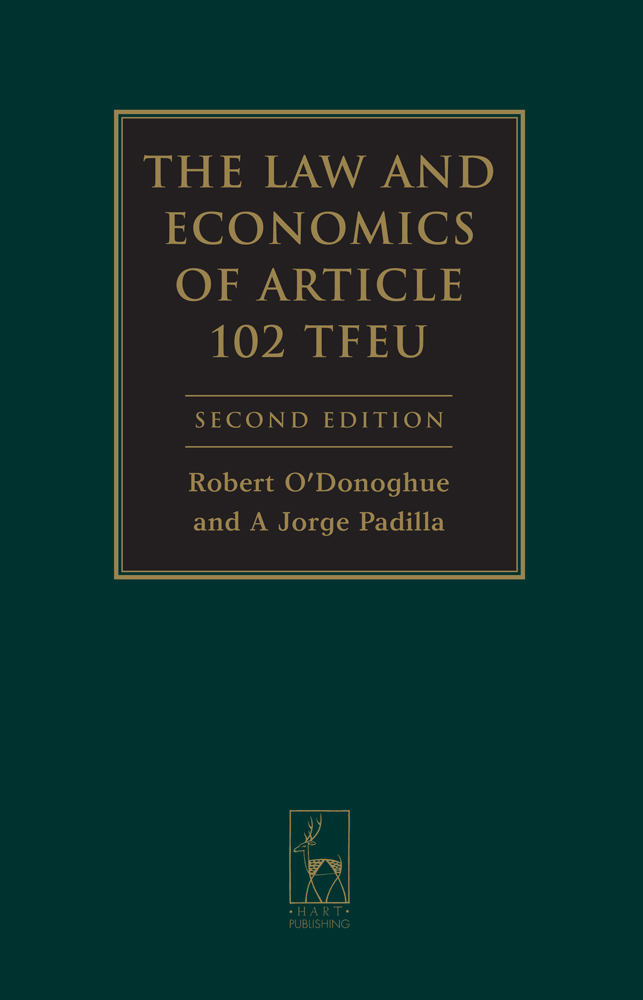
Many competition bibles are released lately.
Today’s bible is clearly, and without the shadow of a doubt, THE reference on Article 102 TFEU.
I guess everyone should thank Robert O’Donoghue and Jorge Padilla for the assistance they have provided to the competition community since the 1st ed.
There is a world before and a world after “The Law and Economics of Article 102 TFEU“.
Clearly, this book should be compulsory reading for anyone approaching the law of abuse of dominance.
I guess it should even be subsidised by agencies.
I paste below the official announcement on Hart Publishing’s website.
The bottom line on what the publishing market tells us: a good bible needs a Spanish author (with the possible exception of this one :)).
New 2nd Edition
The Law and Economics of Article 102 TFEU
By Robert O’Donoghue and Jorge Padilla
The Law and Economics of Article 102 TFEU is a comprehensive, integrated treatment of the legal and economic principles that underpin the application of Article 102 TFEU to the behaviour of dominant firms. Traditional concerns of monopoly behaviour, such as predatory pricing, refusals to deal, excessive pricing, tying and bundling, discount practices and unlawful discrimination are treated in detail through a review of the applicable economic principles, the case law and decisional practice and more recent economic and legal writings. In addition, the major constituent elements of Article 102 TFEU, such as market definition, dominance, effect on trade and applicable remedies are considered at length. Jointly authored by a lawyer and an economist, The Law and Economics of Article 102 TFEU contains an integrated approach to the legal and economic principles that frame policy in this major area of competition law. Although written primarily with practitioners and in-house lawyers in mind, it is essential reading for anyone with an interest in competition law enforcement against monopoly behaviour.
Robert O’Donoghue is a barrister at Brick Court Chambers, London and Brussels.
A Jorge Padilla is Senior Managing Director and Head of Compass Lexecon Europe.
October 2013 1078pp Hbk 9781849461399
RSP: £145 / €188
20% Discount Price: £116 / €150.40
Order Online in the UK, EU and Rest of World
UK, EU and ROW : http://www.hartpub.co.uk/BookDetails.aspx?ISBN=9781849461399
If you would like to place an order you can do so through the Hart Publishing website (link above). To receive the discount please type the reference ‘CCB’ in the voucher code field and click ‘apply’.


 Chillin'Competition