Archive for March 2010
Penguin Dinner 2

This really addictive game will learn you how to allocate scarce resources efficiently, how to make economies of scale, and how to increase labour productivity.
Beware, your own productivity might in turn decrease dramatically. Found on the hilarious blog optimum (in French).
A question to our readers

For weeks now, I have unsucessfully been looking for a specialist of horizontal cooperation agreements under EU competition law.
Could someone help? I need to find a person able to deal with the various types of cooperation agreements.
You can throw names as comments to this post, or if you want full confidentiality, email me at nicolas.petit@ulg.ac.be. I would be immensely grateful for some help.
30 April – Conference on New EU Regulatory Framework for Electronic Communications

The Institute for European Legal Studies (IEJE) of the University of Liege will hold in Brussels on 30 April a half day conference on the new EU Regulatory Framework for Electronic Communications. My good friend Laurent de Muyter (ULg and Jones Day) has helped me bring this conference to birth. I attach the programme below.
Above is a draft logo for the Liege LLM. If you have any comments on it, please let me know.
IEJE Conference on the Next EU Communications Framework – 30 04 10
Oligopolistic collective dominance: the BCA’s Telefonica decision

Some weeks ago, the Basque Competition Authority (“BCA”) issued a decision which has gone largely unnoticed outside of Spain, but which is definitely worth commenting here. To my knowledge, this decision is the first ever to sanction an abuse of a purely oligopolistic collectively dominant position.
In essence, the decision concludes that Telefónica de España SAU (“TSAU”, a subsidiary of Telefónica SA) abused of its dominant position in retail fixed telephone market, and, more interestingly, that Telefónica Móviles (“TME”, another subsidiary of Telefónica SA) also abused of the collective dominant position it held together with Vodafone and Orange in the Spanish retail mobile telephone market.
The BCA considers that TME, Vodafone and Orange constituted a “tight oligopoly”, and pursuant to a thorough examination of market conditions at the moment where the investigated infringements took place, it concludes that the Airtours conditions for a finding of collective dominance are fulfilled. The BCA further refers to the existence of empiric evidence of parallelism of prices and other commercial conditions adopted by the members of the oligopoly. Moreover, citing the CFI’s Judgment in TACA, the decision rebuts the contention that a certain degree of internal competition (allegedly illustrated by the high degree of portability) is incompatible with a finding of collective dominance.
With regards to the abusive conduct, and also in a nutshell, the BCA asserts that both TSAU and TME charged discriminatory tariffs to calls destined to users of the Euskaltel mobile network. The decision concludes that such conduct breached Article 2 of the Spanish Competition Act, and imposes TESAU and TME fines of nearly 3 and 1 million euros respectively.
A few brief comments:
Firstly, it’s interesting to remark that the Comisión Nacional de la Competencia had attempted to affirm its jurisdiction to deal with this case, but the organism in charge of addressing jurisdictional disputes between the CNC and regional authorities ruled in favor of the Basque Authority in light of the strictly local effects of the conduct under analysis. My guess is that had the CNC investigated the case, its outcome would have certainly been quite different.
Secondly, collective dominance is one of the favorite topics of Nicolas and myself, but also of Javier Berasategi, the author of the Telefónica decision, see here (his first work on the subject while a student in Bruges) and here (English version of a recent and extensive report on tacit collusion in the daily distribution of consumer goods which relies heavily on Nicolas’ work). It seems as if this or a similar decision had been under gestation for quite some time.
Finally, independently of whether one believes or not on the necessity of having several regional competition authorities in one Member State, it seems fair to acknowledge that in the past few years, under the Presidency of Berasategi, the Basque Competition Authority has brought forward very interesting cases on which it has adopted brave and innovative but always technically sound decisions.
Only a few days after the Telefónica decision was issued, Berasategi stepped down from the Presidency of the Basque Authority to start a new project in private practice. Congratulations for the good work, and the best of luck in his new venture!
(Image possibly subject to copyrights: source here)
The Geographics of Brussels Competition Law Firms

I visited today the offices of Altius, one of the top Belgian law firms. I was really amazed. Their offices are located at Tour et Taxis, and I must say this is a truly awesome spot for a law firm: very classy building mixing old and modern art; many restaurants, cafes, travel agencies and other service providers on the site; close to the train station and a mile away from the highway to Brussels international airport.
Against this background, I understand less the comparative advantage of settling on Avenue Louise, as most business law firms do when they do launch a practice in Brussels:
- It is more expensive than other areas
- Heavy trafic jam in the morning and afternoon
- There’s no metro station to get there (only a tram, which often finds itself struck in the trafic)
- It is far from the highway entry/exit points
- Buildings are generally huge towers which all look alike
Of course, there are nice shops in the neighborhood of Avenue Louise. Yet, as a law firm manager, you may actually view this as a counteradvantage, in that it will distract staff and associates during lunch breaks. Moreover, most of those shops sell expensive goods and services (jewelry, luxury suits, etc.). Even if competition lawyers earn a very decent life, I am not sure they purchase luxury shoes every day.
In fact, the only decisive thing about Avenue Louise is that it is near the bois de la cambre, which makes it a cool place for running lawyers.
A number of other firms (e.g., Stibbe, Howrey, Cleary) have actually decided to settle elsewhere than on Av. Louise.
Below, a few other pictures of Tour et Taxis.

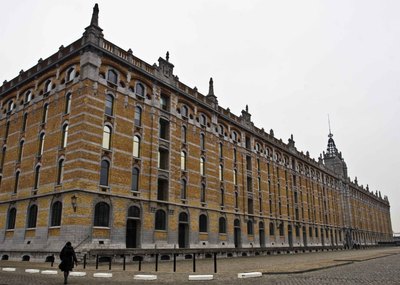
The next battleground for competition lawyers
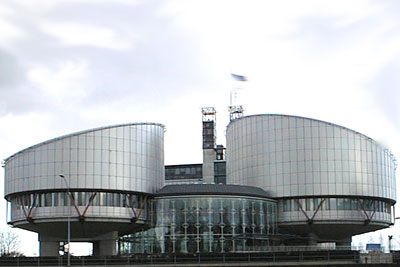
The vociferations of EU lawyers against alleged prosecutorial/decisional biases, criminal nature of the fines system, etc., will soon be put to the test.
Last week, the Commission proposed negotiation directives for the Union’s accession to the European Convention on Human Rights (ECHR). This means that acts of the EU institutions, including Commission decisions and rulings of the EU courts in the field of competition law might soon become challengeable in Strasbourg, for violation of the convention.
I suspect the judges in Luxemburg will not be happy about this.
Thanks to C. Bergqvist for the pointer.
(Image possibly subject to copyright: source here)
Show Business Competition Policy
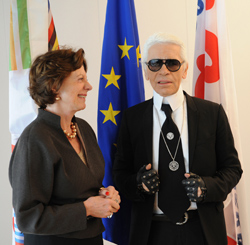
In a speech on Friday I alluded to this concept to describe the past five years of competition enforcement. Just thought a picture would help understand.
Slides of Today’s Lunch Talk and other Important GCLC News

I am a great fan of Luis Ortiz Blanco. I attach his slides below, see in particular the inspiring Part II entitled “Let’s talk real business“.
Now, a few announcements: Bernard Van de Walle de Ghelcke (Linklaters) is the new President of the GCLC, he replaces Jacques Bourgeois. Tarik Hennen (Stibbe) will serve as the new Executive Secretary. He replaces the author of this blog.
As to me, I have the great honour of becoming the new director of the GCLC 🙂 in replacement of Damien Geradin. I am thrilled. Please note that in this new capacity, I am happy to consider any project/idea/cooperation plan you may wish to submit.
Antitrust Movies

Two new leniency videos, respectively by the Swedish and Dutch competition authorities. I actually prefer the second one, which looks more dramatic and glamorous. Yet, the first one may reach out to a bigger audience. Its characters are ordinary sales persons tempted by cartel activity. The second one abuses the cliché of CEOs smoking cigars and drinking cognac in luxurious venues.
Thanks to Christian Bergqvist (Copenhagen Law School) for the pointer.


 Chillin'Competition