Archive for June 2012
Antitrust Parable (2) – The Kroes and The Almunia

A well-inspired friend sent us a new version of yesterday’s Antitrust Parable. We liked it, so we post it:
The Kroes. The Kroes’ job was to catch as many fish as possible, and the bigger the better. Every fish she caught she showed it off and was very proud. When she caught a really big fish the press would report in wonderment about Kroes’s great prowess. If another NCA got a bigger fish, she was embarrassed and immediately went after a fish that was even bigger. Smaller fishes she threw back because she wanted more fish. She saw to it that there were plenty of places for fish to breed and plenty of sources of food for them. Anything that prevented the fish from thriving and multiplying she opposed, because she wanted more and bigger fish.
The Almunia. The Almunia hated cases and wanted only to protect the business. He did not want to catch cases, but caught any he discovered. But he also encouraged staff to scare away cases [settlement?]. He sealed up the holes where cases could hide. He looked for any technique anywhere that would scare away cases [press releases, speeches, RFI…]. If something worked against having cases, he used it. If he caught a case he apologized to the townspeople because one had gotten through. He did everything he could so there would be no cases now or in the future. He wanted to protect the grain for the townspeople.
Antitrust Parable – The Fisherman, the Miller and DG Comp

Here is a little story about the fisherman, the miller and DG Comp (courtesy of a source that we will keep confidential):
The fisherman. The fisherman’s job was to catch as many fish as possible, and the bigger the better. Every fish he caught he showed it off and was very proud. When he caught a really big fish the press would report in wonderment about the fisherman’s great prowess. If another fisherman got a bigger fish, he was embarrassed and immediately went after a fish that was even bigger. Smaller fishes he threw back because he wanted more fish. He saw to it that there were plenty of places for fish to breed and plenty of sources of food for them. Anything that prevented the fish from thriving and multiplying he opposed, because he wanted more and bigger fish.
The miller. The miller hated rats and wanted only to protect the grain. He did not want to catch rats, but caught any he discovered. But he also encouraged cats to scare away the rats. He sealed up the holes where rats could hide. He looked for any technique anywhere that would scare away the rats. If something worked against the rats, he used it. If he caught a rat he apologized to the townspeople because one had gotten through. He did everything he could so there would be no rats now or in the future. He wanted to protect the grain for the townspeople.
DG Comp. DG Comp views its job as catching as many cartels as possible, and the bigger the better. Every cartel it catches it shows off and is very proud. When DG Comp catches a really big cartel the press reports in wonderment about DG Comp’s great prowess. If another government gets a bigger cartel, DG Comp is embarrassed and immediately goes after a cartel that is even bigger. Compliance programs it ignores because it wants to find more cartels. Compliance programs can seriously harm the places where cartels breed and endanger the sources of conspirators necessary for cartels. Company in-house lawyers can help prevent cartels from thriving and multiplying, so DG Comp opposes their professional privilege. Anything that prevents a cartel from thriving and multiplying DG Comp opposes, because it wants to catch more and bigger cartels.
State aid conferences: that’s where the fun is!

(You’ll understand why we chose this pic if you keep on reading)
The European State Aid Law Institute held its 10th Experts’ Forum on new developments in European State aid law last Thursday and Friday.
I didn’t attend (as a means to reducing my current backlog I’m quitting conferences for a while) but some of my colleagues did. One of my bosses colleagues, José Luis Buendía, develivered a critical presentation on the State Aid Modernisation Initiative (“SAM”). Hopefully he will be able to turn it into a post for this blog once he manages to take some time off for this (he’s currently a bit busy representing the Spanish Fund for Orderly Bank Reestructuring, which will be borrowing 100.000 million euros from the EU rescue funds; see here or, actually, almost anywhere else).
I hear that there were other excellent sessions (e.g. there seems to be unanimous praise for Marc van der Woude’s presentation), but the session that will perhaps stick for longer in attendees minds was the Opinion Panel featuring Ryanair´s CEO (Michael O´Leary) and the Deputy Director General for State aid (Gert-Jan Koopman). As you may know, O´Leary has a reputation for being somewhat of an histrionic character, and he stood up to it.
The version of O´Leary’s CV included in the materials was already a bit different from the usual stuff (I promise I’m not making any of this up):
“Michael O´Leary has served as Ryanair CEO since 1993. Born in a stable in 1961, he was a boy genius, who excelled both academically and at sports. Having represented Ireland internationally at bog snorkelling and flower arranging, he graduated from Trinity College in Dublin as soon as they could get rid of him. He then became another boring KPMG accountant until divine inspiration sentenced him to a life of penal servitude in the airline business. Despite his best efforts, Ryanair is the World´s favorite airline, with 1,5000+ low fare routes accross 28 countries. (…) It is widely known that women find him irresistible“.
Some of the points he made in his speech that were most warmly received by the Commission were that (i) DG COMP has hired North-Korean economists to draft the guidelines on regional airports ; (ii) that no Commission official has ever set foot in Charleroi because they only fly on expensive tickets ; (iii) that he had woken up to fly at 6 a.m, something that the Deputy Director General does not even conceive has humanly possible; and (iv) that there are only two sorts of people that like the guidelines: flag carriers and Kim Jong Il. His last slide was actually of Kim Jong Il saying “These guidelines are fab!”.
I’m so sorry I missed it…
Nick Banasevic appointed head of the unit in charge of IT, Internet and consumer electronics

We have just learnt (via M-lex) that Nicholas Banasevic has been appointed Head of the Unit dealing with IT, internet and consumer electronics at DG COMP.
In previous posts we had already highlighted the importance of this appointment at a time when this particular unit is dealing with an immense workload which includes some of the most interesting ongoing cases in our discipline.
We hear that the competition for the job was very tough, and that says a lot both about DG COMP’s staff and about the newly appointed Head of Unit.
Nick is not only an excellent economist, a hard-working, nice and very very tall guy, but he’s also very reasonable, which means that he probably won’t mind about us commenting critically (for good or for bad) on his unit’s work.
Congrats and best of lucks to him!
The Price of Secrecy

Chatham house is throwing a very cheap conference on what looks like a very well-thought, and focused topic: “Competition policy in global markets“.
Here’s the price menu for the conference:
| Standard Rates | ||
|---|---|---|
| Commercial Organizations: | £895 (£1074 inc VAT) | |
| Government Departments: | £650 (£780 inc VAT) | |
| NGOs and Institutions: | £395 (£474 inc VAT) | |
The bottom-line:
I still fail to understand how officials from competition authorities can accept to participate to such events.
Mixed Bag
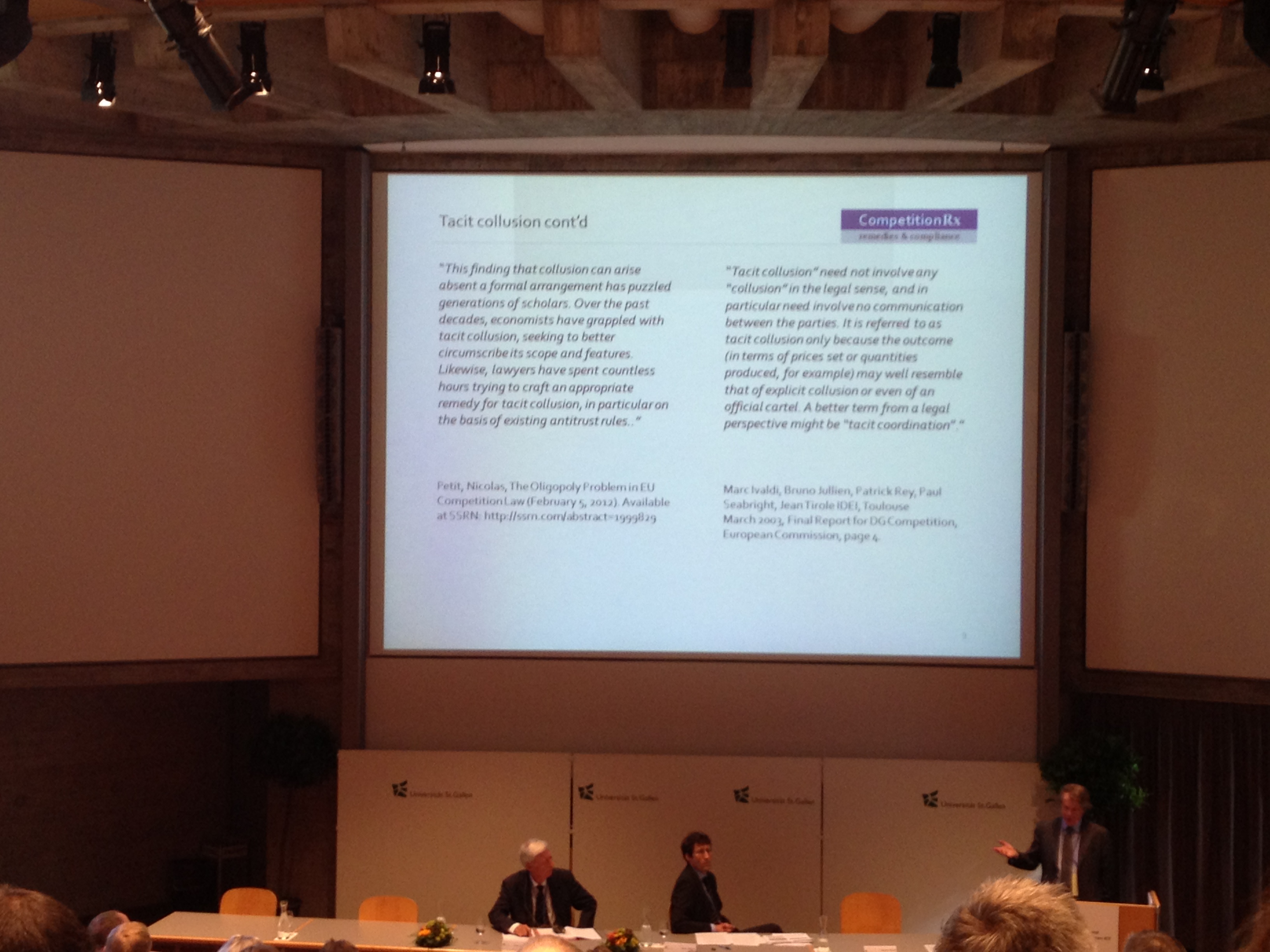
Alfonso must be busy dealing with the negative externalities inflicted by my previous posts (with which he had nothing to do, btw),
It is thus my task to run the blog today. In brief, I have also inflicted a negative externality to my poor self 😦
A mixed bag of things:
- The spirit of emulation within the ECN is amazing. The endives saga is just over. But the veggie decisional roulette keeps spinnin’. A few days ago, the Dutch competition authority slapped a €14,000,000 on bell pepper and onion growers for unlawful cartel. With this focus on agricultural products, the conspiracy theorist that sleeps in me cannot help but thinking that the MS are trying to get their CAP money back. Thanks to D. Mamane (Schellenberg Wittmer) for the pointer;
- Some more results, of EU officials this time, at the 20K: An Renckens (1:26:35); Oliver Stehmann (1:32:09); Sébastien Thomas (1:35:20); Anthony Whelan (1:50:36); Guillaume Loriot (1:52:06); Piet Van Nuffel (1:54:50). I stopped under 2 hours, as the list was pretty lenghty. Please send me your time if you want to appear on this post;
- Dan Sokol (University of Florida and Ioannis Liannos (UCL) new book The Global Limits of Competition Law is out. Looks really nice. Chillin’Competition would welcome a review copy;
- The American Antitrust Institute has put together The International Handbook On Private Enforcement Of Competition Law. Same here, a review copy would be appreciated;
- Who monitoring trustees really are? I thought until now that they were specialised consultants. But in reading a commentary on Intel/McAfee this morning, I learned that former CEOs also make good candidates. In this case, Mr. Olli-Pekka Kallasvuo, former CEO of Nokia, was appointed as Monitoring Trustee;
- Our friend David Mamane (him again) made my day in sending me a picture of today’s St Gallen competition conference. Apparently, my name was high on the screen (see picture on top of this post). Thanks to him, and to Tom Hoehn (the speaker), who quoted me in public;
- I was interviewed today in a local Belgian newspaper on what the concrete impact of the EU on Belgian’s daily life. A tricky question, which demanded quite some thinking. See the result here: Sudpresse – 7 juin 2012;
- Turning to less serious press, I was quoted in the LA Times on the Google case. From what I read, I disagree with Dennis Oswell (Oswell and Vahida). To me, the Commissioner’s move sends the signal that COMP’s case is weak. In line with past practice, the Commission could have simply requested a settlement behind closed doors it if it had had a strong case. My best scientific explanation of why the Commission departed from conventional practice? => it is trying to play some sort of poker game: with strong hands, try to look weak; with weak hands, try to look strong. And BTW, Regulation 1/2003 does not entitle the Commission to formally request Article 9 commitments. They must be proposed by the parties.
| 1:26:35 |
The Economist Corner (4) – Are Cartel Fines too Low?

Given today’s announcement, I suspect Alfonso has better to do than posting on this blog. Run, Alfonso (on the banks), run!
With this, it is thus my duty, and honour, to introduce the 4th edition of the Economist Corner. For this edition, Benoît Durand (RBB Economics) has sent us a good piece on a money-related issue, i.e. fines for cartel infringements. Enjoy!
In the last decade the European Commission has imposed higher fines on cartels, in particular under the helm of Neelie Kroes. The stated purpose for this increase was that fine levels were not sufficiently high to deter the formation of cartels.
In general, the deterrence property of sanctions is a key aspect of law enforcement. Becker (1968), who was the first to apply economic principles to crime and punishment, explains that the level of sanctions should be set so as to deter crime. A high level of sanction in turn contributes to minimise the costs of enforcing the law.[1]
Firms consider the expected benefits and costs of participating in a cartel. Under this logic, if the expected sanctions are higher than the collusive gains, then firms will not take the chance. Because there is always a significant probability that cartels slip through the net, the penalties should be several times larger than the gains such that no firm would dare try fixing prices. By way of example, consider that a cartel member expects to pocket 50 million euros extra every year for about 6 years, whilst the probability of being caught is 1 out of 5. In this setting, it would take a massive fine of slightly more than 1.5 billion euros to convince a firm not to collude.[2]
As cartels continue to exist, it must be the case that the current level of sanctions is ineffective. This is the conclusion that Combe and Monnier (2011) draw after reviewing the fines for 64 EC cartel decisions between 1979 and 2009. They show that in virtually all cases fines were set below the optimal deterrence level; i.e. in spite of the sanctions, the cartels were profitable.[3]
Is it therefore necessary to raise corporate fines above the current levels to deter the formation of cartels? It is hard to say, but to achieve full deterrence, competition authorities need not increase fines at stratospheric levels as suggested by the logic described above. First, they could adjust sanctions to give cartel members the incentive to undercut each other, which would trigger the collapse of cartels. Second, in complement to corporate fines, competition authorities could consider applying measures targeted at company officers who have brokered the cartel agreement.
Ruminations on the Google investigation

Over the past few months we have provided you with our views on the investigation undertaken by the European Commission with respect to Google. Here is an account of recent developments, thoughts, concerns, readings, ideas, and possible questions to be posed:
The developments. As you all may well know, the Commission has sent Google a preliminary assessment (a necessary formal step towards a commitment decision under Article 9 of Regulation 1/2003) and has requested Google to provide swiftly proposals of possible commitments that could address the concerns set out on that document. For the Commission’s statement identifying in broad terms the practices it objects to, see here.
In parallel, Google has lodged a complaint against Microsoft and Nokia. Google claims that “Nokia and Microsoft are colluding to raise the costs of mobile devices for consumers, creating patent trolls that side-step promises both companies have made. They should be held accountable, and we hope our complaint spurs others to look into these practices“. We have no additional information on this complaint and therefore do not have any opinion on whether it may be well-founded or not, but we regard it as something potentially interesting given that, until now, patent trolls had managed to stay more or less away from the antitrust spotlight in this bout of “patent wars” (note the IPCom settlement).
(By the way, the European Commission has excellent staff working on the unit dealing with cases related to IT, Internet and Consumer Electronics, but they must be incredibly swamped with so many complaints piling up on their desks).
The substantive concerns. We’ve already been quite vocal about our substantive concerns with regard to this case (note the caveat that we speak about matters of principle and on the basis of almost no case-specific information), so we won’t insist on them today.
The policy concern. We fully understand the policy rationale for changing the tone and attempting to address competition concerns in high-tech innovative markets swiftly and on the basis of “negotiated” solutions. However, the increasingly frequent recourse to such solutions also gives rise to several concerns. One of them is that commitment decisions do not contain a final position on the existence or non-existence of an infringement. If such decisions become the standard way of dealing difficult with cases –which would then be left substantively unresolved-, this would imply blurring the contours of the law. Laws should be clear. How can we expect the law on Article 102 to be clear when 14 out of the past 17 abuse of dominance cases were put to an end by virtue of brief and unconclusive commitment decisions? How does one strike the right balance between setting the law straight and addressing competitive concerns rapidly and effectively?
The doubt. (this one is not our’s but Pablo Ibañez’s): does publicly requesting a company to offer commitments fit with the letter and spirit of Article 9 of Regulation 1/2003?
The idea. We feel a bit frustrated by the fact that we’ve spent months thinking about this investigation having no information other than news clips and press releases. We’d love to see how the Commission has framed its concerns regarding Google under current competition law standards. We do not rule out the possibility that we may have been wrong all along, and maybe (although I have my doubts) having a look at the Commission’s preliminary assessment would convince us. How about requesting access to the non-confidential versions of the key documents in the file pursuant to Regulation 1049 as soon as the investigation is over? It could be an interesting exercise…
Competition law for kids

If you want to know how to teach the virtues of competition, the harms arising out of monopolies and the concept of an exclusionary abuse to 1-4 year old kids, this could do the trick: http://www.youtube.com/watch?v=3GZ5Yz97erE
Thanks to our yongest reader (Eduardo Guilbeau López, pictured below reading us) for the pointer [and congrats on his second birthday 😉 ]

More 20K results
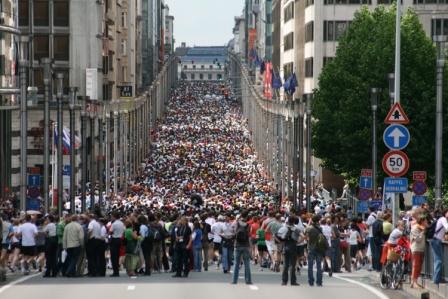
More results, including several IP lawyers.
- Matthew Levitt (HoganLovells): 1:46:25
- Jean-Jo Evrard (former University of Liege and Darts IP): 1:47:31
- Enrique Gonzalez Diaz (Cleary): 1:48:44
- Norman Neyrinck (University of Liege): 1:48:52
- Alain Strowel (University of Liege): 1:49:01
- Thomas Wiese (Ashurst): 1:50:52
- Valentijn de Boe (Allen&Overy): 1:51:56
- Tom McQuail (Morrison Foerster): 1:54:59
- Damien Gerard (Cleary): 1:57:30
- Philip Bentley (Mc Dermott): 1:56:49
- Dirk Auer (Herbert Smith, former ULg student): 1:58:29
- Cedric Burton (Hunton & Williams): 2:01:45
- Maarten Meulenbelt (Sidley): 2:02:10
- Geert Zonekeyn (Ronse): 2:07:10
- Kristina Nordlander (Sidley): 2:10:05
- Philip Werner (Mc Dermott): 2:13:36
- Sarah Ashall (Shearman): 2:57:53
PS: I just selected the people I know. Apologies to those that I missed.


 Chillin'Competition