Author Archive
Announcing the Winner and Finalists of Chillin’Competition’s 5th Rubén Perea Award
On 1 April 2020, almost 5 years ago, we lost Rubén Perea, a truly extraordinary young man who was about to start a career in competition law. We decided to set up an award to honour his memory, and to recognize the work of other promising competition lawyers/economists under 30. EVP Teresa Ribera has kindly agreed to deliver this award. As of this year, we also welcome EU Law Live as a partner in this initiative.
Today, we are announcing the winner and runners-ups of the 5th edition of this award. Thanks a million also to all those who submitted their work for this award. We received a large number of very good submissions and the Jury had a pretty tough time selecting the finalists.
And the winner of this year’s Rubén Perea Award is…
Pablo González Casín for his paper “Airline Cooperation and Competition Law: A Transatlantic Perspective. An analysis of Case Law and Unrealized Scenarios“.
The Jury also selected four other papers of particularly high quality. JECLAP will publish these papers in a special issue. These are:
- “From Economic Security to Legal Uncertainty: Exploring the Impact of the FDI Screening Regulation and Foreign Subsidies Regulation on Mergers and Acquisitions in the EU” (by Enrico Zonta)
- “Demand in Mobile Application Markets and the Role of Top Charts Ranking” (by Benedetta Gianola)
- “Optimal Fines in EU Competition Law – an Economic Analysis“ (by Adnan Tokić)
- “Smokescreens of Digital Markets – Choice Manipulation and the Illusion of Consent“ (by Naimy Paul)
Our warmest congratulations go to Pablo and to the four finalists.
This year’s jury included various experts, some of whom were also friends, former teachers or colleagues of Rubén, namely Petra Nemeckova, Gianni De Stefano, Lena Hornkohl, David Pérez de Lamo, Nicolas Fafchamps and Eugenia Brandimarte. Our gratitude goes to all of them for devoting part of their time to this project.
Is the “exclusionary effects” filter set out under the Draft Guidelines on Article 102 TFEU an empty one?
The “revolution”, “counterrevolution” and most debates around Article 102 TFEU over the past couple of decades have revolved around the notion of an “effects-based approach”. Yet, there remains considerable uncertainty as to the meaning of “effects” in abuse of dominance cases. This is remarkable given the Court’s clarification that a finding of abuse presupposes that the conduct at issue “at the very least, is capable of producing exclusionary effects” (Superleague, para. 130). Indeed, establishing exclusionary effects/foreclosure is the bottom line in every case. If the notion of effects is too narrow or demanding, effective enforcement may be compromised. If, on the contrary, there are no discernible limitations to the notion of effects, then this paves the way to discretionary enforcement and legal uncertainty. We should arguably avoid either extreme.
In the Policy Brief launching the process for the future adoption of Guidelines on Article 102 TFEU (titled “A dynamic and workable effects-based approach to abuse of dominance”) the Commission acknowledged that “[t]he effects-based approach promoted by the Commission is clearly reflected in [case law developments]” (p.2), but also raised “the question of whether the heightened substantive legal standard that the Union Courts have accorded to it may inadvertently lead to undesired outcomes”, expressing concern that “the bar for intervention [could be set] at a level that would render enforcement against practices that restrict competition unduly burdensome or impossible” (p.4).
The desire to “consolidate the case law” in such a way as to make the effects-based approach more “workable” also inspired the March 2023 amendments to the Guidance Paper on exclusionary abuses. With those amendments, the Commission replaced the notion of “anticompetitive foreclosure” that the Commission had publicly committed to follow since the original 2008 version of the Guidance Paper, and which was consistent with that used under merger control (see e.g. the Commission’s non-horizontal merger guidelines, para. 18). This significant amendment, which implied not only signposting for the future, but arguably also an element of goalpost-moving, received scarce attention at the time.
The draft Guidelines now take several additional steps to alleviate the Commission’s burden of having to establish exclusionary effects:
First of all, it is noteworthy that under the approach set out the Commission would not need to establish anticompetitive effects in cases involving “naked restrictions” (Draft Guidelines, para. 60.c) or conduct otherwise “presumed to lead to exclusionary effects” (including exclusivity agreements, conditional rebates, predatory pricing, margin squeeze and certain forms of tying; Draft Guidelines, para. 60.b)). This reliance on presumptions has already been the subject of much commentary (see, e.g., here, here, here, or here).
But for the purposes of this post I will focus on the analytical framework that the Draft Guidelines propose to follow in relation to the only category of practices that the Commission itself describes as “conduct for which it is necessary to demonstrate a capability to produce anticompetitive effects” (Draft Guidelines, para. 60.a):
If one connects what the Draft Guidelines say regarding capability, causality and appreciability together with their definition of exclusionary effects, my reading is that even in the subset of cases where the Commission would be required to establish effects, the Commission would only need to show that conduct by a dominant firm is capable, considered together with other factors, of potentially increasing the likelihood that rivals (including in some cases less efficient rivals) may find it somewhat more difficult to compete against a dominant undertaking (e.g. by increasing barriers to entry), even if the added difficulty is minimal or not appreciable.
Query: Can anyone think of any conduct outside the scope of competition on the merits that would not meet this test?
I can’t. And if every conduct deviating from competition on the merits (itself a controversial and vaporous filter, as discussed here or here) would meet this test then, arguably, the requirement that conduct must be capable of having exclusionary effects to fall within the scope of Article 102 TFEU would constitute an empty filter.
There are, I suppose, three possible counterarguments to my observation, namely (a) that my reading of the Draft Guidelines is an oversimplification; (b) that the Draft Guidelines are simply and objectively based on established case law; and/or (c) that, in practice, the Commission would in any case exercise self-restraint. So let’s address those:
Read the rest of this entry »Reminder: 5th Rubén Perea Writing Award – The deadline is one week away (15 October 2024)
| There’s still a week for you (or your under-30 students/colleagues/friends) to submit a paper for the 5th Rubén Perea Writing Award. As many of you know, our friend and colleague Rubén Perea Molleda passed away five years ago just when he was about to start a promising career in competition law following his graduation from the College of Europe. Rubén remains very present in the memory of everyone who had the chance to cross paths with him. In his memory, we created a competition law writing award. The 5th edition is still open for submissions, but the deadline is now only one week away. As in previous editions, the winning paper will be published in a special issue of the Journal of European Competition Law & Practice, together with a selection of the best submissions received. Who can participate? You may participate if you remain below the age of 30 by the submission date (i.e., if you were born after 15 October 1994). Undergraduate and postgraduate students, as well as scholars, public officials and practitioners are all invited to participate. What papers can be submitted? You may submit a single-author unpublished paper which is not under consideration elsewhere. The paper may be specifically prepared for the award or originally drafted as an undergraduate or postgraduate dissertation or paper. The paper must not exceed 15,000 words (footnotes included; no bibliography needed). Prior to submission, please make sure your paper follows the JECLAP House Style rules, which can be found here. How to submit? Please submit the paper via this link: https://mc.manuscriptcentral.com/jeclap. IMPORTANT: As you go through the submission process, make sure that in Step 5, you answer YES to the question “Is this for a special issue?”, and indicate that your submission relates to the Rubén Perea Award. What is the DEADLINE? Papers have to be submitted by 23.59 (Brussels time) on 15 October 2024. |
GCR LIVE- Law Leaders Europe (9-10 July 2024)
Global Competition Review will be hosting the 2024 edition of its Law Leaders Europe conference in Brussels on Tuesday 9 and Wednesday 10 July. Pablo and Director General Olivier Guersent will be the keynote speakers, and I will be co-chairing the conference together with Ethel Fonseca (RBB), Andrea Gomes da Silva (Fingleton) and Thomas Janssens (Freshfields).
Over two days, the conference will cover pretty much all significant recent (and expected) developments in the competition law field. The full, and pretty impressive, list of speakers is available here.
The program and all other relevant info are also available here.
Announcing the 5th edition of the Rubén Perea Writing Award
Our friend and colleague Rubén Perea Molleda passed away five years ago just when he was about to start a promising career in competition law following his graduation from the College of Europe. Rubén remains very present in the memory of everyone who had the chance to cross paths with him. In his memory, we created a competition law writing award. Today we are launching its 5th edition.
As in previous editions, the winning paper will be published in a special issue of the Journal of European Competition Law & Practice, together with a selection of the best submissions received (the JECLAP special issue featuring the winner and finalists of the 4th edition will be out very soon; the articles are already available as a pre-publication).
Who can participate?
You may participate if you remain below the age of 30 by the submission date (i.e., if you were born after 15 October 1994). Undergraduate and postgraduate students, as well as scholars, public officials and practitioners are all invited to participate.
What papers can be submitted?
You may submit a single-author unpublished paper which is not under consideration elsewhere. The paper may be specifically prepared for the award or originally drafted as an undergraduate or postgraduate dissertation or paper.
The paper must not exceed 15,000 words (footnotes included; no bibliography needed).
Prior to submission, please make sure your paper follows the JECLAP House Style rules, which can be found here.
How to submit?
Please submit the paper via this link: https://mc.manuscriptcentral.com/jeclap.
IMPORTANT: As you go through the submission process, make sure that in Step 5, you answer YES to the question “Is this for a special issue?”, and indicate that your submission relates to the Rubén Perea Award.
What is the DEADLINE?
Papers have to be submitted by 23.59 (Brussels time) on 15 October 2024.
Finding consensus in Article 102 cases (I)- When do the Bronner conditions apply?
Events and discussions around Article 102 are mushrooming in anticipation of the Commission’s draft guidelines on exclusionary abuses, which will likely be subject to public consultation during the summer. Over the next few days I will be taking part in two of those, namely at a BIICL workshop (The future of Article 102 TFEU) in Brussels (today) and at the GCLC’s annual conference in Bruges (Article 102 TFEU- Past, Present, Future) on 1-2 March. (Future conference titles may need to get more creative).
One of the elements that makes Article 102 a most attractive topic for both academic debates and litigation is the uncertainty as to what the law is. Still today, debates in both academic fora and individual cases tend to focus on what the law is (e.g. what is competition on the merits? when do we need to show foreclosure? what is foreclosure? what is the role of the AEC principle? do we need to conduct a counterfactual analysis in 102 cases?, etc), as opposed to on how the law should apply to a specific set of facts/evidence. This is remarkable, and arguably in no one’s interest (unless you’re into lawyering or legal blogging); enforcers, courts and companies would all benefit from a stable and predictable legal framework.
Having spent the past few years debating Article 102 both within and outside Courts, I have come to realize that, contrary to appearances, there is much more common ground and scope for consensus on the applicable legal framework than meets the eye. Most of the discussions on these topics tend to be polluted by a desire to influence, justify, secure or revert the outcome of individual cases, but when one forgets for a moment about specific cases, spaces for consensus start to emerge. To give you an example, after debating some of the major pending cases together in Court, Fernando Castillo and I had a recent debate on Article 102 issues where, after leaving case-specific discussions on the side, we were able to agree on some questions of principle. There is, after all, some truth to the idea that difficult cases make bad law, and all Article 102 cases tend to be difficult cases.
This is all to say that the upcoming guidelines are a perfect opportunity to try to find and build on that common ground to clarify the law instead of to fight about it. In that spirit, we will be publishing a series of blog posts, and at some point a paper (which will also reflect the feedback we receive here) on how we can find consensus on Article 102 based on hopefully non-controversial principles already settled by the Courts. This is not about meeting in the middle, but about having an honest discussion based on an honest interpretation of the case law.
For the purposes of this first post, let me illustrate my point by reference to one of the debates by reference to one of the debates that has kept lawyers (including myself), courts and pundits busy for the past few years.
When do the Bronner conditions apply?
We have spent years debating whether the Bronner conditions should apply or not to margin squeeze, to constructive or passive refusals, to implicit or explicit requests/refusals, to self-preferencing, etc, but the CJEU’s position is clear, consistent and, I think, very hard to disagree with.
According to the CJEU, the imposition of those conditions is necessary and justified where a finding of abuse “has the consequence of forcing an undertaking to conclude a contract with [a] competitor”, because “such an obligation is especially detrimental to the freedom of contract and the right to property of the dominant undertaking” (Slovak Telekom, para. 46).
The CJEU said the same in Lithuanian Railways (para. 86) and in Deutsche Telekom (para. 46). The GC recently said the same in Bulgarian Energy Holdings (para. 257, also 258, 282 and 451). AG Saugmandsgaard Øe explained this perfectly in his Opinion in Slovak Telekom (para. 74). AG Rantos explained it perfectly in his Opinion in Lithuanian Railways (paras. 64, 81 and 85), and AG Kokott also explains it in her recent Opinion in Google Shopping (paras 84-86). As AG Kokott observes, “after all, every obligation which Article 102 TFEU imposes on that undertaking to grant access or to supply to its competitors comes with an interference with that right and that freedom and must therefore be carefully weighed up and justified”.
What matters, in other (the Court’s) words, is whether intervention under competition law would have the consequence of depriving the dominant company of its freedom of contract and right to property, and not so much the labels that one may use to describe the conduct at issue (e.g. constructive vs outright refusals). The European Commission has practically always held the same view; see for example the Commission’s written pleadings in Slovak Telekom, where the Commission explained to the Court that “the distinction (…) between outright refusals and constructive refusal is misleading. The true distinction is whether the circumstances are such that a compulsory access obligation stems directly from Article 102 TFEU, with failure to grant such access constituting an abuse (…)” (para. 34).
Many people would probably expect me to say that I disagree because this is an excessively narrow interpretation of the Bronner case law, but I don’t. Relying on the practical consequences of competition law intervention, as opposed to on formal categorizations, is the perfect way to ensure legal certainty and respect of fundamental rights, and to avoid an unduly wide or narrow application of those conditions. I have no trouble, for example, with the idea that margin squeeze needs to be subject to a different standard, which some have strongly disputed. In my mind the Court of Justice’s case law on this point is clear and sensible.
This, of course, does not mean that we will not continue to disagree on how this test applies to individual cases. For example, I may see weak spots in AG Kokott’s Opinion in Shopping (e.g. at paras. 125-126, where she appears to reason that it’s not necessary to ascertain whether the Bronner conditions should apply to the case at issue because they are not applicable, which seems circular) [I might not be objective, though, given that I represent one of the parties, so take my views with a pinch of salt, read it yourself and form your own opinion]. I, however, would not dispute AG Kokott’s general interpretation of the relevant case law because, again, case-specific disagreements driven by preferred outcomes should not be an obstacle to agreeing on what the law is.
To be continued…
Announcing the Winner and Finalists of Chillin’Competition’s 4th Rubén Perea Award
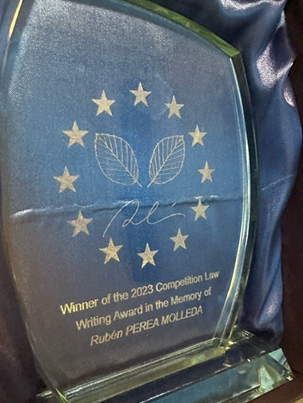
On 1 April 2020 we lost Rubén Perea, a truly extraordinary young man who was about to start a career in competition law. We decided to set up an award to honour his memory, and to recognize the work of other promising competition lawyers/economists under 30. EVP Vestager kindly agreed to deliver this Award.
Today we are announcing the winner and runners-ups of the 4th edition of this award. The winner of the 4th (2023) Rubén Perea Award is…
MUHAMMED MUSTAFA POLAT for his paper “Unraveling Labor Market Collusion: A Comprehensive Analysis Under EU Competition Law “.
The Jury also selected 5 other papers of particularly high quality. JECLAP will publish these papers in a special issue. These finalists and selected papers are:
- “Corporate Sustainability Due Diligence and EU Competition Law: Mandatory Due Diligence Collaborations Under the EU Corporate Sustainability Due Diligence Directive Exempted from the Application of Article 101 (1) TFEU?” (by Lois Elshof)
- “Efficiency and Capabilities in Article 102 TFEU“ (by Selçukhan Ünekbaş)
- “Reconsidering the Limits of EU Competition Law on the IP-Competition Interface” (by Quentin Schäfer)
- ”Access to Environmental Justice under the Aarhus Convention: Evaluating the Contemporary Hurdles for ENGOs in Challenging State Aid Decisions under EU Law “ (by Anna-Lici Scherer)
- “Competition and the Green Deal: a Study of Consumers WTP for CO2 Emissions Reduction in the Italian Car Market” (by Alessandra Catenazzo)
Our warmest congratulations go to Muhammed and the finalists. And thanks a million also to all those who submitted their work for this award. We received a large number of anonymous submissions; you truly made the Jury have a hard time.
This year’s jury composed of renown experts, some of whom were also friends, former teachers or colleagues of Rubén, namely Damien Gerard, Michele Piergiovanni, Gianni de Stefano, Lena Hornkohl, David Pérez de Lamo, Nicolas Fafchamps, Eugenia Brandimarte and myself (our gratitude goes to all of them for devoting part of their time to this project).
We will soon be announcing the 5th edition of the Rubén Perea Award. Stay tuned!
Recent developments in EU Competition Law (9 February 2024- Hybrid event)
Like every year, Fernando Castillo de la Torre (Director of the Competition team at the European Commission’s Legal Service) and Eric Gippini-Fournier (Competition Hearing Officer) have put together a one-afternoon seminar on recent developments in EU Competition Law as part of the annual IEB competition law course. The seminar will take place (under Chatham House rules) next Friday 9 February 2024 between 16 and 20.30 CET. If you’re in Madrid, you can attend in person but, if not, you can also join the discussion online.
For registrations, please write to competencia@ieb.es
More information on logistics is available here:
This is the program:
16:00 – 17:45: Cartel Policy today and tomorrow
Soledad Blanco Thomas, DG COMP
Marisa Tierno Centella, Director for Competition, CNMC
Johan Ysewyn, Partner, Covington & Burling
Peter Whelan, Professor, University of Leeds
18.00 – 19.30: Towards Article 102 Guidelines
Mark English, Partner, Garrigues
Cristina Sjödin, Member of the Legal Service, European Commission
Elena Zoido, Executive Vice President, Compass Lexecon
19.45 – 20.30: EU Competition Law and Sports; the December 2023 judgments in Superleague, ISU and Royal Antwerp
Alfonso Rincón, Partner, MLAB
Launch of The New EU Competition Law (POSTPONED)

We regret to inform you that we have been forced to postpone, due to illness, the even that we had scheduled for tomorrow to celebrate the launch of Pablo’s new book.
We will reschedule once Pablo is back on his feet, which we all trust will happen very soon!
Case T-136/19, Bulgarian Energy Holding (Part I: Substance)

Last Wednesday the General Court annulled the Commission’s abuse of dominance decision and €77 million fine in BEH (Judgment available here). The GC’s Judgment is a rare instance of a full annulment of a Commission abuse of dominance position (prior instances include the 2022 Qualcomm GC judgment, which the Commission did not appeal, the 1979 CJ Hugin judgment, the CJ 1973 Continental Can judgment and the CJ 1975 General Motors judgment).
But beyond anecdotal stuff and case-specific circumstances (a complaint filed by a company that was until 2021 jointly controlled by Gazprom against a public Bulgarian company performing public service obligations in a country dependent on Russian/Gazprom gas during a period in which Gazprom was abusing its dominant position), the reason why this case matters is because of its relevant contribution to the assessment of causality and evidence in abuse of dominance cases.
Remarkably, the GC found that BEH had an exclusionary “modus operandi” for a certain period (see paras 949, 1079, 1083 and 1089), but concluded that the Commission’s decision nevertheless failed in numerous critical respects. The judgment presents a very thorough fact and evidence intensive assessment by a first-instance court.
Here are a few preliminary observations on the substance of the Judgment (skipping the section on market definition and dominance, as well all the various pleas examined in great detail but ultimately rejected by the GC as unfounded or ineffective). Since this is a lengthy and fact-intensive Judgment (I’ve had more entertaining flight reads; at one point I kind of regretted having read the Judgment over the alternative I was carrying…), we will summarize and simplify the debate a bit. We will cover procedural issues in a separate post:
The conduct under examination. The conduct at issue was BEH’s (a vertically integrated state-owned energy company with a license to act as the sole public supplier of gas in Bulgaria) alleged attempt to block competing wholesalers’ access to key gas infrastructure in Bulgaria that it owned and operated (namely the gas transmission network, the only gas storage in Bulgaria, and the only import pipeline bringing gas into Bulgaria, which was fully booked by BEH). The Commission’s Decision found BEH dominant both in the gas infrastructure markets and in the gas supply markets in Bulgaria (a finding upheld by the GC), and concluded that it had engaged in a pattern of behavior aimed at preventing, restricting and delaying access to infrastructure.
Essential facilities doctrine – Bronner is alive (and so am I despite my recent, and not so recent, inactivity on this blog…) .The GC endorses the finding that the pipeline and the storage facilities at issue were essential facilities due to the lack of any alternative (as well as the finding that Bulgargaz was in a dominant position due to its control of the infrastructure even if it was not the owner of the facility). From para. 255 onwards (and in multiple recitals thereafter) the Judgment discusses the application of the Bronner conditions, highlighting the relevance of the indispensability conditions and the fact that the stricter Bronner test is justified because an obligation to conclude a contract “is especially detrimental to the freedom of contract and the right to property of the dominant undertaking” (para. 257, also 258, 282 and 451). The GC takes into account the fact that the facilities in question were built with public resources and the possible existence of a regulatory obligation to deal (e.g. paras 962 and 968-969). This is all fully in line with established case law.
A “refusal” to provide access and the issue of potential competition. One of the Commission’s allegations was that capacity hoarding on the essential pipeline constituted a refusal to supply. The GC finds that in order to prove that BEH’s conduct was liable to eliminate all competition in a neighbouring market on the part of the person requesting the service, there needs to be “proof that the potential competitor has, at the very least, a sufficiently advanced project to enter the market in question within such a period of time as would impose competitive pressure on the operators already present”, as otherwise the alleged effects would be purely hypothetical (para. 281, citing Generics and Lundbeck, also 447-452 which set a higher bar by requiring the Commission to establish rivals’ “firm determination”, “capacity”, “preparatory steps” and “sufficiently tangible project” to enter those markets). The GC concluded that in the case at issue these requirements were not met. In other (AG Kokott’s) words in Generics, there can be no restriction absent potential competition. In other (my) words, the question of whether a given conduct restricts competition needs to be established by reference to the degree of competition that would likely have existed in its absence because otherwise effects would be merely hypothetical. This, in my mind, is very sensible. The question of how far the Commission must go to establish what would have been a realistic/ likely counterfactual is a separate and case specific one.
Interestingly, the GC explains that, because of the serious interference on the freedom to contract derived from obligations to provide access, the dominant company must “be in a position to assess whether it is required to respond to it, failing which it might be exposed to the risk of an abusive refusal of access. However, a purely exploratory approach on the part of a third party to the dominant undertaking controlling access to the infrastructure in question cannot constitute a request for access, to which the dominant undertaking would be required to respond” (para. 282, also 450). The GC finds that the Decision did not show that BEH’s rivals had made a clear request for access to the pipeline to enter the Bulgarian gas supply market, that merely exploratory questions are not sufficient to show a sufficiently advanced intention to enter the market (para. 285, also 459 et seq.), and that requests made to another party (Transgaz) were not communicated to BEH (e.g. paras. 292-294 and 325-333).
Given its position in other cases and the upcoming Article 102 Guidelines, it will be interesting to see whether the Commission agrees with (or can live with) this idea that obligations to supply require an explicit request and an explicit refusal. For background, this is something that arguably does not feature in previous Commission decisions or in the case law, but that did feature in the GC Google Shopping Judgment (note that the President of Chamber and the reporting judge in that case are among the 5 judges signing this case too). I recently explained my view on this question before the Court of Justice, so I will avoid doing that here.
The GC also found that the Decision failed to show unreasonably stalling behaviour by BEH following a detailed analysis of the evidence and of the parties’ written communications which rather revealed a “constructive attitude” (e.g. paras. 359, 364, 395-396 and 442-443).
State action defense and protection of the dominant firm’s interests. Part of the Judgment (paras. 483- 687) is devoted to upholding the argument that some of the relevant conduct was imputable to Bulgaria and Romania negotiation of an agreement in a context characterized by Bulgaria’s dependence on Russian/Gazprom gas (which could only be transported through the controverted pipeline), which also explained BEH’s public service obligations aimed at ensuring security of gas supply in Bulgaria. This context appears to have weighted heavily on the GC, which underlines (i) that the State action defence makes it possible to exempt undertakings from their liability for conduct required by national legislation (paras. 548, 572, 616), and (ii) the legitimacy of dominant firms taking proportionate steps to protect their commercial interests (547, 616, 625). The GC finds that it was legitimate and reasonable for BEH’s subsidiary to take measures to guarantee a minimum capacity reflecting its needs as a public supplier. The GC did not make these findings under an “objective justification” analysis, nor did it examine “less restrictive alternatives”. Query whether the reasoning and outcome on this point would have been the same in a case involving a non-public company or in a situation where dependence on Russian gas were not relevant.
Causality/ Attributability. The assessment of causality /attributability of effects to the impugned conduct is one of the main issues at stake in pending Article 102 cases. It is also one of the topics that the Commission is expected to deal with in future Article 102 Guidelines. The case law requires that anticompetitive effects be attributable to the impugned conduct, and the Commission takes the view that “requiring a nexus of full causality between the conduct and the anticompetitive effects” would “render enforcement unduly burdensome or impossible” (EC Policy Brief, p. 4). In my view, this Judgment is mainly relevant because of its contribution to that debate.
As explained above, in this case the GC finds that an alleged refusal to deal cannot be likely to eliminate all effective competition in a downstream market where there is no evidence that the rivals requested access, or where there is no evidence that they had the firm intention to enter that market. This, in my mind, reflects a clear counterfactual thinking, an approach to causality not unlike the substantive reasoning in the Qualcomm judgment. As also explained above, the GC also found that part of the impugned conduct could be attributable to Member States or derived from BEH’s legitimate protection of its interests in light of its public service mission and obligations (see above).
In addition, and perhaps even more interestingly, the GC explains that even if BEH adopted an anticompetitive modus operandi that hindered rivals’ access to the transmission network and storage facilities and failed to comply with its regulatory obligations during a certain period (paras. 949-950, 953 and 1089-1100), this was incapable of restricting competition. This is because rivals lacked access to the only pipeline available to transport gas from Russia into those facilities “for reasons which are not attributable to proven abusive conduct” (para. 951; in my view, likely to be the most quoted paragraph of the Judgment in the future). In other words, the GC concludes that there is no restriction of competition (para. 953-954) because absent the impugned practices rivals would not have been able to compete anyway.
Another (Article 101) Commission decision in the same sector was already annulled on similar grounds (absence of potential competition) in EON/Ruhrgas. The peculiar regulatory framework applicable in these markets arguably makes things more complex for the Commission but, for that very reason, it contributes to triggering corrections and results in lessons that might be relevant across the board.
To be continued…


 Chillin'Competition