Author Archive
4th ChillinCompetition Conference (Johan Ysewyn “What is a cartel? A Conceptual Waterloo”)

Johan Ysewyn’s spectacular intervention at the 4th Chillin’Competition conference featuring provoking ideas, ABBA songs and his own singing (no kidding) is available here.
[Note: this is the third post in a series featuring videos of the individual interventions that took place at the Chillin’Competition conference on 30 November 2018. For more videos, click here]
4th ChillinCompetition Conference (The Videos: Commissioner Vestager “Strenght in Diversity”)
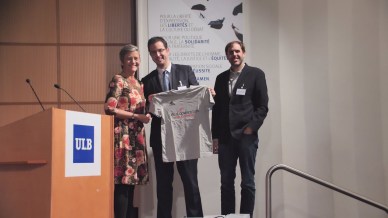
Commissioner Vestager’s intervention (3rd in a row, as she explains at the outset, and for which we are very grateful) is available here.
[Note: this is the third post in a series featuring videos of the individual interventions that took place at the Chillin’Competition conference on 30 November 2018. For more videos, click here]
4th Chillin’Competition Conference (The Videos: Introduction and Highlights)

Over the past few weeks many of you have asked whether there was any possibility to watch a recording from our conference or to have access to the materials presented. Well, now there is:
In the course of the Christmas period we will be publishing videos of all of TedTalks, most likely one a day. We will eventually publish other materials related to the panel discussions.
As a starter, here are:
- My introductory speech, titled Why though?
- A highlights video
Unfortunately, no material is capable of capturing the great, chilled, atmosphere. Thanks again to all those who made it possible. But even if you missed that, and the gifts, and the Syrian food, and the wine, we hope these materials may provide some compensation in the form of food for thought and laughs.
Servier and the myth that one could not challenge market definition

We have not yet had time to read carefully analyze the Servier Judgment rendered today by the General Court and I’m afraid we’ll need the weekend to process a few hundred pages in French and to comment on the many interesting points it surely raises. Expect to hear from us about this case early next week.
For now, and as an appetizer, I’ll just say that the outcome of the case and a mere read of the press release confirms something we had been saying for a while: Courts do carefully review market definitions when asked to, and are open to annulling them when justified.
The perception that applicants have low probability of success in overturning the Commission’s decisions on the point of market definition is (was?), in my view, based on a mere statistical analysis of the cases in which the GC was receptive to the applicants’ arguments.
There is certainly a surprising paucity of precedents in which market definition had played a significant role, but that is not the Court’s fault. Sousa Ferro observed, in a 2015 piece, that within a universe of 608 annulment proceedings concerning substantive competition issues, the issue of market definition was only raised in 134 cases (22%). Within those, the Commission decision under appeal was only wholly or partly annulled in 5 cases (3.75%) on the basis of an incorrect or insufficiently justified market definition, whilst in another 4 cases the Court expressed some dissatisfaction with the market definition but without annulling the decisions at issue. The article concluded that “applicants have only succeeded in persuading the Court that the Commission erred in its delineation of the market in 6.7% of the cases where the issue was raised”.
Whilst interesting, the figures presented in this recommendable article (one among the very few on the subject) may not provide the full picture. The selection of cases considered includes all types of competition cases, including those in which market definition was not required from the Commission (e.g. cartel cases) as well as, admittedly, the “very large number of cases” in which a precise definition would not have altered the Commission’s findings and that, consequently, failed to be examined by the Court. The analysis understandably also fails to account for the way in which arguments were pleaded or substantiated.
Other commentators – including experienced Commission litigators in high-profile abuse of dominance cases (remember Eric Gippini’s “It’s the dominance stupid!” intervention at one of our workshops) coincide in underlining the paucity of challenges to market definition and dominance in many of the abuse of dominance cases litigated within the past 20 years.
Note, for example, that market definition – and dominance – were not contested in a number of the leading abuse of dominance cases in the EU, including Intel, Tomra, Deutsche Telekom and Michelin II. And we haven’t had many other abuse of dominance cases brought before the Courts in the past few years.
Full annulments of market definition are certainly rare, although not unprecedented, as shown long ago by Continental Can, some time ago in Tetra Laval (merger case), more recently in CEAHR (concerning a decision to reject a complaint) and today in Servier. But the objective reality is that the Court has most often (albeit admittedly not always) undertaken a very thorough review of market definitions, and this regardless of the outcome of the case. If one looks closely at the case law, this has happened both in cases where the GC referred to the manifest error of assessment standard (e.g. Clearstream or Astra Zeneca) and in cases where it did not (see e.g. Wanadoo or Telefónica). And the same is true of merger control cases, such as Tetra Laval or NVV.
So don’t let labels such as that of the “manifest error” standard fool you. A careful read of the formulation of the Tetra Laval standard of review (what President Jaeger has called “the forgotten paragraph”), and particularly an analysis of how it has been implemented in practice, reveals that Courts have a wide margin of review and that they can intervene whenever they are persuaded about possible gaps in the Commission’s analysis. [Btw, this confirms what our friends Fernando Castillo and Eric Gippini say in their excellent book, that “practice shows that the manifest error concept captures much more than a decision that is facially or self-evidently wrong. In a way, manifest is whatever the judges consider to be manifest”].
The trend is much more evident in recent years, and my take is that it is here to stay, particularly after KME and Chalkor and perhaps even more following the Court’s enlargement.
And this makes sense, for if everyone were easily found dominant in a narrowly defined market, then the special responsibility would become ordinary and one could easily abuse the notion of abuse. Servier’s lawyers, who clearly did not buy the myth, actually made this point at the oral hearing citing the Bicycle Repair Man Monty Python sketch, showing how ordinary it would become if everyone were superman.
The bad news is that we may run out of material to continue this saga of posts…. 😉
Post Chillin’Competition Conference (Thank you!)

We greatly enjoyed yesterday’s conference and wanted to thank you all once again for making it possible, whether you were able to make it there or not.
The feedback we have received so far has been excellent. You can see some of it on our Twitter profile.
The atmosphere was great and confirmed that there are lots of genuinely nice people in our area of practice. Perhaps the legal rankings have a point in having something positive to say about everyone in the business… 😉
If you were not there, you unfortunately missed the memorabilia which, to top last year’s mugs, included Chillin’Competition t-shirts and classical meme calendars. Btw, the image at the beginning of the post was taken by the Commissioner herself and shared on her Twitter account, so it’s ©Vestager.
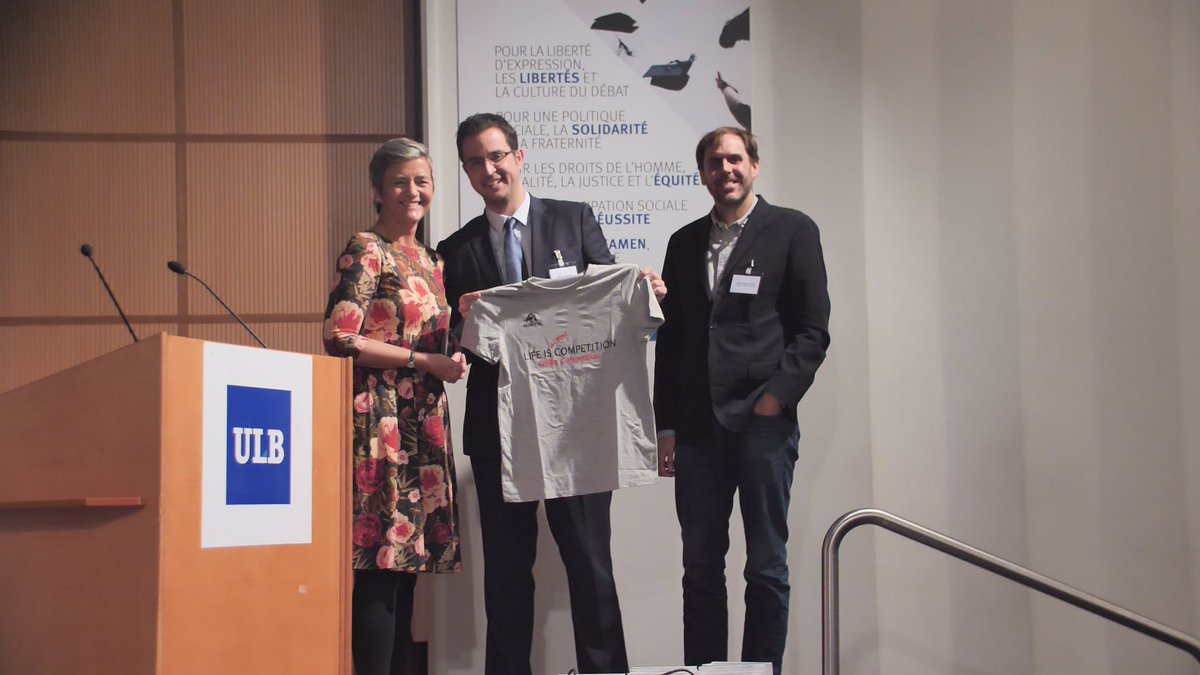

We will soon post all pictures as well as videos of the brilliant panel discussions and presentations.
In the meantime we simply wanted to say: THANK YOU!
4th Chillin’Competition Conference- Thank you!
As is customary the day before our conference, we would like to express our gratitude to the conference sponsors. Their support is what enables us to offer this conference for free (and the food, and the drinks, and the gifts…)
A big thank you to all of them!

The Intel Judgment, by its main author

For several months now every conference and journal in our small world has featured a panel and a few articles on the Intel Judgment, on how to interpret it and on the impact it will have on enforcement and on judicial review going forward. But the most authoritative view has been written by the very Judge in charge of the case.
Judge da Cruz Vilaça was President of Chamber at the Court of Justice of the EU until a few weeks ago, when his term ended. He had also been the first President in the history of the General Court. He is one of the people that has most influenced the course of competition law in recent years, and also (now that he’s not at the Court we can say it) one of the nicest people in the world of EU Law (with a talent for surrounding himself with competent and nice people too). Focusing only on the Intel Judgment doesn’t do justice to his contribution to EU Law and to competition law. But doing justice to that would require much more than a blog post.
Back in August, Judge da Cruz Vilaça published a piece –that has only now come to our attention- titled “The intensity of judicial review in complex economic matters—recent competition law judgments of the Court of Justice of the EU”. It has been published in the Journal of Antitrust Enforcement.
This is a reflection on the role of the Court in competition cases, and in particular on how Intel fits within that case law and on how it is to be understood and interpreted. It does not represent the view of lawyers trying to push things in a given direction or of academics. It is an objective account by the most authoritative person possible. And it engages with academic commentary and is kind enough to cite our blog posts at different points..
We recommend you to read the full piece, but here are just some ideas that stand out:
Intel as an important yet limited step: “the two EU courts have progressively strengthened the conditions of their review and developed a more intense scrutiny in competition cases (…) [the Intel] judgment constitutes an important—albeit limited—step made by the Court in strengthening its judicial control as regards the application of Article 102 TFEU”.
Evolution in the case law: “The way the Court necessarily operates helps to explain why one may sometimes feel that the Court did not always follow an unambiguous line of reasoning in judgments concerning the same field of competition law. It may simply happen that time have not yet come for certain developments (…) But in a fast moving world, judges must also permanently listen to changes in the social, economic, technical, and political environment. How could it be different in the digital age, in a time of globalization and in a knowledge and information-based society?”
On the lessons to be learnt by the Commission: “the regulator would be well advised in the future not to expect any special indulgence for relying on a presumption of any kind of infringement per se of Article 102 TFEU when seeking to prove the anticompetitive character of such a system. Indeed, it would be odd to submit the European Commission to a stricter test when it carries out an analysis of all the circumstances than if it simply had relied on a per se infringement approach!”
Consumer welfare as a useful reference point: “not every exclusionary effect is necessarily detrimental to competition, as a result of which less efficient and less attractive competitors may be forced to leave the market. I believe such statements are useful for clarifying what the Court considers to be the major goal of EU competition rules, which the Commission has articulated as being ‘to protect competition on the market as a means of enhancing consumer welfare and of ensuring an efficient allocation of resources” As Professor Jones put it, ‘the case-law of the EU courts does not unambiguously endorse’ that view. Rather it sometimes also placed emphasis on the interests of competitors or individual undertakings. I do not think this a serious defect: although perhaps not always 100 per cent consistent, the case-law places in general sufficient emphasis on consumer welfare as a goal”.
Making life harder for rivals is not the same as foreclosure [you will have heard me say this a few times..]: “Of course, the objective (or the result) of the competition process is to make life harder for any operator on the market, forcing it to be more efficient—which in general does not happen with monopolist”.
It is all about correctly allocating the burden of proof: “the ECJ also made it clear that the balancing of favourable and unfavourable effects on competition of the practice in question can be carried out only after the analysis has shown the intrinsic capacity of that practice to foreclose competitors that are at least as efficient as the dominant undertaking. I think this is nothing more than the correct apportionment of the burden of proof between the Commission and the defendant. The specificity of a system of rebates that includes an exclusivity clause is that once the Commission has discharged its duty to establish the likelihood of anticompetitive conduct, the hurdles will be particularly high for the latter when trying to rebut the Commission’s finding”
(…)
“the dividing line between margin of appreciation and duty to review is sometimes very thin, which makes it more difficult to maintain the consistency of the case-law in all circumstances. Courts, however, have an arsenal of legal weapons available to them in this challenge. The most obvious are the rules on the burden of proof. A fine example of how to use them is given in paragraphs 66 and 67 of the judgment of the General Court in Intel”.
[By the way, that last bit makes exactly the same point as that made by General Court Vice-President in the abstract of an article to be published soon in JECLAP. He also says that, following Cartes Bancaires and Intel, the key to striking the right balance between the Commission’s margin of discretion and the Court’s in-depth review “can be found in the burden of proof that rests upon the Commission pursuant to Article 2 of Regulation 1/2003”. We couldn’t agree more]
***
The article contains much food for thought. And, incidentally, as frequent readers of the blog will have already noticed, it confirms the understanding of the case that we had been positing here and elsewhere for a while..
An Update on What We Have Been Up To + Important Upcoming Events
The excessively generous eulogy that Pablo wrote a few days ago, together with my inactivity on the blog over the past few months weeks, have led some to suspect of my demise.
The absurd number of extremely kind messages that I’ve received over the past few days even made me doubt it… But I’m happy to confirm that reports in this regard have been greatly exaggerated:
After a few months locked in the office for different and very good reasons (piece of advice: don’t try to combine that with the additional sleep deprivation linked to having a 4 month old baby!), I’m now starting to see the light again and hope to be back blogging regularly very soon.
In the meanwhile, and beyond work, we have made some conference outings to start regaining the habit:
- On 11 October I was in Helsinki for a great conference organized by Ilkka Leppihalme. Director General Laitenberger, Richard Whish, Jorge Padilla and John Rattlif were the other speakers. Richard and John used some slides to accompany their excellent presentations and kindly gave green light for us to post them on the blog (thanks!). Here they are:
Richard Whish- Recent Cases on Vertical Agreements and Excessive Pricing
Kilpailuoikeus 2018 – EC Competition Cases before the European Courts – John Ratliff
I won’t share my slides for now because I might use them again in the future and they’ll lose the surprise factor 😉 But here is a teaser.
- On 24 October I participated at another very good conference put together by Lexxion’s CoRe, the VUB and CCIA on “Competition Policy in Online Markets”. A video with the highlights of the event is available here. While we are not (yet) subject to must-carry remedies, here is a succinct recap of the event published in a “competing” blog;
- And today I spoke on the impact of the Intel Judgment at this LeadershIP conference in Brussels. There was much to discuss and little time, but my main message was one of optimism (and I think realism) and trust regarding EU Courts, who are often the target of what I think is (mostly) unwarranted criticism. Will leave the details for a separate post;
- My efforts to catch up with Pablo re conference appearances were doomed, as he has been not only taking care of the blog but also actively travelling around (see here).
Future events
Looking to the future now, there are several must-attend events coming up:
-First of all, we are very excited to be hosting the 4th Chillin’Competition Conference next Tuesday (20 November). With the help of some overbooking we will try to release some additional seats for those in the waitlist. If you did not get a ticket (apologies), we will try to make sure you are well informed of what goes on. If you registered but cannot make it, please let us know so that we can get someone else in.
-The very day after, on 21 November, there will be an interesting debate on procedural issues in Luxembourg (“Due Process in Competition Law Enforcement: A Comparative Perspective”). More info is available here. I won’t be able to attend, but if any of you can and is willing to report on it, please drop us a line.
-On 26 November I will be speaking at the AEDC’s annual conference (that is the Spanish Association for the Defence of Competition) in Madrid. The programme is here: Programa Jornada Anual AEDC 2018. The conference is sold out but will be streamed live.
-On 17 January Commissioner Vestager will be hosting her conference “Shaping Competition Policy in the Era of Digitalisation”. Registrations are now open and here is all the relevant info (again, stay tuned, because we hear additional speakers may be announced soon…)
Registrations Now Closed

All tickets released for the Chillin’Competition 2018 Conference were gone in 4 minutes. Thanks so much for the interest! We hope you won’t be disappointed; the food at least should be good 😉
There are already another 250 people on the waitlist, and we also need to reserve seats for our sponsors, so unfortunately we need to close registrations now.
But there is still one way for you to make it: you can always persuade one of our sponsors (soon to be announced) to register you with their reserved seats…


 Chillin'Competition