Author Archive
Reminder: Registration for the 2018 Chillin’Competition Conference Opens Tomorrow at 10.am CET
Registrations will open up tomorrow morning at 10.am via a link that will be made available on the blog.
This is the final programe (minus the surprises).
THE CHILLIN’COMPETITION CONFERENCE 2018
9.00-9.30- Registration
9.30-9.45- Opening remarks featuring some substance and a few bad jokes (but that’s when we’ll be handing out the special conference goodies, so better be there!)
Alfonso Lamadrid (Garrigues and Chillin’Competition)
9.45- Panel 1: Competition law in its economic and political context
Isabelle de Silva (Autorité de la Concurrence)
John Fingleton (Fingleton Associates)
Luis Garicano (IE Business School)
Philip Marsden (CMA and College of Europe)
Tommaso Valletti (European Commission)
Moderator: Lewis Crofts (MLex)
11.15- KEYNOTE SPEECH by Commissioner Margrethe Vestager
11.45-12.15: Coffee Break
12.15- Panel 2: And so what? Procedural violations in EU Competition Law
Jérémie Jourdan (White & Case)
Stephen Kinsella (Sidley)
Jenny Leahy (Freshfields)
Jürgen Schindler (Allen & Overy)
Wouter Wils (European Commission and King’s College London)
Moderator: Kyriakos Fountoukakos (Herbert Smith)
13.30- Syrian Lunch by “We Exist”
14.45- Panel 3- Market Power Revisited
Avantika Chowdhury (Oxera)
Kirsten Edwards-Warren (Compass Lexecon)
Eliana Garcés (The Brattle Group)
Bojana Ignjatovic (RBB Economics)
Oliver Latham (CRA)
Moderator: Alexandre de Streel (Université de Namur)
16-16.30- Coffee Break
16.30-17.45- Ted@Chillin’Competition (“Concepts”)
Pablo Ibáñez (LSE and Chillin’Competition)
Andriani Kalintri (City Law School)
Catriona Hatton (Baker Botts)
Robert O’Donoghue QC (Brick Court Chambers)
Denis Waelbroeck (Ashurst and Université Libre de Bruxelles)
Johan Ysewyn (Covington)
17.45-18- Break
18-19.15- Ted@Chillin’Competition (“Concepts”) cont’d
Christian Ahlborn (Linklaters)
Peter Alexiadis (Gibson Dunn)
Fiona Carlin (Baker McKenzie)
Sarah Long (EUCLID Law)
Rich Pepper (Cleary Gottlieb)
Randy Picker (University of Chicago)
19.15-? Drinks
4th Chillin’Competition Conference (20 November 2018) – The Programme

We are exactly two months away from the annual Chillin’Competition conference. This time it will be bigger and better than ever.
- The conference (with thanks to the IEE) will take place at the Auditorium of the ULB (Salle Dupréel, Avenue Jeanne 44, Brussels); it will kick off at 9.15 am.
- Registrations will open on Friday 19 October at 10 am Brussels time via a link that will be made available on the blog. As you know, in the past three years all tickets were gone within just a few minutes, so hurry up!
- If you are travelling over 1,000 km and need to plan in advance, drop us a line and we will secure you a spot in exchange for the effort;
- The conference will be free thanks to the sponsors that make the multi-sided business model possible. If your organization would like to contribute as a sponsor, please drop us a line;
- Last year we gave out one of these mugs to all attendees. This time we will try to top that.
- Here is the programme:
THE CHILLIN’COMPETITION CONFERENCE 2018
Opening Introductory remarks featuring some substance but mostly bad jokes
Alfonso Lamadrid (Garrigues and Chillin’Competition)
Panel 1: Competition law in its economic and political context
Isabelle de Silva (Autorité de la Concurrence)
John Fingleton (Fingleton Associates)
Luis Garicano (IE Business School)
Philip Marsden (CMA and College of Europe)
Tommaso Valletti (European Commission)
Moderator: Lewis Crofts (MLex)
Keynote Speech by Commissioner Margrethe Vestager
Panel 2: And so what? Procedural violations in EU Competition Law
Jérémie Jourdan (White & Case)
Stephen Kinsella (Sidley)
Jenny Leahy (Freshfields)
Jürgen Schindler (Allen & Overy)
Wouter Wils (European Commission and King’s College London)
Moderator: Kyriakos Fountoukakos (Herbert Smith Freehills)
Syrian Lunch
Panel 3: Market Power Revisited
Avantika Chowdhury (Oxera)
Eliana Garcés (The Brattle Group)
Bojana Ignjatovic (RBB Economics)
Oliver Latham (CRA)
Kirsten Edwards-Warren (Compass Lexecon)
Moderator: Alexandre de Streel (Université de Namur)
Ted@Chillin’Competition (“Concepts”)
Christian Ahlborn (Linklaters)
Peter Alexiadis (Gibson Dunn)
Fiona Carlin (Baker McKenzie)
Pablo Ibáñez (LSE and Chillin’Competition)
Andriani Kalintri (City Law School)
Catriona Hatton (Baker Botts)
Sarah Long (EUCLID Law)
Robert O’Donoghue QC (Brick Court Chambers)
Rich Pepper (Cleary Gottlieb)
Randy Picker (University of Chicago) Denis Waelbroeck (Ashurst and Université Libre de Bruxelles)
Johan Ysewyn (Covington)
Drinks
Grillin’&Chillin’: Two new entrants in the competition press segment

Competition is thriving in the chilling competition market. This blog always stood for the proposition that it’s possible to cover competition law in an informative, serious manner, yet with a relaxed or even purportedly fun tone. We are glad to see that apparantly there is increasing demand, and supply, for this. A number of new outlets have emerged and are doing a great job at chillin’ while grillin’ the real issues [I know it’s a bad one but, hey, I needed something to fit the image…] Instead of seeing them as rivals in attracting the short time span attention precious time of slacking busy ompetition professionals, we see them as complementary goods. They also complement the excellent media services that for very good reasons have long dominated this field.
Two examples (that also share the odd commonality of featuring fishes in their logos) are these:
[Intermission: if any if you can identify a law firm and a department of an institution that also featured marine creatures in their logos, you get one of the last remaining Chillin’Competition meme-coffee mugs]
-Competition Lore, a podcast series run by Prof. Caron Beaton-Wells (University of Melbourne) where she seeks to engage guest in a debate about the role of competition in a digital economy and society. To get more info, suscribe or listen to the 7 episodes available thus far, click here. Btw, Nicolas Petit (founder emeritus), who’s a big podcast fan, also recently appeared on a different series where he also touched on these issues (see here).
-POLITICO is taking a new approach to covering competition with two weekly publications: Fair Play, a briefing on what’s driving the competition world, and Competitive Edge, a column that analyzes and challenges ideas about mergers control, antitrust, state aid policy and more. Politico has been a very successful entrant in the EU media market, and has made an ambitious bet to cover competition policy too, with a team of expert senior journalists (Simon van Dorpe and Christian Oliver) and, unusually (for the good), a competition economist (Thibault Larger).
Their mandate is to explain how competition is increasingly the weapon used to shunt the policy through, whether it be in the digital single market, the energy union or any other enforcement area. Their primary focus centers on the politics, economics and personalities behind the cases, but they are also keen on op-eds and will soon also be giving subscribers data tracking and case monitoring. The tone is meant to be fun and thought-provoking, but they certainly are not afraid to touch on challenging or uncomfortable issues. More info on their services is available here [pro@politico.eu]
Below we give you an example of their work, and we also use the occasion to recycle some of the quotes that weren’t finally used throw some ideas out there that we did not discuss here. Since they are good media professionals, their articles give you quotes from all sides. Since we are (I am) a biased, conflicted, non-neutral lawyer, below I only reproduce only mines 😉
These hyperlinks enable you to read the full pieces which would otherwise only be available to subscribers:
MULTI-SIDED MARKES AND AMEX. Politico ran a very good piece explaining the arguments on the multi-sided discussion on the SCOTUS decision in Amex. For that piece, we contributed with views that I had already advanced on the blog. This is what I sent Thibault for that one (including a couple of quotes that did not make it to the article, but that I still think may be of interest): (i) “The Opinion effectively holds that complex, multi-faceted market realities cannot be examined in silos. Requiring that the full picture be considered is sensible and in line with established EU case law“; (ii) “The only practices that this Opinion exempts from antitrust liability are those that are necessary for the operation of business models that overall do not restrict but foster competition“; (iii) “The case in no way immunizes multi-sided platforms, nor should it. The case is however a blow to the Nirvana fallacy that one can challenge piecemeal a complex business model under the assumption that only positive things will follow“; (iv) “In reality, this all boils down to the burden of proof. It may be hard to show with empirical evidence that a given practice is, or is not, necessary for a platform to deliver established procompetitive benefits. Very often one simply does not know. But holding that uncertainty plays against the accused would be problematic on many levels“.
POLITICS IN COMPETITION. Politico recently inquired into the real role of politics in competition policy and cases.. My quoted view was that “Political principles guide competition policy. There’s nothing inherently wrong about that.” The problem comes when politics impacts not on policy the outcome of specific individual cases. My additional views on these question avoided recent big cases and mostly focused on State aid cases, where “politics plays a particularly evident and crucial role“. This is because “the institutional set up for State aid cases puts the center of gravity on Member States, so politics inevitably plays a much more important role”. In my view, “a way to make State aid control less political and more objective would be to grant more rights and a greater role to companies (beneficiaries and complainants)”. In any event, “Courts are however well placed to identify and correct any undue influence of short-term politics”.
HR RULES AT DG COMP. A recent piece crunched through which big players at DG COMP would soon have to move according to HR rules. My take was the value of these rules to the EC is arguable and, in addition, DG Comp is a different animal (there are others, like the Legal Service). Officials deal with cases that require time, familiarity with the law, with the files and industry knowledge. In my personal view, doing away with experience and with some of the DG’s top assets could be counterproductive.
Side effects of DG Comp’s work (and research all lawyers should read)

(Official pictured just hours after having clicked “Send”)
Competition law enforcement is also a multi-sided industry. Optimal enforcement depends on a complex balancing of incentives between enforcers, Courts, companies, lawyers, economists, politicians, journalists and other stakeholders.
This means that we often forget about the implications of certain initiatives on other sides of the market. And there is one of these cross-side effects on which (for several reasons) I have particularly strong feelings this year.
You know the joke about how the Commission plays with lawyers holidays adopting Decisions, Statements of Objections and Information Requests just before August? Well, some lawyers are lucky enough to have just received all three.
So at a time when many are asking for summer read suggestions, this is my suggestion to DG Comp: “LEISURE AS A COPING RESOURCE“, a study of how lack of holidays impacts lawyers’ life based on a sample of 900 law firm lawyers. 😉
This is the abstract:
“This article explores whether leisure is an effective coping resource in response to the demands of one’s job and in reducing depression. Karasek’s job demand-control-support (JDCS) model of psychological strain serves as a framework for empirically examining the importance of leisure in reducing depression and buffering the detrimental effects of excessive job demands. This article relies on data from a sample of 887 law firm lawyers who are renowned for working in highly stressful work settings. We find that participating in active and social leisure activities or taking a vacation are important in reducing lawyers’ depression, whereas participating in passive leisure is not. None of the leisure variables buffer the harmful effects of job demands on depression. We discuss the implications of these findings“.
Enjoy your time off!
Save the date- The Ultimate Chillin’Competition Conference- 20 November 2018
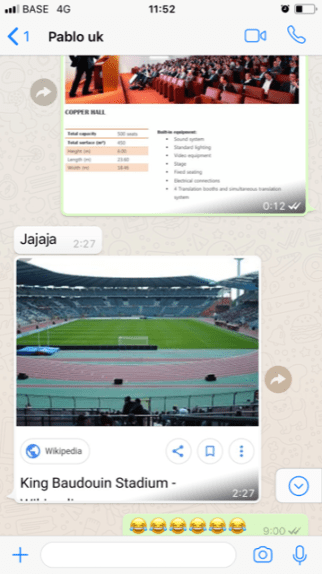
The 4th Chillin’Competition Conference will take place in Brussels on 20 November 2018.
Here is what we can tell you for now:
-It took us a while to settle on a venue (because Pablo mocks my ambitions; the picture above corresponds to a real recent Whatsapp conversation regarding possible venues. His counterproposal reveals how seriously he takes me…).
-We have so far invited only one speaker, who has very kindly accepted: Commissioner Vestager will once again be our star speaker;
-The theme of the conference will be: “Concepts“. We will pick a few common but often misunderstood, or yet unclear, concepts and we will invite a group of experts to discuss their meaning and implications. It’s a bit what we did with the notion of “neutrality” in our 2nd conference, but with a broader scope. We will discuss horizontal concepts, not cases or industries.
-We are selecting the specific concepts that will be disected and your feedback would be most useful; what are the concepts that you think are in need of clarifications?
–We are open to fresh ideas and new speakers, so if you think you can astonish the competition community with a brilliant speech on any particular concept, please send us a one pager with your ideas. Depending on what we get, we might invite those with the best ideas to deliver a brief Ted-like talk (note that candidates will be selected “on the merits”; i.e. on the basis of wholly subjective and undisclosed criteria);
-Our non-business model consists in making the conference accesible to everyone by offering the service for free. If you want to be one of the sponsors that makes this possible, please shoot us a line;
-It will be, by far, the best Chilling Competition conference to date;
-Yes, yes, there will be drinks afterwards
More info on the programme, registration, etc. will follow in September…
The Book You Should Not Miss Is Now Out

Pablo’s new book “The Shaping of EU Competition Law” is out and only two clicks away. You can verify this yourselves; just click here. Anyone working in this field should read the book (this includes me, btw, as I miserably failed to read the proofs on time!). Nowhere else will you find such a thoughful and data-intensive analysis about the role of institutional interactions in the evolution of EU competition law.
For our other recommendations on what competition law books to read this summer, click here and here.
And remember that on 14 September we will be holding an event in London (@LSE) to celebrate the launching of the book and discuss some of the issues it raises with an amazing line up of speakers. You should not miss that either; more info is available here.
SCOTUS clarifies US law on multi-sided platforms (Amex, the American Cartes Bancaires)

The U.S. Supreme Court has issued today its Opinion in the AMEX case. It is available here. This is likely to be the most discussed antitrust opinion in the decade.
The lesson in a nutshell. Showing an apparent restriction on one side of a multi-sided platform is not sufficient to meet the burden of establishing prima facie anticompetitive effects. The plaintiffs’ argument “wrongly focusses on just one side of the market”. EU readers will wonder whether this was not already settled, well that is because…
EU Courts got there first. Back in December 2017 I outlined the main lessons flowing from EU case law regarding multi-sided platforms (see here). In that post I wrote “my bet is that when the SCOTUS rules on Amex (a case which some expect will provide us with quasi divine guidance), it will say nothing new as regards what we already have in EU case law”. And then in February, I insisted that the case “is important, but it could not be more straightforward in the light of the current EU case law. Indeed, the issues to be decided upon in that case are exactly the ones that EU Courts have perfectly understood”. Today’s Opinion fits exactly with the ideas developed in those posts. The merit obviously isn’t mine, it’s the ECJ that got it right and got there first. Actually, I think the issue continues to be better solved in EU law than in this case. In the EU we don’t need to hold the existence of a single product/ relevant market to factor in multi-sidedness; considering it under the relevant economic and legal context is arguably a more refined way to get to the right result.
Identifying multi-sided platforms. The Opinion makes sure to explain that not every market exhibiting some indirect network effects qualifies as a multi-sided platform. It relies on established economic literature and, in line with it, clarifies that a market is to be treated as multi-sided when indirect network effects are strong and don’t just go in one direction so that greater output depends on striking the balance between the different sides (“interconnected pricing and demand”).
Burden-shifting. At what stage is multi-sidedness relevant? All parties agree that the restraints should be assessed under a 3-step rule of reason analysis applicable to vertical restraints. In the first step, it is for the plaintiff to show a substantial anticompetitive effect in the relevant market. In the second, it is for the defendant to bring forward a pro competitive rationale. In the third, the plaintiff must show that there were less restrictive alternatives to attain the procompetitive effects. The transcript of the hearing reveals that all parties considered multi-sidedness to be relevant, the question was whether these considerations belonged to the first or second step. In other words, it was all about who bears the burden of proof (i.e who benefits from uncertainty). The SCOTUS makes clear that this is a question to be dealt with upfront by the plaintiff. As the CJEU had already established, multi-sidedness is part of the economic and legal context against which a restriction must be established in the very first place, when the burden still lies with the accuser.
Business model and inter-brand/platform competition. The Opinion notes that Amex competes with Visa and MasterCard “by using a different business model” (i.e. providing better rewards, which requires a continuous investment funded by charging higher merchant fees). The SCOTUS considers that this business model has “stimulated competitive innovations” in the industry, but creates frictions with merchants, who have incentives to “steer” consumers to pay with other cards. The restraints at issue were precisely Amex’s antisteering provisions used since the 1950’s and which the Court considers “necessary to maintain cardholder loyalty”.
On output and inter-platform competition as the relevant criteria. The Opinion confers great importance to the fact that “while these agreements have been in place, the credit-card market experienced expanding output and improved quality”. It also observes that Amex has made payment services “available to low-income individuals who otherwise could not qualify for a credit card and could not afford the fees that traditional banks charge”. It also underlines that the provisions have not stifled but “promote[d] inter-brand competition” and did in no way prevent rivals from promoting their broader acceptance. In my mind, those are indeed the right elements to look at, just like they are for other intra-brand vertical restrictions. In fact. this has a lot to do with what we recently discussed regarding McDonalds. In the words of the Opinion, to establish relevant anticompetitive effects the plaintiffs should prove that the provisions “increased the cost of credit-card transactions above a competitive level, reduced the number of credit card transactions, or otherwise stifled competition in the credit-card market”.
On causality/attributability. The plaintiffs alleged harm was that the high price of Amex’s merchant fees. But the Court rightly observed that rivals’ merchant fees also increased “even at merchant locations where Amex is not present”, suggesting that the explanation may lie not so much in a restriction but “rather [in] increased competition for cardholders”. This is a sound analysis that again reveals how looking at inter-platform competition produces more accurate results than isolating silos.
The phrases that encapsulate it. “Amex business model has stimulated competitive innovations in the credit-card market, increasing the volume of transactions and improving the quality of the services. Despite these improvements, Amex’s business model sometimes causes frictions with merchants”. Once again, I find it quite hard to believe that Justice Thomas wrote something with which I can agree. It has become populistic popular to argue that multi-sided platforms are “gatekeepers”. In reality, all of the ones we typically think of have actually spurred output and competition. If third parties somehow depend on them, or if frictions exist, that is often because they have created opportunities for third parties in the first place. This doesn’t mean specific restrictions cannot be challenged, but one needs to show how they are severable from the system that enables the opportunities/the greater output in the first place (ah, the counterfactual! See point 6 here)
Why this doesn’t immunize multi-sided platforms. Proponents of the new antitrust revolution have been quick to criticize the Opinion for “immunizing multi-sided platforms from antitrust scrutiny”. EU case law again offers two killer arguments against this interpretation:
- Remember what happened after the CJEU ruled in Cartes Bancaires? Under the clarified/new framework the EC was still able to win after the case was sent back to the GC. This is therefore not about immunization; it’s about following the right analytical framework, without shortcuts.
- Vertical restraints (which is what anti-steering provisions are, according to all parties) have long been held to pretty much the same standard now applicable to multi-sided platforms, and for the very same reasons. It is not enough to show an apparent reduction in intra-brand competition if it spurs inter-brand competition. See cases like Pronuptia or Metro. And has this resulted in immunizing vertical restraints? No, it has only structured the analysis to adapt it to reality. Good cases remain possible.
A 5-4 vote. The 5-4 vote, and above all, the transcript of the oral hearing reveals that some misconceptions were not entirely dispelled. That is unfortunate, particularly because I generally tend to agree with the Justices who are on the dissenting side in this case. When time allows we will write another post commenting on the dissenting opinion and on why I think it gets it wrong, at least under EU law standards. Some may think the 5-4 vote suggests that this is a political decision. The convergence with EU case law would suggest this is not the case.
A very timely Opinion. For many reasons, this is a very timely Opinion. In 5 days I was supposed to hand in an article for The Antitrust Bulletin dealing precisely with case law lessons for antitrust enforcement in multi-sided markets! Fortunately, since my second son was born just last week (now I need to babysit another Pablo 😉 ) and summer looks busy, the editors have graciously granted me an extension until late October. The thoughts in this blog post will be expanded then, also to incorporate this case and reflect any comments you might have.
Disclaimer. I had no role in this case and don’t work for Amex. I do work for a number of multi-sided companies that will like this Opinion, and also for a bunch of not multi-sided companies that may not. The views in this post are the same ones I have been holding for the past 4 years including here, here,here and here.
Breaking Antitrust News from Brussels, North Korea, the U.S. and Luxembourg

-It has been reported this week that the European Commission is getting ready to take a step that could have profound implications on the internet as we know it. We did not know whether to comment on this development or not given my conflict of interest, but the Commission’s view would appear to put at risk what this blog stands for as well as part of my work during the past two years. Yes, you guessed right, legal memes are allegedly at risk; for more, see here.
-Yesterday was a historically surreal day. But contrary to what has been reported, Trump and Kim Jong-Un had interacted before (on Twitter, regarding antitrust, and Commissioner Vestager was involved). Click here to see the screenshots (from slide 3 onwards).
-In what many see as a blow to Trump, the AT&T/Time Warner merger was unconditionally cleared yesterday after the DOJ’s suit was dismissed. The full text of Judge Leon’s Opinion is available here. Its drafting seems to be quite specific and not a challenge to the growing concern about vertical mergers. The Judge himself has stated that “the temptation by some to view this decision as being something more than a resolution of this specific case should be resisted by one and all”. This development will trigger many comments, but the most succinct, persuasive and full blown attack against vertical mergers we have read so far comes from 30 Rock and is available here (make sure to click) 😉
-Moving on to more serious news, the Luxemburgish competition authority has exempted an algorithm price fixing mechanism for taxis. The Decision available here (in French) notes that the joint use of a multi-sided platform that fixes prices constitutes a horizontal agreement, but concludes that the agreement shall be exempted given the efficiencies generated by the agreement (which include lower prices for consumers thanks to the algorithm) and the absence of any viable alternative to attain them. Would the Commission and other NCAs agree with this view? We don’t know because the case concerns only Luxemburgish law (otherwise an exemption would not have been possible pursuant to the Tele 2 Polska case law). According to the decision, the taxi sector is subject to national regulation and does not impact trade between Member States (which arguably doesn’t fit squarely with what the CJEU held in paras. 65-70 of Eventech). Since Member States can’t exempt agreements under EU Law, they may be led to adopt this sort of jurisdictional interpretations, which may in turn not be ideal for legal certainty and for the internal market.
Wouldn’t it be nice if the European Commission decided to adopt 101(3) decisions too? Quizz question: what was the last 101(3) exemption granted by the Commission? It’s already been 7 years (!) since we wrote about The Slow Death of Article 101(3), and it’s not that the landscape has improved.
Mighty Simple: Important Competition Lessons from McDonald’s Quarter Pounder

Other stuff on our plate has prevented us from commenting on many of the competition law developments that took place in the past few weeks. But we know you are hungry for commentary. Without a doubt, the meatiest recent development is the class action accusing McDonald’s of anticompetitive tying. Don’t assume this is just going to be another post with puns; there really is food for thought here.
Background
The plaintiff challenges McDonald’s distribution of the Quarter Pounder line of burgers. The allegation is that McDonald’s only markets the Quarter Pounder and Double Quarter Pounder with cheese (in the past it also sold defaults without cheese) and only as part of a value meal. The plaintiff argues that this practice forces consumers to “pay for two slices of cheese, which they do not want, order, or receive”. They estimate that non-cheese-eaters are charged 30 to 90 cents for the cheese they don’t want even if they have to ask for the cheese to be removed (or have to remove it themselves). This would enable McDonald’s to charge for cheese it does not deliver. The plaintiffs have done their research and noted that the original 1975 trademark does not refer to cheese (only to a frozen beef patty, a sesame-seed bun, one tablespoon of diced fresh onion, mustard, ketchup and two Heinz pickle slices). The full class action complaint is available here.
McDonald’s has replied that “the advertised Quarter Pounder burger comes with cheese. We try to accommodate our customers’ requests by allowing them to customize their orders, such as a Quarter Pounder with no cheese.”
The merits
This is a US case, but imagine you wanted to run a case like this in the EU. Could it fly? What would you do to meet the requirements set by the case law? Is this really a crazy case as it may seem to many? Let’s see:
First, you would argue that the tying and the tied products are separate products. The two were once sold separately by McDonalds; cheese can be added or not; the trademark does not cite cheese; there are independent producers of cheese. At the same time it’s true that the forked versions of the Quarter Pounder do incorporate two slices of cheese (see e.g. here) [yes, there are many different types of McDonald’s forks]. Overall, one could get away with saying that a Quarter Pounder and cheese are different products. Box ticked.
Second, you could argue that McDonald’s is dominant in the tying product. You would only need to argue that McDonald’s franchisees don’t really have the option of buying burgers from any other source. So McDonald’s is dominant in the market for “franchisable burguers to be sold at McDonald’s restaurants”. The plaintiffs refer to McDonald’s market power in the “fast food quarter pound hamburger market” (para. 75). Box ticked.
Third, customers have no option of obtaining the tying product without the tied. That’s the point the plaintiff is making. One is certainly not forced to eat the cheese and to customize the burger further (you can pretty much put anything in there and McDonald’s will let you) but it is true that the cheese comes pre-installed as a default. The plaintiffs in this case also invoke the “uniqueness” and “desirability” of the tying products.
Fourth, you would need to show that the tying is capable of restricting competition. One can argue that McDonald’s is hindering consumers choice. You can even define a market for cheese to be used in McDonald’s Quarter Pounders and conclude that rival ingredients are being excluded (even if there is no technical obstacle for users to add other ingredients to be added to the Quarter Pounder; McDonald’s even facilitates that: see e.g. here).
Piece of cake. The plaintiffs wouldn’t even have to argue that they are overpaying, as they do in this class action. I guess they could make the same allegation even if McDonald’s provided the burger and the cheese for free.
[As this is a US damages claim, the plaintiffs also need to prove that they suffered injury as a result of their purchase. That may be easier to show, but I doubt the injury I have in mind could be attributed to the alleged tying…]
The lessons
One can argue anything in a competition case (see here for some example on market definition), but most of you will –hopefully- agree that the case makes little sense. But let’s try to slice and reason that intuition:
Franchise business model necessarily implies a package of interrelated items. Whilst tying is assumed to be restrictive (because it is presumed that it serves no procompetitive goal), franchise agreements are presumed procompetitive and justify even what would otherwise be seen as hardcore restrictions (non-compete clauses, outright exclusivity; see e.g para. 191 of the Vertical Guidelines). How do we then square this out? It all depends on the issue of severability. This was made clear by US Courts in a case involving… alleged McDonald’s tying (Principe v McDonalds; a case concerning licensees obligation to operate their franchises in premises leased from the franchisor). What is the actual licensed/franchised tying product? Is it just trademark or is it rather a business format?
In that case McDonald’s had argued that “the appellants are asking the court to invalidate the way McDonald’s does business and to require it to adopt the licensing procedures of its less successful competitors” (para. 23). The Fourth Circuit agreed. It observed the question depends on whether the items were “integral components of the business method being franchised” (para. 32).
After analyzing the specific contributions of the obligation at issue to McDonald’s business method (paras. 34-37, which take into consideration protecting the “system’s goodwill”, ensuring “consistent quality”. “broadening the applicant base and opening the door to persons who otherwise could not afford a McDonald’s franchise” as well as the extent of McDonald’s financial investment), it concluded the following:
“All of these factors contribute significantly to the overall success of the McDonald’s system. The formula that produced system wide success, the formula that promises to make each new McDonald’s store successful, that formula is what McDonald’s sells its franchisees. To characterize the franchise as an unnecessary aggregation of separate products tied to the McDonald’s name is to miss the point entirely”.
Severability in Principe v McDonalds was analyzed at the “separate products” step, whilst in in the EU it would be part of the assessment of the economic and legal context (this is true of any restraint that may be part of a wider context, not only franchising; see e.g. Cartes Bancaires 73-79). But the substantive reasoning is pretty much the same. Ignoring the relevant context to any restraint leads to missing the point entirely. Much like in Principe v McDonald’s, EU Courts have also observed that restraints are deemed to fall outside the scope of the competition rules when the such analysis shows that they are related to a main operation that “could not be implemented or could only be implemented under more uncertain conditions, at substantially higher cost, over an appreciably longer period or with considerably less probability of success” (T-112/99, Métropole, para. 111).
This explains why competition experts would find this new class action complaint hard to swallow.
College of Europe Alumni in Competition (30 May) (Feat. us) [Update]

College of Europe alumni have set up the “Alumni in Competition” group. Like many platforms, this one seeks to leverage network effects. The idea is to bring together senior experts and young professionals with ties to the CoE to stimulate discussion and “inspire a new generation of competition professionals”.
As it often happens, the goal is commendable but its implementation may be questionable: the organizers have decided to start off with an inaugural event featuring the two least inspirational speakers they could find: Pablo (as a young somewhat promising academic) and myself (as an established senior statesman, of course).
On the plus side, they have also invited Nick Banasevic (DG Comp) and Aleksandra Boutin (Compass Lexecon) (so there’s an enforcer, ana academic an economist and a lawyer) and they have been so sensible as to organize it at a bar. In fact, my impression is that the group intends to bring together senior experts and young professionals with ties to the CoE essentially to stimulate beer consumption. This is of course why we gladly accepted to take part and be the example that young professionals would be well advised not to follow.
Readers of this blog will not be fooled and know not to expect much from us (except perhaps a round from Pablo if he feels generous), but join us if you can! The event will take place next Wednesday 30 May at 20:00 at Piada Bar (Rue de Trèves 44– right across from the European Parliament).
Please confirm your attendance by registering under https://collegeofeurope.hivebrite.com/networks/events/8445
P.S. If anyone has registration issues, please contact: joanna.hornik@coleurope.eu


 Chillin'Competition