Author Archive
The definitive and true Best of the Best Awards

Last Thursday I participated in the announcement of the first “30 in their 30s list” made by W@Competition, of which I was also happy to be a juror. Seen from the inside, this really was a neutral, independent exercise, and the women who made it onto the lists (available here) all very much deserved it (as also did many of those who did not), so congratulations!
Interestingly, however, this is an exception in many ways. Anyone familiar with awards, prizes and recognitions in our field realises that they are not always given on the merits; sometimes they are priced prizes, other times they are sponsored-for and in other cases they are simply a bit random. Pablo and I have typically been quite well treated by some of the organizers of some of these things so we think we are in a position to say these things.
Although, again, there certainly are a number of serious, well researched rankings and awards, others that don’t necessarily meet this criteria are mushrooming. People within the industry can distinguish the serious from the non serious, but other people can’t.
One example, a couple of weeks ago, we saw this LinkedIn post by Damien Geradin explaining that he had been offered an “Internet Law Firm of the year” award which only required a payment of 2795 pounds. Apparently Damien responded that for that price he’d like to be named “Master of the Universe”.
So that gave us an idea. With a view to lowering barriers to entry in the awards market, and in order to serve the competition community, we have decided to create our very own awards, the Chillin’Competition “True Best of the Best, Really” awards.
The idea behind it is that anyone interested in a prize will get one; you simply need to tell us what prize you would like to receive (the only restriction is that Pablo will keep the “True Best of the Best Academic Star of the Century” award, and that I will compete with Damien for the “Best of the Best Master of the Universe Award” (which I will win -because I created it- and will include in my cv and on business cards) 😉
Alternatively, you can also tell us something about yourself and then we will craft an award that suits you. For example, if you wrote part of a 1 page newsletter piece on, let’s say, the truck cartel, then we can give you an award for the “True Best of the Best Contribution to a Professional Publication in the Automobile Sector”.
We could then give ourselves the award at a dinner ceremony (i.e. a pretext to have some laughts at a tax deductible dinner). We are only partially kidding; if we have enough applications we will do a dinner, trust us.
Antitrust Spring Meeting in Madrid (10 March)

It can hardly get better. This year we are celebrating the 20th anniversary of the competition law course that Luis Ortiz Blanco and I co-direct in Madrid (I was first involved in its 10th edition, as a student), and we wanted to do something special to commemorate it. And what we will be doing is bringing the Spring Meeting to Madrid, or sort of (and giving you a perfect excuse for a deductible getaway that does not involve travelling to D.C.)
On the 10th of March we will be hosting a seminar to discuss 20 years of case law in competition law with a truly stellar line-up of speakers including the current US Assistant Attorney General for Antitrust (Renata Hesse, appointed by Barack Obama, sigh…), the Commission’s Deputy Director General for Antitrust (Cecilio Madero, who is among the very few having participated in all 20 editions of the course), the ECJ Judge (Andreas O’Keefe) who wrote, among many others, Cartes Bancaires and Mastercard which have been recurrent themes in this blog, some of the Commission’s officials most closely connected to the most important cases in recent years (namely Nick Banasevic from DG Comp and Nicholas Khan and Eric Gippini from the Legal Service), Milan Kristof as representative of the ECJ référandaires behind the big cases, academic/blogosphere stars (like our very own Pablo and Jesús Alfaro), a selection of the new generation of top-notch Spanish economists and lawyers (Susana Cabrera, Elena Zoido and Alfonso Gutiérrez) and the most-up-to-date person in competition law and future literary star Lewis Crofts.
An overview of 20 years of competition case law
Introduction: Luis Ortiz Blanco and Alfonso Lamadrid
15.30-16.40- Cartels and other anticompetitive agreements: Alfonso Lamadrid (moderator), Andreas O’Keefe (former Judge at the European Court of Justice), Nicholas Khan (Legal Service, European Commission), Jesús Alfaro (Professor of Law, Universidad Autómoma and Linklaters).
16.40-18- Unilateral conduct: Milan Kristof (Référendaire, ECJ; moderator), Pablo Ibañez (LSE and College of Europe), Nick Banasevic (Head of Unit, DG Comp, European Commission), Eric Gippini-Fournier (Legal Service, European Commission).
18.20-19.30 –Merger control: Lewis Crofts (Chief Correspondent, MLex; moderator), Susana Cabrera (Partner, Garrigues), Elena Zoido (Senior Vice-President, Compass Lexecon), Alfonso Gutierrez (Partner, Uría Menéndez).
19.30- Closing keynotes: Renata Hesse (Acting Deputy Attorney General for Antitrust, US Department of Justice) and Cecilio Madero (Deputy Director General, DG Comp).
***
For further information, click here: An overview of 20 years of case law (10 March 2017)
Academic Excellence Awards and more
Global Competition Review has just opened the voting window for its annual awards.
Among the 5 nominees for the Academic Excellence Award (given to “an academic competition specialist who has made an outstanding contribution to competition policy in 2016“) are my current and former co-bloggers, Pablo Ibañez Colomo and Nicolas Petit, which is great news and a testimony to their influential work, also here. They are joined by Wouter Wils, Ariel Ezrachi and the University of East Anglia’s Centre for Competition Policy. You can vote for one of them here.
Also, today is the last day to vote for the Antitrust Writing Awards. You only have to click on this link and then on the 5 stars.
Finally, the clock is ticking for those of you interested (you should be) in attending W@competition’s upcoming conference on contemporary competition developments; you can register here. The 30-in-their-30s lists will be disclosed then.
And speaking of awards, today we delivered the prizes to the 3 co-winners of the meme competition. We just received the meme below from one of them in Copenhaguen…

A priceless precedent for multi-sided platforms (and beyond)- The UK’s High Court Judgment in Mastercard and the key relevance of the counterfactual analysis (PART I)
Few seem to have remarked the great importance of the Judgment issued by the UK’s High Court of Justice on Monday this week in the Mastercard private litigation case.
This case is the most relevant instance of practical application of the legal criteria set out by the ECJ in its two leading cases so far on multi-sided platforms. It constitutes highly relevant guidance for the future, including for several high-profile ongoing cases (in some of which I disclose to be involved) (for more on this see in particular prior discussions on Pay-TV and Android, here and here). It also fits exactly with the arguments Pablo and I developed in our piece on The Notion of Restriction of Competition regarding the key importance of the counterfactual assessment (see particularly section 2.1.1 of the piece).
As you will remember the ECJ’s Judgments in Cartes Bancaires and Mastercard –issued on the same day- converged in the message that multi-sided considerations should not play a role at the tail-end of the analysis, but rather be considered as part of the economic and legal context prior to examining whether a restriction exists in the first place under 101(1) (see Cartes Bancaires, paras. 73-99) and Mastercard (paras. 179-182). Importantly, at this stage the burden of proof lies on the Commission.
What this means in practice is that one cannot examine a practice that affects one side of the market in isolation; one also needs to look at how it contributes to balancing all sides of the platform. In other words, would the business model be viable in the absence of the practice at issue? That is the counterfactual assessment.
This exercise may show that the practice is indispensable, or that it could be indispensable for the platform to operate (and in the face of “uncertainties” the practice will be considered legal, as shown by the GC’s Judgment in O2) [which ties very well with the limiting principles I proposed here (in writing) and here (in ppt format; slide 13), as well as with what Pablo explained last week in his GCLC presentation on dynamic markets; see here, slide 8]
In the Mastercard Judgement the ECJ actually used this analytical framework for the analysis of the counterfactual (para. 161, also distinguishing it from ancillary restraints at para. 173). And it also identified an error of law in the Commission’s choice of the counterfactual in the absence of the agreements, as it had failed to consider whether it was a “likely” counterfactual. (para. 169). Importantly, the reason the Court ultimately did not annul the GC’s ruling and the decision was because Mastercard had failed to “claim” that its scheme would have collapsed in the counterfactual scenario (para. 173). The ECJ did therefore rule that the MIF at issues was restrictive of competition in the sense of Art. 101(1) and could not be exempted under 101(3) [for our comments on the also very interesting 101(3) leg of this case, see here and here].
Several large retailers decided to initiate follow on actions in the UK on the basis of the Commission’s decision as confirmed by the ECJ Judgment. It may have seemed like a home-run.
On Monday, however, the High Court ruled against them concluding, contrary to the ECJ, that the MIF was not restrictive of competition in the sense of Art.101(1) relying precisely on a counterfactual assessment.
There seems to be some surprise at this apparently diverging outcome but, frankly, it is not that surprising. Why? Because Mastercard did learn the lessons from the ECJ’s Judgment. As I explained before, para. 173 of the Judgment explains that “it was not in any way claimed before the General Court that MasterCard would have preferred to let its system collapse rather than adopt the other solution” and the key para. 180 says that the counterfactual argument had only been invoked by an intervener too late before the ECJ but was not part of the arguments submitted before the General Court. The ECJ therefore did not consider it.
As revealed by an MLex headline from last year, Mastercard learnt the procedural lesson very well:

As you will notice, this is exactly what the ECJ said Mastercard did not do before it. In the damages case, by contrast, Mastercard did put all the eggs in the basket of the counterfactual argument, and it won.
Actually, the word “counterfactual” is used about 190 times in the High Court’s Judgment.
And the winning argument was indeed what the Court refers to as the “death spiral” argument, pursuant to which in the counterfactual scenario other platforms would have killed Mastercard, whose scheme “would not have survived (…) in a materially and recognisably similar form“.
For an analysis of how this analysis was conducted on Monday’s (pretty lengthy but excellently written) Judgment (including on important issues related to the burden of proof or the differences with the notion of ancillarity), stay tuned for the second part of this post.
Trump on Pablo
We read this last night on Twitter. Since we take our blogging responsibility seriously we thought we owed our readers a reality-check.

Fact check:
Pablo did actually speak yesterday at the GCLC annual conference and discussed The Ubiquity and Limits of Competition Policy in Dynamic Markets. The slides are available here: ibanez-colomo-ubiquity-and-limits-of-competition-policy He did very well and he was literally “elegant” as he was wearing a tie I lent him (and it would be nice to have it back). We have checked with experts and it is a fact that there were more attendees at the Chillin’Competition conference, so the claim that yesterday featured the largest audience ever is only an “alternative fact”. And needless to say, if anyone disagrees they certainly are not losers and should not keep their mouth shut; polite and public disagreement is healthy; the law, as many other things, only evolves through exchanges of ideas. The conference was truly excellent, so congrats to the GCLC (mainly to Damien Gerard) for putting it together.
A year in review: competition law developments in 2016 (selected issues)

One of the yearly highlights of the competition law course that I co-direct in Madrid is the seminar coordinated by Fernando Castillo (the author of the most downloaded materials in competition law in 2016; see here) and Eric Gippini (one of our Friday slot interviewees; see here).
On this edition the seminar will take place on Friday 3 February under the title “A year in review: competition law developments in 2016 (selected issues)”, and the programme is the following:
12:30 – 14:30: “The year in Brussels”
- Gero Meessen (Member of the Legal Service, European Commission)
- Eric Van Ginderachter (Director, Cartels Directorate, DG Competition, European Commission)
- Mariarosaria Ganino (MLAB Abogados)
16:30 – 18:30: “The year in Luxembourg”
- Fernando Castillo de la Torre (Legal Advisor, Legal Service, European Commission)
- Nils Wahl (Advocate General, European Court of Justice)
- Cani Fernández (Cuatrecasas)
A not-to-be-missed event and a perfect excuse to spend a weekend in Madrid…
For further information and registration (at predatory prices), please write to competencia@ieb.es or drop me a line at alfonso.lamadrid@garrigues.com
Competition Law and Big Data: Do Competition Authorities Know How To Do It? #CPIChronicle
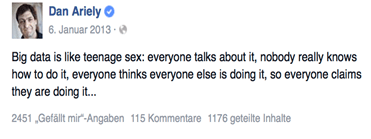
You may remember that just before Christmas I wrote a post saying that Pablo was putting pressure on me to write a joint article on selectivity in State aid during the holidays? Well, it should not surprise you to know that we never got around to it (it will happen, though).
We nevertheless did take the time to do some other non-work writing: Pablo did his thing (probably wrote the majority of his forthcoming books) and I did mine (wrote a couple of short pieces on general issues), namely one editorial for the next issue of the Journal of European Competition Law and Practice on “Competition Law and Fairness” (more on this soon), and one piece on competition and big data (co-written with my colleague Sam) for Competition Policy International’s special Antitrust Chronicle issue on “Competition in Digital Markets”.
The latter contribution -which builds on the Dan Ariely quote above…- can be freely accessed here, courtersy of CPI: cpi-lamadrid-villiers
UPDATE: Pablo tells me that Common Market Law Review has published today an article on this topic by our friends Francisco Costa Cabral and Orla Lynskey; it will certainly provide you with insightful thoughts and views that may moreover diverge from the ones developed in our piece.
Judgment in Case T-699/14, Topps

On 11 January the General Court handed down its Judgment in the Topps case, concerning alleged anticompetitive practices in relation to collectible football stickers and trading cards. As some of you have noted, the subject-matter of the case makes it a must-cover for us.
We will say a few words on the Judgment (not that it is particularly remarkable, but given the scarcity of competition cases we can’t afford not to look at it; we want to collect posts on all of them) and leave the important stuff (i.e. the anecdotal facts) for the end. I have in any event marked in bold the truly important content of the Judgment.
Topps’ appeal targeted a Commission decision rejecting a complaint against Panini, FIFA, UEFA and a number of other national football federations. Following a preliminary inquiry the Commission rejected this complaint on the grounds that there was no EU interest and that there was a very limited likelihood of establishing an infringement so that pursuing an investigation would be disproportionate.
The Judgment deals with some procedural issues of no apparent interest before delving into substance.
Regarding market definition, the applicant argued that the Commission had committed a manifest error in holding that it was likely that relevant markets were not confined to, first, World Cup collectibles sold to children aged 6 to 14 and, second, Euro collectibles sold to children aged 6 to 14 [as if there were no geeky collectors after 14…]. The Commission reached that conclusion on the basis of several arguments challenged by the applicant, among which was the claim that it was not obliged to have recourse to the SSNIP test. Topps seemed to contend that since Panini’s collectibles were roughly 20%-50% more expensive than other collections and that price increases resulted in greater profits, this would necessarily imply that they were not substitutable with other collectibles. The Court nevertheless rejects this argument. There is nothing groundbreaking on this part of the Judgment. It confirms that the SSNIP test is not the only method available to the Commission, which may legitimately use others and goes on to validate its assessment of the facts at issue. Very unfortunately, the Court says that “it is not even necessary to adjudicate on the possibility of applying the SSNIP test to children”. We would have loved to read that discussion; perhaps we could have added the infant fallacy to the “cellophane fallacy” and “toothless fallacy”. Here goes a missed opportunity…
Regarding a possible infringement of Article 101. Topps claimed, first, that the parties had entered into long-term exclusive agreements with Panini that resulted in total foreclosure in the market for collectibles of the World and Euro tournaments. The Commission, however, took the view that their duration was not unreasonably long (“typically” relating to one tournament; the Judgment, by the way, contains a prior discussion on the meaning of “typically) and that the evidence suggested competition in the (most likely) relevant markets and not the foreclosure of Panini’s competitors. The Court also observed that agreements of over 4 years could potentially be justified or have little relevance when related to short events taking place every 4 years.
Ass regard the argument that Panini had imposed exclusivity obligations on retailers (due to a letter noting that retailers carrying non-official products would not be considered), the Court notes (i) that the claim is based on the wrong premise of unduly narrow relevant markets; (ii) that it only affected World Cup 2010 collectibles and only in Cyprus [By the way, an arguably important fact omitted in the Judgment is that Spain won that World Cup…] and that therefore there was no generalized exclusivity and no foreclosure.
Regarding a possible breach of Art.102.
On dominance. The Court endorses the Commission’s conclusions of the unlikelihood of finding dominance on the part of Panini noting once again that the complaint relied on the premise of a narrow market definition, and that once that market is enlarged it shows lively competition. Very interestingly, the Judgment notes that sales of football collectibles in Italy fell “following the enthusiasm for the collections relating to the Dragon Ball universe based on the eponymous manga”.
The Court also dismisses the idea of upstream dominance, thus validating the Commission’s conclusion that IP rights held by FIFA, UEFA and national associations are not indispensable for creating collectibles related to international tournaments. The Court noted that the lack of those rights did not preclude some collections by Panini and Topps in the past and underlined that, in any event, a claim of dominance based on this circumstance once again assumed a too narrow market definition.
On the alleged refusal to deal. The Court observes that Topps was not refused the IPRs at issue but was rather invited to some tenders, that on other occasions it merely sent a letter without any follow-up, and that the IMS conditions are not met, as the emergence of a new product was not prevented (the Court validates the Commission’s assessment that video trading cards and cards “made with pieces of match worn shirts” [?!] did not constitute new products but rather new features of existing ones). It further observes that it had not been demonstrating that the IPRs at issue were necessary to bring these to the market and that, in any event, numerous competitors are active in a correctly defined market, thereby suggesting the absence of foreclosure.
On the alleged excessive prices. The first Judgment discussing excessive prices in the wake of the Commissioner’s seminal speech at the… ehem…equally seminal Chillin’Competition conference (also attended by the Judge in charge of this case; see below) dismisses the claim simply by saying that the data available does not show that the price of World Cup and Euro collectibles is higher than that of other football collections neither in absolute terms nor compared with its cost of production.
Anecdotal facts
-The first (prohibition/fine) decision under Regulation 1/2003 was also about collectible cards (Pokémon) and actually targeted Topps; see here. The Judgment issued last week refers to that decision observing that the arguments developed by Topps were “diametrically opposed to those developed by Topps at the time” [by the way, perhaps this was the case, but when the Commission does that the Court simply says that it is not bound by its precedents…]
– This is the first competition Judgment in which Ian Forrester has acted as “rapporteur”.
– The Commission may not see collectible cards as an enforcement priority, but other competition authorities are still there, ready to act. I remember a Spanish precedent from not so long ago in which the national competition authority gave an example of prioritization and allocation of resources when sanctioning 5 distributors of Magic cards with 7,000 euros (one party received a 148 euro fine, another a 748 euro fine; the highest fine was 3,424 euros). I remember an official defending the investigation saying that geeks also had the right to consumer welfare…Indeed, but they paid twice, the first time as victims of the cartel and the second one as taxpayers financing a full-blown investigation that resulted in such fines.
And the winners are…

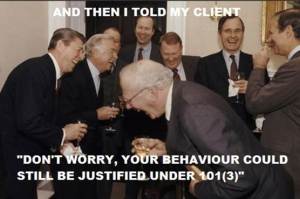
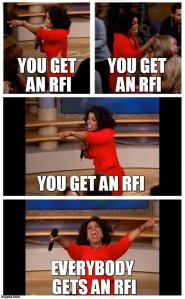
With some delay (that has triggered reminders such as the image above…), we are pleased to announce the winnerS of the meme competition. Thanks to everyone for participating. Those unhappy about not having won, please remember that the juror was my colleague Sam, not Pablo or I. Given the strong competition, we did decide to have not one but three winning memes, namely these:

We will contact the winners (congrats!) over email for logistical arrangements regarding collection of their sweet prize!
Antitrust Writing Awards 2017
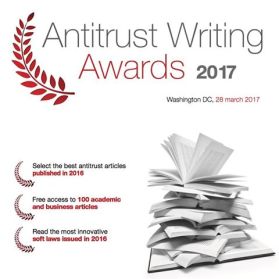
If 2016 taught us anything is that voters always get things…well, never mind. But what is undeniable is that it does suit 2017 to start it off with a vote. The list of nominated publications for the Antitrust Writing Awards is now closed, and you can start voting for the best antitrust writings of the year.
Pablo and I are jointly nominated for the award on the “Academic/General Antitrust” category for our article On the Notion of Restriction of Competition (it could hardly be more general….). Pablo also has a standalone nomination for the “Academic/Unilateral Conduct” award for this piece.
We encourage you to click on the links above and vote for your favorite articles and also for ours (in case you have little time simply voting for ours will suffice). Although, actually, we are not too concerned, as our friends Dmitry and Evgeny have assured us that everything is being taken care of…. 😉


 Chillin'Competition