Author Archive
ECJ’s Judgment in Case C-74/14, Eturas (on the scope of “concerted practices” and on technological collusion)

Yesterday the ECJ rendered its awaited Judgment in the Eturas case on the boundaries of the notion of agreement and, specifically, on concerted practices. (An English version was not yet available last night, so what follows uses my own relaxed translation from the French version).
The case originates in a preliminary reference from the Lithuanian Supreme Administrative Court in the context of annulment proceedings against a national decision finding that travel agents had coordinated the discounts applicable to clients.
What makes the case particularly interesting, is that the alleged coordination would have taken place via an online travel booking system (E-TURAS, owned by Eturas) used by more than 30 travel agents in Lithuania. The question that attracted interest to the case was, in essence, that of whether a common electronic platform facilitates collusion, an issue that has elicited interesting comments in recent times (see here for an interesting paper by Ezrachi and Stucke, and here for a New Yorker piece (When bots collude) on a US case involving coordination through an algorithm). Online poker players discovered these problems a long time ago, so my brothers say…
The facts
According to the Lithuanian authority, prior to the alleged infringement the director of the Eturas had sent an email to other travel agents asking on a vote on whether discounts should be reduced (there is only record of one agent having received it). Following those emails
- a system notice was sent via the internal E-TURAS messaging system announcing that on the basis of the declarations, suggestions and wishes of agents, discounts were in principle capped at 3% (the message was available and could only be consulted in a section of the system called “information messages”; there is only evidence that two agents accessed it; no one replied and no one took public distance from the message either) and, subsequently
- a technical restriction was set in the E-TURAS system (integrated in the websites of the agents) limiting to a maximum 3% the discounts available for online bookings (the technical restriction did not preclude larger individual discounts, but those required additional technical actions)
The national competition authority found an infringement as it observed that agents had not publicly distanced themselves from the initiative, could have reasonably assumed that others had received the same message and were likely to abide by it, and it inferred that agents had previously discussed these actions. An annulment action was partially upheld and fines were reduced, but both the authority and the companies appealed before the Administrative Supreme Court, who referred two questions to the ECJ:
The Judgment
—First question: is the fact that a message was sent enough to establish that its addressees became or should have become aware of its content, and that by not opposing it they acquiesced in a way that would make them liable under the competition rules?
The ECJ starts off recalling the principles that companies are to determine their behavior autonomously (27) and that “passive modes of participation” (i.e. complicity/facilitation) are also caught by Art. 101 (and refers here to the recent Judgment in Treuhand (28)) (our comment on that one is available here).
The Court nevertheless explains that, whereas there is a presumption that companies take into account the info exchanged with others for determining their behavior (33, citing the infamous T-Mobile), the question posed by the national Court is not really about that, but rather about an evidential issue (34). As recalled in paras. 29 to 32, issues pertaining to the standard of proof are not harmonized by Regulation 1/2003 and therefore remain a matter of the national law at issue provided that the principles of effectiveness and uniformity are respected.
The principle of effectiveness requires that national rules on evidence don’t render the application of EU law impossible or excessively difficult; accordingly, it requires that not only direct evidence, but also indicia, be valid to prove an infringement (35-37). However, if, as in the case at issue, the national Court has doubts as to whether the travel agents became or must have become aware of the content of the system notification, then the presumption of innocence applies, in the sense that the mere sending of the notification cannot be in itself enough to infer awareness of its content (38-39). It could nonetheless be used in combination with other objective and consistent indicia to establish a rebuttable presumption of awareness (40).
According to the Judgment, the national Court should not make it excessively difficult for the companies to rebut this presumption; for instance, they should be able to show that they had not received the message, consulted that part or read it until some time had elapsed.
—Second question: in the event of a negative reply to the first questions, what elements should be taken into account in determining whether undertakings participating in a common system like the one at issue take part in a concerted practice?
The ECJ recalls that a “concerted practice” implies not only an element of concertation, but also an ensuing behavior on the market and a causal link between the two (42)
After repeating the facts of the case (43), the ECJ holds that (a) those agents that were aware of the content of the system notification could be presumed to have tacitly acquiesced provided that the other elements (behavior + causal link) are met and thus be liable as from the moment of reception (44); and (b) those agents whose awareness cannot be established cannot be presumed to have participated in a concerted practice by virtue only of the implementation of the technical restriction (45).
A presumption of the participation of a given undertaking in a concerted practice can nonetheless be rebutted by publicly distancing itself from that practice or by reporting it to administrative authorities. In addition, the Court says that, according to the case law, in the absence of a collusive meeting there may be other ways of rebutting the presumption (46).
With regard to “public distancing”, the Court observes that in a case like this, in which it is impossible to identify all addresses of the message, it cannot be required that a company distances itself in the eyes of all other addressees (47), and takes the view that a “clear and explicit objection” addressed to the system administrator would be enough to rebut the presumption (48). AG Szpunar had suggested something similar in his Opinion, adding also that ignoring the communication or instructing employees not to abide by it would not have been sufficient.
With regards to the other means of rebutting the presumption of having participated in a concerted practice, the Court states that, in circumstances such as the ones at issue, the causal link could be rebutted by showing that the company systematically applied a discount exceeding the cap (49).
My comments:
On the first question -whether prove that a message was sent is enough to presume the awareness of the recipient- is rightly treated by the Court as a matter of evidence subject to national law; the Court’s reasoning in the regard is sound and consistent.
Usual readers of the blog have my issues with the principle of procedural autonomy (it is an undeniable problem that the outcome of cases dealt with the same provisions – Art. 101 and 102- can vary so much depending solely on the authority that handles it because in real life cases procedure matters, in practice often more than substance.
We all know that the principle of procedural autonomy is often eroded by the principles of effectiveness and uniformity (there are several examples in competition law; see here). When those principles are applied, however, the result is typically to enlarge the scope of rules, powers of prohibitions (in practice effectiveness tends to weigh more than uniformity…). But in Eturas the Court says something interesting, even if obvious: above all, above other presumptions, and also above effectiveness, is the presumption of innocence, and in the face of doubt, the solution is clear. So, there are two outer limits to procedura autonomy in this regard: proving something cannot be too easy (presumption of innocence) nor too difficult (effectiveness).
In its response to the second question, the ECJ’s approach consists in applying the same principles (presumption that info will be taken into account + requirement of public deviation) but with some flexibility to account for the peculiarities of the technology at issue (i.e. admitting other means of distancing, not requiring that distancing be done with regard to all others, and not suggesting, like the AG’s Opinion did, that it could be necessary to also inform customers).
The Court also admits that distancing can be shown by conduct on the market, but provided that it is “systematic” (AG Spuznar’s Opinion had proposed not to accept market conduct as a valid element of rebuttal as it could hardly be distinguished from “cheating”). This is sensible, and in fact there are several precedents in which EU Courts accepted distancing that did not involve express declarations (e.g. Cases T-208/08 and T-209/08, Gosselin Group v Commission, para 161 or Cases T-122/07 to T-124/07, Siemens AG Österreich, paras 60-61).
Furthermore, the ECJ introduces a twist –not so visible in AG Szpunar’s Opinion- which is to make the establishment the concerted practice conditional on the finding that a given company was aware of the content of the message. Note in this regard that the second question posed by the national Court was consciously and expressly framed in a way that assumed that the companies were not aware of that content. Nevertheless, the ECJ rejects the possibility that a concerted practice is proved in the absence of evidence on awareness of the message (45). This is sensible and in line with previous case law.
The implications of the Judgment are interesting:
Companies sharing important IT functions with competitors will now have to carefully craft protocols to avoid possible liabilities. I have my ideas on how to do that, but I (or rather my firm) bills for those 😉
Questions remain open, particularly concerning system administrators. For instance, in para. 48 the ECJ accepts that distancing may be done only vis á vis the “system administrator”. But in that case, what obligations fall upon the system administrator? Would the immediate forwarding of that message or the withdrawal of the initial communication exempt it from liability? If yes, would that run counter the effectiveness of the prohibition given that a signal was already sent? If not, what incentives would it have to correct its behavior?
Also, would a “suggestion” or “recommendation” on pricing –as opposed to a technical restriction- be enough of a signal to give rise to a concerted practice? Is the legality of the system administrator’s conduct conditional on the actions adopted by the users of the system? (after all, in the absence of a concerted practice, its conduct would be unilateral and hardly objectionable, unless perhaps framed as an individual abuse of collective dominance –in what would be a mixture of the EU’s Irish Sugar and the US’s Ethyl case on facilitating practices-). And, in in this sense, could the use of a common IT system be considered as a structural link relevant to establishing collective dominance? I guess not, but take a look at Italian Flat Glass…
My bet is that it won’t take long before these questions come up again.
An Emerging Competition Law for a New Economy? Kevin Coates at the Chillin’ Competition Conference
Kevin Coates has just published on his own blog the excellent introductory remarks he made for one of the panels of our Chillin’Competition conference. We very much encourage you to read it. They are available here.
LCII Half-Day Conference on Regulating Patent “Hold-Up”?, Brussels, February 29, 2016

I’m spending most of my week at an oral hearing, so an easy post is in order: here goes another conference announcement. This one, however, is particularly important because (i) it refers to a conference organized by the emeritus founder of this blog; and (ii) it refers to one of the very few events that can actually provide a full view view of a complex issue, in this case patent-hold up.
The full Conference programme is available here: LCII-Conference-29th-February-2016-Patent-Holdup-Final
How Nicolas has managed to attract the speakers appearing on the programme (including two members of EU Courts, the US’ Deputy Assistant Attornet General for Antitrust among many other reknown experts) is beyond me.
Below please find the abstract provided by the organisers:
The patent hold-up theory has nurtured many policy developments in the past ten years. On the one hand, Standard Setting Organizations (SSOs) have been exploring changes to their licensing policies, in particular in relation to the commercial implications of FRAND pledges given by holder of Standard Essential Patents (“SEPs”). On the other hand, antitrust agencies and patent courts across the globe have been confronted with several waves of cases Those proceedings have generated a thick, diverse and somewhat inconsistent body of case-law on a wide array of topics, including the availability of injunctive relief, patent valuation, portfolio licensing, practicing and non-practicing entities, etc. This conference seeks to provide a 360° state of play on patent hold-up in contemporary antitrust and patent policy.
You can register now via this link: http://www.eventbrite.fr/e/billets-lcii-half-day-conference-regulating-patent-hold-up-19397594728
(Already) Failed New Year’s Resolutions

I’m writing this short post just to make sure that Pablo doesn’t publish his 7th straight one, which would match my record of posts by the same author (he really does keep track of these things…).
My absence from the blog these past few weeks days is explained mainly by me being swamped with all sorts of possible things at work, including quite a few new and most interesting Court and Commission cases, some of which may be worth commenting on here at some point. Given that I was already foreseeing some of this could happen, I made a new year’s resolution: say no to any invitation I received to speak at least until my annual lecture at the Brussels School of Competition in mid-March.
Well, only two weeks into the New Year, this is how my non-billable speaking calendar for that period is looking (just in case it isn’t clear, what comes below is self advertising events you may be interested in).
- Yesterday I lectured on cartels at LSE. Glad I did it, also for the great burger with Pablo at Fiveguys;
- On January 26th I’ll be speaking on platform regulation (yes, again) at the European Parliament at a dinner debate organized by the European Internet Forum.
- On the January 29th I will participate at a seminar in Madrid (more info on this soon), discussing issues related to the notion of “single and continuous infringement” in cartel cases with Viktor Bottka (Commission’s Legal Service) and Santiago Soldevila (former General Court Judge, now at the Spanish Court of Appeal). If interested in attending, you can drop me a line.
- On February 2nd I will be making comments about the notion of restriction of competition at the Global Competition Law Centre’s annual conference in Brussels. Pablo and I are likely to write a joint piece on the subject soon. Btw, if you haven’t done so yet, you should register to this one; the programme is truly excellent.
- On February 19th I’ll be taking part in another Madrid seminar coordinated by Cecilio Madero, Nick Banasevic and Milan Kristof (programme to be published here soon).
- On March 1st and 2nd I’ll be lecturing on State aid litigation, and on March 15th about the interface between competition law and IP.
- On March 4 and 5, intervening in AIJA’s conference on Competition Law Developments in Technology, Media and Telecommunications in Valencia, Spain (on a weekend, decent weather, paella…; couldn’t say no). Btw, registrations are now open here.
So much for my good intentions (the above also means that my “sleep more” resolution is also done with…).
Fortunately, however, I have found a way to reconcile work and spending time with my son 😉
What went on at our conference and more
As you might have realized, other commitments have prevented us from writing much in the past few days. I would like to convey my heartfelt gratitude to the European Commission for doing everything possible to systematically send lawyers work in December.
So, a quickie is in order today:
We have found out that the lawyers at BDK have done a summary of what went on at the Chillin’Competition conference. It was first mentioned by Nicholas Hirst (Politico) in his weekly email, and today it was circulated as part of Lexology’s daily email. It is about time that we link to it too; thanks its authors for coming over from Serbia for the conference, for drafting it and for the very kind words. You can read it here: Chillin’ at the Chillin’Competition Conference
In the coming days we will be commenting on a few recent developments of interest. We’re still thinking whether to write something about the fact that there will now be a preliminary ruling from the ECJ in one of the cases that has attracted more attention in this blog: the endive cartel. I’m, not kidding. For those of you that don’t remember it, click here (I still can’t help laughing at some of the stupidities in those posts… 🙂 )
Tomorrow I will be speaking on platforms (yes, again) at ITIF. Pablo also spoke about platforms last weekend at the European University Institute in Fiesole. By the way, if Giorgio or anyone else at the EUI reads this, please realize how cruel it is that you invite Pablo there while I only get invited to talks in the cold, rainy, gray alleged European capital of jihadism…
Towards a ‘Law of the Platform’? A Regulatory Perspective

Continuing the “inter-platform dialogue” on platforms started by my post last week, we are very pleased to post a guest contribution from Jakob Kucharczyk, Director of Public Policy at CCIA‘s Brussels office, that will also go up on the DisCo blog. I hope you the reader enjoy this exchange of views.
—
As a trade association representing many of the most popular online platforms, CCIA obviously has some strong views as regards the many elements of the debate on platforms, as well as its roots which Alfonso adequately described in his post. While Alfonso tackled the debate from a competition law perspective, I will look into this debate from a regulatory perspective. As an immediate reaction to Alfonso’s points I have to say that regulation should have one key commonality with competition law enforcement: it should be a fact- and evidence-intensive exercise. However, very often there is a difficulty in Brussels to frame the regulatory debate against actual market dynamics and facts. While regulation is somehow bound to be subject to greater political influence than competition law enforcement because of the legislative process, good regulation should at the minimum be based on the concrete identification of economic or societal problems that merit regulatory intervention.
As the initiator of legislative proposals at European level, the Commission has extraordinary responsibility to base proposals on solid evidence in tune with its recently announced better regulation package. I guess in competition law terms one can say that in light of the Commission’s quasi monopoly on legislative initiatives is carries a special responsibility.
So let me start this dialogue with some good news and insights into Europe’s digital economy which I think are worthwhile to keep in mind when discussing online platforms.
Investment into European E-Commerce Ventures is Booming
Alfonso mentioned how political frustration with competition law enforcement in digital markets led to increased regulatory pressure on platforms. The mythical ineffectiveness of competition law, however, is often accompanied by a political belief that European online players are unable to compete in a market ‘dominated’ by mostly American players. This might explain why European policymakers seem quite willing to explore the regulatory path since intervention would not primarily hit European interests. I will discuss this argument later but for now let’s shed some light on the market. At CCIA we wanted to have insights from investors, people who are detached from Brussels and who invest ‘real’ money into e-commerce ventures. What do they think about the chances of European e-commerce companies?
Well, here is the good news — they seem to be very optimistic. Investments into European e-commerce ventures are booming. Our friends from ‘The Analyst’, an independent equity research house based in London, found investments into their study’s sample group of 25 publicly traded, pure e-commerce companies have increased by 27 times over the last three years. Capital inflows into the sample group of 500 private e-commerce companies, many in the startup/early development phase, increased by 4.5 times in the same period. In aggregate numbers, since 2012 the group of 25 publicly listed e-commerce companies raised €12 billion and the group of 500 private companies raised over €5 billion. Yes, money is essentially pouring in and the report illustrates several success stories in fashion, real-estate, and food delivery, whose range shows how the e-commerce market is becoming more diverse. (You can see Mark Hiley, CEO of The Analyst, speaking about the report here).
While these findings are a snapshot of the e-commerce sector, they confirm the one of the main characteristics of digital markets: very low barriers to entry (see e.g. here for our previous discussion of this theme). European e-commerce ventures are vibrant and in the process of greater diversification. Investors continue to bet on this positive development. All of this is indicative of healthy market dynamics and should send a clear signal to policymakers. European businesses are competing and platform regulation as a tool of industrial policy would be misplaced. In fact, increasing regulatory barriers might go the other way and stifle this development because it benefits today’s ‘incumbents’. In all likelihood they will be able to deal with more regulation which will shield them from more agile competitors. Policymakers need to keep this potentially disproportionate impact of regulation in mind when weighing the pros and cons of intervention.
Definition of ‘Platform’ – The Never Ending Debate
Let me give you examples of Europe’s e-commerce success stories: in only eight years, Germany’s Zalando became Europe’s largest mass-market fashion e-tailer. Rightmove has become the UK’s leading residential property portal, providing services to estate agents. Italian-Swiss Yoox/Net-a-Porter operates the leading online, luxury apparel portal in Europe and after only four years the online food ordering platform Delivery Hero operates in 34 markets across five continents.
Apart from being successful and growing businesses, what else do these companies have in common? Of course, they are all platforms. But is that true? Alfonso rightly suggested that the answer to this question may not be easy as we currently witness a lot of blind men trying to describe the elephant — hence definitions are quite subjective. Therefore, let’s have a look at the definition provided by the Commission in its consultation on platforms. Interestingly, it does make sense but it seems that the consultation is inconsistent in the application of that definition. The consultation states that an online platform is “an undertaking operating in two (or multi)-sided markets, which uses the Internet to enable interactions between two or more distinct but interdependent groups of users”. However, it is not clear why a company like Netflix, which is explicitly mentioned as an example, would fall under that definition because it essentially functions as a retailer for audiovisual content. While there might be network effects, there is no direct interaction between content rights owners and consumers. Netflix negotiates with rights owners, ‘stocks’ the content at own risk and offers it to its subscribers. Amazon as such, for example, does also not fit neatly under the definition. Amazon’s online retail business is a one-sided market while its open marketplace does indeed bring together two distinct but interdependent groups: sellers and consumers. Today Zalando operates an online retail business in a one-sided market. Should it change its business model and open its site to third party sellers, just like Amazon did, it would suddenly fall under the Commission’s definition of an online platform.
The rule of law and legal certainty in EU competition fines (by Luis Ortiz Blanco)

Last week we posted here Wouter Wil’s summary of the main procedural developments in recent times (it has already been downloaded quite a few hundred times…).
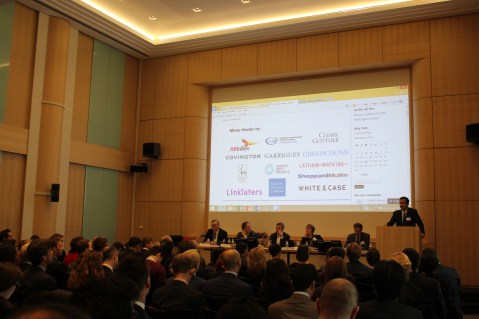
Today we are publishing the transcript (thanks to Carlos Bobillo) of Luis Ortiz Blanco’s intervention at the Chilling’Competition conference (pictured above).
I will do the same unnecessary introduction I did at the conference: Luis is a partner at Garrigues, a Visiting professor on competition procedure at the College of Europe, and the single reason why I decided to work in competition law (not sure that’s something he deserves credit for…)
His provoking intervention is available here: Chillin Competition Conference – Intervention by Luis Ortiz Blanco – 19.11.2015
Regulating platforms? A competition law perspective

A few days ago I spoke at CEPS about the debate concerning online platform regulation that is attracting some interest these days as DG Connect’s and the House of Lords’ consultations are ongoing (my presentation and a video interview are available here). This is a most interesting issue although, admittedly, one that not so long ago I would not have expected to be an issue at all.
In the wake of this event we thought that perhaps it would be useful to contribute a bit more to the debate, so here you will find a summary of what I said at that conference. In order to complement it, we have decided to engage in an “inter-platform” dialogue with our friends at CCIA and their DisCo (Disruptive Competition) Project blog. This post will also be published there, and we will soon be posting a guest contribution from them. Any comments you might have will certainly enrich the debate.
Not being an expert in regulation, my views on the subject are eminently related to competition law and to its application to multi-sided markets which, as you know, is one of the fields in which I have recently done some work, advising platforms, non-platforms competing with platforms or simply reflecting on wider policy issues (e.g. here or here). The competition law perspective is a particularly useful one because competition law seems to be the elephant in the room, much at the root of these discussions.
Indeed, many of you will recall that ex ante “platform” regulation went from being a non-issue to being very much an issue when a number of Member States (notably Germany and France) expressed frustration at how competition law would not be enough to tackle some problems (not clear which) caused by “some” (apparently not all) platforms (some examples of such statements are available here, here and here). [This concern about the possible shortcomings of competition law coincidentally emerged at a time when some thought that the ongoing Google investigation would fail to establish a “neutrality” obligation incumbent upon Google’s search activities] And since competition law was seen as insufficient (read: did not lead to the outcome that some expected), some thought that it would be idea to either change competition law or to bypass it by adopting specific regulation.
What kind of animal is a platform?
In this context, the word “platform” seems to have been chosen to encompass those “some platforms” that people had in mind. However, as explained in previous posts written on the DisCo Project blog (here or here), it may not be the best term to identify a category of companies subject to specific regulation.
Some of you may have heard of the expression “The Law of the Horse”. This is a term coined by American judge and antitrust expert Frank Easterbrook in a now famous conference in the US. In this conference he explained that there is no “law of the internet” more than there is a “law of the horse”; that there are laws of contracts that apply when horses are sold, of animal husbandry that apply when they need care, of laws of gambling that regulate when they race, but there is no law of the horse. Nowadays some partisans of regulation are trying to create some sort of “Law of the horse platform”. But then of course we come back to the somehow relevant question of what a platform is…
I don’t know if you are familiar with the Indian story of “The Blind Men and the Elephant”. This is a story in which several blind men are asked to describe what an elephant looks like by touching different parts of its body. The one touching the leg says the elephant is like a pillar; the one touching the belly says it must be like a wall; the one feeling the trunk believes it must look like a tree branch; the one touching the ear is convinced an elephant resembles a hand fan, and so on.. This story illustrates the fallacy that one’s subjective experience can be true but at the same time it is inherently limited and cannot account for the totality of the truth.
We see something similar regarding “platforms”: some appear to extrapolate certain features or problems from a limited number of companies to a whole business model, but those problems are neither exclusive nor common to “platforms” (as defined in the Commission’s consultation). Before doing such a thing, one should perhaps understand how markets work and why companies do what they do.
Having this complete view would certainly be necessary, for, as stated by Easterbrook in his talk The Law of the Horse, “the blind do not make good trailblazers”.
The wrong question
As already noted, the question many are asking is whether competition law is sufficient to address the challenges raised by platforms or whether we need a new framework; does competition law need to adapt?
In my view, and whereas enforcement may need some refinements (e.g. merger notification thresholds may not be well suited for some mergers—see here—and we do not have good economic tools to assess demand-side efficiencies–see here), there is no other branch of law that, over more than a hundred years, has proved similarly flexible, adaptable and accommodating of the evolution of markets and economic thinking than competition law.
In my view, the questions that are being posed now are the wrong ones, so I would suggest that instead of looking at supposed flaws in competition law, perhaps we should look to competition law to extract some lessons.
The above includes understanding why competition authorities are sometimes reluctant to intervene, or why issues that are perceived to be problematic by the lay public are not understood as such by experts in the field. Also, it would be worth reflecting on whether there may be a possibility that if competition law has not done more regarding “platforms” it might be due to the fact that there may indeed be very good reasons for it not to do more.
Why competition law can teach us?
Some may wonder whether competition law can really teach us something about platforms and about how to deal with them. If you ask me, it sure can.
Procedural developments (by Wouter Wils)

Many of you have been asking for the document used by Wouter Wils yesterday during his presentation at the Chillin’Competition conference (we’ll tell you more about how it went soon; we also have plenty of photos).
In the coming days we hope to be posting other materials (and even guest posts from speakers who may be interested); for the time being we leave you with Wouter’s paper, which will come in handy to many (including myself, given that it greatly facilitates the updates for the courses I teach on procedure…).
Here it is: antitrust procedure developments November 2015 final
Chillin’Competition in Politico
We have just been made aware that the following text was published in todays’s Playbook by Politico. We are very grateful, but sexy?? 😉
Only one clarification: it’s Nicolas, not me, who deserves credit for founding the blog!
BRINGING SEXY TO COMPETITION POLICY: The Who’s Who of Brussels’ competition world will congregate today at a conference organized by the blog Chillin’Competition. In a barren landscape dotted by multiple dry competition law journals, Chillin’Competition has attracted a fervent readership with its sometimes irreverent, sometimes serious look at European antitrust.
The blog was founded by Alfonso Lamadrid, an associate at law firm Garrigues, and Nicolas Petit, a law professor at Liège University, in 2009. It is now run by Lamadrid and Pablo Ibáñez Colomo, an associate professor at the LSE. Its long-running “The Friday Slot” puts a series of offbeat personal and professional questions to eminent practitioners, judges and officials, including competition commissioner Margrethe Vestager, Google outside counsel Maurits Dolmans and General Court Judge Ian Forrester.


 Chillin'Competition
