Author Archive
A handy copyright infringement
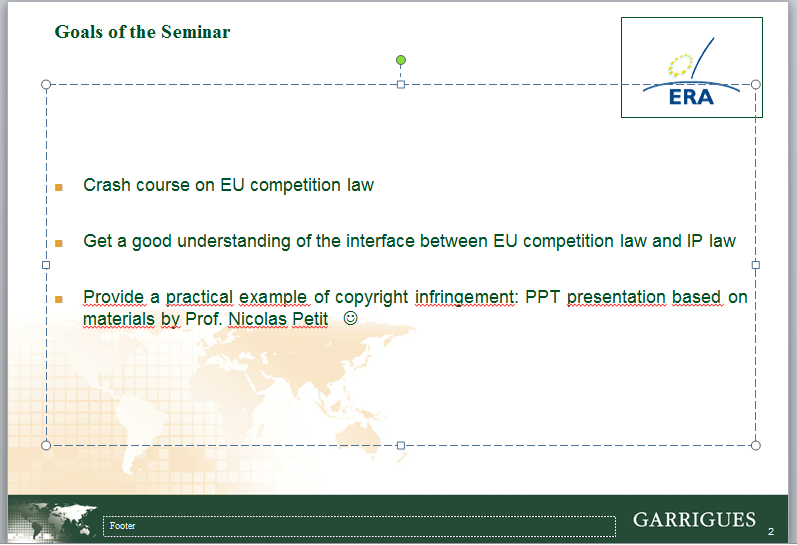
(Warning: this is a fairly uninteresting post with no legal content whatsoever, so feel free to skip it. The reason why I’m posting it comes at the last paragraph)
I’d anticipated another post on reverse payments today, but it will have to wait until Monday. With only one week to go before the holidays I’m swamped at work and accumulating significant delays on a bunch of non-work stuff (several articles, book reviews, paper grading, etc.) which, for some reason, I had committed to do before the holidays.
It makes you reflect. This is one of the peculiar features of private practice; you try to do your best in work-related matters and you end up doing all other stuff hastily and sometimes badly. It’s never bothered me that much, but it probably bothers others (the ones you pay less attention to, or the ones that suffer your delays). I don’t know to what extent this is inherent to the profession or to my irrational tendency to embark in all sorts of projects (or most likely both), but it clearly is an area in need of improvement, at least in my case. Tips welcome!
I won’t bore you with details on what keeps me busy and what I’m being unable to do (it actually was my initial plan, but I then I realized that with a too personal post I’d risk ending up appearing as another whining-while-at-the-same-time-bragging lawyer). Actually, even this actual post may be enough to convey that impression, but that’s not the intention. Anyway, let me give you an example of me doing non-work things at the last minute badly and how I resorted to Nico to fix it.
I spent this whole week travelling because of work (right now ,Friday at 16.20, I’m writing from the Court’s library in Luxembourg; by the way, the food was worse today…) and had to lecture yesterday at ERA (Academy of European Law) on the interface between Intellectual Property Article 101. It’s always a challenge to explain the Technology Transfer BER in a way that doesn’t induce people to suicide, but I think I succeeded: only two people tried, one by jumping out of the window, the other by attempting to read the actual guidelines on technology transfer (despite my warnings) 😉
As usual, preparations were done at the last minute. The problem, however, is that I was asked to deliver a fairly detailed ppt in advance (smart trick to force speakers to prepare in advance..). And that was a bit of challenge; so I resorted to Nico.
He has an excellent and incredibly detailed power point presentation on IP and competition law (I hate using power point, and not only because of its lack of interop with 3rd party applications… yes, cheap pun, but I couldn’t avoid it..) so I basically copy-pasted it in a Garrigues template ppt and used it (actually, I didn’t even do the copy-pasting myself; I’ve to thank Rocío de Troya for that).
It ended up being a good idea, as I explained to the students, my use of Nico’s materials was useful to illustrate several concepts that are very relevant to IP law, such as a copyright infringement, free-riding and follow-on innovation (btw, the term “based” that you see in the slide above -the 2nd in my (his) presentation was actually a euphemism).
You most likely don’t give a damn about this story, but put yourself in my shoes: I had to (i) thank Nico and acknowledge his authorship of the materials; (ii) write something quick and light for a summer Friday afternoon; and (iii) minimally and superficially reflect on the absorbent (for good and for bad) aspects of the profession.. Have a good weekend!
Reverse payments (Pay for delay settlements) in EU and US antitrust law (Part I)

I’ve somewhat of a bad conscience for not having been able to cover this topic before (not least because one of you has been pestering me with emails asking when I’d write about it…)(btw, the same person has also gently and repeatedly reminded me to post a link to his new –and actually very interesting (really)- paper, so here it is; titled The Law of Abuse of Dominance and the System of Judicial Remedies).
As you may have read, within a lapse of two days the US Supreme Court (SCOTUS) and the European Commission issued, respectively, an opinion (in FTC v Actavis) and a decision (against Lundbeck and others) addressing reverse payments.
Most of the superficial client alerts analyses I’ve seen merely note the time coincidence and suggest a certain convergence in the US and EU approaches to the issue. The headline goes that the Commission imposed its first fine for this practice, and that the SCOTUS reversed a Circuit clash, holding that reverse payments are subject to the rule of reason and dismissing the “scope of the patent test”. In my view, this reading, although right, is also incomplete and hides a few of the interesting issues that have surfaced in these cases.
If I were to start explaining what reverse payments are, the background to these cases and the content and implications of the opinion and the decision you’d probably be tempted to stop reading after a few lines. In order to avoid that, instead of following the normal structure of a post, this will be a reverse post on reverse payments:
Today we will provide you with some comments on these developments and of why they can be relevant beyond their specific context. Tomorrow (if I’ve time) or on Friday (more likely) we’ll offer you our vision on the background to these cases and an overview of the opinion and the decision. I trust this will enable (i) connaisseurs to skip the background stuff; and (ii) those not initiated in these issues to grasp their relevance and to become interested in reading more about them.
Some reactions to the SCOTUS opinion and to the Commission’s decision
– Leaving the pharma sector aside, and looking at things from a broader perspective, the underlying philosophy of the Opinion in relation to the IP regulation/antitrust interface (condensed in this statement: “it would be incongruous to determine antitrust legality by measuring the settlements anticompetitive effects solely against patent law policy, rather than by measuring them against procompetitive antitrust policies as well”) appears to be at odds with the principles governing the interface between sector-specific regulation and antitrust established in Trinko . It’s therefore not surprising that Justice Scalia, that wrote the majority opinion in Trinko, has joined Roberst and Thomas in a dissenting opinion here. So, does this signal a change of trend in the way the SCOTUS interprets antitrust law? The 3 dissenting Justices at least do seem to see it that way, and argue in strong terms that the opinion overturns understood antitrust.
– On a very related but more specific note, although I haven’t read any comments on this point I see common link between these two recent cases on reverse payments and other landmark cases like Linkline US) and Telia Sonera (one of the most controversial EU cases in recent years). In all these cases some party relied on the idea that “he who can do the most can do the least”. In Actavis and Lundbeck the argument was that a patent holder was entitled to exclude competition provided that it remained within the limits of the “scope of the patent”; and in TeliaSonera and Linkline it was that if refusing to supply would not be deemed abusive, there could be no room to find an abusive margin squeeze.
This argument, however, had only been accepted by the SCOTUS in Linkline, with European Courts taking a different line in the most criticized TeliaSonera Judgment, so it’s not surprising (at least to me) that the Commission has rejected it in Lundbeck, but it’s remarkable that the SCOTUS has taken a different line in Actavis.
By the way, I leave one provoking thought I heard from someone the other day discussing TeliaSonera: “I don’t have an obligation to let anyone into my home, but once they’re inside it would be illegal for me to kick them out violently…”. (I expect some virulent reactions to this; happy to discuss).
– Are the EU and US approaches converging with regard to reverse payments, or even with regard to the assessment of horizontal agreements more widely? Not really (leave aside the synchronized summer desk cleaning timing coincidence). Sure, both the SCOTUS and the Commission see a margin for potential restrictions of competition in reverse payments, but they have chosen very different approaches. And whereas the theoretical difference does not appear to be large, the practical consequences hugely differ. In the US reverse payments will need to be assessed under the rule of reason –which imposes a very considerable burden on plaintiffs- (as we will explain in our forthcoming post, the Supreme Court has dismissed the “quick look approach” proposed by the FTC). In Europe, on the contrary, the Commission has decided to take the usual “object” shortcut. This is key, for an “amorphous rule of reason” (an expression actually used in the dissenting opinion in Actavis) analysis normally means difficulties for the plaintiff, whereas a “bifurcated” 101(1) / 101(3) analysis generally results in condemnation because of the (anticipated and worrysome) death of Art. 101 (3).
(Interestingly, the FTC wasn’t able to give a satisfactory answer to a very pertinent question asked by Justice Sotomayor at the hearing: “Why is the rule of reason so bad?”)
If you ask me, I would have no objection to the EU solution if Art. 101(3) were an effective possible way out (this was basically the ECJ’s stand in GlaxoSmithkline) and I would have no objection to the US approach if the burden of proof incumbent upon plaintiffs was a bit less burdensome. As things stand, it was probably not feasible to strike the right solution in theory (where I think the SCOTUS’ one is preferable) as well as in practice (where the Commission’s will likely yield better results) for these cases.
To be continued…
Cases that never will be (I) – Hynix (Case T-148/10)

Last week one of the most knowledgeable people in the EU competition law world (Commission official whose name I can’t disclose) tipped me to a new series of blog posts:
His words were “someone should one day write on a blog the story of competition cases that could have had a significant impact on the law had they not been withdrawn”. Since the number of competition law bloggers is not that high (even though it’s rapidly increasing…), and since I was the addressee of the message, I sort of got the point.
Actually, I very much like the idea of writing about cases that never were or, rather, that never will be.
There are a few candidate cases to be discussed; a non-exhaustive tentative list of non-cases could include: Siderca, Chi Mei, Suez-Environment, Formula One, Oulmers, BIC Deutschland, Balog or Van der Weerd. [Additional suggestions would be welcome].
Today we’ll start with Hynix (Rambus), a case in which the hearing was scheduled for 2 July but that was withdrawn a few days ago following a settlement.
The Judgment that will never come to light in this case would have constituted a most important precedent in relation to some important general enforcement issues, as well as in relation to an eventual judicial review of the current investigations concerning Google or Samsung.
A bit of background:
In 2002 Hynix filed a complaint alleging that Rambus had engaged in deceptive conduct in a standard setting procedure in relation to DRAM chips by not disclosing the existence of the patents and patent applications which it later claimed were relevant to the adopted standard, and that it had later charged excessive royalties for the use of those patents (i.e. royalties higher than those that it would have been able to claim had it not engaged in deceptive conduct). This is what is generally referred to as “patent ambush”.
The case was interesting because the deceptive conduct at issue had made Rambus acquire dominance (it preceded dominance), and the charging of high royalties could be regarded as the natural consequence of such dominance. Given that EU law does not target “monopolization” practices (those use to achieve dominance), the Commission had attempted to close this enforcement gap by targeting exploitative pricing under Art. 102 under the argument that dominance had been unlawfully attained. This was a brave and controversial move on the part of the Commission.
On 27 July 2007 the Commission adopted a statement of objections setting out its concerns. Rambus responded to the SO and a hearing was held.
Almost two years later, however, Rambus submitted preliminary commitments, those were later market-tested, revised, and eventually made binding on December 2009 (in a nutshell, Rambus committed (i) not to charge royalties for the two standards adopted while Rambus engaged in the deceptive conduct; (ii) to set a maximum royalty of 1,5% for the later generation of standards and to offer thus maximum rate to all market participants). (Note that the commitments concerned only future payments, not those already made).
As you know, in a case like this (or in a case like Google’s), once the Commission accepts commitments it must (a) adopt an Article 9 decision making them binding; and (b) adopt a decision rejecting any complaints stating that there are no longer grounds for action.
Hynix appealed both of these decisions.
In essence, Hynix argued that the Commission violated Article 9 of Regulation 1/2003 by choosing the procedure envisaged in that article where its concerns related to a serious violation of Art. 102.
In its SO, the Commission had envisaged a finding that the charging by Rambus of capped royalties is incompatible with Article 102 (82 back then). However, the corollary of the commitment decision was to make royalty caps binding, thus endorsing their legality.
The Judgment that will never on this case would have shed light on some of the hottest current topics in EU competition law (abuse of dominance in high-tech sector, misuse of patents, the circumstances in which the Commission can or cannot adopt commitment decisions…). In the past we have devoted lots of ink pixels to discussing these issues, and it’s a pity for the law that questions like the following will, for the time being, remain unaddressed:
What constitutes an abusive practice with respect to standardization, in particular so far as concerns patent ambushing?
Were commitments in the form of future royalty caps sufficient to eradicate the competitive problems found by the Commission?
What guiding principles (beyond Alrosa) are to be taken into account when assessing the appropriateness and adequacy of commitments?
Can the Commission address what it had perceived as a serious violation by means of a commitments decision? In that context, may the Commission adopt remedies which are only prospective in nature? Is the Commission entitled to have recourse to a commitment (Article 9) decision after having adopted a Statement of Objections? And in this case, can a Statement of Objections be considered as a valid “preliminary assessment” for the purposes of Art. 9 of Regulation 1/2003?
Preliminary thoughts on Google’s proposed commitments

As long anticipated, here are some comments on the proposed commitments in the Google case (I graciously granted myself an extension, like the one other third parties have received; it actually is convenient because I can comment on others’ comments as well).
Four caveats are in order:
- The views expressed below are written against the background of the Commission’s concerns as set out in the press release and the Q&A doc. accompanying the market testing of Google’s proposal. The relevant question to keep in mind is whether the proposed commitments –in their current form- are apt to address the concerns identified by the Commission in its preliminary assessment, not whether they are apt to lead to candy world for satisfy the wishes of all third parties.
- My views are necessarily incomplete and they’re also work in progress. I’ve only read the limited publicly available information and have not had access to any confidential info or documents that might be contained in the case-file. Moreover, I have allocated two flights time to draft this (and I should ideally also do some billable work, you see), so I’ll (i) update and improve this document on the basis of any new thoughts or possible feedback and (ii) refine my thoughts for a forthcoming piece on Oxford’s Journal of Competition Law and Practice
- My views are mine (sounds like a tautology, but don’t always take this for granted in our area of work…); some of my colleagues and clients may well have different opinions.
- I haven’t worked nor for Google nor for any of the 17 complainants.
In case I haven’t yet got you tired before even starting, here is a methodological explanation. This will be a five-pronged analysis; I will very succinctly summarize (i) DG Comp’s concerns; (ii) my take on the substantive concerns; (iii) the content of the proposed commitments; (iv) third-party criticism of the proposal (notably that read here, here, here or here) (I actually read some favorable comments as well); and (v) my take on the proposed commitments. And this for each of the four concerns flagged by the Commission (although only the two first ones raise interesting issues).
The structure will make this post longer. In order not to cram the page, click if interested.
Competition law and sport: we need more, not less ‘financial fair play’ in Europe
 This time I do not have particularly good excuses for squatting the blog, but I do so nonetheless. This said, thanks to Alfonso and Nicolas!
Basketball fans like myself are probably following the NBA playoffs. Those basketball fans that are also interested in competition law and in statistics (no doubt a substantially smaller fraction) will have realised that the teams reaching the conference finals this year are based in relatively small metropolitan areas. Only Miami is in the US top ten (9th). Indianapolis (29th), San Antonio (31st) and Memphis (45th) are far behind. Just because there is always a good excuse to point out how incredibly good Kevin Durant is, I will also mention that Oklahoma City is right behind Memphis in the ranking. It is safe to say that the fans of any NBA franchise can realistically hope to see their team win the championship one day.
There was a time where a team based in a comparable European city could aspire to win the UEFA Champions League — Nottingham Forest, which won the European Cup two years in a row (1979 and 1980) is the archetypal example in this sense. Not any longer. Or maybe it could, if a tycoon decided to pour billions of euro into the team overnight. Starting probably with Chelsea FC, we are now used to the stories of teams becoming instant winners. Monaco, just promoted to the top division in France, is the latest (and one of the most outrageous) examples. In parallel, the Spanish football championship has become unbearably boring. Only Barcelona and Real Madrid can aspire to win. We have witnessed yet another freak show record-beating championship this year.
And yet, the celebrity sports lawyer, Mr Dupont, complains about the modest attempt by the FIFA to introduce ‘financial fair play regulations’. I thought this is a good occasion to point out why more measures actively promoting competitive balance, not less, would be needed in Europe. It has been said thousands of times, but one cannot emphasise enough the fact that competition among sports teams is fundamentally different from competition among firms in most other markets. Teams are interdependent. Without teams against which to compete, clubs are worth nothing (even the Harlem Globetrotters need the Washington Generals!). This means that one big team’s success is only partly attributable to it. In this sense, I have no doubt that Real Madrid and Barcelona are taking a free ride on competing Spanish teams by capturing around 45% of the income coming from the sale of television rights. It also means (and this will look obvious to the readers, but competition authorities tend to ignore this fact when convenient) that fan interest lies in the championship taken as a whole, not the individual teams.
What are the implications of these features? They look obvious to me. There are very good reasons to set a stringent ‘salary cap’ to preserve the competitive balance among teams. Similarly, transfers of star players from relatively poor to relatively wealthy teams should be severely restricted (just as they are in the US). I prefer a championship in which Tottenham Hotspur (to clarify, West Ham is my London team!) can build a winning team around Gareth Bale instead of seeing this player leaving for Manchester City or Real Madrid as soon as he achieves superstar status. Finally, television rights should be more evenly distributed among teams. I believe we will progressively get there, and I hope that, when the moment comes, the Commission will take account of the objective features of sports competitions (which are measurable differences, not some sort of tailor-made exception) so that European sports become genuinely interesting and the outcomes of competition truly difficult to predict and vary from year to year just as they do in the US.
Back to blogging + post hearing thoughts
![European-Court-2-620x250[1]](https://chillingcompetition.com/wp-content/uploads/2013/05/european-court-2-620x2501.jpg)
I’m back to blogging after my leave of absence from for work.
As some of you know, on Wednesday we had the oral hearing in case T-79/12, Cisco v Commission (Microsoft/Skype) . I will of course not write anything about the merits of the case, notably because (i) I shouldn’t –which is quite a good reason to start with-; and (ii) I’m deeply involved in the case, and therefore you should take anything I say with a huge grain of salt [however objective and accurate it would’ve been 😉 ]
But since this blog is about personal thoughts, I nevertheless figured that I could share some not substance related thoughts on the experience.
Regardless of what might happen, the hearing was intense, interesting and even fun. If you like competition law, litigation, technology and opponents who are challenging, it can’t get much better.
There’s always an intra-story behind every case, and here there are a few interesting coincidences I can safely tell you about:
1) We had to go to Luxembourg to discuss about one of its “national champions” (they had home court advantage!). In case you didn’t know, Skype’s headquarters are located in Luxembourg, at 23-29 Rive de foreclausen (bad joke, but couldn´t resist it..)
2) I’ve been a student of both my partners (Luis Ortiz Blanco and José Luis Buendía), of one of our client’s counsels (Alvaro Ramos) and of our opponent (Jean Yves Art was a truly good merger control professor in Bruges).
3) The very issues dealt with were actually the subject of my LLM thesis and of my interrupted PhD research, which was convenient. I’ve to thank Pablo Ibañez for initially suggesting the topic;
4) Another coincidence is that literally a few minutes after the hearing, while we were having lunch at the canteen (decent grill, actually), Microsoft announced and explained the activation of the Lync-Skype bridge of which we had been talking about all morning (no kiddin’; that’s what I call interesting timing…). I’m trying to set it up in my computer at work right now (even after 4 months of fights with our IT department we were never allowed to download Skype at work…)
After the hearing I made the joke that I should now find a new purpose in life. This earned me a couple of gentle reminders: one from my partners, who gently pointed out to the pile of pending stuff that I’ve waiting, and another from my girlfriend, who subtly reminded me that I’ve some wedding planning pending too…
What went wrong with Article 102 TFEU? A procedural-institutional hypothesis

My writing in the blog is not the only side effect of Alfonso’s long working hours. We should have run the Brussels 20k together (I bet he even forgot about that). Maybe next year!
As I have devoted part of my Sunday to update an article, I thought It could be a good idea to ask your views about one of my forthcoming pieces. The view that there is something wrong with Article 102 TFEU is far from unanimous, but it is certainly widespread. There is not even a consensus as to what exactly is wrong with the said provision. In my view, the problem with existing case law is not in any way economic, as many authors believe, but legal. Cases addressing the same questions (say, price cuts) follow different rationales (just compare AKZO and Compagnie Maritime Belge). The substantive standards of intervention also vary across practices. Sometimes, the mere potential of foreclosure is sufficient to trigger the application of Article 102 TFEU (rebates and exclusive dealing are a classic example). Other practices require concrete evidence of foreclosure (just think of the case law on refusals to deal and that on margin squeezes).
AG Cruz Villalon on the scope of the Regulatory Framework for electronic communications

Publicly exposed as I have been, I have no choice but to be back in my capacity as interim blogger (which I confess is something I pretty much enjoy). It is not even a bad time for Alfonso to be extremely busy. Some readers will remember a post I uploaded a few months ago on a ‘not-so-mainstream’ pending case, which addressed some questions that I follow closely. Right on time, Advocate General Cruz Villalon delivered his opinion on 30 April, which is for the time being only available in French.
The fundamental question raised was that of whether a multichannel bundle offered by a cable operator is an ‘electronic communications service’ within the meaning of the Regulatory Framework for electronic communications. The material scope of the Framework was defined in an awkward way, as ‘services providing, or exercising editorial control over, content transmitted using electronic communications networks and services’ were not covered by it. This would mean that audiovisual media services (TV channels, on demand services and others) are subject to a different set of rules (typically media laws, which follow a different logic).
A careful reading of the Regulatory Framework suggests that multichannel services provided by cable operators do not qualify as ‘electronic communications services’ . In that sense, the question raised by the Dutch Court looked like a non-issue. This seems to stem clearly from Recital 45 of the Universal Service Directive, pursuant to which ‘[s]ervices providing content such as the offer for sale of a package of sound or television broadcasting content are not covered by the common regulatory framework for electronic communications networks and services’. It is also something that derives from Article 31 of the same Directive, which is carefully worded so as to make it clear that ‘must-carry’ obligations do not apply to the said packages but only to the exploitation of the infrastructure. What is more, the Commission and the National Regulatory Authorities seemed to assume that the said services are not caught by the Framework.
In his analysis of the question, Advocate General Cruz Villalon does not refer to the Universal Service Directive. This is surprising, if only because it seems to provide the most straightforward and directly relevant answer to the question. The Opinion does not go beyond the generalities and the definitions found in the Framework Directive. As a result (and this time unsurprisingly), the answer suggested by the Advocate General fails to bring a satisfactory solution to the real problem created by the truncated scope of the Regulatory Framework. He takes the view that multichannel bundles qualify as ‘electronic communications services’ insofar as (my free translation of ‘des lors que’) they comprise the transmission of electronic communications signals. But then does this mean that only the transmission element of the activity is caught by the Framework? Or does it mean that the bundles as a whole are caught by it? I hope the ECJ will be more explicit in this regard.
A la prochaine!
Leave of absence
 The question that I get the most often from readers of Chillin’Competition relates to how I manage to reconcile an already quite time consuming job –and a few adjacent academic and business activities – with blog writing
 (other typical questions being: why don’t you change your pic on the blog? why don’t you use a fake pic of a better looking dude? do you really not make any money out of the blog? (that has a follow up: are you dumb?); why are you not at a fancy firm with a sequence of anglo-saxon names? how does your firm let you write a blog? are you and Nico lovers, friends, do you hate each other?; are you two the same person?)
I generally have a decently good -if long- response to that, and the fact is that I’ve -generally- managed to find the time to juggle everything.
However, I recently whined justified myself wrote about not being able to find the time needed to write something worth your reading time, and commited to make a greater effort. However, in spite of my good intentions, I will not be able to honor my commitment (including the one about writing down my detailed views on Google’s commitments).
I will be taking a short leave of absence until 30 May. In a way it’s a pity, because there’s most interesting stuff going on on which to comment, but work these daysis as interesting as it is absorbing. As it is becoming customary, Pablo Ibáñez (LSE) will be covering my absence.
P.S. On Google’s proposed commitments, and in a nutshell, I would argue that the Commission’s strong hand play has yielded very good results for the Institution. Whereas I retain my doubts about the underlying and arguably unknown theories of harm, it’s hard to deny that the Commission has managed to extract very significant concessions from Google that should make its competitors’ lives easier.
A stupid post

You already know this trick: busy days= attempts at light funny or stupid posts. Today’s post isn’t particularly funny, but it sure is particularly stupid. Even though it’s not prima facie related to competition law, I’m sure that you’ll be able to find it of practical application to your law firm, competition authority, university or psychiatric institution (to name only the four organizations from which we get more readers):
A couple of Swedish professors (M. Alvesson and A. Spicer) have recently published an article titled A Stupidity-Based Theory of Organisations in which they develop the concept of “functional stupidity” and conclude that organizations with too many smart individuals risk being disfunctional. Their article has been discussed in other places like Fortune or New Scientist, where it was originally published.
The authors posit that stupidity boosts productivity, streamlines things in an effective manner, facilitates consensus, conveys respect for hierarchy, fosters a culture of commitment and effort, and that it can even help you (no offence; I didn’t mean you, I meant the stupid at issue..) get a promotion faster (the argument supporter the latter being that bosses would not promote their most useful assistants because they couldn’t do without them).
The theory also goes that people who try to make sure that everyone notices how smart they are are likely to do worse than those who hide their intelligence (a troubling thought for many of us show-off lawyers). Likewise, places where people tend to believe they are clever are, according to this theory, quite inefficient (I wonder whether profit per partner ratios confirm this intuition)
Interestingly, the Fortune piece discussing this article and the benefits of stupidity concludes with a reference to Google’s simple and functional user interface (as already anticipated a few times, whether Google’s UI will be smartened up or made more complex thanks to DG Comp will be discussed in our upcoming comments on Google’s commitments; but don’t take my word for it, a couple of years ago we also committed to hold a Chillin’Competition conference and, well…).
For more on stupidity, check out Cipolla’s masterpice on The Basic Laws of Human Stupidity.
P.S. If you ask me, whereas there may be some logical basis and abundant practical evidence for some of this “functional stupitidy” theory, holding it as true would be a bit stupid, and, as most things stupid, quite dangerous.


 Chillin'Competition